Self-growth
 Apps & Digital Tools
 Business & Career
 Success
 Growth Tools
 Psychology
 Communication
 Relationships

Can a Harvard course really live on your laptop — without an application, a campus, or a five-figure tuition bill?
That question is basically the whole edX pitch. Since 2012, edX has been the online learning platform where universities like Harvard and MIT publish real courses for anyone with an internet connection, and as of August 2026, the platform reports a community of 100 million learners worldwide. It's one of the most credible names in online education and one of the most misunderstood — people sign up expecting a quick-learning app and find themselves holding a syllabus.
This edX review covers what's really on the platform, how the free and paid tracks differ, what certificates cost, and whether they're worth it. And because "credible" and "right for you" aren't the same thing, we'll also look at where edX shines, where it drags, and what to use instead when your goal is daily growth rather than a credential.
📘 Want the big ideas without the eight-week syllabus? Take Headway's quick quiz and get a personalized plan built on 15-minute book summaries.

Quick answer: Is edX worth it?
Short on time? Five findings carry the whole review.
edX is legit. It was founded by Harvard and MIT, and its courses come from real universities (HarvardX, MITx, Oxford, Cambridge) and companies like Microsoft and IBM.
Many edX courses can be audited for free — you watch the video lectures without paying, but graded assignments and certificates sit behind a paywall.
A verified certificate typically costs $50 to $300 per course as of August 2026, with multi-course programs running from a few hundred dollars to $1,500+.
edX certificates are worth it when a specific job, promotion, or degree pathway rewards them — less so if you're paying just to feel productive.
The workload is real. Courses take 2–6 weeks each; online degrees take 1.5–3 years. If you want structured academic depth, that's a feature. If you want a daily learning habit that survives a busy week, a 15-minute format like Headway does that job better.
All app features described in this article are accurate as of August 2026. Prices may vary depending on your region, current promotions, and seasonal offers.
What is edX? A quick history and a snapshot
edX started in 2012 as a nonprofit founded by Harvard and MIT — one of the original MOOC (massive open online course) platforms, built on the idea that university courses shouldn't be locked inside lecture halls. In 2021, the education company 2U acquired the platform, and edX has since leaned harder into career-focused programs: Professional Certificates, executive education, boot camps, and full online degrees.
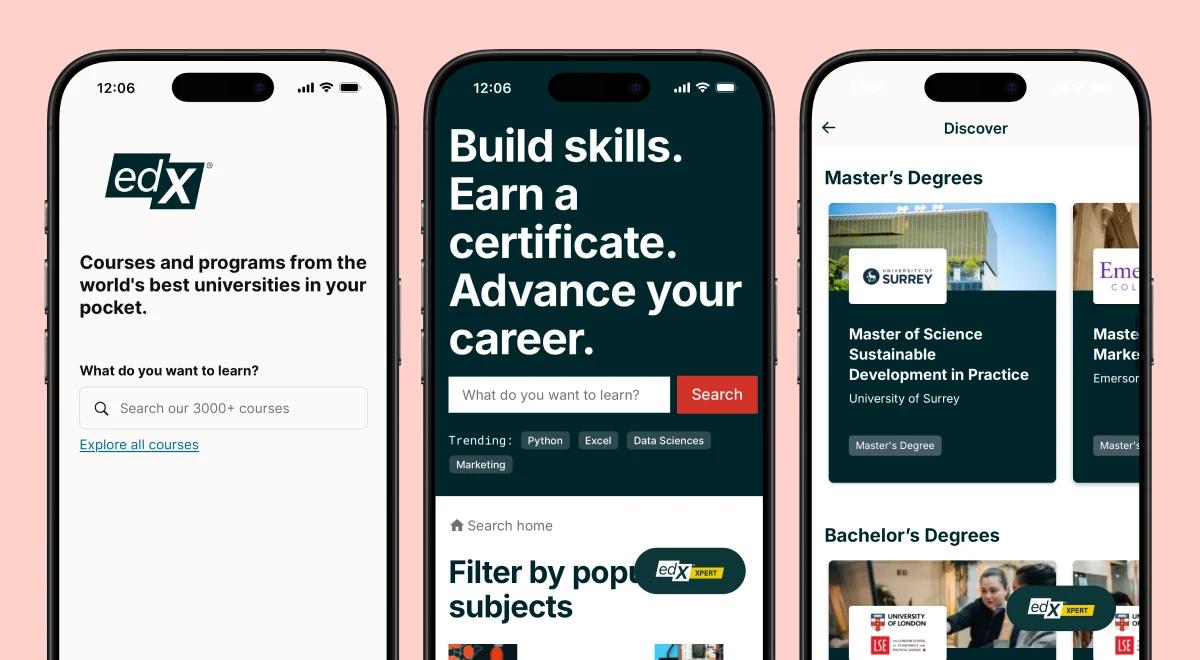
The catalog today spans computer science, data science, artificial intelligence, business, engineering, cybersecurity, project management, product management, healthcare, and the humanities. The single most famous item on the platform is probably CS50, Harvard's legendary introduction to computer science, which has pulled millions of complete beginners into programming.
So when people ask what edX is in 2026, the fairest answer casts it as a university course platform first and a learning app second. You don't scroll edX. You enroll in it.
How does edX work? Courses, certificates, and degrees explained
edX organizes everything as a ladder — each format stacks on the one below it, from a single free course all the way up to a master's degree. Each rung deserves a closer look, starting at the bottom.

edX online courses and the free audit track
The basic unit is a single online course: video lectures, readings, discussion forums, and quizzes, usually taking 2–6 weeks at a few hours per week. Most courses are self-paced, so you can binge a module on Sunday or crawl through it over a month.
New users are regularly surprised to learn that many edX free courses aren't a separate catalog. You can audit a huge share of regular courses at no cost, which means full access to the learning materials for a limited time. What the free audit track doesn't include: graded assignments, instructor feedback on them, and any certificate at the end. A free online course on edX is genuinely free — it just ends with knowledge, not paperwork.
The edX Verified Certificate
Pay the course fee — typically $50 to $300 as of August 2026 — and you're upgraded to the verified track. An edX Verified Certificate means the platform confirmed your identity, you completed the graded assignments, and you passed. You get a shareable certificate for your resume or LinkedIn, plus unlimited access to the course materials.
Worth knowing: the verified certificate proves course completion, not university admission. Finishing an MITx course doesn't make you an MIT student, and edX is upfront about that distinction.
Professional Certificate programs
A Professional Certificate bundles several courses — usually 3 to 6 — into one job-oriented sequence, built by universities or companies like Google, IBM, and Microsoft. Popular Professional Certificate programs cover data analysis, Python for data science, cybersecurity, and project management, and they typically take 8–12 weeks of steady effort.
These are the credentials employers are most likely to recognize by name, since they map to specific job skills rather than academic subjects.

MicroMasters, MicroBachelors, and XSeries programs
This is where edX gets more academic than most competitors:
MicroMasters programs are graduate-level course series from schools like MIT and Columbia. Complete one, and you may be able to apply the credit toward a full master's degree at participating universities — MIT's supply chain MicroMasters is the classic example.
MicroBachelors programs are the undergraduate version, designed for working adults, with transferable credits at partner institutions.
XSeries programs are course bundles for depth on a topic without any credit pathway — pure learning, no degree math.
One caveat about edX college credit: credit acceptance varies by institution, so confirm with your target university before enrolling. "Credit-eligible" and "credit-guaranteed" are different words for a reason.
Executive education, boot camps, and online degrees
At the top of the ladder sit the heavyweight formats. Executive education programs (6–20+ weeks) come from schools like Oxford Saïd and MIT Sloan and are priced accordingly. Boot camps compress career-switch skills — coding, cybersecurity, data — into intensive schedules. And edX online degrees let you earn a full degree, bachelor's or master's, from a partner university over 1.5–3 years, with real admissions and real tuition.
By this rung, calling edX an app undersells it — you're looking at grad school with better parking.
edX pricing: What's free and what costs money
Let's put the numbers in one place. As of August 2026, published edX pricing generally looks like this:
Format | Typical cost | What you get |
Audit track | Free | Course materials, limited-time access, no certificate |
Verified Certificate | $50–300 per course | Graded assignments, certificate, unlimited access |
Professional Certificate | A few hundred to ~$1,200 per program | Multi-course, job-focused credential |
MicroMasters / MicroBachelors | Roughly $600–1,500 per program | Graduate- or undergraduate-level series, possible college credit |
Executive education | Often $1,000–3,000+ | Cohort-based leadership programs |
Online degrees | Priced per program | Full bachelor's or master's degree |
Two footnotes matter here. First, the edX free vs paid line moves — course availability, audit windows, and promotions shift regularly, so check the current listing before you plan around a price. Second, edX for Business plans (for teams) are priced separately, starting in the hundreds of dollars per user per year as of August 2026.
edX financial aid: Yes, it exists
edX offers financial assistance on many verified courses. Eligible learners can apply for a significant discount on the verified track — the application is per course, and approval isn't instant, so build in lead time before a session starts. If cost is the only thing between you and a course, it's genuinely worth the form.
📘 Prefer learning that fits your budget and your Thursday? Answer a few questions, and Headway will build a plan around the minutes you already have.
Is edX legit? The credibility question, answered
Yes — is edX legit is the easiest question in this review. The platform was created by two of the most famous universities on Earth; its content comes directly from institutions like Harvard University, MIT, Oxford, and Cambridge, and its certificates are issued through those partnerships. edX also reports that 84% of its learners saw professional growth after earning a certificate, per the company's own published figures as of August 2026.
The nuance worth keeping: edX itself isn't a university, so a standalone course certificate isn't an accredited degree. The degrees on edX are accredited by the partner universities that grant them. Legit? Completely. A shortcut to a diploma? No — and edX doesn't pretend otherwise.
Is an edX certificate worth it?
Whether an edX certificate is worth it depends on what the certificate has to do for you. The decision usually sorts into three lanes:
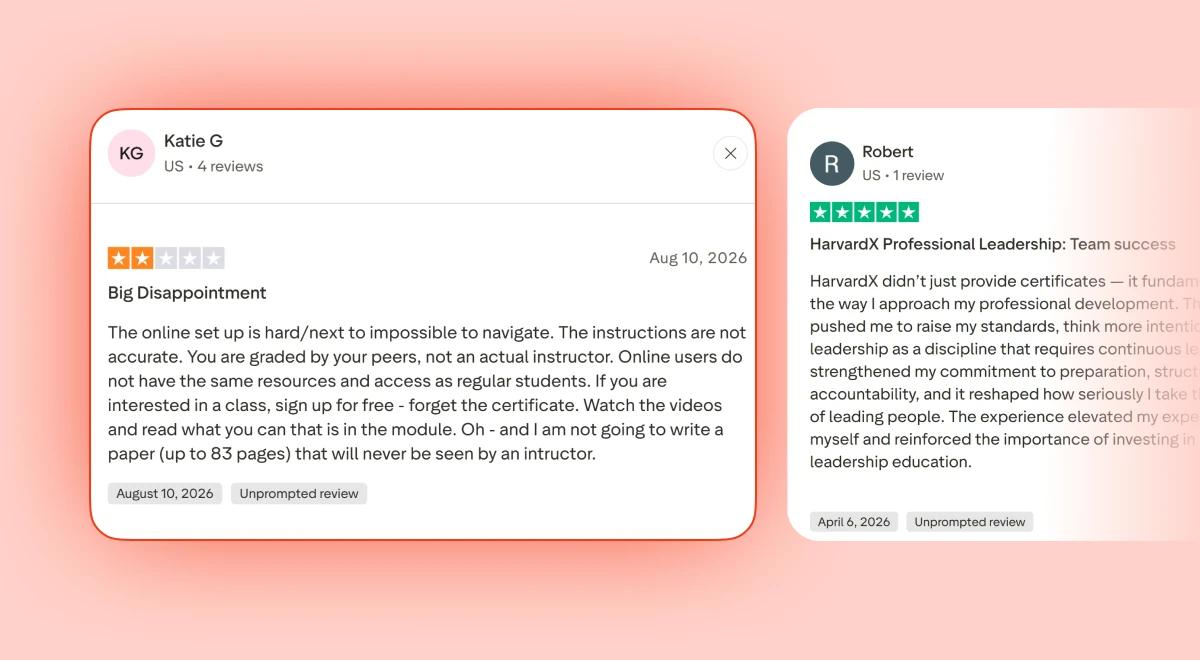
Worth paying for: You're switching into tech, data, or another skills-verified field where a named credential from Harvard, MIT, or IBM gets a recruiter's attention. Or you're using a MicroMasters as a discounted on-ramp toward a master's degree.
Think twice: You're collecting certificates as motivation. The audit track teaches the same material for free, and an unfinished paid course helps nobody — completion rates in MOOCs are famously humbling.
Skip it: Your real goal is broad, continuous professional development — staying sharp on leadership, communication, decision-making, and business thinking. Certificates measure courses completed. That goal is measured in weeks of consistency, and it calls for a different tool entirely.
That last lane matters more than most edX reviews admit, so let's give it its own section.
Where edX fits — and where it doesn't
edX is built on school logic: enroll, follow the sequence, pass, graduate. When you need credentialed depth — a career pivot into data science, college credit, a full degree — that structure is exactly right, and edX offers it at prices far below campus tuition.
But school logic has a known failure mode for busy adults: the course you never finish. Between a job, a family, and a life, "3–5 hours per week for 10 weeks" is a promise many of us can't keep, and the graveyard of abandoned MOOC enrollments proves it. Upskilling for most working professionals doesn't look like a semester. It looks like 15 focused minutes on most days, applied the same afternoon.
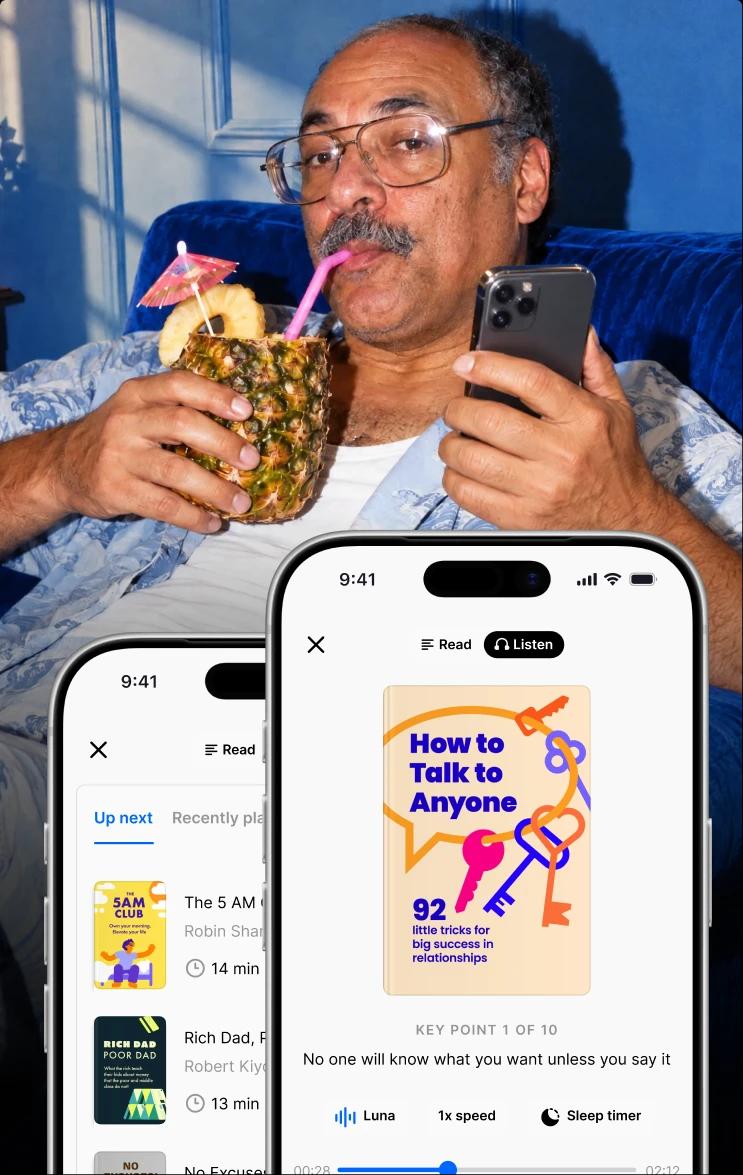
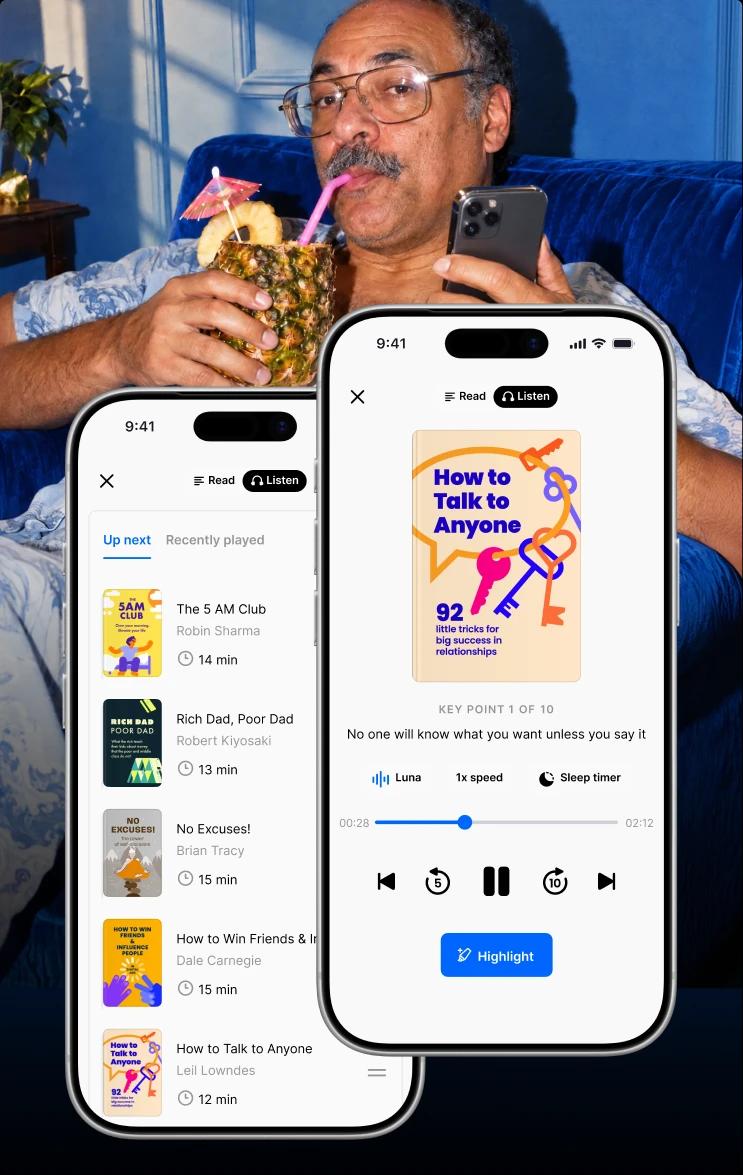
Headway takes the opposite bet. Instead of courses, it distills 2,500+ bestselling books — on leadership, productivity, psychology, communication, business, and health — into 15-minute summaries you can read or listen to. A quiz at the start builds a personalized growth plan around your goals, and streaks, Recaps, and Highlights keep the habit alive on the days when a lecture never stood a chance. No enrollment window, no problem sets, no guilt.
The two make poor rivals, because they finish different sentences: edX turns learning into credentials, while Headway turns learning into a daily habit. Plenty of people run both — a MicroMasters for the resume, Headway for the commute.
📘 Certificates prove what you studied. Habits change how you work. Start your Headway plan and build the second kind.



What daily learning looks like in real life: Five Headway routines
Course pages show curricula; real schedules show trade-offs. Five professionals shared how microlearning earns a spot in days where a semester never would.
Israel, a freelance writer and editor with 20+ years of experience, got tired of paying for courses that ate his hours without changing his work — his review of testing Headway for professional development is basically a recovering course-collector's diary.
Olena, a content marketing manager, went from one business book a month to 20 in three months by using summaries to pre-screen which frameworks deserved real testing — she road-tested 'Deep Work' on her actual marketing calendar.
Abdelrahman, a cost control manager, credits a 20-minute morning routine with moving him from firefighting to strategic leadership; a colleague told him, "You don't rush decisions anymore — you frame them."
Deyvis, an executive coach with 30 years in the field, uses 15 minutes each morning to stay current on leadership research between client sessions — insights often become the questions he asks clients that same day.
And Ivan, a software developer, triathlete, and dad of three, got through 120+ book summaries in four months on early-morning walks, without giving up code, training, or bedtime stories.
None of them enrolled in anything. Their curriculum is their calendar.

edX vs Coursera, Udemy, and Khan Academy
If you're weighing edX alternatives inside the MOOC world, the differences come down to who makes the content and what you walk away with.
edX vs Coursera is the closest matchup — both are university-backed online learning platforms with Professional Certificates and full degrees. As of August 2026, Coursera leans harder on industry certificates (Google, IBM, Meta) and offers a subscription (Coursera Plus) that covers thousands of courses, while edX leans more academic, with MicroMasters programs and stronger degree pathways from Harvard and MIT. Career-first learners often prefer Coursera's subscription model; academically minded learners tend to pick edX.
edX vs Udemy is a philosophy split. Udemy is an open marketplace where anyone can publish, so you get enormous variety and frequent $10–30 sale prices, with quality that swings course to course. edX curates everything through universities and major companies, so the floor is higher and so is the price.
edX vs Khan Academy is the simplest: Khan Academy is a free nonprofit focused on K-12 and foundational subjects, while edX serves university-level and career learning. They're neighbors, not competitors — plenty of learners use Khan Academy to prep for an edX course.
And if your comparison shopping extends beyond MOOCs, a few adjacent tools are worth a look: Brilliant for interactive STEM problem solving, Imprint for visual-first learning, SmartyMe for mixing academics with soft skills, and idea-collection apps like Deepstash — see how Deepstash's pricing stacks up and how Deepstash compares with Blinkist before you commit.
The pros and cons of edX
Pros:
Genuine university content — Harvard edX courses and MIT edX courses are taught by the same faculty as on campus
Free audit track on many courses, plus financial assistance for eligible learners
Stackable credentials, from a single verified certificate up to a full degree with transferable credits
Strong catalog in high-demand fields: AI, data science, computer science, cybersecurity, business
Self-paced options that respect adult schedules better than fixed semesters
Cons:
Real workloads — plan on hours per week, and completion takes discipline most schedules quietly sabotage
Costs climb fast above the single-course level, and program pricing isn't always obvious upfront
The platform's growing focus on executive education and enterprise programs can feel heavy if you wanted one physics course
No built-in mechanism for daily, bite-sized learning between courses — momentum is on you
Keep growing between the big courses — make it a habit with Headway
Every section of this edX review points to the same verdict: edX is one of the best places on the internet to earn serious credentials, and if a certificate, college credit, or a master's degree is the goal, enroll with confidence. The platform has earned its reputation.
But most days aren't degree days. Most days you have 15 minutes between a meeting and a school pickup, and the only question worth asking sounds less like "which credential?" and more like "what did I learn today?"
Headway answers that one: a quiz builds your personalized plan, 2,500+ book summaries cover the leadership, psychology, and business thinking your career runs on, and streaks keep the habit standing on the weeks when everything else falls over. If you're still comparing bite-sized learning apps, check out our Headway vs Blinkist comparison and honest takes on whether Blinkist is worth it, whether Audible is worth it, and whether Coach.me can help you pick your stack.
Semesters end. Growth shouldn't.
📘 Get your personalized Headway plan — a few questions now, 15 minutes a day after that, and something new learned by tonight.
FAQs about edX
Is edX free to use?
Partly. Many edX courses offer a free audit track, which gives you the video lectures and course materials for a limited time at no cost. You pay only if you want graded assignments, unlimited access, and a verified certificate. Degrees, boot camps, and executive education programs are always paid. So edX is a real source of free online courses — just not free credentials.
How much does an edX certificate cost?
As of August 2026, a verified certificate for a single course typically costs between $50 and $300, depending on the course and institution. Multi-course Professional Certificate programs generally run from a few hundred dollars to around $1,200, while MicroMasters programs often land between $600 and $1,500. Prices vary by region and promotion, so always check the current course page before budgeting.
Is edX legit and accredited?
edX is fully legitimate — it was founded by Harvard and MIT in 2012, and its content comes from accredited universities and major companies. The platform itself isn't a university, though. Individual course certificates aren't accredited degrees; they're verified proof of completion. The full online degrees offered through edX are accredited by the partner universities that grant them.
Can I get college credit through edX?
Sometimes, yes. MicroBachelors and MicroMasters programs are designed as credit-eligible pathways, and completing one may let you transfer credit toward a full degree at participating universities. The keyword is "may": credit acceptance varies by institution. Before enrolling for credit purposes, confirm directly with your target university that it recognizes the specific program.
Does edX offer financial aid?
Yes. edX provides financial assistance on many verified courses, giving eligible learners a substantial discount on the certificate track. You apply separately for each course, and processing takes time, so submit your application before the course session starts. Degree programs and executive education follow their own pricing and aid rules through the partner institutions.
Which is better: edX or Coursera?
Neither wins outright — they're built for slightly different learners. Coursera emphasizes industry-backed Professional Certificates and a subscription model that rewards high-volume learners. edX runs deeper academically, with MicroMasters programs, university credit pathways, and degrees from Harvard and MIT. Pick Coursera for job-focused certificate stacking, edX for academic rigor and degree ambitions.
How long do edX courses take?
Individual courses usually run 2–6 weeks at a few hours per week, and many are self-paced. Professional Certificate programs take roughly 8–12 weeks, executive education runs 6–20+ weeks, and full online degrees take 1.5–3 years. Budget honestly: the number-one reason online courses go unfinished has less to do with difficulty than with schedules that couldn't absorb the weekly hours.
Is edX good for complete beginners?
Yes, with the right picks. Introductory-level courses are clearly labeled, and CS50 — Harvard's introduction to computer science — is one of the most beginner-friendly (and beloved) programming courses anywhere. That said, edX assumes you'll show up for structured study. If you're rebuilding a learning habit from zero, starting with 15-minute daily sessions is a gentler on-ramp than a university course.
What's the difference between edX and Headway?
They do different jobs. edX delivers university coursework — lectures, graded assignments, certificates, and degrees — over weeks or years. Headway delivers the key ideas from 2,500+ bestselling books in 15-minute text and audio summaries, organized into a personalized daily growth plan. Choose edX when you need a credential; choose Headway when you want consistent, everyday learning that fits an already-full life.