Self-growth
 Business & Career
 Success
 Communication
 Healing
 Relationships
 Psychology
 Happiness

When you're building something from nothing, the pressure is constant. You're managing funding rounds, keeping high-performing teams motivated, and staying ahead of competitors' latest pivots. But there's a silent threat that could tank your valuation faster than a bad product launch: startup burnout. It's not just "being tired." It's a fundamental breakdown of your most valuable asset, your mind.
In this guide, we'll explore why startup burnout is the ultimate "unfiltered risk" for your business and how you can protect your wellbeing while still hitting your goals. We'll cover the latest startup founder burnout statistics, symptoms to watch for, and prevention strategies that actually fit into a 100-hour work week.
➡️ Learn how to outsmart exhaustion with the Headway app, your unfair advantage for staying sharp while everyone else burns out.
What is startup burnout?
Startup burnout is a state of physical, emotional, and mental exhaustion caused by prolonged stress in high-stakes entrepreneurial environments. It involves a total depletion of your internal resources, leaving you feeling cynical, ineffective, and disconnected from your startup journey.
According to the World Health Organization, burnout is an occupational phenomenon, not a medical condition. In the context of startup life, it happens when the hustle becomes a permanent state rather than a short-term sprint. If you're a business owner or an entrepreneur, ignoring it doesn't just hurt your personal life; it also harms your business. It actively damages your company's ability to innovate and scale.
Startup founder burnout symptoms and signs
You might think you're just "grinding," but your body and brain are likely sending warning signals. Recognizing these early is the difference between a quick reset and a total collapse.
Startup founders often have a high pain tolerance, which makes identifying signs of burnout tricky. You might find yourself snapping at your co-founder or feeling a strange sense of emptiness after hitting a major milestone. These aren't just personality quirks. They're red flags that your mental health is on the line. Here are the most common startup founder burnout symptoms to watch for:
Decision fatigue: Struggling to make even simple choices during your workday.
Emotional flattening: Feeling zero excitement when your team hits a goal or wins a deal.
Chronic irritability: Getting unusually angry with startup employees over minor mistakes.
Physical decline: Dealing with frequent headaches, back pain, or a general lack of energy.
Cognitive clutter: Feeling like you can't focus on one task for more than a few minutes.
Sleep disruption: Spending your night thinking about your workload instead of resting.
📘 Don't let exhaustion stop your growth. Use Headway to find balance!
Startup founder burnout statistics: The real cost of the hustle
Fight founder burnout and get practical insights for mental wellbeing.
The data on founder wellbeing in 2026 is eye-opening. While we celebrate "unicorns," we rarely talk about the human cost of reaching that status.
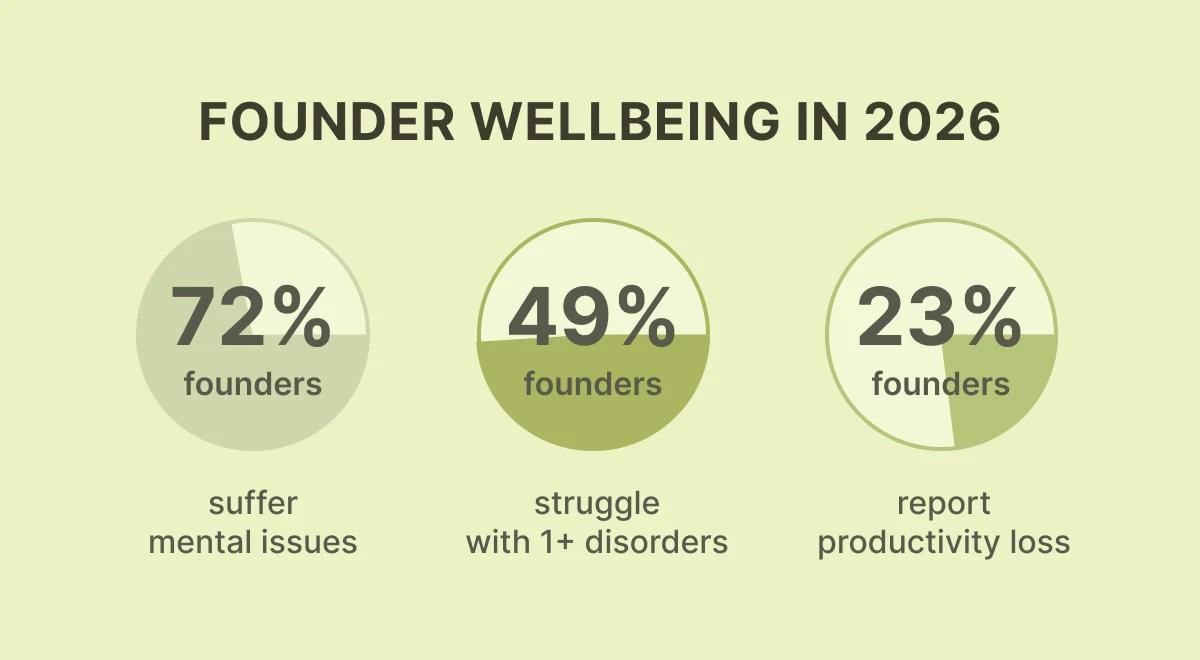
Recent startup founder burnout statistics show that nearly 72% of entrepreneurs report mental health concerns, significantly higher than the general population. In high-stress tech hubs like the Orange County startup scene, these numbers can climb even higher due to the density of competition and the pressure of back-to-back funding rounds.
Mental health prevalence: 49% of founders report having one or more lifetime mental health conditions.
Productivity loss: Burned-out high-performing teams see a 23% drop in output efficiency.
Executive turnover: Burnout is a leading cause of co-founder conflict and early-stage startup failure.
The startup burnout test: Are you in the red zone?
If you're unsure whether you're just stressed or truly burned out, a quick audit can provide clarity. This assessment isn't a medical diagnosis, but it helps you see the patterns in your behavior.
This startup burnout test focuses on your relationship with your work. If you find yourself nodding along to more than three of these points, it's time to reassess your working hours and your overall work-life balance.
Do you dread opening your laptop even on a Monday morning?
Have you started to feel like your startup journey is a trap rather than a choice?
Is your workload the only thing you talk about in your personal life?
Do you feel like you're working longer hours but achieving less?
Have you lost interest in the hobbies or people that used to make you happy?
📘 Build a resilient mindset with quick insights on Headway!



Startup founder burnout prevention strategies that work
You don't have to quit your first startup to save your sanity. Prevention is about changing the operating system of your life to support long-term success.
The most effective startup burnout prevention strategies aren't about taking a three-month vacation. Most founders can't do that anyway. Instead, they focus on small, repeatable actions that protect your wellbeing without stalling your progress. Here is how you can implement these strategies right now:
Set a "Hard Stop" time: Decide when your workday ends and stick to it at least four days a week.
Build a reading habit: Spend 15 minutes on the Headway app learning about resilience or communication. Even that small window compounds over a work week.
Practice radical delegation: If a task doesn't require your specific founder-level expertise, give it to your team.
Schedule "Deep Rest": Treat your sleep as a non-negotiable part of your productivity toolkit.
Audit your social circle: Spend time with people who don't care about your valuation or your LinkedIn profile.
How Headway supports founders
Founders are notoriously short on time. You probably have a stack of "essential" business books on your nightstand that you haven't touched in months.
That's where Headway comes in for early-stage startups. The app distills the world's bestsellers into short summaries you can read or listen to in 15 minutes. Whether you're dealing with co-founder conflict or looking for ways to improve your work week, Headway has what you need.
Personalized lists: Create a collection focused on "Mental Health," "Wellness," or any other topic you're interested in.
Daily growth: Use your commute to listen to books like 'Burnout' by Emily and Amelia Nagoski.
Clear takeaways: Each summary gives you clear steps to implement immediately.
Three must-read books to build founder resilience
Learning from the experiences of others is one of the fastest ways to avoid the common traps of entrepreneurship. These three summaries on Headway give you the mental tools to handle high-pressure situations without burning through your reserves.
'Zero to One: Notes on Startups, or How to Build the Future' by Peter Thiel and Blake Masters
This book pushes you to think differently about innovation by focusing on creating something entirely new. Instead of just improving what already exists, you learn how to go from "zero to one" by building a company that offers a unique value to the market. That mindset helps you escape the exhausting cycle of constant competition with other copycat brands.
Founders who are caught in reactive mode, watching every competitor move and scrambling to respond, will find this a useful reset. Focusing on your own vision rather than reacting to everyone else's reduces the mental load considerably. That clarity of purpose is one of the most practical defenses against early-stage founder burnout.
'The Lean Startup' by Eric Ries
Ries introduces a practical approach to building a business through continuous experimentation and learning. You'll see how to test your ideas quickly and adapt your strategy based on real-world feedback. It helps you avoid wasting months on features nobody actually wants, which is one of the more underrated sources of startup stress.
The core argument here is about working smarter during your workday rather than just working longer hours. Focusing on what actually drives growth lets you cut the "busy work" that quietly eats your week. For any entrepreneur trying to build something sustainable without grinding themselves down, this one's worth your 15 minutes.
'The Hard Thing About Hard Things' by Ben Horowitz
Horowitz gives honest, unfiltered advice about the difficult decisions that come with being a business owner. He writes about real moments of managing teams and surviving the deep uncertainties of a first startup, not the polished retrospective version you usually find on social media.
What makes this one useful for burnout specifically is that it validates the struggle. Knowing that even the most successful startup founders faced moments of total panic makes the hard stretches feel less like personal failure. It gives you the perspective to stay steady when everything feels like it's falling apart.
Plan out steps for your next funding round with Headway
The "first one in, last one out" mentality looks great on a LinkedIn post, but it's a disaster for long-term company health.
High-performing teams aren't built on exhaustion. They're built on clarity and creativity. When you consistently log 80-hour weeks, your brain loses the ability to think strategically. You shift from playing offense to constantly reacting, and your startup employees will eventually follow your lead straight into the burnout zone.
And this pattern only intensifies during funding rounds. The expectation to perform for investors can quietly push even the most resilient founders past their limits, and the damage often doesn't show up until after the round closes.
That's why burnout isn't something you fix after the fact. It's something you prepare for. To navigate these high-stakes periods without breaking down, you need a system that protects your mental energy before the pressure peaks.
Start by building small, intentional habits into your schedule before the crunch begins:
Batch your meetings: Don't let pitches bleed into your deep work time.
Use transition rituals: Take a five-minute walk after a high-stakes call to reset your mind.
Stay connected to your "why": Remind yourself what you're building and who you're building it for.
Because at the end of the day, your startup can only grow as sustainably as your mind allows it to.
📘 Turn your stress into strategy with Headway.
Frequently asked questions about startup burnout
What are the latest startup founder burnout statistics for 2026?
Current data suggests that about 34% of founders are experiencing high levels of burnout. It's often linked to the "always-on" nature of modern entrepreneurship and the constant pressure to adapt. Research also indicates that startup founders are twice as likely to struggle with suicidal ideation compared to the general population. If you're struggling, you're not alone, and support is available.
How can I find an Orange County tech startup founder burnout support group?
Many local tech hubs have recognized that founder loneliness is a real problem. In Southern California, organizations like Octane and local co-working spaces often host "Founder Circles." These groups provide a space to discuss the high-stress realities of the entrepreneurship ecosystem and to share startup burnout-prevention strategies with peers.
Why is startup burnout Medium such a popular search term?
Many entrepreneurs go to Medium to read raw, first-person accounts of failure and recovery. While these stories can help you feel less alone, you also need actionable frameworks. Pairing these stories with the professional book summaries found on the Headway app gives you both the empathy and the frameworks to actually move forward.
How does the World Health Organization define the burnout phenomenon?
The World Health Organization describes burnout as a syndrome resulting from chronic workplace stress that hasn't been successfully managed. It's characterized by three dimensions: feelings of energy depletion or exhaustion, increased mental distance from your job, and reduced professional efficacy. For startup founders, this often shows up as a total loss of passion for their company.
Can startup founder burnout prevention strategies save my company?
Absolutely. Research shows that founders who prioritize their wellbeing make better decisions and retain talent longer. By implementing startup burnout-prevention strategies, you ensure that your high-performing teams stay intact and that your company remains innovative. Remember that your company's valuation is directly tied to your ability to lead effectively.
How can I identify and prevent startup employee burnout within my team?
Managing a team means watching for signs of exhaustion beyond your own desk. Startup employee burnout often results from high-pressure environments and a lack of clear boundaries. You can prevent this by fostering a culture of open communication and encouraging your team to use Headway for their daily personal growth and mental wellbeing.
What is the difference between stress and startup burnout?
Stress is usually short-term and tied to specific situations, like a product launch or funding round. Startup burnout, on the other hand, is chronic. It doesn't go away after rest and often leads to emotional detachment, reduced performance, and long-term mental fatigue.
How long does it take to recover from startup burnout?
Recovery depends on how severe the burnout is. Mild cases can improve within a few weeks with proper rest and routine changes, while deeper burnout may take months and require structural changes to your workload, habits, and mindset.