Self-growth
 Business & Career
 Success
 Communication
 Healing
 Relationships
 Psychology
 Happiness
Are you ready to take charge of your growth? Experts such as Carol Dweck and Malcolm Knowles agree that the biggest progress happens when you guide your own learning. Self-directed learning (SDL) means deciding what you want to learn, how you'll learn it, and when you'll do it.
This approach toward lifelong learning is a necessity in a world that moves faster than any traditional syllabus. To thrive, you need to be an active learner who can adapt and grow without waiting for permission. Self-directed learners stay ahead because they find the right learning resources to solve real-world problems.
Headway helps you absorb the most important insights from world-changing nonfiction, all in bite-sized formats designed for your pace. Here's everything you need to know about self-directed learning, along with useful advice from top experts who drive self-improvement.
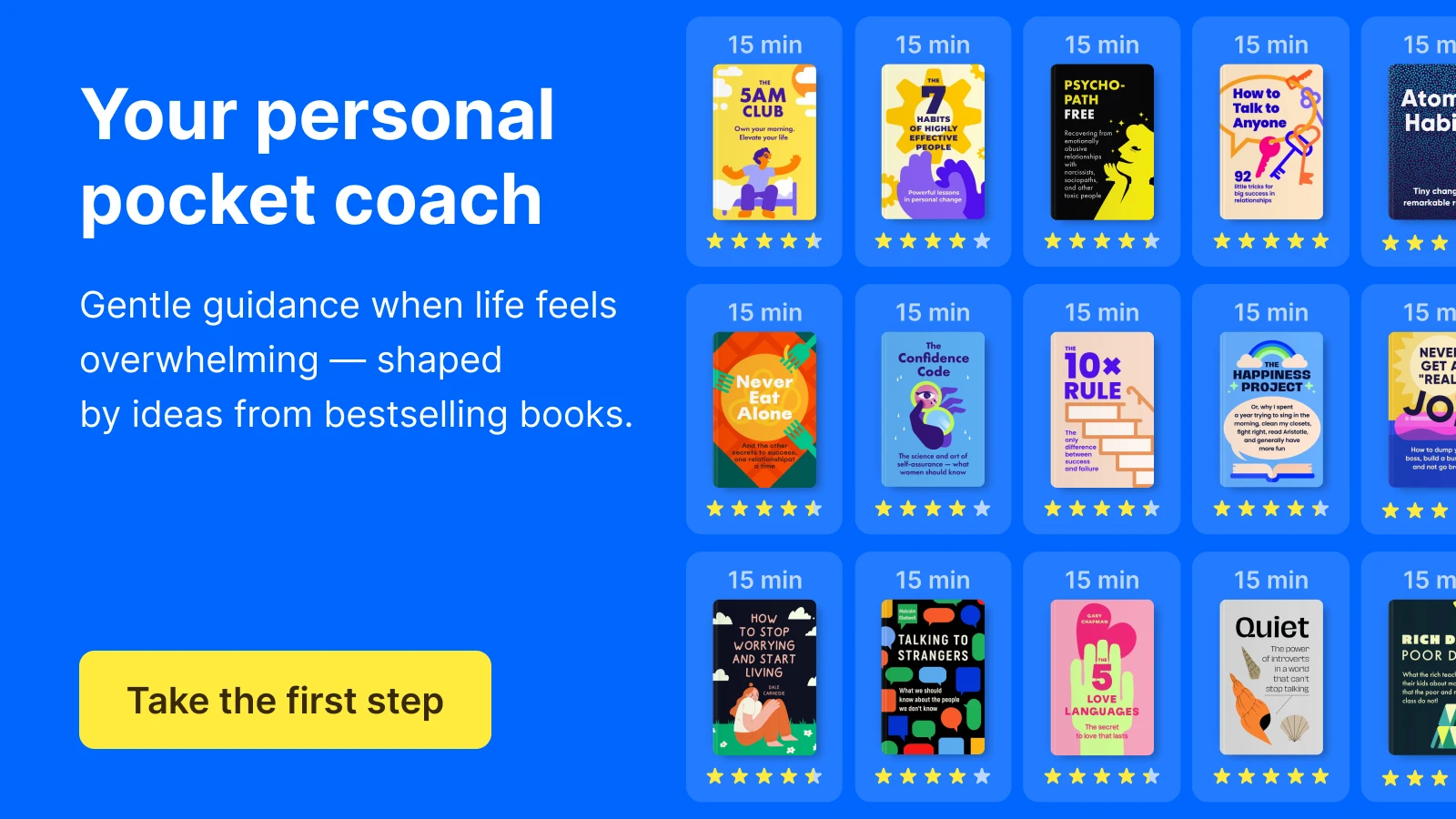
Download the Headway app today for self-paced education!
Quick summary: SDL at a glance
Self-directed learning is a process of building personalized learning goals.
It is vital for modern professional development and career agility.
Using tools like books and learning programs is crucial to staying consistent.
Headway book summaries fast-track your progress with 15-minute insights.
Building mental toughness makes this learning experience sustainable.
Self-directed learning vs traditional learning
According to Harvard Medical School, self-directed learning (or SDL) is "a process in which individuals take the initiative, with or without the help of others, in diagnosing their learning needs, formulating learning goals, and evaluating learning outcomes."
The principal difference lies in who holds the power. In a traditional learning situation, a teacher acts as the authority, setting the pedagogy and pace for everyone.
This structure often creates a non-interactive learning experience where the student simply absorbs what is given. In the self-directed learning approach, you become the facilitator of your own journey.
You choose the learning methods that best fit your learning style, enabling a much deeper, more relevant student learning experience. While traditional schooling focuses on grades, SDL focuses on the actual application of knowledge in your daily life.
| Feature | Self-directed learning | Traditional learning |
|---|
Primary driver | The learner | The instructor |
Learning objectives | Set by the individual | Set by the institution |
Learning environment | Anywhere (home, app, and work) | Formal classroom |
Pace | Your own pace | Fixed schedule |
Evaluation | Self-assessment | Grades and exams |
The role of feedback within self-directed learning
A common critique of the self-directed learning approach is the lack of external feedback. In a classroom, a teacher corrects your mistakes; on your own, you must create your own feedback loops.
Without this, you might repeat the same errors or hit a plateau in your professional development.
One way to solve this is through active self-assessment. After finishing a chapter or a Headway book summary, ask yourself: "Can I explain this to a ten-year-old?" If you can't, you haven't mastered it yet.
You can also use interactive features, like quizzes or flashcards, to test your retention. Many self-directed learners find success by seeking out "micro-mentors" or peer groups for reviews.
Sharing your learning outcomes on a blog or in a forum creates an opportunity for others to offer insights you possibly have missed. Reflection is the final piece of the puzzle. At the end of each week, adjust your learning strategies based on what worked and what didn't.
Real-life examples show that the most successful active learners treat their learning experience like a science experiment, always testing, reflecting, and improving. This practice ensures your learning journey never reaches a dead end.
Six key benefits of self-directed learning
Transitioning to self-regulated learning offers more than mere convenience. It reshapes how you interact with the world and improves your critical thinking:
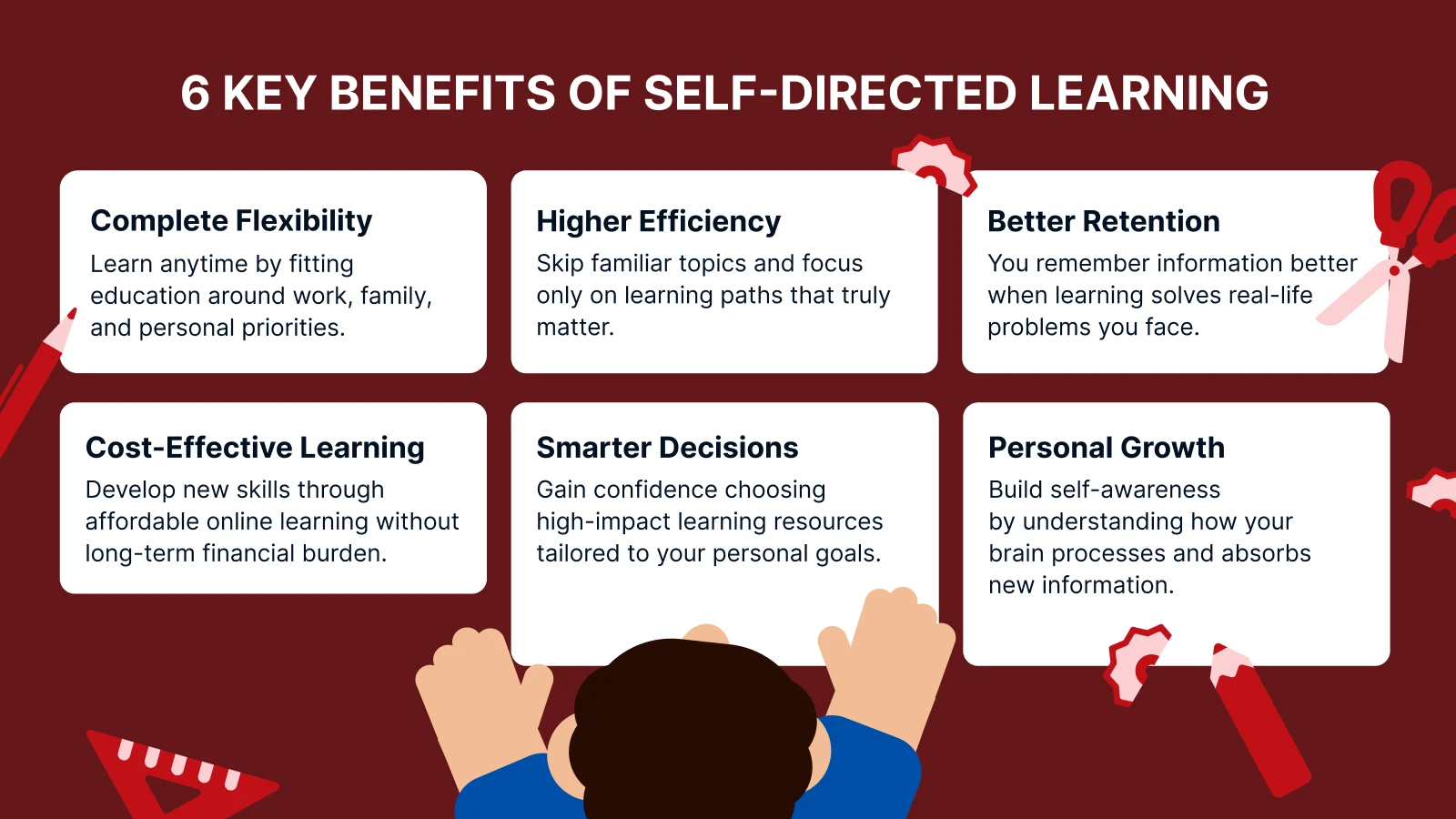
Complete flexibility: You can fit independent study into any schedule, making it perfect for adult education where career and family come first.
Increased efficiency: You skip what you already know and focus on the learning paths that matter. This approach makes the learning process seem much faster.
Higher retention: When you choose the topic, your self-motivation ensures the information sticks because it solves a problem you actually have.
Cost-effective: You can pursue continuing education through affordable online learning opportunities without the debt of higher education.
Empowered decision-making: You develop the skills needed to curate your own curriculum, choosing only the most impactful learning resources.
Self-growth: It builds self-awareness, helping you understand how your brain works and how you best process new data.
Common mistakes in self-directed learning (and how to avoid them)
One major hurdle for self-directed learners is the lack of a clear structure. Without a teacher, it is easy to fall into the trap of "passive consumption," where you read many books but apply nothing.
Another common error is getting overwhelmed by too many learning resources. When you try to learn everything at once, you often end up learning nothing well. To avoid this, use SMART goals: make your learning objectives Specific, Measurable, Achievable, Relevant, and Time-bound.
Managing distractions is another battle for those doing independent study. It is vital to set a specific time for your learning activities and follow it.
Consistency is more important than intensity; fifteen minutes of daily microlearning beats a five-hour binge once a month.
To stay on track, use progress evaluation features like those in the Headway app. Seeing your growth streak visually can provide the self-motivation needed to keep going.
Finally, avoid burnout by balancing your own learning with rest. If you push too hard without a break, your learning outcomes will suffer. Remember, this is a marathon of lifelong learning, not a sprint.


How can I apply self-directed learning in real life?
You can apply these learning skills to almost every sphere of your life to see immediate results. It is about creating a lifestyle of curiosity:
Career growth: Identify a gap in your professional development to learn quickly and master a new software or leadership skill. This ability makes you more valuable in the job market.
Health and wellness: Create a custom learning program to understand nutrition and fitness science. Instead of following fads, you learn the actual biological mechanisms.
Financial literacy: Take an independent study approach to investing and money management. Understanding the learning style of finance allows you to build a secure future at your own pace.
Creative hobbies: Whether it's painting or coding, self-directed learners use a variety of learning activities to master skills that bring them joy outside of work.
Useful tools to aid your journey
To succeed, you need a toolkit that supports your learning process. While there are many learning resources available, the right ones save you time and energy. Effective tools turn a daunting subject into a manageable learning experience.
Headway app: This app is a key tool for the modern self-directed learning model. It provides book summaries that let you grasp core concepts from the world's best nonfiction in minutes. It is a perfect microlearning tool that helps you stay consistent.
Digital libraries: Accessing journals and e-books via platforms such as Jossey-Bass provides academic depth when you need to explore a specific learning theory in depth.
Goal trackers: Tools that help you set goals and monitor your progress are essential for staying self-disciplined. Without a teacher to check your work, these apps keep you accountable.
Peer networks: Forming partnerships with other learners provides a social aspect that imitates higher education. Discussing what you learn helps solidify the information.
Audio content: Listening to summaries while commuting turns "dead time" into a valuable learning situation, which is why more Americans are turning to audiobooks every year.
Five proven tips for impactful self-directed learning
To succeed, you need more than just a list of books; you need a strategy. Using insights from the best authors, you can build a self-regulated learning habit that lasts. Here are five tips that teach you how to learn effectively on your own.
Tip 1: Build mental toughness
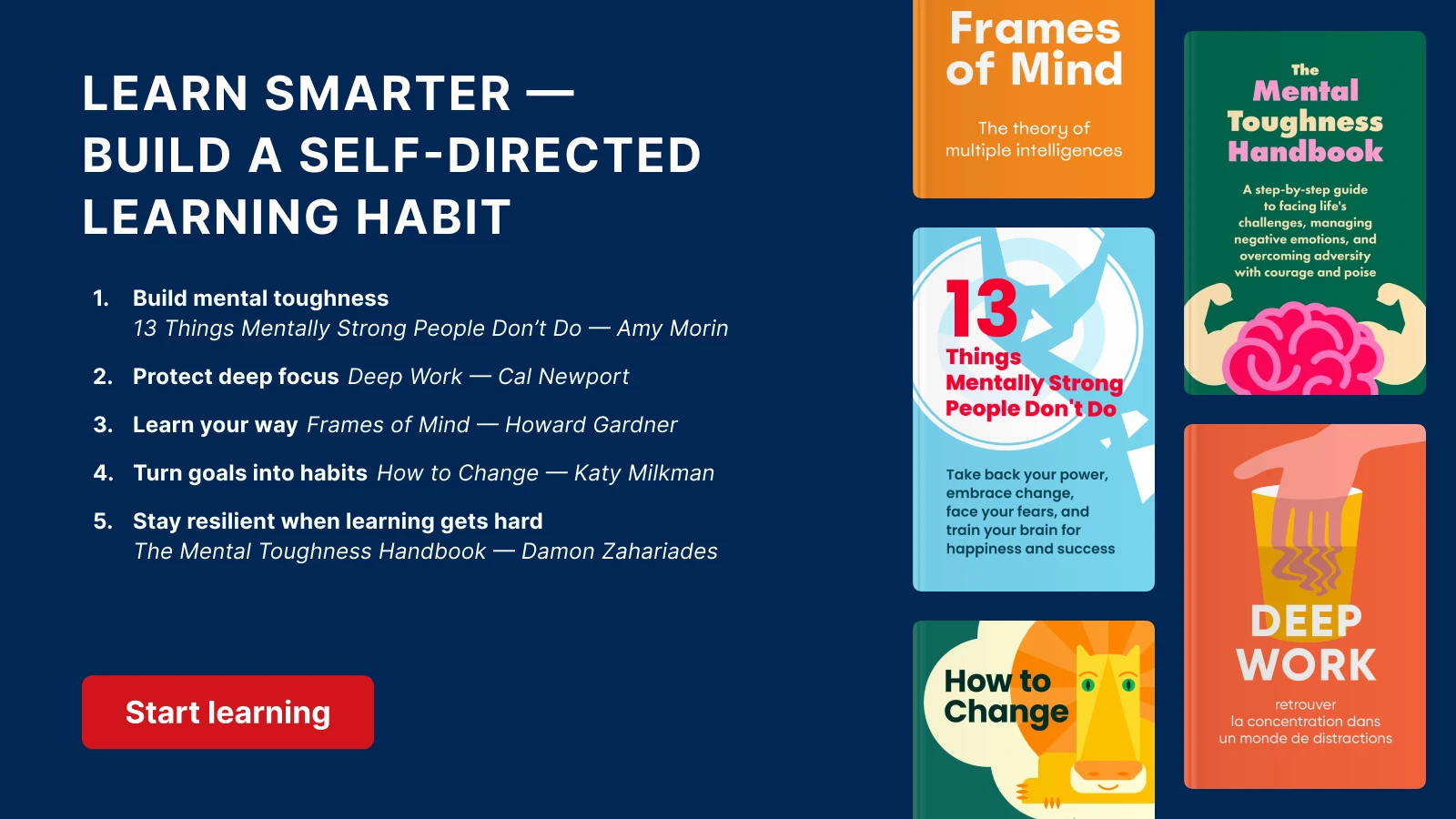
Becoming self-disciplined is the hardest part of working alone. In the summary of '13 Things Mentally Strong People Don't Do' by Amy Morin, you can learn how to stop wasting energy on things you can't control. This self-knowledge helps you stay the course when the learning situation gets tough.
→ Read the summary of '13 Things Mentally Strong People Don't Do'
Tip 2: Prioritize deep work
To see real learning progress, you must eliminate distractions. Cal Newport's 'Deep Work' explains how to reach a state of intense focus. This is vital for SDL because without a teacher watching, it is easy to lose focus.
→ Read the summary of 'Deep Work'
Tip 3: Frame your learning
Everyone has a unique learning style. Howard Gardner's 'Frames of Mind' explores the idea of multiple intelligences. Understanding your own strengths helps you pick the right learning activities and partnerships to succeed.
→ Read the summary of 'Frames of Mind'
Tip 4: Embrace habit change
If you want to set goals and actually hit them, you need to change your behavior. In 'How to Change,' Katy Milkman shares how to turn learning opportunities into long-term habits. This is a great way to use microlearning to your advantage.
→ Read the summary of 'How to Change'
Tip 5: Cultivate mental toughness
The learning process includes failure. Damon Zahariades's 'The Mental Toughness Handbook' provides a guide for staying resilient. Developing this self-assessment skill will help you stay on track when an idea is hard to grasp.
→ Read the summary of 'The Mental Toughness Handbook'
From self-directed learning to lifelong learning: Your long-term growth plan
Self-directed learning keeps lifelong learning alive. It's how you hold onto a growth mindset and keep growing as a learner, year after year.
Here's a five-year SDL roadmap you can follow:
Year 1: Foundation
Focus on "learning how to learn." Master decision-making and self-assessment to understand your baseline.
Year 2: Skill acquisition
Choose one major professional skill, like a new language or technical ability, and complete a self-designed learning program.
Year 3: Expansion
Explore areas beyond your comfort zone, such as philosophy or history, to boost analytical thinking and creativity.
Year 4: Mastery
Revisit core subjects with advanced learning resources to extend your expertise. Focus on high-level decision-making in your field.
Year 5: Mentorship
Use your knowledge to facilitate others' learning, reinforcing your own learning outcomes through teaching.
Step into your new growth path with Headway
Embracing self-directed learning is the ultimate way to future-proof your life. It allows you to build a steady cycle of growth in which each challenge becomes a new opportunity to expand your mind.
With the right tools and self-motivation, you can change your potential into reality.
The Headway app is the perfect companion for this journey. It provides the Headway book summaries you need to keep yourself informed and inspired without feeling stressed.
With just 15 minutes a day, you can stay on top of the latest trends in professional development, psychology, and leadership.
Download the Headway app and start your journey in personal development today. Mastering your own learning has never been this accessible or rewarding.
Frequently asked questions about self-directed learning
What are the 5 steps of self-directed learning?
The five steps of self-directed learning are diagnosing needs, formulating learning goals, sourcing learning resources, selecting learning methods, and evaluating learning outcomes.
Why is SDL important?
SDL is important because it supports the type of self-directed motivation and critical thinking that the modern workforce requires. It can also help individuals develop a personalized plan for their own professional growth.
What is a real-life example of self-directed learning?
For example, an individual interested in pursuing a data analysis career may utilize Headway's book summaries, along with instructional videos, and take part in an online community for collaborative learning and partnerships.
All of these options allow the learner to create a customized learning experience, making SDL a legitimate solution for acquiring advanced skills.
What are some SRL strategies?
Self-regulated learning (SRL) strategies include formulating clear learning objectives, practicing self-awareness to avoid distractions, and using self-assessment to check your knowledge. These strategies help a learner stay focused and ensure that their self-directed learning approach is as effective as possible over the long term.
How to teach self-directed learning?
To teach it, you must move from a lecturer to a facilitator. Encourage others to set goals and find their own learning resources. Provide a safe learning situation where they can experiment with different learning activities. Teaching self-directed learning is about giving people the learning skills to succeed on their own.
What are the best books on self-learning?
Essential books include 'Deep Work' for focus, 'How to Change' for habit building, and 'Frames of Mind' to understand your learning style. These titles provide the psychological foundation for a successful self-directed learning model. You can find all these and more in the Headway library to start your growth today.