Self-growth
 Business & Career
 Success
 Communication
 Healing
 Relationships
 Psychology
 Happiness
Many people start the year with a long list of books but find it hard to keep up when life gets busy. If that's happening to you, it's completely normal.
Whether you wanted to read 50 books last year or are planning your 2026 goals, the secret isn't picking great books. It's about building a reading habit that fits into your daily life. This guide shows you how to set goals that move you forward, so you reach the end of the year feeling smarter and more satisfied.
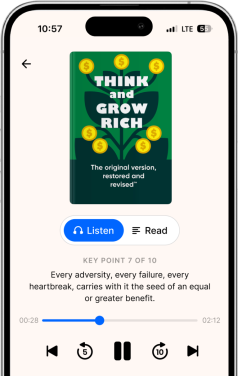
📘 Building a habit takes consistency, which is often the biggest challenge. Using microlearning tools like Headway can support your journey with book summaries and progress tracking that fit into a busy schedule.
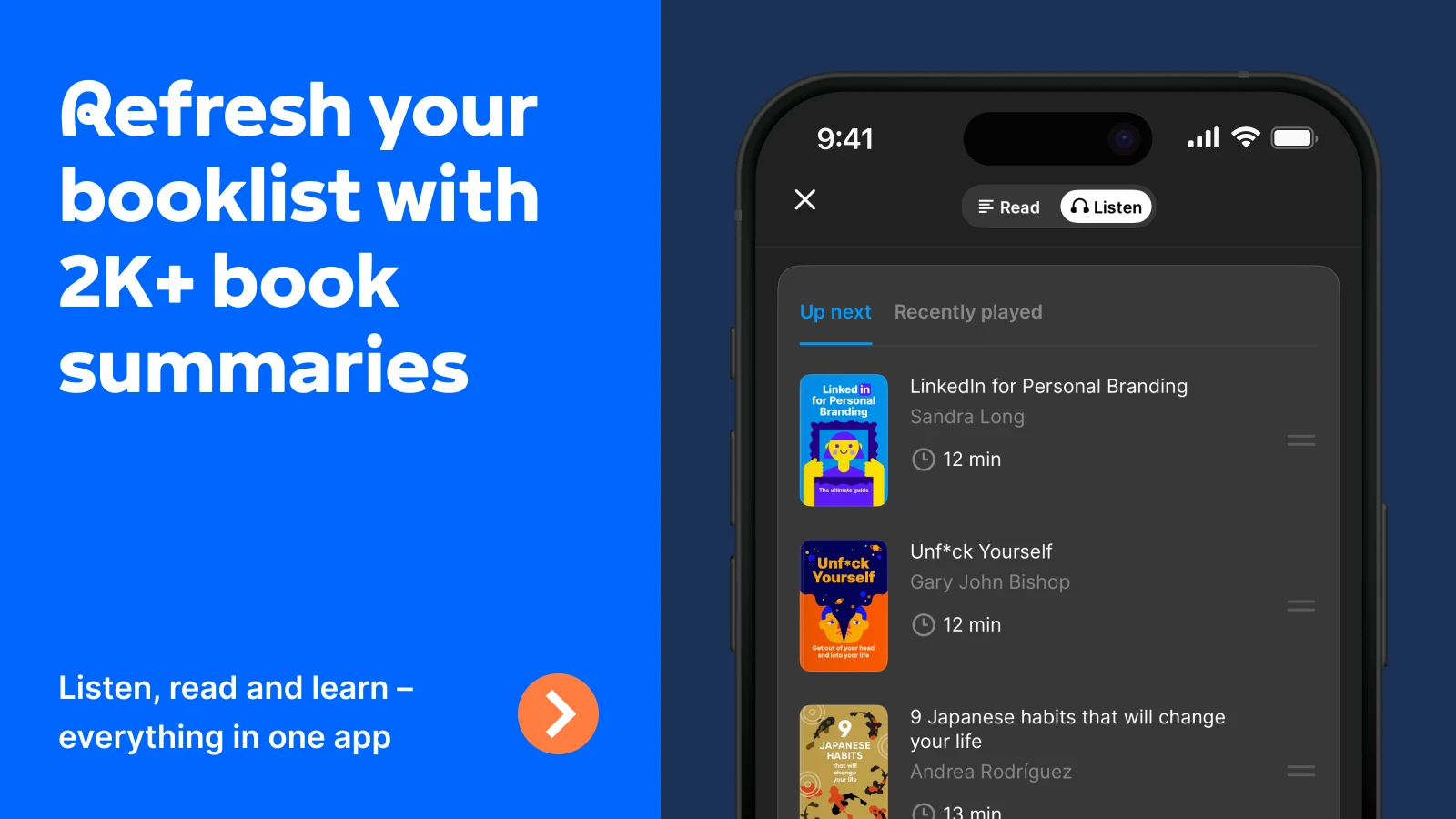
➡️ What is Headway and how does it work?
Quick answer: How to set and achieve your reading goals?
Purpose: You can achieve your reading goals by shifting your focus from quantity to consistency.
Use SMART goals: Make your goals specific, measurable, achievable, relevant, and time-bound.
Prioritize quality: Focus on what you learn, not just the number of books you finish
Use microlearning: Tools like Headway help you learn from a nonfiction book in just 3–20 minutes.
Track your progress: Attend book club, use a reading journal, or book apps to stay motivated.
Focus on retention: Build a personal system that helps the ideas you read actually stick.
What are reading goals, and why do they matter?
What are reading goals? Simply put, they're personal targets you set to help you read more or learn specific things. While a yearly reading goal often focuses on a number, a better goal focuses on how much you grow.
Setting a goal helps you stay intentional with your time. Instead of scrolling through TikTok or rereading your favorite books, you might pick up a nonfiction book or listen to a book summary like a podcast. This shift turns a simple hobby into a tool for self-growth. When you have a plan, your reading life becomes a way to solve real problems in your career or relationships.
📘 Grow through reading with Headway.
How to set reading goals that align with your life
The first step is to identify your "why." Are you reading books to learn a new skill, or do you want to explore a new genre for fun? Knowing your purpose helps you choose the right books for your bookshelf.
Next, pick your formats. You don't have to sit still with a paper book to reach your targets. You can use audiobooks on Headway or Audible while you drive or read graphic novels when you want something visual. If you're on a budget, check out your local library or use Libby to borrow digital books for free.
Finally, create a clear reading list. Don't just grab whatever is popular. Look through your backlist of books you already own but haven't started. Organizing your TBR (to-be-read) pile makes it much easier to decide what to read next.
📘 Create your TBR with Headway right now.
The ten-minute reading audit
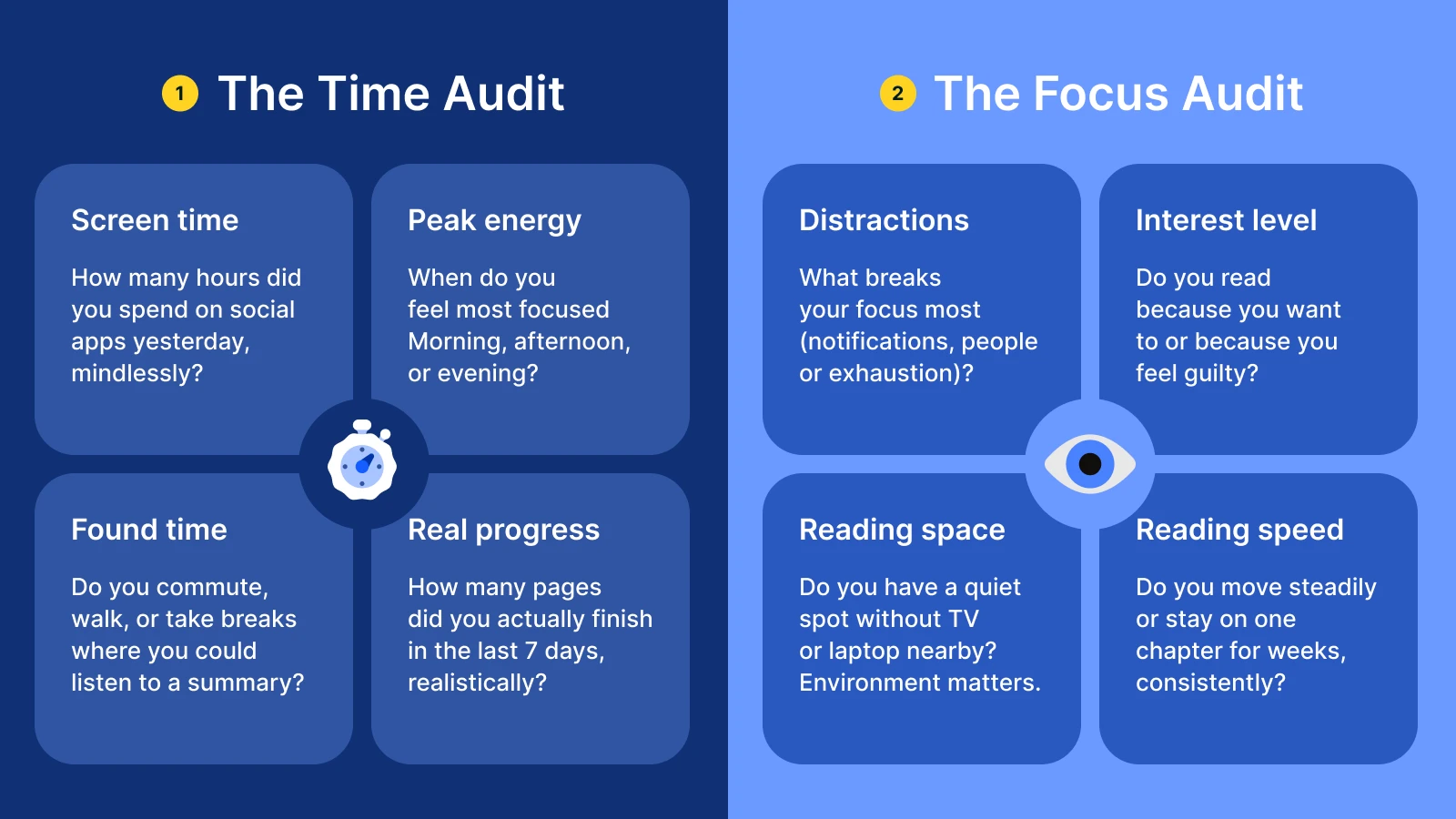
Setting a goal is easy. Knowing where your current habits are failing you? That's the hard part. Before you commit to a new list of books, take ten minutes to look at your real behavior. This self-test will show you exactly where you're getting stuck. Grab a notebook or open notes on your phone and answer these questions as honestly as possible.
The time audit
Check your phone's screen time: How many hours did you spend on social apps yesterday?
Find your peak energy: When do you feel most awake and ready to learn?
Identify your 'found time': Do you have a commute or a lunch break where you could listen to a summary?
Count your current pages: How many pages did you actually finish in the last seven days?
The focus audit
Spot your biggest distraction: Is it your phone notifications, your family, or just feeling too tired?
Rate your interest level: Are you reading books because you enjoy them or because you feel forced?
Review your physical space: Do you have a quiet place to sit without a television or computer nearby?
Analyze your speed: Do you feel like you're stuck on the same chapter for weeks?
What can you do to solve your bottlenecks?
If social media takes up three hours of your day, your primary bottleneck is digital distraction. You don't need more time; you need better digital boundaries. If you're reading books you don't like, your bottleneck is interest. You should give yourself permission to quit those titles immediately. This way, you can save your energy for books that actually matter to you.
Perhaps you found that your energy is highest in the morning, but you currently try to read at night. In this case, you're fighting your own biology. Change your reading time to 7:00 am instead. This simple shift can turn a failing goal into daily progress without adding any stress to your schedule.
If your physical space is the problem, move your books to a more obvious spot. If your speed is the issue, consider using book summaries to get through the main ideas faster. Use these specific results to pick a goal that fits your real life today. This honest look at your habits is the only way to build a routine that actually lasts until the end of 2026.


Five creative reading goals for 2026
Setting a goal is one thing, but making it interesting enough to keep you coming back is another. You need targets that feel like a fun activity rather than a chore.
To help you stay excited about your progress, try one of these creative approaches to your daily reading. These ideas make it easier to stay on track even during your busiest weeks.
The Skill Island approach: Pick one topic, like leadership or health, and read three summaries on Headway about it this month.
The comfort zone challenge: Try a new genre you usually avoid, like a classic by Jane Austen or a modern movie adaptation.
The microlearning sprint: Commit to 5–15 minutes of learning every morning before you check your emails.
The habit pair: Listen to a book summary during your commute using tools like Headway's CarPlay integration.
The page number goal: Instead of a full book, aim to read 10 pages a day to keep your reading habit alive.
Good vs bad reading goal examples
| Goal type | Bad example | Good example (SMART) |
|---|
Quantity | Read more books this year. | Read one book summary every morning for 30 days. |
Variety | Explore different subjects. | Read two books about history before the end of June. |
Habit | Start reading every night. | Read five pages before turning off the bedroom lights. |
Learning | Learn about leadership. | Finish three book summaries on the Leadership Skill Island. |
Top five books to help you reach your reading goals
If you want to read more, faster, or deeper, these five books are the perfect starting point. You can find summaries for all of them on the Headway app.
'Atomic Habits' by James Clear: Use this book to build a daily routine. It teaches you how to make reading the easiest choice by changing your environment and starting with tiny steps.
'How to Read a Book' by Mortimer J. Adler: This guide helps you move past simple reading to active analysis. You'll learn how to extract deeper meaning and remember more from every page.
'Speed Reading' by Kam Knight: If your goal is to finish a large number of books, this is for you. It offers practical ways to increase your speed while keeping your comprehension high.
'The 12 Week Year' by Brian P. Moran: Stop setting vague yearly resolutions. This system helps you break your reading goals into 12-week sprints to create a sense of urgency and better execution.
'I'd Rather Be Reading' by Anne Bogel: This book celebrates the joy of being a reader. It serves as a great motivator to prioritize your reading life, even when you have a busy schedule.
Essential tools to crush your reading goals
There are many digital tools available to help you stay organized and motivated. Choosing the right ones can make your reading journey much smoother:
Amazon and Kindle: These platforms allow you to buy and download new books instantly. You can keep thousands of titles in your pocket and adjust the font size to make reading more comfortable.
Storygraph: This app is a great choice if you love data. It provides detailed charts about your reading habits, showing you which genres you enjoy most and how your pace changes over time.
Goodreads: Use this social platform to see what your friends are reading. It's perfect for finding honest reviews and joining a community that keeps you excited about your next book.
While these tools are great for tracking and access, Headway is your partner for execution and consistency. It turns the world's best nonfiction into quick summaries that you can fit into any part of your day. This flexibility makes it a powerful choice for anyone who feels they have too little time to read but still wants to learn from the best authors. Headway also features daily streaks to help you stay on track without the pressure of a huge page count.
📘 Stay consistent and learn with Headway.
Overcoming common reading obstacles
Even with the best tools, life can get in the way. Knowing how to handle these hurdles will keep your habit alive and your mind growing:
Lack of time: Use "found time" like your morning coffee or commute. Listening to audiobooks or summaries makes it easy to grow during busy moments.
Loss of interest: Don't be afraid to stop reading a book that isn't helping you. Your time is valuable, and it's better to move on to something that inspires you.
Distractions: Keep your phone in another room or use focus sounds to block out noise. Setting a "no phone" rule for 15 minutes can make a huge difference.
Information overload: Trying to learn too many subjects at once can lead to burnout. Focus on one topic at a time to keep your progress clear and manageable.
Passive reading: Many people read without actually thinking about the content. In his book 'How to Read a Book,' Mortimer Adler teaches that "reading a book should be a conversation between you and the author." He explains that understanding is a "two-way operation" where you must question the writer. Marking your agreements or differences is "the highest respect you can pay him."
Make your reading knowledge stick with Headway
Reading is only half the battle; you also need to remember what you learned. Most people forget 70% of a book within a few days. To stop this, you need to use your knowledge right away and revisit key points often.
Headway helps you explore over 2,500 titles on relationships, wealth, career, healing, communication, happiness, psychology, and business, with several features designed for deep learning:
Goal-oriented reading list: After a quick quiz about your goals, Headway builds a custom list of books for you. This plan changes as you learn, suggesting the best summaries to help you reach your personal or career targets.
Skill islands: If you want to master a specific topic, head to the Explore tab. Skill islands give you a clear path of summaries and quizzes to build expertise in areas like negotiation or emotional intelligence.
Highlights and spaced repetition: Save the most important ideas from any summary as highlights. Headway turns these into digital flashcards that you can review later. This feature ensures that the wisdom from 'Atomic Habits' or 'The 12 Week Year' stays fresh in your mind.
Interactive shorts: These are quick, playable stories that put you in real-life situations. You get to make choices and see how to apply book lessons to solve challenges like office conflict or time management.
Focus and sleep sounds: Staying concentrated is a skill. Headway offers ambient focus music and binaural beats for sleep. These sounds help you stay in the zone while you learn or wind down after a long day of reading.
Siri and shortcuts integration: If you're listening to a summary on your iPhone, you can just say, "Highlight this in Headway." The app will automatically save that specific moment as a highlight, so you don't lose your flow.
📘 Make reading stick with Headway.
Frequently asked questions on reading goals
What are reading goals?
They are personal targets designed to help you build a better reading habit. These targets help you stay focused on self-improvement instead of just scrolling through social media. By setting clear goals, you ensure that every book you pick up helps you learn a specific skill.
What are some reading goals for students?
Students often aim to improve their comprehension and speed for school. A good goal is to finish two new books outside of class each month. By doing so, they can expand their vocabulary, learn about different cultures, and build a lifelong love of learning.
How many books should I read a year?
There is no "right" number of books to read in a year. The best yearly reading goal is one that challenges you but still feels enjoyable. Whether you read five books or 50, the real success is how much that knowledge improves your daily life and mindset.
What is an example of a reading goal?
An example of a reading goal is committing to read 15 minutes of a nonfiction book every morning. Another example is finishing one movie adaptation and its original book each month. These specific targets are easier to track than vague promises and help you stay very consistent.
What are the goals for reading?
The main goals for reading include gaining new knowledge, improving your focus, and reducing stress. Many people read to find solutions to career problems or to understand human psychology better. The more you give your reading life a purpose, the more you turn every session into an ambitious growth opportunity.
What are the 7 reading strategies?
The seven reading strategies include visualizing, questioning, making connections, predicting, inferring, summarizing, and synthesizing. Using these helps you engage with the text more deeply. Instead of just looking at words, you activate your brain to understand the main ideas and how they apply to your own life.
What is a good reading goal for a year?
A good reading goal for a year is to finish one book per month in a new genre. That method helps you step out of your comfort zone without feeling overwhelmed. You can also aim to complete a reading challenge that focuses on building a daily 10-minute learning habit.