Self-growth
 Business & Career
 Success
 Communication
 Healing
 Relationships
 Psychology
 Happiness
Does your voice rise to levels you never thought possible when your child refuses to put on their shoes for the tenth time? You're standing there, feeling your blood pressure climb, knowing this isn't how you wanted to parent. The truth is, parents who struggle to control their anger aren't failing. They're simply managing stress they haven't learned to handle yet.
Practical tips from 'How to Stop Losing Your Shit with Your Kids' and 'No Bad Kids' on the Headway app offer bite-sized strategies that can transform these explosive moments into connection opportunities. With just 15 minutes a day, you can access proven techniques from parenting experts and start building the calm, patient approach your family deserves.
Get the Headway app today and start your day with actionable tips from the top parenting books!
Disclaimer: This article provides general information about parenting and anger management. It's not a substitute for medical advice, diagnosis, or treatment. If you're struggling with persistent anger, anxiety, or other mental health concerns, please consult a qualified health care provider or mental health professional.
Quick summary: What you need to know about parental anger
Children raised by angry parents often develop low self-esteem that follows them into adulthood.
Recognizing your triggers is the foundation of anger management.
Patience and emotional safety create the secure environment children need to develop healthy emotional regulation skills.
Simple practices like deep breathing, taking breaks, and reframing negative thought patterns can dramatically reduce parental anger.
Expert-backed strategies for improving your child's emotional well-being.
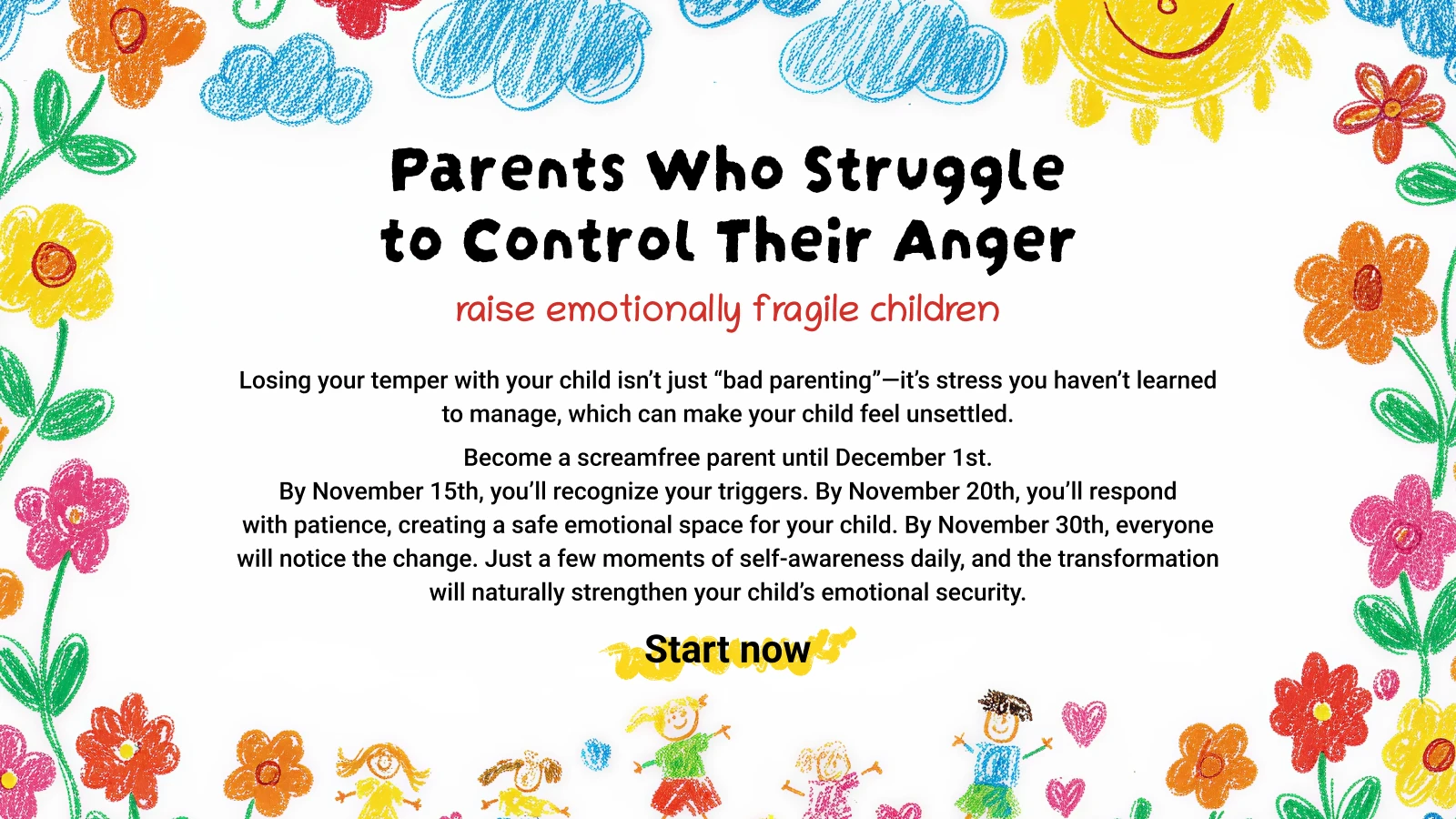
Quiz: How well do you manage your anger as a parent?
Struggling to keep your cool around your kid? Let's find out how well you're coping with all this emotional buildup. And be honest with yourself!
Why parental anger damages a child's emotional development
When parents lose control repeatedly, children don't just feel scared in that moment — they carry that anxiety into every interaction.
A five-year-old who watches their parents explode over spilled milk learns that the world is unpredictable and unsafe. They start walking on eggshells, constantly monitoring the moods of the adults around them.
Research in child psychology indicates that children living with angry parents experience behavioral problems, anxiety, and difficulty regulating their own emotions.
Author Jennifer Senior explores this in 'All Joy and No Fun,' explaining how the stress of modern parenting — managing careers, households, and children's packed schedules — creates the perfect conditions for parental burnout:
"And so our world becomes smaller, and the internal pressure we feel to parent well, whatever that may mean, only increases."
When we're overwhelmed, our patience evaporates. Our children then internalize that they're the problem, rather than recognizing that their parent is struggling with stress management.
The negative effects extend far beyond childhood. Adult children of angry parents often report trust issues, relationship difficulties, and their own anger management challenges.
They may struggle with ADHD symptoms, heart disease, and other health problems linked to chronic stress exposure during their formative years. This intergenerational pattern continues until someone decides to break the cycle.
📘 Ready to break the cycle? Get Headway for anger management wisdom from psychology experts!
The top five common triggers that make parents lose their cool
Parents don't wake up planning to yell at their kids. Something triggers that explosion. For most of us, it's a combination of factors that pile up until we snap:
1. Lack of sleep tops the list
When you're operating on five hours of interrupted sleep, your emotional regulation system simply can't function properly. Your brain treats exhaustion like a threat, keeping your stress response on high alert. That's why battles at bedtime feel especially unbearable — you're already running on empty.
2. Work stress doesn't stay at the office
When you've had a frustrating meeting or faced criticism from your boss, those negative emotions follow you home. Your child's normal behavior — whining, negotiating, and making messes — feels unbearable when you're already emotionally depleted.
3. Unrealistic expectations set everyone up for failure
We imagine that our children will behave rationally, follow instructions the first time, and appreciate our efforts. In 'The Smartest Kids in the World,' Amanda Ripley notes how American parents, in particular, struggle with the gap between what we expect from our kids and what's developmentally appropriate for their age.
4. Feeling unsupported magnifies everything else
When family members don't share the parenting load equally, resentment builds. Single parents face this daily — carrying the entire mental and physical burden alone while society judges them for not doing enough.
5. Your own childhood trauma can resurface when you become a parent
If you grew up with angry parents, those patterns are embedded in your neural pathways. When your child misbehaves, your brain might sometimes react as if you're back in that unsafe childhood environment.
That is why many parents find themselves saying and doing things they swore they'd never repeat.
📘 Recognize these triggers? Try Headway for self-awareness strategies from parenting psychologists!



Five steps to managing parent anger (and reconnecting with your kid)
The following five steps draw from expert research and real-world strategies that thousands of parents have used successfully. Each step includes a specific exercise from top-rated parenting book summaries on the Headway app.
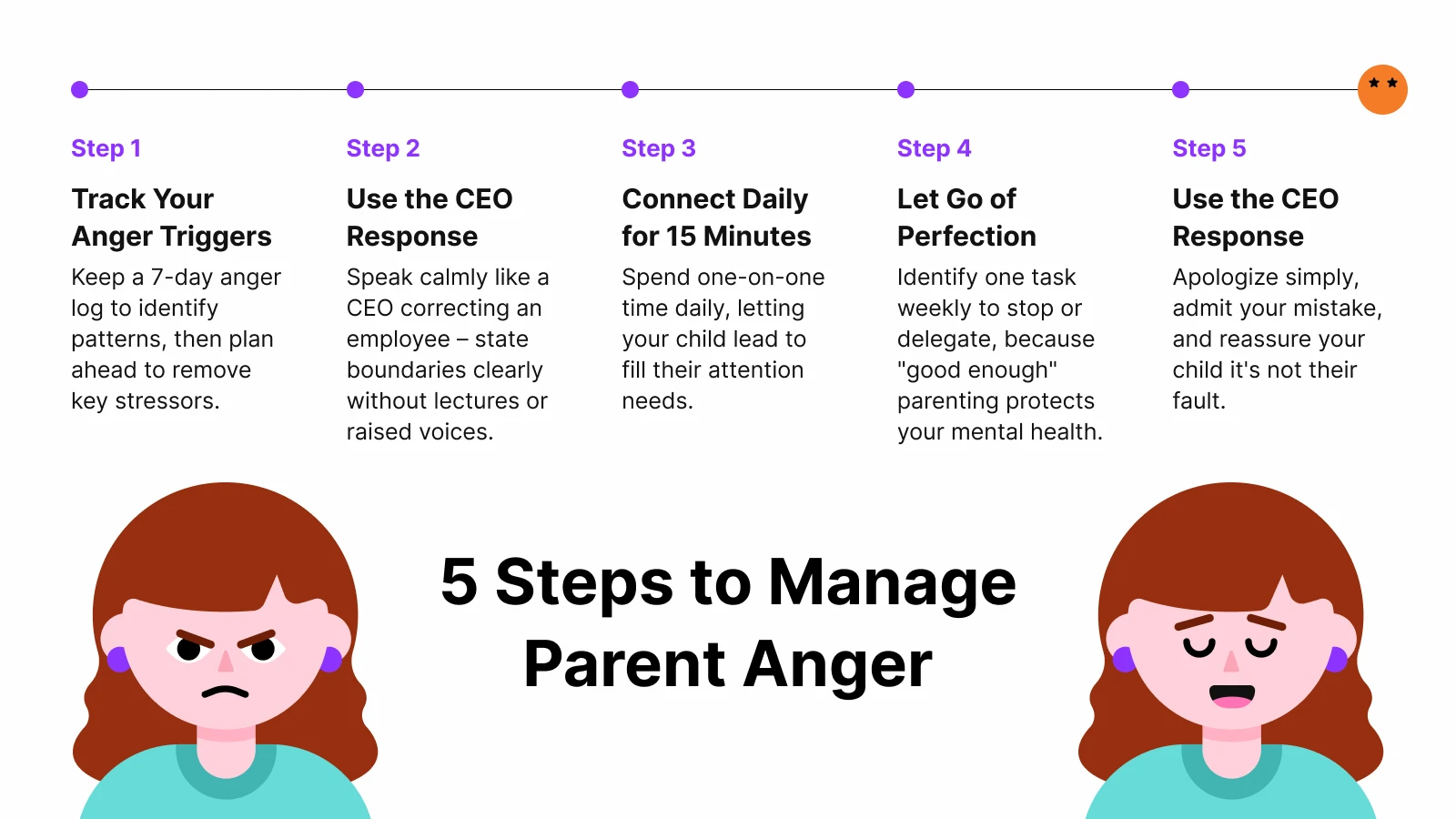
Step 1: Recognize your unique anger triggers before they escalate
Clinical social worker Carla Naumburg teaches that identifying your triggers is the first and most important step. She calls these "buttons" — the specific situations that make you lose it. Maybe it's the morning rush when everyone needs to be out the door. Maybe it's dinnertime chaos. Or maybe it's your child talking back.
The Headway app's summary of 'How to Stop Losing Your Shit with Your Kids' breaks down Naumburg's "BuRP" system: Buttons, Urges, Reactions, and Practice. Understanding this sequence helps you catch yourself before reaching the point of no return.
Practical exercise: Keep an anger log for seven days.
Each time you feel anger rising, write down: What time is it? What's happening? How much sleep did you get last night? Have you eaten recently? Who else is involved? Are you dealing with any major life stress right now? After one week, review your notes.
You'll spot clear patterns. Maybe your buttons get pushed most on mornings when you've had less than six hours of sleep, or during the evening rush when you're exhausted from work.
Once you know your specific triggers, you can plan ahead. If mornings are your danger zone, prep the night before. Lay out clothes, pack lunches, and prep the coffee maker. Removing just one stressor can prevent the whole explosion.
📘 Want Naumburg's complete system? Download Headway to master the full BuRP method in 15 minutes!
Step 2: Use deep breathing and mindfulness to calm down your nervous system
When you feel that familiar heat rising in your chest, your body has entered fight-or-flight mode. You have about 10 seconds before rational thought disappears completely. Your nervous system needs a signal that you're safe and that no emergency requires you to yell.
Janet Lansbury, author of 'No Bad Kids,' emphasizes that staying calm isn't about suppressing your emotions but choosing how to express them. Children need to see that adults feel frustrated too, and that we can handle those feelings in healthier ways.
Practical exercise: Practice the CEO response technique that Lansbury teaches. When your child misbehaves, imagine you're a confident CEO addressing an employee's mistake.
CEOs don't get emotional or uncertain — they correct calmly and efficiently. When your three-year-old throws a toy, use this exact script in a neutral, matter-of-fact tone: "I won't let you throw toys. Toys are for playing. If you throw it again, I will need to put it away."
Then physically block the behavior if needed, but stay calm and brief. No lectures, no scolding, and no raised voice. Just clear, confident leadership.
This approach makes your child feel safe because you're obviously in control, which is exactly what they need when they're acting out.
Step 3: Set clear boundaries with compassion to prevent meltdowns
Children test boundaries. That's their job. They're developmentally obliged to push limits to learn where the edges are. When parents understand this, it becomes less personal. Your child isn't defying you maliciously — they're checking if the rules still apply today.
'The New Father' by Armin Brott addresses how fathers often struggle with this balance, wanting to be the "fun parent" while also maintaining authority. He suggests that emotional regulation starts with accepting that parenting involves constant negotiation, not perfect control.
Practical exercise: Spend 15 minutes of one-on-one "floor time" with your child every day, no phones or distractions allowed.
During this time, let your child lead the activity. If they want to stack blocks and knock them down 47 times, follow their lead.
This regular connection fills your child's attention bucket, making them less likely to seek negative attention through boundary-pushing behavior. When you do need to set limits later, they're more likely to cooperate because they feel secure in your relationship.
Step 4: Practice self-care to protect your mental and physical health
You can't pour from an empty cup. This phrase appears in nearly every parenting book, yet parents still often feel guilty about prioritizing their own well-being.
Jennifer Senior's 'All Joy and No Fun' reveals that modern parents spend more hours on childcare than any previous generation, while also working longer hours — a recipe for complete burnout.
Getting enough sleep matters more than a clean kitchen. Your brain literally cannot regulate emotions properly without adequate rest. Exercise, even brief walks, reduces stress hormones and improves your mood for hours afterward. Connect with other parents through support groups or online communities to find mutual support and resources.
📘 Struggling to prioritize yourself? Start Headway for self-care strategies that actually fit your life!
Practical exercise: Recognize that you're living through a unique historical moment where parenting expectations have become impossible.
Give yourself permission to let some things go. Each week, identify one thing you can stop doing or delegate. Maybe it's elaborate birthday parties — store-bought cake works fine.
Maybe it's perfectly organized toy rooms — kids will mess them up anyway. Maybe it's answering every work email within minutes — boundaries protect your family time.
Senior's research shows that parents who accept "good enough" instead of chasing perfection report better mental health and less parental anger. Write down three specific expectations you're releasing this month.
Step 5: Repair the relationship after you lose your temper
You will mess up. Every parent does. What matters is what you do next. Author of 'The Smartest Kids in the World,' Amanda Ripley, found that in high-performing education systems worldwide, teachers and parents who admit mistakes and repair relationships raise more resilient, emotionally intelligent children.
Within an hour of losing your temper, apologize to your child. Keep it simple: "I'm sorry I yelled. I was feeling overwhelmed, and I should have handled that differently. It's not your fault that I got upset."
Practical exercise: Create a family "do-over" ritual.
When you lose your cool, after apologizing, ask your child: "Can we have a do-over?" Then literally replay the situation with the calm response you wish you'd given initially.
It also rewires your own brain, creating new neural pathways for calm responses. After each do-over, check in: "How did that feel different?" This simple question helps you and your child process the experience and remember the better way forward.
Create lasting emotional safety for your child with Headway book summaries
As you can see, parents who struggle to control their anger can still raise emotionally mature children. The trick is to manage your frustrations and turn them into learnings that help your kid grow.
Thus, the path from angry, reactive parenting to calm, connected parenting isn't complicated. You just need the right information at the right time, and Headway provides exactly that.
The app makes accessing this knowledge realistic for busy parents. Instead of finding an hour to read — an impossible task when managing young children — you get the core insights in the time it takes to drink your morning coffee. Everything you need for growth is there, waiting when you're ready.
Download the Headway app, choose the parenting challenge you're facing right now, and find the expert guidance that speaks to your situation. Your children will notice the change, and so will you!
FAQs
How do I deal with a parent who has anger issues?
Set boundaries while showing empathy. Recognize that their anger stems from unmanaged stress, not you. Encourage them toward professional help and avoid taking their outbursts personally. If you're an adult child, limiting contact during particularly volatile periods protects your mental health while maintaining the relationship.
How does a parent with anger issues affect a child?
Children develop anxiety, low self-esteem, and trouble with emotional regulation. They may exhibit behavioral problems, struggle academically, or develop physical health issues like high blood pressure later in life. The constant stress of an unpredictable home environment disrupts healthy brain development and attachment patterns.
What kind of childhood trauma causes anger issues?
Growing up with angry parents, experiencing neglect or abuse, witnessing domestic violence, or facing constant criticism creates neural pathways for anger. These early experiences teach that the world is unsafe and that anger is how you protect yourself or gain control.
What happens to kids who grow up with an angry parent?
Adult children often struggle with relationships, trusting others, and managing emotions. They may either replicate the angry patterns or swing to the opposite extreme of avoiding conflict entirely. Many report ongoing mental health challenges and difficulty setting healthy boundaries throughout their lives.
What are the 3 R's of anger management?
Recognize your triggers and early warning signs. Respond with healthy coping strategies like deep breathing or taking a break. Repair relationships afterward by apologizing and reconnecting. These three steps (Recognize, Respond, and Repair) form the foundation of effective anger management for parents.
How do I control my anger toward my child?
Identify your specific triggers, practice mindfulness techniques, ensure you're getting enough sleep, and develop a cool-off routine. Take breaks when anger rises, use self-care regularly, and consider professional help if anger persists. Remember that controlling anger is a skill you can develop through practice and patience with yourself.
How can I calm down an angry mom?
If a mom is feeling overwhelmed, think of something practical to help lighten her load. Sometimes simply saying, "I can see you're overwhelmed. What can I take off your plate?" helps! And, if she's angry often and intensely, you can support a commitment to practice self-care or recruit professional help.