Self-growth
 Apps & Digital Tools
 Business & Career
 Success
 Growth Tools
 Psychology
 Communication
 Relationships
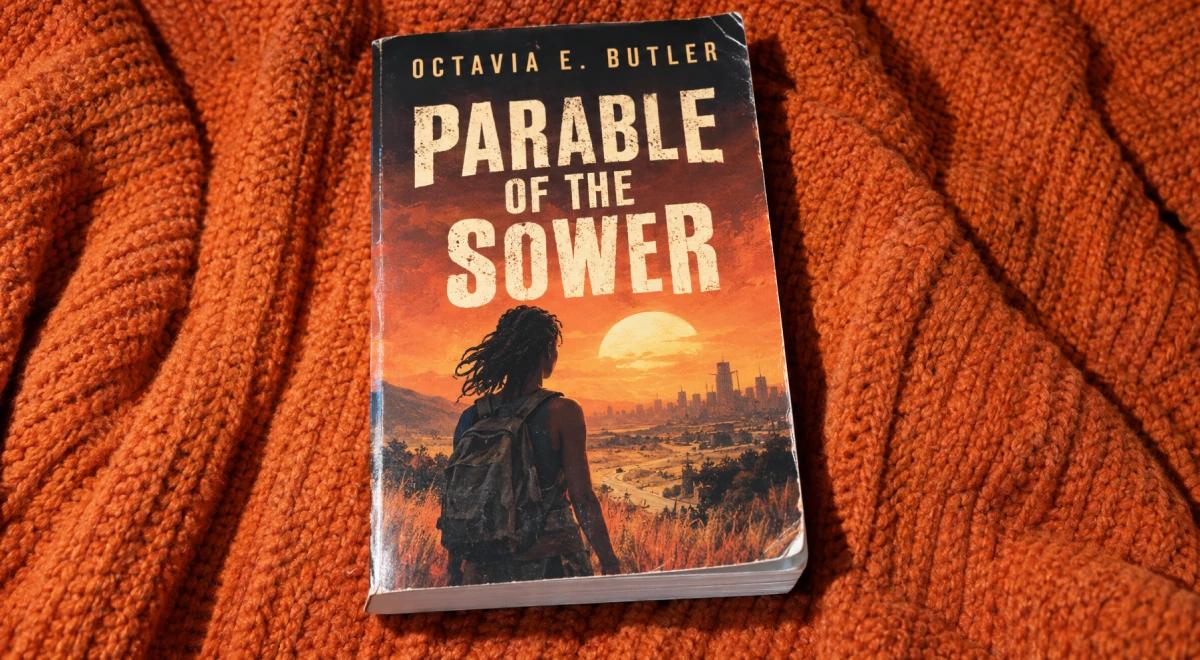

'Parable of the Sower' is a 1993 dystopian novel by Octavia E. Butler, told through the journal entries of Lauren Olamina. By early 2021, the novel had sold about 200,000 print copies, according to Library of America. In this 'Parable of the Sower' summary, you'll get the plot, the characters, Earthseed, Butler's own reply about prophecy, and a clear verdict.
Five authors help explain why Lauren's world still feels close: Nassim Nicholas Taleb, Viktor E. Frankl, Robin Wall Kimmerer, David Wallace-Wells, and George Orwell.
You can read or listen to their key ideas in short summaries when you download the Headway app, then pick the one that fits your week.

Quick summary: 'Parable of the Sower' at a glance
Short on time? Here's what to take away in about 20 seconds.
Parable of the Sower summary: Lauren Olamina survives a collapsing California, from 2024 to 2027.
Lauren's hyperempathy makes her feel other people's pain as her own.
She founds Earthseed, a belief system built on one idea: God is Change.
After fire destroys her walled neighborhood, she leads a group north to Acorn.
The title nods to the Gospel parable of seeds falling on different soils.
Keep reading for the full plot, the cast, and the Gospel story behind the title.
Gospel story or Butler's novel? Which 'Parable of the Sower' summary do you need?
Searchers land here with two different questions. Pick the box that matches yours.
The Gospel parable: The Parable of the Sower is a story Jesus tells in Matthew 13:1-23, Mark 4:1-20, and Luke 8:4-15. A sower scatters seed on four kinds of ground, and only the good soil produces a crop. Jump to the Gospel section.
Butler's novel: 'Parable of the Sower' is a 1993 novel set in California from 2024 to 2027, published by Four Walls Eight Windows. A teenager named Lauren Olamina keeps a journal while her neighborhood falls apart, and she builds a new belief from the wreckage. Jump to the plot section.
How they connect: Butler borrowed the title, and Lauren spends the book planting a new belief and a new community.
📘 Find the book that fits your question on Headway!
'Parable of the Sower' summary: What happens in Butler's novel (spoilers ahead)
This Parable of the Sower summary tells the whole story, ending included. Butler writes the book as Lauren's journal, and each chapter opens with a verse from Lauren's own text, 'Earthseed: The Books of the Living.'
Spoiler notice: this section reveals the full plot, including how the book ends.
Here's the plot in six steps:
In 2024, fifteen-year-old Lauren lives in Robledo, a walled neighborhood near Los Angeles, and quietly prepares for disaster.
She creates a new belief system, Earthseed, around one idea: God is Change.
Her younger brother Keith leaves the walls and dies, and her father disappears.
In 2027, raiders destroy Robledo, and Lauren's family dies in the attack.
Lauren, Harry Balter, and Zahra Moss head north, and many others join them on the road.
The group reaches Bankole's land in northern California and founds Acorn.
2024 and 2025: Life inside the Robledo walls
Lauren lives in Robledo, a walled neighborhood about 20 miles from Los Angeles, with her father (a Baptist minister and college professor), her stepmother Cory, and her brothers. Water is scarce and costly. Neighbors grow as much food as they can, keep rabbits for meat, and bake bread from acorns, because food production is how the neighborhood stays fed.
Lauren turns fifteen in July 2024. She has already lost her faith in her father's God and starts shaping a new idea: God is Change. She packs an emergency bag with supplies and teaches the neighborhood children survival lessons. Adults tell her to stop scaring people. Dangerous streets lie outside the gate, so the family goes to church armed.
2026: Keith, a missing father, and a fire drug
Her brother Keith slips out of the walls, runs with thieves, and is later found tortured and dead. In November, her father disappears and is presumed dead. Lauren speaks at a church service for him, takes on more teaching, and starts to emerge as a leader.
Outside the walls, pyro addicts set fires for the thrill of watching things burn, and the neighborhood starts to come apart. Some neighbors weigh a move to Olivar, a company town that offers safety in exchange for debt slavery. Lauren fears the company will cheat and abuse its workers. Everything Lauren feared is now happening, and the adults around her are still waiting for the good old days to come back.
2027: The attack and the walk north
Raiders overrun Robledo. Lauren's family dies, and she survives with neighbors Harry Balter and Zahra Moss. Lauren cuts her hair so she can pass as a man, and the three walk north along the freeway toward Highway 101. They take turns keeping watch at night.
Group members join along the way: Travis and Natividad Douglas with their baby, Allie and Jill Gilchrist, Emery Solis and her daughter Tori, and Grayson Mora and his daughter Doe.
Jill is killed when a gang attacks the camp. Bankole, a doctor, joins too and becomes Lauren's partner. Lauren learns how to make acorn bread from a book, and it helps feed the group, while she teaches Earthseed at every camp.
The ending: Bankole's land and the first Earthseed community
The group reaches Bankole's land in the coastal hills of Humboldt County, in northern California. The house is burned, and Bankole's sister and her family are dead. They settle there anyway and name the community Acorn. The book closes with the Gospel passage that gave it its title.
Who's who: The characters you meet on Lauren's road
Most of the cast joins Lauren after Robledo falls. Here are the people who matter most.
| Character | Role in the story | Why they matter |
|---|---|---|
Lauren Oya Olamina | The teenage narrator who writes the journal and founds Earthseed. | She leads the group north and turns a belief into a community. |
Reverend Olamina | Lauren's father, a Baptist minister and college professor. | He holds Robledo together, and his disappearance pushes Lauren into leadership. |
Cory Olamina | Lauren's stepmother, who teaches the neighborhood children. | She keeps school going until the attack ends it. |
Keith Olamina | Lauren's younger brother, who leaves the walls to make money. | His death shows what the outside world does to a boy looking for a way out. |
Harry Balter and Zahra Moss | Neighbors who survive the attack and walk north with Lauren. | They are her first companions, and Zahra, the youngest of Richard Moss's three wives, learns to read with Lauren's help. |
Taylor Franklin Bankole | A 57-year-old doctor who joins the group on the road. | He owns the land where Acorn begins, and he becomes Lauren's partner despite a nearly 40-year age gap. |
Allie and Jill Gilchrist | Sisters pulled from earthquake rubble who join the group. | Jill's death in a fight shows what the road costs. |
Emery Solis and Tori | A mother and daughter who flee an agribusiness debt and join the group. | Fellow sharers who feel pain the way Lauren does. |
Grayson Mora | A father who joins with his daughter, Doe. | He is another fellow sharer, along with Doe. |
📘 Try 15-minute summaries on empathy and communication on Headway!
Hyperempathy syndrome explained: Why Lauren feels what others feel
Hyperempathy syndrome in 'Parable of the Sower' is a condition that makes Lauren feel the physical pain and pleasure she sees in others. It's a condition from the novel, not a medical diagnosis.
In the book, her mother took a drug called Paracetco during pregnancy, and that's the cause. Lauren calls herself a sharer, and on her father's advice, she hides the condition, since it looks like a weakness in a violent world.
The condition shapes her choices. She feels the pain of anything she shoots, including a feral dog in the hills, so violence costs her something every time. It also fits the way she builds her group around care.
Lauren isn't the only sharer. Grayson, Emery, Tori, and Doe share the condition too, so a wounded group member's pain spreads to them.
What is Earthseed? "God is Change" explained
Earthseed is Lauren's religion, built on one idea: "God is Change." It gives her a path for spiritual growth that doesn't depend on her father's church.
Earthseed in one sentence: Change is the only lasting truth, and people can shape it.
The core ideas fit in three lines: God is Change, people can shape God, and humanity's destiny is "to take root among the stars," which is Lauren's picture of the future. She finds the name while gardening, when she sees plants seed themselves away from their parent plants.
The seed and oak imagery runs through the book. Lauren loves acorn bread, her neighbors once wanted to cut down the oak trees for something more useful, and the group's new home is called Acorn. The spirituality here is practical, and Lauren writes verses, then acts on them.
Key themes in 'Parable of the Sower'
Four key themes carry the book, and each one has a scene you can point to.
Change as the one constant
Earthseed says change is coming, and it won't wait for anyone's plan. In Robledo, the adults wait for the past to return, while Lauren packs her emergency bag. Her father tells her to stop panicking people, then lets her teach the neighborhood children anyway.
Community built from strangers
Lauren's first rule on the road is to trust no one. Then she and Harry pull Allie and Jill from earthquake rubble, and Bankole says he's surprised anyone cared about two strangers. When Emery and Tori sneak into camp, Lauren hands them pears, and others share their own food. Mistrust turns into a family.
For a modern novel about people who build something together, see our 'Tomorrow, and Tomorrow, and Tomorrow' summary.
Freedom and debt slavery
Olivar offers safety, jobs, and food, but workers pay with their rights, and wages barely cover living costs. Emery's story shows the price: she works for an agribusiness company, falls into debt, and loses her two sons to it before she runs.
Butler's dystopia also differs from Orwell's '1984.' In an analysis for 'Novels for Students,' critic Bryan Aubrey notes that the government in Butler's 2020s is irrelevant rather than oppressive, while Orwell's state controls everything.
Faith without a rulebook
Lauren leaves her father's church but keeps the sense that life needs a purpose bigger than survival. At her father's memorial service, someone starts singing 'We Shall Not Be Moved,' and Lauren thinks the opposite: they will be moved, and only the when and how are open. Butler said in an interview that she came to see power as a tool that can help or harm, and Lauren's story tests that idea.
📘 Test new ideas about community and trust on Headway!
Seven details that make readers call Butler a prophet (and what she said about it)
This section delivers the promise in the headline. Each item says what the book shows first, then why readers connect it to the news. None of them proves that Butler predicted a specific event.
Water that costs more than gas. Water is scarce and expensive in the novel, and readers link it to drought and water shortages in the western US.
Alternating floods and drought. California swings between heavy rain and long dry years, and readers see echoes in recent weather extremes.
Walled, gated neighborhoods. Robledo's walls extend a real trend, since gated communities grew fast in the 1990s as fear of crime rose.
Company towns that pay in debt. Olivar's workers owe the company, and readers connect that to worries about wages and debt.
A president who loosens labor laws. The novel's president weakens worker protections, and company towns grow as a result.
Distrust of police and fire services. Families in Robledo don't count on public services, so every household keeps guns, and readers connect that to wildfire seasons and strained emergency crews.
Fires set on purpose by users of pyro. Pyro addicts burn homes for the thrill of it, which readers link to California's wildfires, though real fires have many causes.
In January 2025, after fires burned across the Los Angeles area, Rolling Stone ran a story noting that many people were calling Butler a prophet.
Butler heard that label early. At a 1998 conference, she called the book a cautionary tale, and when people said it was prophecy, she answered that she hoped not, as Library of America records. That framing matters. A cautionary tale asks readers to change course, and Lauren's whole story is about doing exactly that.
Where the title comes from: The Gospel Parable of the Sower explained
The Parable of the Sower is a story Jesus tells in the Synoptic Gospels: Matthew 13:1-23, Mark 4:1-20, and Luke 8:4-15. All three tell it, with small differences in wording.
A sower scatters seed freely, showing God's word offered generously to everyone. The seed is the same everywhere, but the ground changes, so the same seed gives different results depending on the soil. Luke 8:11 says the seed is the word of God.
The four soils stand for four conditions of the human heart, and the story asks each listener to check which one fits. How well spiritual truth takes root depends on how receptive that heart is. The path represents a closed or hardened heart, and Luke 8:12 says those listeners lose the word before they can believe and be saved, tying the story to salvation.
Enduring faith shows up as visible fruit in a person's life. Good soil is a heart that hears the word, holds on to it, and keeps going. Here's how the four soils line up:
| Soil | What happens to the seed | What it represents |
|---|---|---|
The path | Birds eat the seed, or people trample it. | A closed or hardened heart that hears the word but doesn't take it in. |
Rocky ground | The seed sprouts fast, but the sun scorches it because thin soil over rock gives it no root. | A listener who receives the word with joy and falls away when trouble comes. |
Thorns | The seed grows, but thorns choke it. | A listener whose worries about money and daily life crowd out the word, so no fruit ripens. |
Good soil | The seed takes root and produces a crop, thirty, sixty, or a hundred times over. | A receptive heart that hears the word and bears fruit with patience. |
How Lauren reuses the Parable in the novel
The title's significance shows in four confirmed links: Butler took her title from the parable, built Earthseed around seed imagery, named the first community Acorn, and ended the novel with a Gospel passage.
One reading is our own, not Butler's: the soils map onto the people Lauren meets. Neighbors who ignore her warnings look like the path or the rock, and travelers who join her and stay look like good soil. Butler never draws that map herself.
📘 Listen to ideas about purpose and meaning on Headway!
Does 'Parable of the Sower' hold up? Our review
Yes, it holds up, with a warning: it's a hard read. The journal format pulls you into Lauren's head, and the ending gives you a reason to keep going.
Pros:
The journal voice puts you inside Lauren's head, so the fear and the planning feel immediate.
The survival details feel practical, from the emergency bag to the acorn bread.
The ending offers hope: a small, shaky community with a plan.
Cons:
The violence is graphic, and some scenes are hard to read.
Most secondary characters stay sketchy, except Bankole, as one critic points out.
Kirkus Reviews called the plot thin and the tone preachy when the book came out.
Critics have split on it since 1993, so the mix above is fair.
Reception: It was a 1994 New York Times Notable Book and a finalist for the Nebula Award for Best Novel. It reached the Times best-seller list in September 2020, and in 2021 Times readers voted it the top science fiction pick for the best book of the past 125 years. Locus called Lauren's religion the most appealing the reviewer had met in nearly four decades of science fiction reading, and the Times Book Review praised it as a gripping tale of survival.
Content warnings: The book includes sexual violence, torture, slavery, racial violence, and drug addiction.
Who it suits: Readers of dystopian fiction. Teen readers are a case-by-case call, so check the content warnings above first.
Legacy: Toshi Reagon and Bernice Johnson Reagon turned the novel into an opera, and Damian Duffy and John Jennings adapted it as a graphic novel that won the 2021 Hugo Award for Best Graphic Story or Comic.
The 2015 story collection 'Octavia's Brood' took its inspiration from Butler. In April 2026, Variety reported that Warner Bros. will make a film with Melina Matsoukas directing, and it's still in development. The sequel, 'Parable of the Talents' (1998), won the Nebula Award for Best Novel.
Five ideas from Lauren's playbook, backed by Headway book summaries
Reading is one of the smartest ways to train your brain, and short summaries make every minute count. Not sure which book deserves your next free weekend? Read or listen to a summary first, then decide what earns a full read. Each pick pairs a book with an idea from Butler's novel and includes one small exercise.
1. 'Antifragile' by Nassim Nicholas Taleb: for plans that break when life changes
Taleb sorts the world into fragile things that break under shock, tough things that hold steady, and antifragile things that get stronger. That pairs with Earthseed's God is Change, since Lauren's emergency bag is a small bet that change is coming. Headway's summary runs about 12 minutes.
2. 'Man's Search for Meaning' by Viktor E. Frankl: for purpose under pressure
Frankl writes about searching for meaning during hard times, and Headway's summary frames that search as something that can strengthen the mind. Lauren's version is Earthseed, a purpose bigger than staying alive. For more reading on drive under pressure, see our guide to motivational books for men.
3. 'Braiding Sweetgrass' by Robin Wall Kimmerer: for seeds, oaks, and giving back to the land
Kimmerer, a botanist and member of the Citizen Potawatomi Nation, writes about plants, reciprocity, and what indigenous knowledge adds to science. Butler's oaks and acorns point the same way.
4. 'The Uninhabitable Earth' by David Wallace-Wells: for the climate backdrop
Wallace-Wells describes what a warming planet could bring, including wildfires, floods, and food shortages. It's the real-world backdrop to Butler's California.
5. '1984' by George Orwell: For two dystopias side by side
Orwell's novel shows a dystopia built on control, while Butler's shows one built on neglect.


What to read after 'Parable of the Sower'
'Parable of the Talents' by Octavia E. Butler: the 1998 sequel and Nebula Award winner, which picks up at Acorn.
'Kindred' by Octavia E. Butler: a time-travel novel about a woman pulled back to the antebellum South.
'The Handmaid's Tale' by Margaret Atwood: a dystopia where a religious regime controls women's lives.
'Snow Crash' by Neal Stephenson: a 1992 dystopia where corporations run city-states.
'A Clockwork Orange' by Anthony Burgess: a grim story of a teenage gang member put through a government treatment program.
Lauren's walk north follows a story shape as old as 'The Odyssey,' and our guide to the book covers the original. For another survival story, see our 'The Great Alone' book review, or try books like 'The Alchemist' if you want a story about following a calling.

Not sure what to read after Butler? Let Headway pick your next idea
Butler's novel gives you a teenager's journal, a collapsing California, and a belief system built on change, all tied to a Gospel story about seed and soil. If it sends you looking for the ideas behind it, Headway is a handy place to start.
Personalized recommendations, daily insights, challenges, and progress tracking turn spare minutes into a reading habit. Preview a book in a 15-minute summary, in text or audio, then decide which full book earns your time.
Download the Headway app and pick one summary for your next reading break.
FAQs about 'Parable of the Sower' summary
What is the main message of 'Parable of the Sower'?
The main message is that change can't be stopped, so people have to adapt and shape it. Lauren's Earthseed religion puts that into one line: God is Change. The book pairs it with a second idea: that survival works better in a community built on care than in a walled, fearful one. Critics in 'Novels for Students' make both points.
What does the parable of the sower mean in the Bible?
In Matthew 13:1-23, Mark 4:1-20, and Luke 8:4-15, Jesus describes a sower whose seed lands on a path, rocky ground, thorns, and good soil. The seed represents the word of God, and the soils represent how people respond. Only the good soil produces a crop, which shows that a receptive, patient heart bears fruit.
Is 'Parable of the Sower' based on a true story?
No, it's fiction. Butler built her 2024 California by extending trends she saw in the news, such as gated communities, drug epidemics, and climate change. At a 1998 conference, she called the book a cautionary tale, and when people said it was prophecy, she answered that she hoped not, according to Library of America.
How many books are in the 'Parable' series?
The series includes two finished books: 'Parable of the Sower' (1993) and 'Parable of the Talents' (1998), which won the Nebula Award for Best Novel. Butler began a third novel, 'Parable of the Trickster,' and planned others, but she died in 2006 before finishing any. The series remains unfinished.
Is 'Parable of the Sower' science fiction or dystopian fiction?
It's both, though the science is light. Critics place it in the dystopia tradition because it magnifies trends such as gated communities, drug epidemics, and climate change. A 'Novels for Students' essay notes that Butler pays little attention to technology and focuses on people. It also has a utopian touch in Lauren's plan for Acorn.
Why did 'Parable of the Sower' hit the best-seller list in 2020?
It first appeared on the New York Times best-seller list in September 2020, 27 years after publication. Coverage at the time linked the surge to readers seeing parallels between the novel's collapsing California and the news, while some attributed it to pandemic-era interest in Butler's writing. Butler had written the goal of reaching that list in her own notebook.
Is 'Parable of the Sower' appropriate for teens?
That depends on the reader, so check the content warnings first: the book includes sexual violence, torture, slavery, racial violence, and drug addiction. Its protagonist is fifteen when the story starts. One library catalog lists a Lexile measure of 710L, which describes how hard the text is to read, not what's in it.