Self-growth
 Business & Career
 Success
 Communication
 Healing
 Relationships
 Psychology
 Happiness
Ever felt like your brain just went "out of office" right when you needed it most?
You've got your sketchbook open, your coffee is hot, but all you can see is a void. That heavy, clogged feeling isn't a lack of talent; it's a signal that your mental gears simply need some grease. Figuring out how to overcome creative block is less about waiting for a "muse" and more about having a practical toolkit to kickstart your brain again.
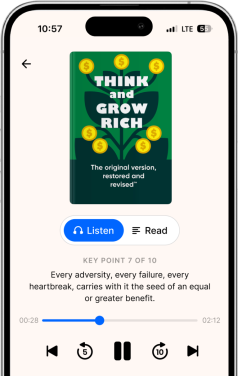
Headway helps you build this toolkit by distilling the best creative strategies from world-class authors into five-minute insights. You can listen to summaries that help silence your inner critic and manage self-doubt. It's a simple way to feed your mind fresh perspectives without feeling overwhelmed by a 300-page book.
📘 Download the Headway app here and start your first 5-minute inspiration session!
Make reading addictive!
It's much easier to start when a book takes just 15 minutes, isn't it?
Let's tryQuick answer: How to overcome creative block?
A creative block is essentially a temporary mental wall that stops you from accessing new ideas or making progress on new projects. To break through, you need to lower the stakes by embracing a "quantity over quality" mindset and stepping away from the creative process to reset your nervous system.
Mindset shift: Accept the stall without judgment to reduce the fear of failure.
Actionable tactics: Try sensory shifts (like a new playlist) or structured brainstorming to bypass your ego.
Expected result: Less cognitive load, so your creative spirit flows naturally again.
What is creative block, and why does it happen?
A creative block is your brain hitting the "pause" button because it's overwhelmed. It's that gap between wanting to make something and actually getting started. Whether you're a graphic designer staring at an empty canvas or a writer stuck on a first sentence, it feels like the well has run dry.
It doesn't happen for no reason though. Usually, it's a mix of burnout and that nagging perfectionism that tells you if it isn't a masterpiece, it isn't worth doing. We get stuck in creative ruts by repeating the same habits, or maybe the fear of failure is just loud today.
When you're constantly scrolling through social media and comparing your "behind-the-scenes" to everyone else's highlight reel, it's easy to freeze up. Understanding that this moment is just a temporary glitch in your creative process is the first step to getting your momentum back.
📘 Try the Headway app and turn your morning coffee into a masterclass on overcoming creative blocks.
Four common myths about creative blocks
We tend to romanticize artist block, but most of what we hear about it is total nonsense. Let's clear the air.
→ #1 Myth: It means you've lost your talent.
Reality: Talent doesn't just evaporate. You're just mentally tired. Even a professional artist has days when they can't draw a straight line.
→ #2 Myth: You just need to wait for inspiration to strike.
Reality: If you wait for the "muse," you'll be waiting forever. Inspiration usually shows up after you start working, not before.
→ #3 Myth: Taking a long vacation will fix everything.
Reality: Sometimes a break helps, but often, the art block is still waiting for you when you get back because the underlying system (like your daily routine) hasn't changed.
→ #4 Myth: You need expensive new materials to get started.
Reality: You don't need the fanciest acrylic paints or a high-end tablet. Sometimes the best way to find inspiration is to go back to basics with a cheap pen and a scrap of paper.



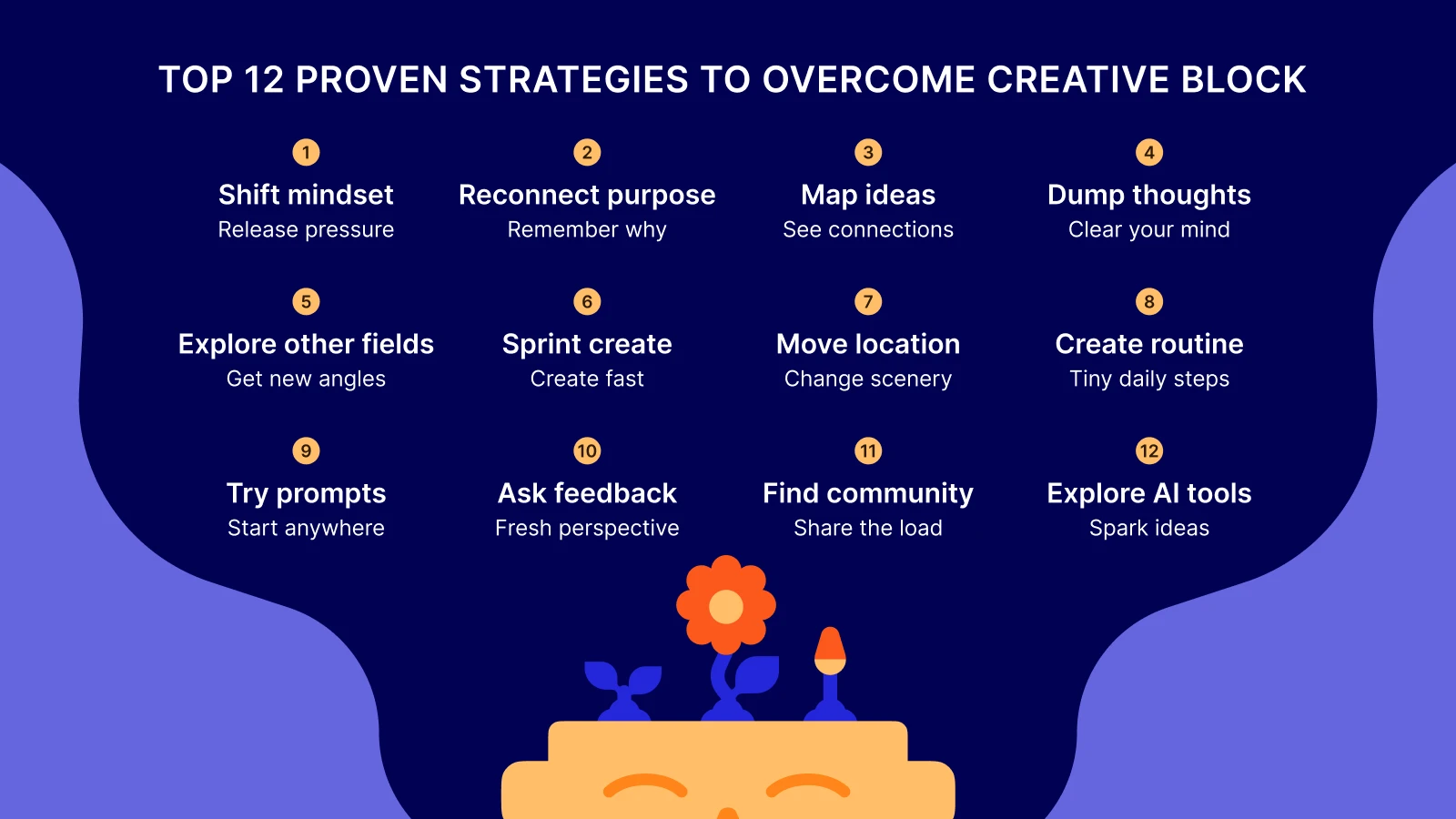
Top 12 proven strategies to overcome creative block
Don't try to do all of these at once. Pick one that feels like the least amount of work and start there.
1. Reframe your mindset
a) Accept the block without shame. The more you fight it, the stronger it gets. Tell your inner critic to take a backseat for an hour. When you stop treating artist's block like a personal failure, you lower your stress levels. It's just a rainy day in your head; the sun will come back eventually.
b) Reconnect with your creative purpose. Why did you start doing this in the first place? Forget about the "likes" or the money for a second. Tapping back into your creative spirit is about remembering the joy of making something just because you can. It takes the pressure off and makes the blank page less scary.
2. Creative techniques
c) Mind mapping and SCAMPER. When you can't find new ideas, stop thinking in straight lines. Grab some art supplies, even just a Sharpie, and map out every weird thought you have. The SCAMPER method (Substitute, Combine, Adapt, Modify, Put to another use, Eliminate, Reverse) forces you to look at your old artworks and see how they could be flipped into something totally different.
d) Free writing or a brain dump. This approach is great for clearing out the mental "trash" that causes procrastination. Set a timer and just write or doodle without stopping. Don't worry about it making sense. Usually, once you get the boring stuff out of your system, the good stuff starts to leak through the cracks.
e) Cross-disciplinary learning. If you're a writer, go play with some acrylic paints. If you're a painter, listen to a podcast about architecture. Stepping outside your usual creative work gives your brain a chance to make "sideways" connections. You'll often find that a solution for a painting problem comes from a cooking tip.
f) Timed creativity sprints. Perfectionism thrives when you have all day. Give yourself ten minutes to finish a project, no more. These high-pressure bursts lead to breakthroughs because you don't have enough time to let self-doubt tell you that your work is bad. You just have to move.
3. Environment and routine
g) Change your environment. Your brain gets used to your desk. If you're in a creative rut, move to a coffee shop, a park, or even just the floor. A simple shift in lighting or a new background playlist can be enough to trigger a few fresh perspectives and get the gears turning again.
h) Microhabits and routines. Don't wait for a giant block of time. Make a daily routine of doing something tiny, like five minutes of sketching or one paragraph of writing. It's much easier to find inspiration when you're already in motion than it is to start from a dead stop every morning.
i) Creative prompts toolbox. Keep a folder of tutorials or prompts for when you're stuck. If you can't think of what to draw, let a random generator decide for you. Having a "Plan B" removes the "what do I do?" friction that usually leads to a full-blown art block.
📘 Why wait for inspiration when you can build it? Get Headway and discover how the world's best thinkers stay productive under pressure.
4. Social and collaboration
j) Peer feedback and accountability. Sometimes you're just too close to the project. Show your work to someone you trust. They might see a solution that you've missed because you've been staring at it for six hours. Getting a second pair of eyes on your creative process can break the stalemate.
k) Join creative communities. Being a professional artist can be lonely, and that isolation breeds fear of failure. Hanging out in forums or local groups helps you realize that everyone else is also struggling. Seeing how others handle their own art block makes yours feel a lot less permanent.
Tools and tech angle
i) Using digital and AI tools to spark ideas. Don't be afraid to use tech as a sounding board. Ask a chatbot for ten "bad ideas" for new projects or use a digital tool to mix up your color palette. You don't have to use what it gives you, but reacting to something — even if you hate it — is better than staring at nothing.
How to build long‑term creative flow
Look, fighting off a creative block once is fine, but you don't want to be doing this every single Tuesday. To stay in the zone, you need a system that doesn't rely on luck or the "perfect" mood. Here is where a solid daily routine comes in. It's not about being a robot; it's about making "starting" the easiest part of your day so you don't fall into procrastination.
Keep a sketchbook or a simple notes app specifically for the "bad" new ideas. It gives your inner critic a place to play without ruining your actual creative work. If you read 'The 5 Elements of Effective Thinking,' you'll see that deep learning is basically just asking small, honest questions.
Also, if you start sharing your messy progress — the stuff Austin Kleon talks about in 'Show Your Work!' — the pressure to be a genius drops. You aren't just making artworks; you're building a sustainable life where your creative spirit has room to breathe.
📘 Get Headway and learn the science of flow through our quick, actionable book summaries.
Quick wins vs deep change: When to use what
When you're stuck in a creative rut, you have to figure out if you're just tired or if your whole system is broken.
→ Quick wins are for the "I'm just stuck today" moments. Switch your playlist, grab some new materials like a fresh set of brushes, or go for a walk. These provide fresh perspectives almost instantly. It's a band-aid, but a good one when you have a deadline.
→ Deep change is for when you're facing real burnout or a total artist block. That requires looking at why you're scared to fail and rebuilding your relationship with your creative process. Sometimes you need to stop watching tutorials and just doodle for no reason. It reminds you that you aren't a machine. You're a person who makes things.
Overcome creative blocks with the Headway app!
If you're ready to stop spinning your wheels, you need better frameworks, not just more "hacks." That's exactly why we built Headway. We've pulled the most impactful lessons from books that focus on the messy, high-pressure side of being a professional artist or graphic designer.
Take 'Burn Your Portfolio' by Michael Janda. It's a massive wake-up call for anyone struggling with the business side of creativity and dealing with the fear of failure when clients are involved. Or check out 'The 5 Elements of Effective Thinking,' it teaches you how to break down complex problems into tiny, manageable pieces so you don't get paralyzed by the scale of new projects.
Instead of letting self-doubt win, spend five minutes with a summary of 'Show Your Work!' to learn why being an "amateur" is actually a superpower on social media. You don't need to spend hours reading these books cover-to-cover to get the breakthroughs you need. Headway gives you the core strategies without the filler, helping you silence that inner critic and get back to the work you love.
📘 Download Headway now and get the insights you need to smash through your next art block in minutes!
FAQs about how to overcome creative block
How do you get over a creative block?
Just think of it as a short mental sprint. You take one specific problem and solve it in five minutes flat. No long-winded intros or boring fluff allowed. It's built specifically for those awkward gaps in your schedule, like standing in line for lunch, so you actually get a win without needing a massive, four-hour study block.
Can exercise help with creative block?
Getting away from your desk isn't just a break; it actually reboots your brain. When you're walking or moving, your mind stops over-analyzing the blank screen and starts making random, helpful connections in the background. It's usually the fastest way to get a fresh idea when you've been staring at the same problem for hours on end.
Is creativity a skill or a talent?
Talent might give you a head start, but showing up every day is what actually keeps the lights on. It's more like a muscle than a mysterious gift you're born with. If you practice even when you aren't "in the mood," you stop waiting for inspiration and start making it happen on your own realistic schedule.
What causes a lack of creativity?
Usually, it's not a lack of ideas, but an overflow of stress. Burnout, perfectionism, and overuse of social media can freeze your brain. When you're tired, your mind goes into survival mode, which kills the playful energy needed for creative work. To get it back, you have to rest and lower your daily expectations.