Self-growth
 Business & Career
 Success
 Communication
 Healing
 Relationships
 Psychology
 Happiness
The holidays are over. They were awesome, right? But somewhere between that fourth Amazon package and the credit card bill that just landed in your inbox, you might be wondering: How did I spend this much?
You're not alone. Every year, millions of people look at their bank accounts and feel that familiar post-holiday sting. And now here you are, entering No-Spend January — the annual challenge that promises to reset your wallet and your spending habits.
Before we jump in, let us tell you something most guides won't: the challenge isn't really about saving money. It's about what you do with the time you usually spend shopping, scrolling, and buying things you don't need.
This guide will show you how to get through the entire month without white-knuckling it. You'll learn what counts as "essential," how to handle the mid-month slump, and — most importantly — how to turn this challenge into something that actually sticks past February 1st.
What is No-Spend January?
No-Spend January is a financial challenge with simple rules. For 31 days (yes, weekends included), you can only spend money on real necessities: bills, food, and unexpected expenses. Everything else is a clear "not today" expense.
The goal isn't just to save money. It's to break the reflex of buying things when you're bored, stressed, or mindlessly scrolling on TikTok before bed. Research from the Kellogg School of Management shows that Americans make around 35,000 purchasing decisions each day. Most of them happen on autopilot. The No-Spend Challenge interrupts that loop, forcing you to pause and consciously ask, Do I actually need this?
And here's the comforting part: if you didn't need it last January, you probably don't need it this January either.
The rules: What you can (and can't) spend on
Before you start your money-saving challenge, you'll need clear boundaries. Vague rules lead to vague results. So, here's a simple breakdown for a productive no-spend month:
| What you can spend on during No-Spend January | What to skip during No-Spend January |
|---|
Rent or mortgage payments | Takeaways and restaurant meals |
Utilities and phone bills | Coffee shops (yes, even the "small" $6 latte) |
Basic groceries from the grocery store | New clothes and accessories |
Gas or public transportation for work | Streaming services you barely watch |
Medications and healthcare | Amazon impulse buys at 11 PM |
Childcare if you have kids | Subscriptions you forgot you had |
Minimum debt payments on your credit card | Gift cards for yourself, "just because" |
Here's a tip: if you find yourself asking "Does this count?" — it probably doesn't. That little mental debate is your brain trying to find a loophole.
Why most people quit by January 10th
Let's be honest. Most no-spend challenges fail before the second week. And it's not because these people lack willpower. It's because they misunderstand what shopping actually does for them.
Shopping fills time. It's something to do when you're bored on the couch. It's a reward after a hard day. It even gives you a little hit of excitement when that package arrives.
When you suddenly stop spending money, you create a void. And your brain notices. If you don't fill that space with something else, you'll end up right back on Amazon looking at things you don't need (and spending a lot of money).
That is why most advice about No-Spend January falls flat. Telling someone to "go for a walk" instead of shopping is like telling someone who quit smoking to "just chew gum." It might help a little, but it doesn't address the real issue.
So, the real question isn't "How do I stop spending?" It's "What do I do with all this extra time and mental energy?"
The mindset shift: From consumer to learner
Here's where things get interesting.
Last year, you probably spent several hours each week browsing, comparing products, reading reviews, and waiting for deliveries. That's real time spent — time that you could have used to learn something, build a skill, or actually understand how money works.
What if you redirected all of that energy into growing smarter about your finances?
Instead of scrolling through sales, you could learn why you overspend in the first place. Instead of watching TV shows you've already seen twice, you could pick up a book about building an emergency fund. And instead of impulse purchases, you could invest in your own knowledge.
This shift is what makes the January challenge stick: you're not just "not spending." You're actively choosing to spend your attention on something better.



How to structure your No-Spend January (week by week)
One month is a long time. Having a loose plan can make the whole thing feel less overwhelming. Here's a simple structure that builds momentum as you go.
Week 1: The detox
The first week is about breaking the automatic habits. Your goal is simple: make spending harder and learning easier.
Your actions this week:
Unsubscribe from every promotional email in your inbox. All of them.
Remove any saved credit card info from Amazon and other shopping sites.
Delete shopping apps from your phone. (You can reinstall them in February if you want.)
Put a sticky note on your debit card that says "Do I need this?"
Now is also a good time to tackle your spending habits at the root. Understanding why you buy things is more useful than just forcing yourself to stop. Books like 'Atomic Habits' by James Clear or 'The Power of Habit' by Charles Duhigg explain how habits form and how to change them.
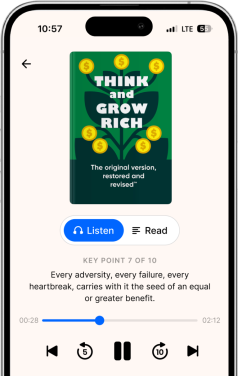
If you don't have time for full books, the Headway app breaks down the main ideas from titles like these into 15-minute summaries. You can listen while doing dishes or walking the dog — no extra time required.
Week 2: Financial literacy
By week two, you've broken the first-week jitters. Now, it's time to get curious about your money.
Your actions this week:
Look at your bank statements from last year. Where did your money actually go?
Identify your top three "leak" categories (Dining out? Subscriptions? Impulse buys?).
Calculate how much you spent on things that you can't even remember buying.
Here is where financial education becomes incredibly valuable. Books like 'The Psychology of Money' by Morgan Housel or 'Rich Dad Poor Dad' by Robert Kiyosaki change how you think about earning, saving, and growing money.
You don't need to become a finance expert overnight. But understanding basic concepts, like why an emergency fund matters or how overspending today can impact your future, can shift your entire perspective.
Headway's library includes summaries of the most popular finance books, so you can absorb these ideas without committing to 300-page reads.
Week 3: The mid-month slump
Truth be told, week three is when people quit. The novelty has worn off. The weather's cold. You're tired of eating at home. And that pair of boots you've been eyeing is finally on sale...
This feeling is normal. Expect it. Plan for it.
Your actions this week:
Track every dollar you didn't spend. Seeing the number grow is motivating.
Find free activities that genuinely interest you. Don't just "go for a walk" just because, do something you'll actually enjoy.
Reach out to friends for low-cost hangouts. A potluck dinner beats an expensive restaurant.
Remind yourself why you started.
This time is also when gamification helps. Some people keep a "savings jar" where they physically add cash every time they skip a purchase. Others use apps to track their progress. The Headway app has streaks and achievements that give you that same sense of accomplishment — except instead of buying something new, you're learning something new.
Week 4: Future proofing
You made it to the final stretch. This milestone is where you can plan what happens after the challenge ends.
Your actions this week:
Decide which spending rules you want to keep permanently.
Set up automatic transfers to your savings or emergency fund.
Make a short list of purchases that you'll allow yourself in February (if you still want them).
Reflect on what you learned about yourself this month.
Now is the perfect time to read about long-term wealth building. Titles like 'I Will Teach You To Be Rich' by Ramit Sethi or 'The Intelligent Investor' by Benjamin Graham give you a roadmap for what comes next.
The goal isn't to never spend money again. It's to spend with intention instead of on autopilot.
The 7 tips to actually finish the no-spend challenge
Need a quick reference? Here are seven things that make the difference between quitting and crushing it:
Use the 72-hour rule: Before any purchase, wait three full days. If you still want it after 72 hours, reconsider. Most of the time, you'll forget about it.
Calculate your hourly rate: Before buying something, figure out how many hours you worked to earn that money. A $50 dinner might equal three hours of your life. Is it worth it?
Audit your subscriptions: You're probably paying for streaming services, apps, or memberships you haven't used in months. Cancel the ones you don't actively use.
Meal planning saves everything: Plan your meals on Sunday and shop once. This practice prevents expensive last-minute takeaways and keeps you out of the grocery store (where impulse buys happen).
Turn your commute into a classroom: Instead of browsing shopping apps on the bus or train, read or listen to a book summary using the Headway app. You'll arrive smarter and without a cart full of things you didn't need.
Shop second-hand when you truly need something: If something breaks or wears out, check thrift stores or online resale sites before buying new. You'll spend less and still get what you need.
Tell someone about your challenge: Accountability works. When a friend knows you're doing No-Spend January, you're less likely to quietly cave and pretend it never happened.
What about self-care?
This part is where people get nervous. "But I need my spa treatments!" Or: "My gym membership is self-care!"
Here's a reasonable approach: if something genuinely supports your mental or physical health, it's probably okay to keep. A gym membership that you actually use? Keep it. Monthly massages that help you manage stress? Maybe worth it.
But be honest with yourself. Scrolling through Walmart under the guise of "treating yourself" isn't self-care. Buying new clothes because you're bored isn't self-care. Real self-care often costs nothing: a good night's sleep, time with friends, a quiet walk, or learning something that makes you feel more capable.
Can No-Spend January backfire?
Yes, if you approach it wrong.
Some people restrict themselves so much in January that they go on a spending spree in February. Others use the challenge as an opportunity to punish themselves rather than learn from it. And some folks focus so much on deprivation that they miss the real benefit.
The point isn't to hate yourself for spending money. The point is to become more aware of why you spend and how you could spend more wisely.
If you catch yourself feeling miserable, step back. This challenge is supposed to be a reset, not a punishment. Adjust your rules if you need to. A slightly flexible challenge you complete is better than a rigid one you abandon.
What to do with the money you save
Let's say by the end of the month you have an extra $200, $500, or even $1,000. What then?
A few smart options:
Start or add to your emergency fund. Three to six months of expenses is the standard goal.
Pay down high-interest credit card debt.
Set it toward a specific goal, such as a trip, a course, or something meaningful.
Invest it, even a small amount, and let it grow over time.
Just avoid letting it sit there until you spend it on random stuff in February. Give your savings a purpose before the month ends.
Build a habit that lasts longer than January with Headway
Saving money for one month is good. Changing your relationship with spending is better.
Here's the real win: by February 1st, you won't just have more cash in your account. You'll understand your bad habits. You'll know which purchases actually made you happy and which were just instant gratification. And you'll have filled some of that "shopping time" with something that made you smarter.
Whether you spent January reading about money, listening to book summaries on Headway, or just sitting with your thoughts instead of clicking "buy now," you grew.
That growth compounds. Just like interest in a savings account. And just like how knowledge builds on knowledge.
📘 So yes, do the challenge. Save the money. But don't stop there. Use this month to upgrade how you think, not just how you spend.
Frequently asked questions about no-spend January
What is the No-Spend January trend?
No-Spend January is a yearly challenge where people commit to buying only their bare necessities for the entire month. It started as a way to recover from holiday overspending but has grown into a popular method for resetting spending habits, saving money, and building better awareness around how and why you make purchases.
What are the rules of no-spend in January?
The basics are simple — only pay for what you need: bills, groceries, healthcare, and commuting. Try to survive without restaurants, shopping, and unused subscriptions. Skip the "I deserve it" shopping: coffee runs, delivery, late-night Amazon orders, and subscriptions you don't use. You can customize the specific rules, but being stricter from the start usually leads to better results.
How do I not spend money in January?
Start by removing any temptations. Unsubscribe from promotional emails, delete shopping apps from your phone, and remove saved payment info from websites. Plan your meals each week, so you avoid ordering takeaways. Fill your free time with low-cost activities, such as reading, exercising, learning something new, or spending time with friends at home.
What is the 3-6-9 rule of money?
The 3-6-9 rule refers to emergency fund targets based on months of living expenses. Three months is the minimum safety net. Six months gives you a comfortable cushion. And nine months provides strong financial security. No-Spend January can help you jumpstart building toward these savings goals by freeing up extra cash.
Who is the no-spend challenge for?
The challenge works for anyone who feels like their spending runs on autopilot. It's especially helpful if you're carrying credit card debt, feeling stressed about money, or wanting to break the cycle of impulse purchases. You don't need to be in financial trouble — a spending reset benefits people at every income level.
Can No-Spend January be counterproductive?
It can — especially if you treat it like a punishment or end up splurging the second February (or Valentine's Day) rolls around. The goal isn't extreme restriction; it's about changing your habits. So give yourself some flexibility when you need it, and pay more attention to what the challenge teaches you about your spending patterns — not just what you're saying no to.