Self-growth
 Business & Career
 Success
 Communication
 Healing
 Relationships
 Psychology
 Happiness
Most of us have been taught that chasing a big goal requires a dramatic, life-altering leap, but the truth is far more subtle. Success is actually built on microskills.
We often obsess over "reinventing ourselves," yet real personal development rarely happens in a single moment of transformation. Instead, it's the tiny, trainable skills — the way you phrase a question or how you manage the first sixty seconds of a meeting — that shape your trajectory.
If you've ever felt overwhelmed by the sheer scale of the change you want to see in your professional life, it's time to stop looking at the mountain and start looking at the individual steps. Once you master the small, the big becomes inevitable.
📘 Knowledge is only powerful when you use it. Download Headway now to find microskills you can apply to your own life right away.
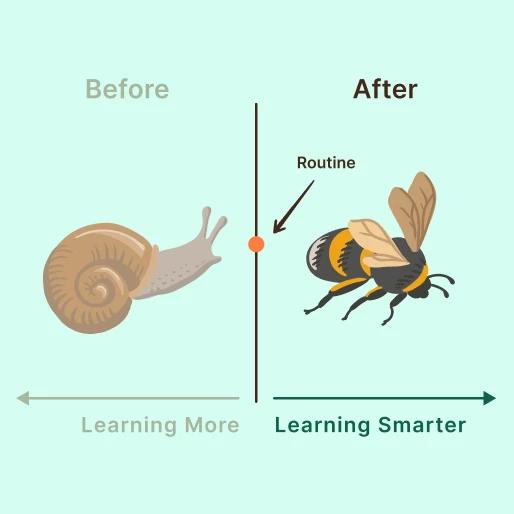
Unlock your daily growth superpower
Transform your routine to fuel continuous learning and effortless improvement.
Let's startQuick answer: What are microskills?
Microskills are specific, small-scale, and learnable units of competence that serve as the foundation for larger capabilities. Examples include active listening, giving concise feedback, maintaining eye contact, and time-blocking. Mastering these tiny building blocks is the most effective way to achieve rapid self-improvement and long-term career success.
What are microskills? A closer look
If you look at any major professional development milestone, it's usually just a bunch of tiny wins stacked on top of each other. That's essentially what microskills are: the specific, bite-sized building blocks that make up a larger capability. Take "negotiation," for example. It's a huge, complicated skill. But the ability to stay silent for five seconds after someone gives you a price? That's a microskill.
A common mistake is confusing microskills with habits. While habits are things you do on autopilot, like grabbing your keys before you walk out the door, microskills are deliberate. You choose to use them to get a specific result. They are the tactical tools you keep in your personal development kit.
Think of it this way: a macro skill is the finished Lego castle, while the microskills are the individual bricks. You can't have the castle without the bricks, and once you master a specific brick, like a communication skill, you can use it to build entirely different things in other areas of your life. It's about breaking down the "big and scary" into things you can actually practice during your lunch break.
Why microskills matter: The compounding effect
The reason most people burn out on self-improvement is that they try to change everything at once. But the science of the compounding effect shows that getting just 1% better in a few small areas leads to significant results over time. This is especially true for people in an early career slump. If you improve your eye contact by a fraction or learn to pause before a decision-making moment, those tiny shifts add up.
Consider the "forgetting curve." If you go to a weekend-long seminar, you'll likely forget 90% of it by Tuesday. But practicing a single microskill for five minutes a day tends to stick. Research shows that micro-practice can improve information retention by 20–30%. The question isn't how much you learn. It's how much of it actually stays with you.
In healthcare, for example, medical students don't just "become doctors." They spend years perfecting specific tasks, like suturing or listening to heart sounds. These are the building blocks of their professional competence. When you focus on small wins like these, you stop feeling overwhelmed and start seeing real, measurable progress.
📘 You're only 15 minutes away from a smarter you. Stop scrolling and join millions of learners on Headway and start working toward your big goals with microlearning.

Microskills examples: Small skills that make a big difference
It's easy to say you want to improve your communication skills, but that's too vague to actually practice. You need to get specific. High performers aren't just "good at talking." They've mastered dozens of tiny behaviors and habits.
Here are some microskills that can make a real difference in your professional life and personal wellness:
Verbal communication: Practice the "power of the pause." Before answering a tough question, wait two seconds. It makes you look thoughtful and in control.
Body language: Instead of just standing there, try "angling" — pointing your torso slightly toward the person you're talking to. It shows you're actually present.
Mental health and self-care: Try a "shutdown ritual." It's a two-minute routine where you close your laptop and physically move to a different room to prevent burnout.
Productivity: The "2-Minute Rule." If a task takes less than 120 seconds, do it immediately instead of adding it to a list.
Career: Write a "bottom-line-up-front" email. Put the most important information in the first sentence so people don't have to hunt for it.
Wellness: Mindful breathing during transitions. Take three deep breaths every time you switch from one task to another to protect your well-being.
How to develop microskills: A simple framework
Most people fail at self-improvement because they try to do too much at once. If you want to actually see results, you need a system that doesn't feel like a second job. You can listen to every self-help podcast on the planet, but if you don't break the advice down, it's just noise.
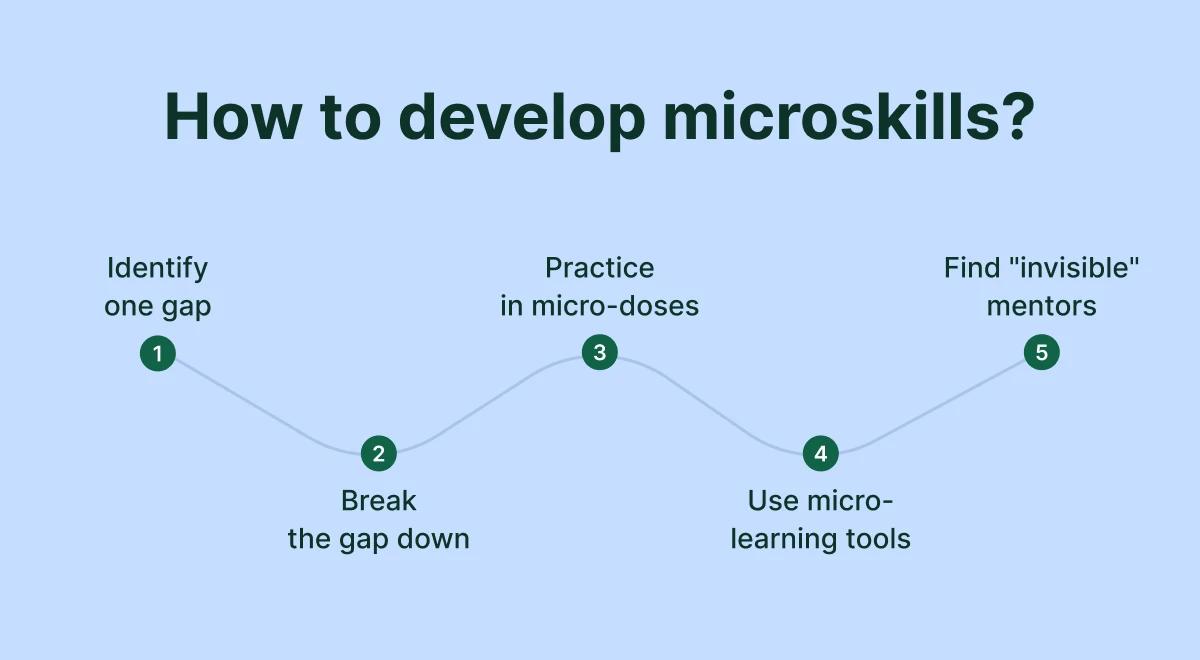
Break down your path to success using these science-backed ideas.
Identify one gap: Think about where you feel the most friction. Is it your verbal communication during meetings? Pick one tiny thing to fix.
Break it down: If you want to be better at networking, your microskill shouldn't be "talk to everyone." It should be "ask one follow-up question that starts with how or what."
Practice in micro-doses: Spend just five minutes a day on this. Whether you're in healthcare or tech, the goal is repetition over duration.
Use microlearning tools: Don't wait until you have a free hour to learn. Use a book summary app to grab a single tactic from a bestseller while you're standing in line for coffee.
Find "invisible" mentors: You don't need a CEO to sit down with you for an hour. Observe people who are good at the skill you want. Watch their body language and literally copy one thing they do.
📘 Great leaders are built in the small moments. Use Headway to refine your communication skills and body language, one 15-minute summary at a time.
Real growth: What the Headway community says
Talking about microskills in theory is one thing. Seeing how they play out in someone's actual life is another. Thousands of learners have used Headway to turn tiny gaps in their day into real progress. Deyvis, a leadership coach, found that microlearning completely shifted how he handles his daily schedule.
The results extend beyond just reading more. It's about building a new relationship with how you learn. One user put it simply:
"My experience in Headway is pretty straightforward. I'm there to read insights and move through them quickly."
That consistency is its own microskill. By showing up for just a few minutes at a time, members of the Headway community are seeing a real compounding effect on their wellbeing and career.
Build your first microskill with the Headway app!
At the end of the day, you don't need a life overhaul to get where you want to go. Real change is a collection of microskills practiced consistently. Whether you're trying to move up in your early career or just want better mental health, the answer is almost always to go smaller.
That's exactly why we built Headway: We know you don't have all day to sit through a three-hour seminar or read a 400-page book on professional development. Our microlearning app gives you the core ideas from the world's best nonfiction in bite-sized portions that you can actually use right away.
You can master a new decision-making framework or a stress-relief technique in the time it takes to brush your teeth. It's one of the simplest ways to turn your spare moments into lasting growth.
📘 Download the Headway app today and start mastering your first microskill in under 15 minutes!
FAQs about microskills
What are microskills?
Microskills are the tiny, specific pieces of a larger ability that you can actually practice. Instead of trying to master broad professional development overnight, you focus on small things like asking follow-up questions or keeping eye contact. These small building blocks make a complicated task feel much easier to handle and lead to better results in your professional life.
What are examples of microskills?
You can find these small tactics in every area of your personal development. Some people focus on verbal communication, like using a pause before speaking, while others work on body language to show they are present. In healthcare, medical students might practice specific ways to give feedback. Even tiny self-care routines, like a two-minute breathing exercise, count as microskills.
What five microskills can I learn today?
Try these five moves to support your well-being and career. Start by making purposeful eye contact during your next conversation. Practice a two-minute shutdown ritual to prevent burnout. Use a quick breathing habit for wellness. Try a "bottom-line-up-front" email style for better communication. Finally, ask one follow-up question in every meeting to sharpen your verbal communication.
Do microskills really help?
These small shifts work because they stop you from feeling overwhelmed by a big goal. When you focus on tiny, repeatable actions, your brain builds connections faster. Going small also prevents the mental drain that often comes with ambitious self-help plans. Small repetitions create a lasting impact — especially early in your career.
Can Headway help me with microskills?
Headway is built for learners who don't have time for a long podcast or self-improvement deep dive. Our app takes big ideas from bestsellers and breaks them down into practical pieces. You can listen to a summary to learn a new decision-making trick or a self-care habit. It's one of the easiest ways to practice skills mentors usually recommend.