Self-growth
 Business & Career
 Success
 Communication
 Healing
 Relationships
 Psychology
 Happiness
Aren't you tired of living your life through a screen? Of course you are. When you're spending 5 hours a day on your phone, this digital overload is crushing your ability to focus and enjoy your life.
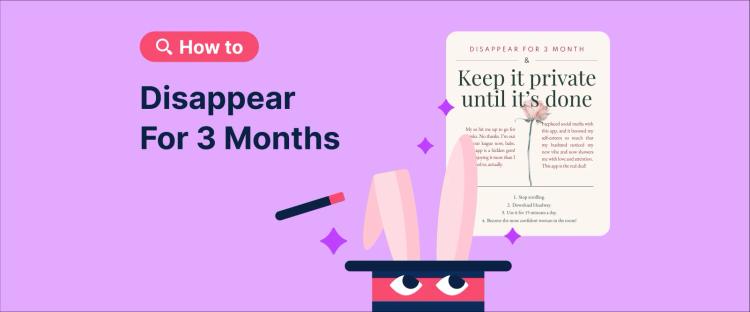
To break this cycle, you need more than a weekend off. It's time to disappear for 90 days by stepping back from the noise and focusing on your self-growth. Learn how to disappear for 3 months and find expert tips on coming back fully recharged.
With practical insights from bestsellers like 'Deep Work' and 'Think Like a Monk,' which are available on the Headway app, your life reboot is just one step away. The app gives you 15-minute summaries of these essential books and serves as your pocket coach for daily growth.
Download the Headway app now to stop surviving and start evolving!
Disclaimer: This article is for general guidance and personal growth only. We recommend consulting with a professional before making significant lifestyle changes.
Your 90-day reset checklist
Here's a snapshot of how you will transform over the next three months. This approach combines psychology with practical habits from top nonfiction books:
| Phase | Duration | Key activity | Book guide |
|---|
1. Detox | Days 1–7 | 90-minute deep work blocks | 'Deep Work' |
2. Reorient | Weeks 2–4 | Tech audit & deleting apps | 'Digital Minimalism'' |
3. Rebuild | Months 2–3 | Purpose journaling | 'Man's Search for Meaning' |
4. Return | Week 12 | Screen-free meals | 'Ruthless Elimination of Hurry' |
5. Engage | Week 13+ | Daily gratitude | 'Think Like a Monk' |
Print this mental checklist out and keep reading for the complete 90-day plan!
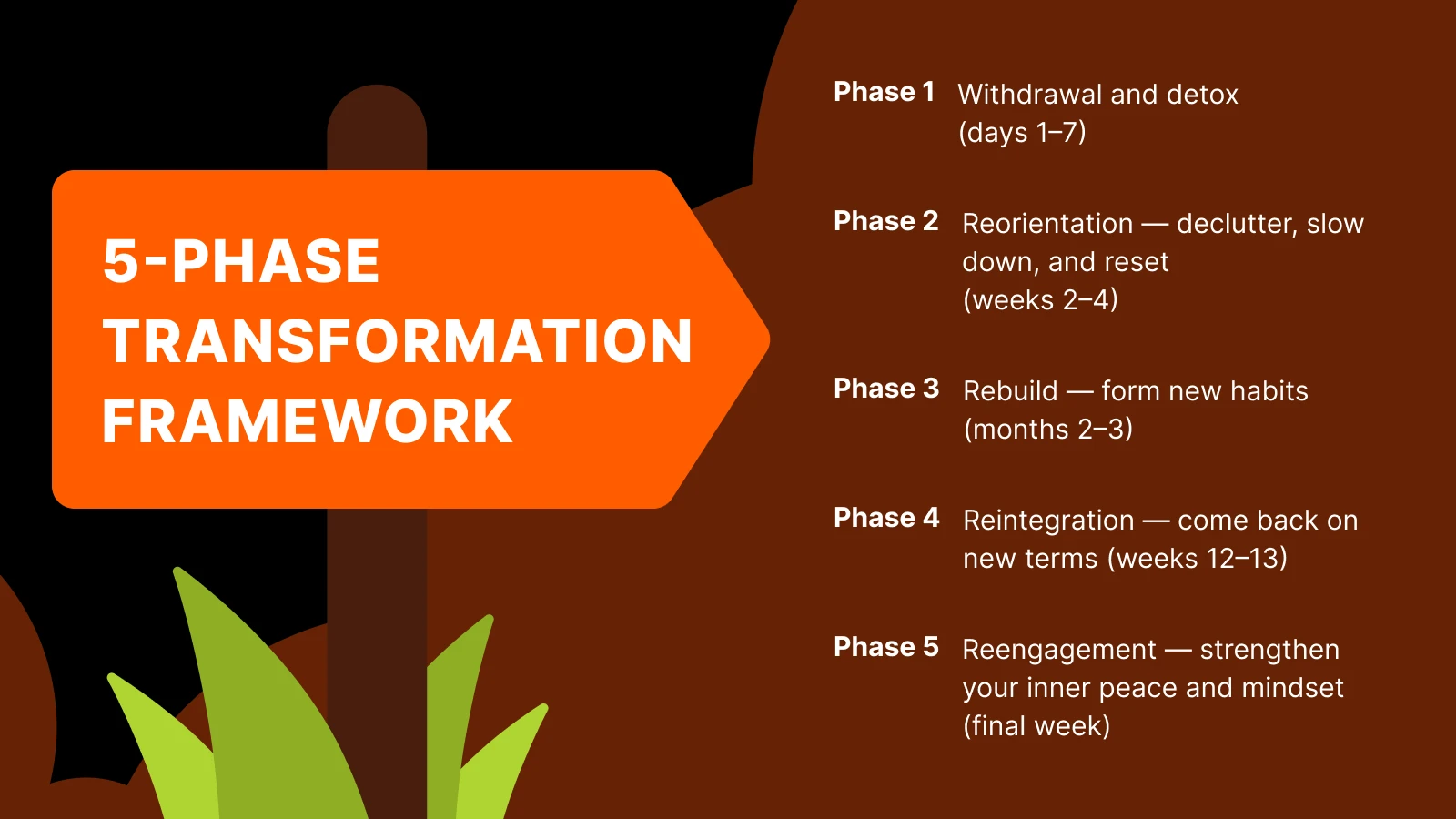
The "disappear and return" framework: Your 5-phase transformation plan
Here's your structured retreat plan designed to dismantle bad habits and rebuild your focus brick by brick. We have divided this journey into five distinct phases, with each one guided by a key concept from a bestselling nonfiction book to help you transform.


Phase 1: Withdrawal and detox (days 1–7)
Goal: Disconnect and begin mental or physical detox.
The first week is the hardest. Your brain is used to constant stimulation. When you take that away, you might feel bored or anxious. This feeling is normal. Your goal here is to stop the flow of digital noise and learn how to stop scrolling addiction for good.
In his book 'Deep Work,' Cal Newport explains that high-quality work and thought require sustained, uninterrupted focus. You must not think deeply if you check your phone every 10 minutes.
Exercise: The 90-minute focus block
Turn off your phone and put it in another room.
Close all tabs on your computer except the one you need.
Work on one important task or learn a new skill.
Don't let anything interrupt you.
This practice retrains your brain to focus. It shows you that the world won't fall apart if you aren't online.
Phase 2: Reorientation — declutter, slow down, and reset (weeks 2–4)
Goal: Declutter your mind and surroundings, reestablish new priorities.
Once you have started detoxing, you need to look at what remains. What's taking up your time? What's adding value, and what's just noise? Here's where you audit your life.
Cal Newport's 'Digital Minimalism' argues that we should only use technology that supports our values. Everything else is clutter. This phase is about removing the apps, contacts, and habits that drain you.
Exercise: The tech philosophy audit
List every app and digital service you use.
Ask: "Does this add value to my life?"
If the answer is no, delete it.
Delete the phone numbers of toxic people who only bring drama.
Turn off all non-essential notifications.
This practice clears space for personal growth. You aren't just deleting apps; you are making room for your life.
Read the summary of 'Digital Minimalism' on Headway for a full guide on this audit.
Phase 3: Rebuild — form new habits (months 2–3)
Goal: Build sustainable habits and focus routines that align with new values.
Now that you have cleared the clutter, you have a void. You must fill this void with meaning, or the noise will rush back in. This stage is about entering a state of monk mode to achieve your goals through deep focus.
Viktor Frankl's 'Man's Search for Meaning' teaches us that humans are driven by a need for purpose. Without a clear "why," we drift. You need to define what matters to you.
Exercise: Morning purpose journaling
Ask yourself: "What makes today meaningful?"
Write down one thing you want to accomplish that aligns with your values.
Reflect on what you are grateful for.
This anchors your day in purpose. It prevents you from reacting to the world and helps you act with intention.
Phase 4: Reintegration — come back on new terms (weeks 12–13)
Goal: Gradually return to work and social media with boundaries in place.
You cannot stay hidden forever. Eventually, you have to return to the world. But you don't have to return to the rush. You can choose a slower, more intentional pace.
John Mark Comer's 'The Ruthless Elimination of Hurry' explains that hurry is the enemy of a spiritual and healthy life. You can be busy without being in a hurry.
Exercise: The slow living meal
Sit down at a table.
Put your phone away.
Eat slowly and taste your food.
If you are with others, talk to them. If you're alone, just be.
This plan sounds simple, but it breaks the habit of rushing. It teaches you to enjoy the moment.
Phase 5: Reengagement — strengthen your inner peace and mindset (final week)
Goal: Develop a deeper sense of purpose and maintain emotional balance as you return to daily life.
The final phase involves solidifying your new mindset. You want to ensure that when you see your friends or go back to the office, you don't lose your peace. You want to think like a monk, even in the city.
Jay Shetty's 'Think Like a Monk' offers tools to overcome negative thoughts and access the calm that lies within us.
Exercise: The gratitude routine
Before you sleep, think of three things you are grateful for.
Visualize the people who helped you today.
Send a silent "thank you" to them.
This routine shifts your focus from what you lack to what you have. It builds a shield of positivity around your mind.
Read the summary of 'Think Like a Monk' on the Headway app to deepen this practice.
Why it's time to disappear for 90 days
The world is louder than ever. We're bombarded with notifications, emails, and demands every hour of the day.
This constant stimulation keeps our brains in a state of high alert. We rarely get a moment of true silence.
And that's why a short break isn't enough. A weekend away is nice, but it doesn't change your brain. It takes time to break bad habits and build new ones.
Ninety days is the sweet spot. It is long enough to reset your dopamine levels and short enough to be a realistic goal.
When you disappear, you aren't running away. You're stepping back to see the big picture. You're choosing to focus on your own voice rather than on others' opinions.
You're deciding that your mental health is more important than your feed.
The science behind detox, slowdown, and deep work
Why does this work? It comes down to how our brains handle dopamine. When we constantly check social media or the news, we flood our brains with cheap dopamine.
Over time, we become numb to simple joys. We need more and more stimulation just to feel normal.
Research shows it takes about 66 days to form a new habit. A 90-day plan covers this and gives you extra time to adjust. It's easier to stick with than a strict six-month plan, but still powerful enough for real change.
Detox alone isn't magic. If you just sit in a room for 90 days, you might struggle. You need to replace the bad habits with good ones.
That's why podcasts about growth or reading summaries are vital. They give your brain healthy food to digest while it heals.
What "coming back" looks like
When you finish these 90 days, you won't be the same person. You'll notice that you are calmer. The urgency to check your phone will be gone. You'll also be able to sit through a conversation without looking for an exit.
This transformation is powerful for everyone, but it resonates deeply as a guide for those who want to disappear and come back stronger, helping them rebuild confidence and clarity.
Instead of clicking "show more" on a video you don't care about, you'll close the tab. Instead of letting playback run on auto, you'll choose what to watch.
Make your self-growth journey easier with Headway book summaries
Now that you know why it's time to disappear for 90 days to fully restart your life, you need a toolkit to keep you going. After all, a three-month plan is a big commitment! And that's where Headway helps you out.
The app offers text and audio summaries of nonfiction bestsellers, turning them into microlearning lessons for your daily growth. You can get the core ideas in 15 minutes, rather than flipping through the 300-page book, which is perfect for busy lifestyles.
Download the Headway app today and start your phase 1 detox with the top self-improvement expert hacks.
Good luck on this journey — it's worth it!
FAQs
What is a good quote about disappearing?
A powerful quote often attributed to various thinkers is, "Sometimes you have to disconnect to stay connected." It reminds us that stepping away from the noise allows us to reconnect with ourselves and what truly matters. It validates the need for solitude in a busy world.
What is the 90-day theory?
The 90-day theory suggests that three months is the ideal timeframe to set and achieve a significant goal or change a lifestyle. It's long enough to build lasting habits and see tangible results, but short enough to stay motivated and see the finish line.
Is it true that it takes 90 days to break a habit?
While popular psychology often cites 21 days, research from University College London suggests it takes an average of 66 days to form a new habit. Therefore, the 90-day period provides a solid buffer to ensure a new behavior truly sticks and effectively replaces the old one.
How long will it take to change my life?
Significant life change doesn't happen overnight. However, committing to a focused plan for 90 days can create a massive shift in your trajectory. You will see improvements in your mood and focus within weeks, but the deep, lasting transformation usually solidifies around the three-month mark.
How do I disappear completely and transform?
To disappear and transform, you must cut out distractions. Delete unnecessary apps, limit social contact to a supportive circle, and commit to a daily self-improvement routine. Use tools like the Headway app to learn new skills and stay focused on your goals during this period.