Self-growth
 Business & Career
 Success
 Communication
 Healing
 Relationships
 Psychology
 Happiness
Are you scrolling through app stores, hoping to find something that finally sticks? Then, most likely, two apps keep popping up, both promising to help you grow without reading full books. Simply put, the Imprint vs Blinkist debate comes down to one thing: which app actually helps you remember what you read?
Imprint focuses on visual learning with interactive graphics and spaced repetition. Blinkist serves up 15-minute summaries from more than 9,000 nonfiction books. Here's a detailed review of both apps to help you make the right choice.
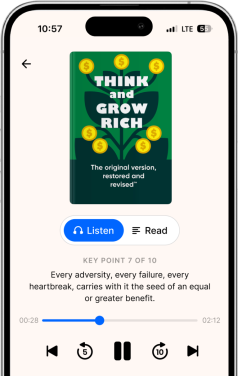
And if you want to grow and feel more in control, but life keeps getting in your way, try Headway. It fits into busy days and helps you build progress with bite-sized insights from bestselling books on topics like personal growth, leadership, and discipline. You also get personalized recommendations that are tailored to your goals and progress tracking to keep you moving forward.
Get the Headway app for daily growth and turn idle moments into learning opportunities!
Quick summary: Blinkist vs Imprint at a glance
| Feature | Imprint | Blinkist |
|---|
Content focus | Visual learning with graphics | Text and audio summaries |
Library size | 1,000+ topics across multiple subjects | 9,000+ nonfiction books |
Price | $100/year or $16/month | $100/year or $16/month |
Best for | Visual learners who like interactive content | Readers wanting quick key takeaways |
Unique feature | Spaced repetition quizzes for retention | Shortcasts — podcast-style content |
Keep reading for a detailed breakdown of features, pricing, and which app matches your learning style!
The Imprint app review: Content, features, and pricing
App Store rating: 4.8/5
Google Play Store rating: 4.4/5
Imprint takes a different approach to learning. This app uses colorful graphics, animations, and bite-sized lessons to teach you complex ideas in minutes.
How Imprint delivers content
Open the app, and you'll see topics organized into short lessons. Each lesson takes 5–10 minutes and uses visual storytelling to explain concepts. Instead of reading paragraphs, you swipe through animated screens that break down ideas step by step.
These topics range from psychology and philosophy to health and productivity. Want to grasp cognitive biases?
Imprint shows you visual examples of how these biases play out in real life. The app makes abstract concepts feel concrete through graphics and simple explanations.
Unique features that set Imprint apart
Spaced repetition sets Imprint apart from other educational apps. The app brings back information at specific intervals to help you with retention. After finishing a lesson, you'll get quizzes days or weeks later. This method helps move information from short-term to long-term memory.
The visual approach works well for visual learners who struggle with text-heavy content. Instead of reading about a concept, you see it illustrated. The graphics stick in your mind longer than plain text does.
Imprint app cost: Pricing and subscription plans
Is Imprint app free? How much does Imprint cost? Those are the most common questions before any subscription activity. The app offers a 7-day free trial to test the app. After that, you'll pay $100 annually or $16 monthly. The annual plan saves you over $90 compared to the monthly option.
The subscription unlocks all lessons, courses, and quizzes. No tiers or premium levels — one price gets you everything. Compared to other learning apps, Imprint sits on the affordable end.
User experience on Imprint
The interface feels polished and modern. Navigation stays simple — swipe through lessons, tap to answer quizzes, and track your progress on the home screen. The app works smoothly on both iOS and Android devices.
Some users mention wanting more depth. The 5–10-minute lessons cover main ideas without going too deep. If you want a comprehensive analysis, you'll need to look elsewhere. Imprint prioritizes quick learning over thorough explanations.
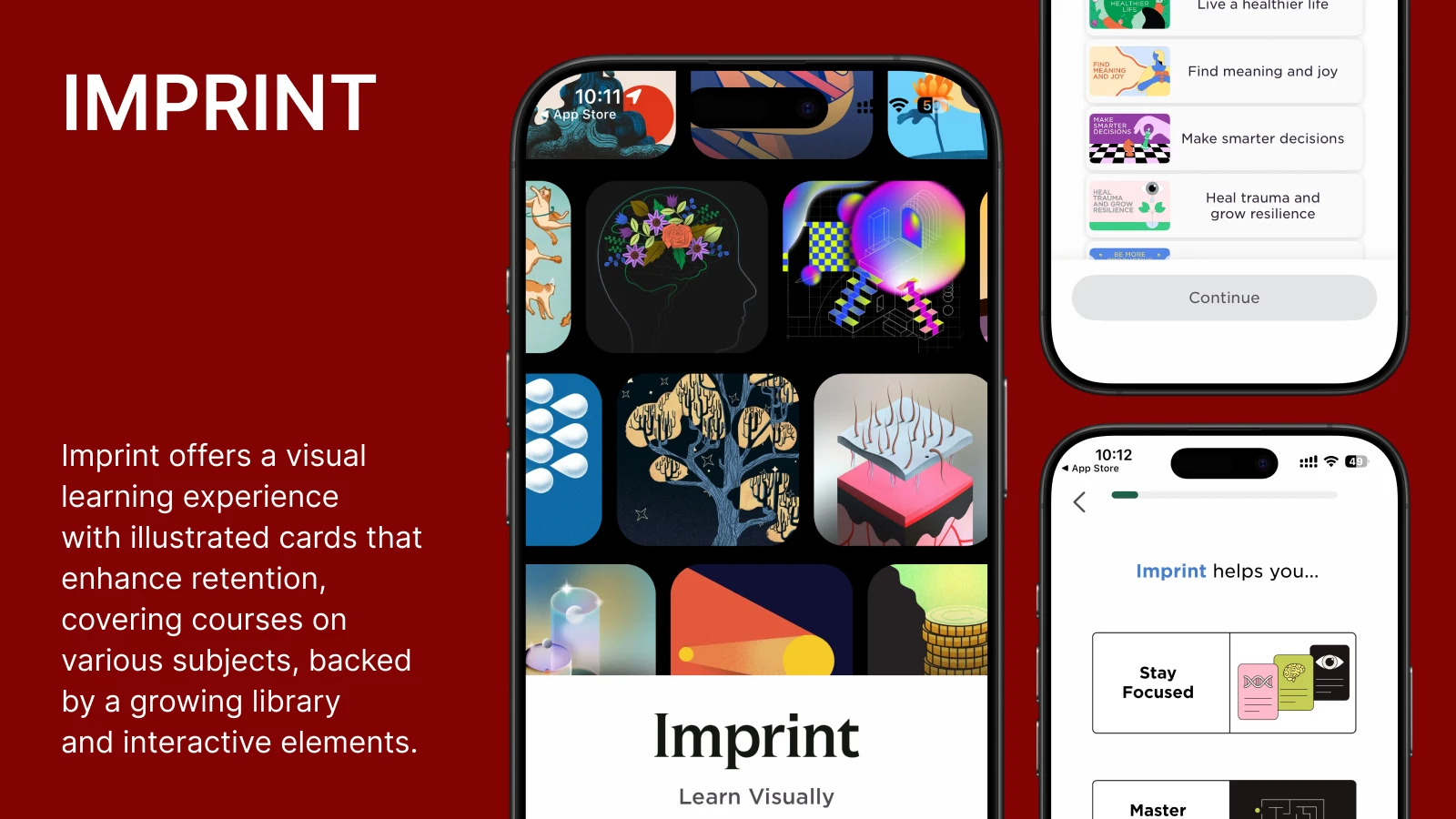
The visual format also makes learning feel less like work. You're not staring at walls of text. The animations and graphics keep your attention, making it easier to finish lessons.
📘Want something different? Try Headway for daily growth!
Is Blinkist worth it? A detailed look into the app
App Store rating: 4.8/5
Google Play Store rating: 4.6/5
Blinkist has been around since 2012, making it one of the original book summary apps. The platform turns bestsellers into 15-minute reads called blinks.
How Blinkist works
Each blink breaks down a book into key insights and core ideas. You can read the text version or listen to audio summaries. Most blinks take 15 minutes to read or 20 minutes to listen to.
The app covers many topics like business, self-help, psychology, and health. New titles get added weekly, keeping the library fresh. Blinkist offers both classic bestsellers and new books shortly after publication.
Shortcasts add another dimension. These podcast-style audio pieces feel more conversational than standard narrations. Perfect for walks or commutes when you want something engaging.
What makes Blinkist stand out
The library of more than 9,000 titles gives you endless options. Want to sample five books on habit formation before deciding which full book to read? Blinkist makes that possible in under two hours.
Personalized recommendations help you find relevant content. The app learns your interests and suggests blinks that match your goals. Collections curated by an expert group of books around trending topics or specific challenges.
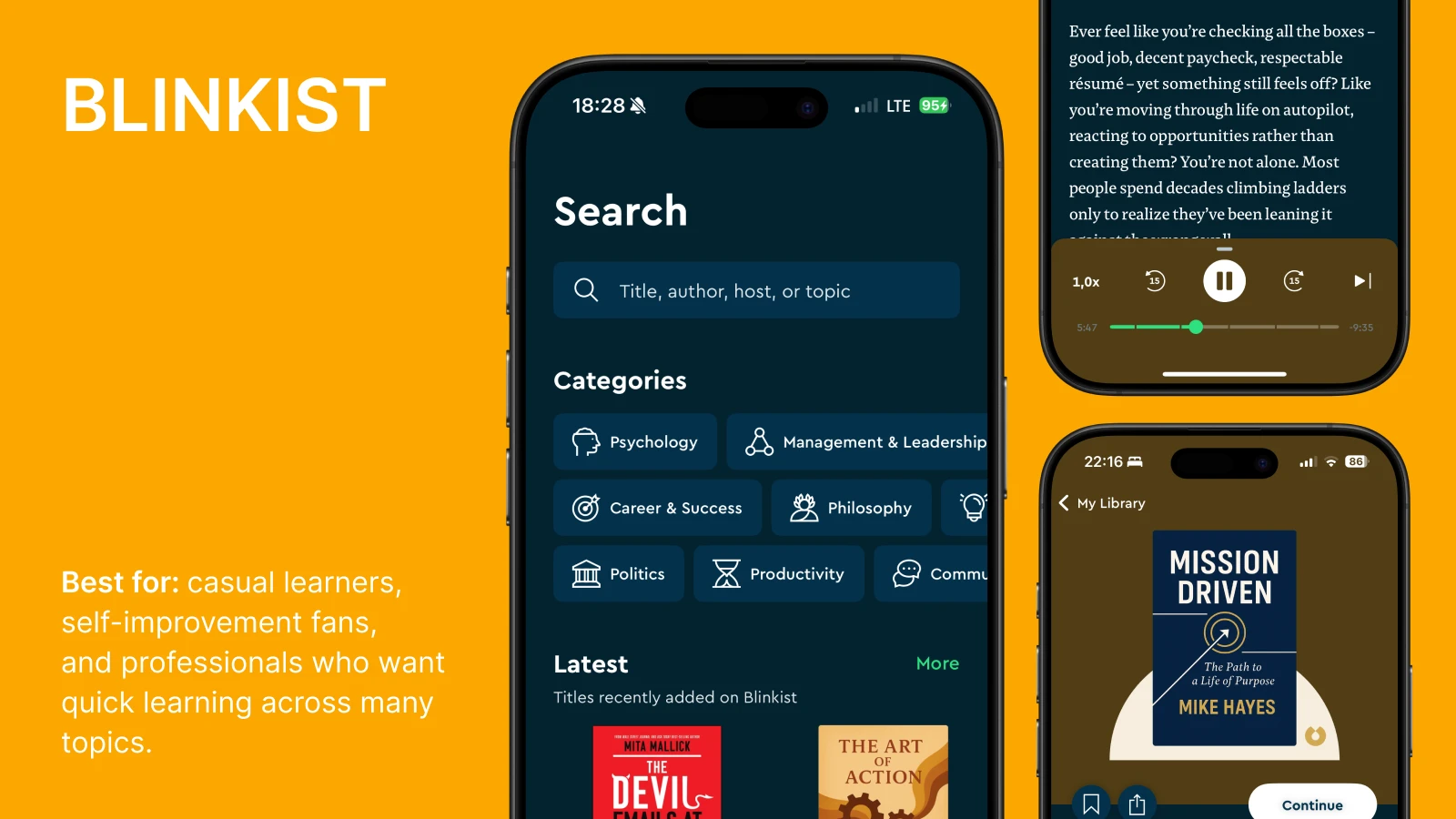
The user-friendly interface makes navigation effortless. Search for specific books, browse by category, or check your daily pick. Audio versions play seamlessly with adjustable narration speed. The reading experience stays consistent across devices.
Blinkist pricing structure
Blinkist offers a 7-day free trial for new users. The premium plan costs $100 annually or $16 monthly. The annual plan works out to $8.3 per month — a solid value if you use it regularly.
Premium unlocks the entire library of blinks and shortcasts. And there are no limits on how many summaries you can read or listen to. Occasional promotions drop the annual price even lower, making it worth watching for deals.
Compared to buying books on Kindle at $10–15 each, Blinkist offers significant savings. When you read summaries of over 50 books each year, the subscription pays for itself.
Blinkist user experience
The mobile app opens to a clean homepage with your daily pick and personalized suggestions. The design feels intuitive — even first-time users navigate efficiently.
Some users mention that summaries feel too brief. You get key points without much context or supporting stories. For many learners, that's exactly what they need — just the essentials.
Others wish for more depth, similar to what you'd find in bite-sized learning platforms that offer slightly longer formats.
📘Don't stop on one app. Try Headway!

Comparing Imprint and Blinkist side by side
Both apps solve the same problem — helping you grow without spending hours on full books. They just take completely different approaches. Here's how they stack up across what matters most.
Content depth and learning approach
Imprint uses visuals and animations to teach concepts. Each lesson runs 5–10 minutes and breaks down one specific idea. The app focuses on helping you understand and remember through graphics and spaced repetition quizzes.
Blinkist extracts key takeaways from entire books. You get the main ideas and key points in 15 minutes. The summaries skip most examples and stories, giving you concentrated insights.
The learning process differs significantly. Imprint feels like an interactive course. Blinkist feels like reading a condensed version of a book. Neither replaces the entire book, but both save time.
Library size and content variety
Blinkist wins on quantity, with its collection holding over 9,000 titles across multiple genres. The library includes books about business classics, self-help bestsellers, and psychology research. New books get added regularly, keeping their content current.
Imprint offers around 1,000 topics organized into lessons and courses. The selection covers broad subjects like philosophy, science, psychology, and health. The library grows slower than Blinkist's, but each piece is carefully designed with custom graphics.
If you want variety and options, Blinkist delivers. If you prefer curated content with strong visual design, Imprint fits better.
Retention and learning outcomes
Imprint focuses on spaced repetition. Quizzes test your memory days after completing lessons. This active recall strengthens long-term memory better than passive reading.
Blinkist relies on you to remember what you read. The app doesn't include quizzes or retention tools. Note-taking features help, but you'll need to create your own system for remembering key insights.
Research shows that spaced repetition improves retention significantly. If remembering what you read matters most, Imprint's approach gives you an edge. If you just want exposure to ideas, Blinkist works fine.
Mobile app experience and ease of use
Both apps work smoothly on iOS and Android. Blinkist feels slightly more polished with its clean design and seamless audio playback. The interface stays consistent and predictable.
Imprint's visual approach makes it more engaging but slightly more complex. You're swiping through animated screens rather than scrolling text. Some people find this more fun, others prefer simpler text.
Audio summaries on Blinkist use professional narrators, making listening comfortable for long periods. Imprint doesn't focus on audio — the visual format works best on screen.
Pricing and value comparison
Imprint costs $100 yearly or $16 monthly. Blinkist also runs $100 annually or $16 monthly. Both offer 7-day free trials.
At first glance, the cost is similar. But Blinkist offers nearly five times as many titles. The cost per piece of content favors Blinkist significantly.
Value depends on what you care about. If retention and visual learning matter most, Imprint's lower price makes sense. If you want maximum variety and flexibility, Blinkist's larger library justifies the higher cost.
📘Get insights without the reading guilt, download the Headway app!
Real user experiences with Imprint and Blinkist
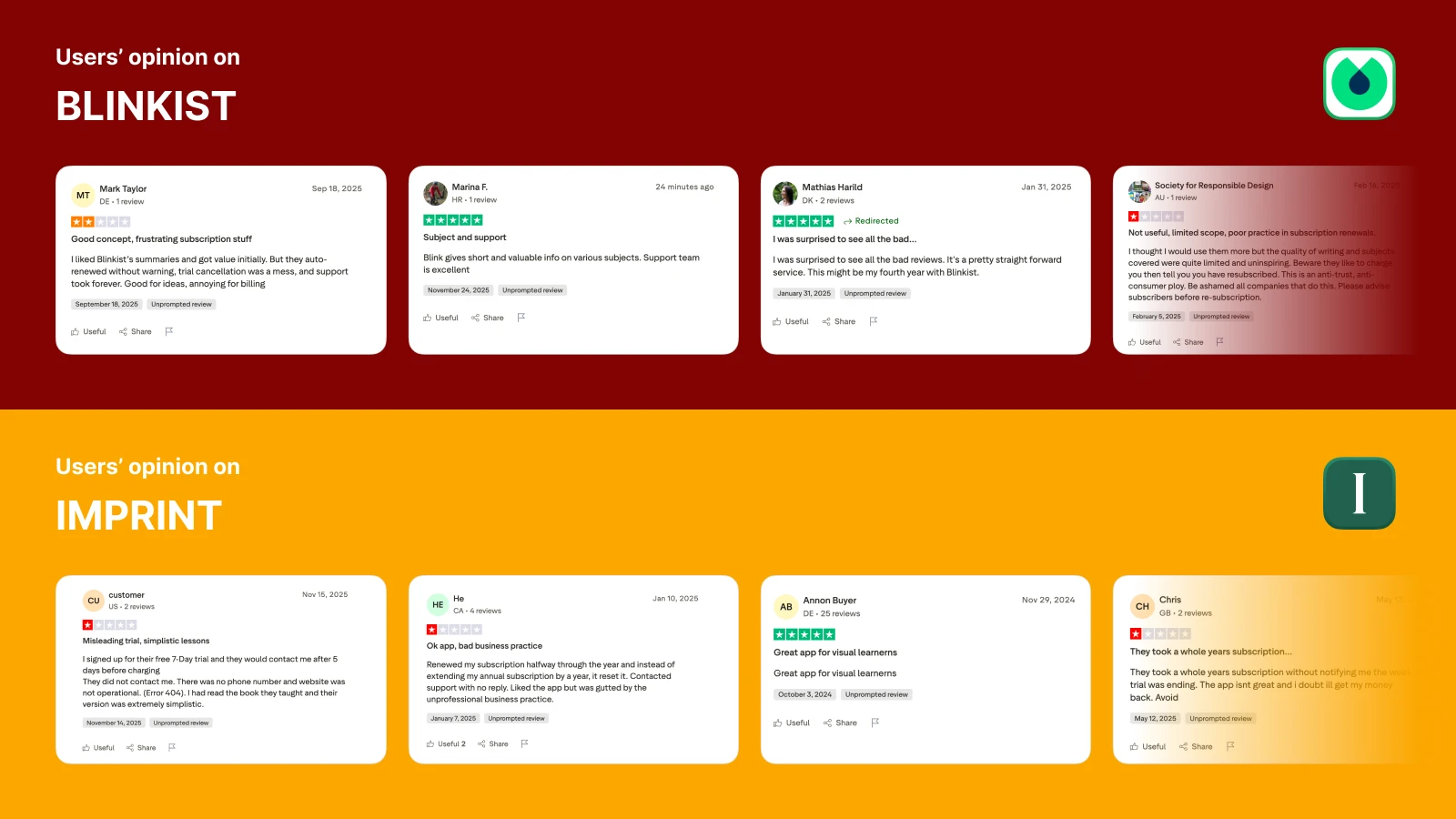
Is Imprint worth it? Is Blinkist a good investment? Actual reviews on Trustpilot reveal how these apps perform in daily life. Some users praise both apps for interactivity, while others point out buggy interfaces and counterintuitive subscription models:
The pros and cons you need to know before hitting "download"
Every subscription comes with trade-offs. Here's an honest look at what each app delivers and where it falls short.
Imprint reviews: Advantages and limitations
Pros:
Visual format makes complex topics accessible and engaging
Spaced repetition quizzes improve long-term retention
Courses provide structured learning paths
Clean, modern interface works well on mobile
Perfect for visual learners who struggle with text
Cons:
Smaller library of 1,500 topics compared to competitors
Lessons feel brief for people wanting an in-depth analysis
Limited audio content for people who prefer listening
Technical issues reported on some Android devices
New content appears more slowly than on other platforms
Blinkist strengths and weaknesses
Pros:
Massive library of over 9,000 nonfiction books
High-quality audio narrations with professional voice actors
Shortcasts offer podcast-style content variety
Regular updates with new bestsellers
Works seamlessly across iOS and Android
Cons:
Summaries sometimes feel too brief and lack context
No built-in retention tools like quizzes
Can encourage surface-level learning without deep understanding
Audio narrator quality varies between titles
Monthly plan pricing adds up quickly
The comparison shows clear patterns. Imprint trades library size for retention features. Blinkist trades depth for variety. Your choice depends on whether you value remembering less content or sampling more topics.
📘Explore the Headway app for quick lessons from nonfiction bestsellers!
Other apps worth checking out if you're exploring options
These two apps get most of the attention, but several alternatives offer different approaches to learning. Exploring your options helps you find the right fit for how to learn most effectively.
Headway: The balanced choice for daily growth
Headway combines the best of both worlds. You get quick summaries like Blinkist, but with gamification elements that improve retention like Imprint. Daily challenges, streak tracking, and progress rewards create habits that stick.
The library includes over 2,000 nonfiction books in text and audio formats. Summaries run 10–15 minutes — slightly longer than Blinkist's blinks but shorter than reading full chapters. The app feels modern and motivating with a clean design and smooth navigation.
Pricing sits between Imprint and Blinkist at around $90 annually. Personalized recommendations help you find books that match your goals.
When comparing Headway vs Blinkist and Headway vs Imprint, many users find Headway's approach to habit-building more effective for long-term growth.
📘Test-drive Headway to build your daily growth habit!
12min: The budget-friendly microlearning option
12min offers summaries that take roughly 12 minutes to complete. The app has more than 2,000 summaries available in text and audio formats.
What sets 12min apart is the pricing. Annual plans often run around $48, making it one of the more affordable options. A free tier with limited access lets you test the app before subscribing.
If price matters most and you want access to free microlearning apps, 12min deserves consideration.
Audible: For people who want full audiobooks
Audible takes a different approach entirely. Instead of summaries, you get complete audiobooks narrated by professional voice actors. The subscription gives you credits to purchase full-length books each month.
This app works well if you have longer periods for listening — like long commutes or daily walks. You get the full story, all examples, and complete context. Retention often improves when you hear the entire narrative rather than condensed key points.
Pricing runs around $15 monthly for one credit. Additional books cost extra or use more credits. The investment makes sense if you actually listen to full books rather than letting them pile up unfinished.
📘Find more insights in Headway book summaries!
Making the right choice for your learning goals
The actual value of any learning app depends on how you use it. So, be honest about your habits and preferences before subscribing.
Choose Imprint if you:
Learn best through visuals and graphics
Want help remembering what you read through quizzes
Prefer short 5–10-minute learning sessions
Like structured courses on specific topics
Choose Blinkist if you:
Want access to thousands of book summaries
Need audio versions for commuting or multitasking
Like sampling many books before buying the full version
Prefer 15-minute text summaries over visual lessons
Final verdict: For most people, Blinkist offers better value with its vast library and professional audio narrations. The variety lets you explore dozens of topics and find books worth reading in full.
Imprint wins if you're a visual learner who struggles with retention — the spaced repetition quizzes actually help information stick. But if you want maximum flexibility and content options, Blinkist is worth the extra $40 yearly.
📘Start making change with Headway!
Find the learning path that matches your life with the Headway app
As you can see, the Imprint vs Blinkist comparison comes down to how you prefer to consume information. Imprint uses visuals and spaced repetition to help you remember less content deeply. Blinkist offers thousands of quick summaries to expose you to more ideas broadly.
Neither app replaces reading whole books. They serve as tools for exploration, quick learning, and deciding where to invest your time. The best book summary app is the one you'll open every day.
With Headway, you get a handy daily growth tool with key insights from global bestsellers. It's like your personal library with streaks and challenges that keep you going.
Download the Headway app today to turn free time into meaningful growth moments!
Frequently asked questions about Imprint and Blinkist
Is the Imprint app better than other learning apps?
Imprint excels for visual learners who want interactive content with retention tools. Spaced repetition quizzes help information stick better than passive reading. However, the smaller library of 1,000 topics means you'll run out of content faster than platforms offering thousands of summaries. For a broader selection, other apps offer more options.
What is better than Blinkist?
Several alternatives to Blinkist compete depending on your needs. Shortform offers deeper analysis via 20–30-page guides. Headway offers short summaries with gamification, helping you retain more information. So, if depth is your goal, Shortform wins, but if you need motivation and want to build a habit, Headway is a better option. When considering alternatives to Headway vs AI tools, dedicated apps still offer more structured learning experiences.
What is the best free brain training app?
Free options include Lumosity, which offers a basic version, Peak, which has a limited-access free option, and Elevate, which offers a free tier, but they focus more on cognitive games than on book summaries. If you want free book summaries, there are many Authors and YouTube channels that provide summaries without subscriptions or membership, but it is true that the quality and organization leave a lot to be desired compared to paid services.
What age group is the Imprint app for?
Imprint works best for adults and teens aged 16 and up. The content assumes basic knowledge of subjects like psychology, philosophy, and science. Younger users might struggle with abstract concepts even with visual aids. The reading level sits around high school and above, making it appropriate for college students and working professionals seeking self-improvement.
Is Blinkist worth the hype?
Blinkist delivers value if you use it consistently. One must only read a couple blinks a week to justify the same annual cost in buying books. The app lends itself well to exploring certain topics, helping with decision-making, and as a quick way to learn on a commute. However, if you can honestly say that you forget the summaries the minute that you close out of the app or have to drag yourself to re-open it again, then you're wasting money on the subscription.
What are apps like Imprint?
Apps like Imprint include Headway for book summaries with retention tools, Blinkist for audio summaries, and Khan Academy for free educational courses. Skillshare offers video-based classes. All focus on quick learning, but Headway adds spaced repetition flashcards and daily challenges to help information actually stick.
Imprint vs Headway: What's the difference?
Imprint uses visual animations and 5-10 minute lessons focused on psychology and philosophy. Headway offers 15-minute book summaries with audio, spaced repetition, and over 2,500 titles across more categories. Pick Imprint for visual learning. Choose Headway for broader topics and retention tools that help you remember — and grow.