Self-growth
 Business & Career
 Success
 Communication
 Healing
 Relationships
 Psychology
 Happiness
Let's be honest. If consuming self-improvement content were enough, you'd be thriving by now. You'd have rock-solid self-esteem, bulletproof time management, and the kind of mental well-being that makes people ask what your secret is. But that's not what happened, and you still want to know how to work on yourself, right?
This cycle that you're stuck in isn't your fault. You've fallen into what researchers call the "insight trap" — the dopamine hit you get from learning something new, without the friction of actually doing anything with it. Your brain rewards you for reading about personal growth almost as much as it would reward you for achieving it. Almost.
The problem isn't your motivation. It's that you've been approaching self-improvement like it's a knowledge problem when it's actually a systems problem. And until you build the right system, willpower alone won't get you anywhere sustainable.
In this guide, you'll discover a practical framework for working on yourself that doesn't rely on feeling inspired every morning. You'll understand why traditional self-help advice keeps failing you and what to do instead.
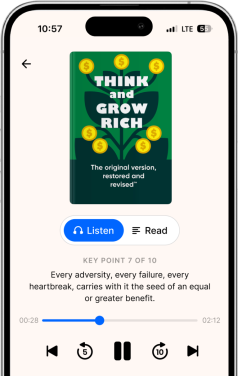
📘 If you're ready to stop consuming and start changing, the Headway app offers growth plans and quick book summaries that turn insights into action — because real personal development happens in small but consistent doses.
Quick answer: What does it mean to work on yourself?
Working on yourself is the systematic process of improving your mental health, self-awareness, and new skills through consistent, bite-sized actions rather than major life overhauls.
This definition matters because most people approach self-improvement backwards. They wait for a Monday, a New Year, or a breakup to overhaul their entire lives. Then they burn out within weeks because transformation doesn't work that way.
So, how do you work on yourself?
Real change happens through what researchers call microlearning — when you absorb information in small, manageable chunks that your brain can actually process and retain. Personal development is built on this foundation through four essential pillars:
Self-awareness: Identifying the gap between your values and your actual behavior is where all meaningful change begins. You can't fix what you don't see. Pay attention to how you spend time versus how you say you want to spend it. That gap tells you everything about where your personal goals and reality diverge.
Microlearning: Your brain forgets up to 70% of new information within 24 hours. This concept is known as the forgetting curve, first identified by psychologist Hermann Ebbinghaus. Spaced repetition (reviewing material at strategic intervals) fights this decay. Apps like Headway use this principle, delivering bite-sized insights, highlights, and quizzes you can actually remember and apply to build a new habit.
Mental well-being: Your capacity for personal development is limited by your baseline mental health. Managing stress and academic anxiety isn't separate from growth. It's the foundation that makes growth possible. Without this, every new habit crumbles.
Social systems: Accountability isn't about shame. It's about having people who notice when you show up and when you don't. Your loved ones, a mentor, or your broader social support network make consistency easier because humans are wired to keep promises to others before they keep promises to themselves. Healthy relationships provide the external structure that willpower can't.
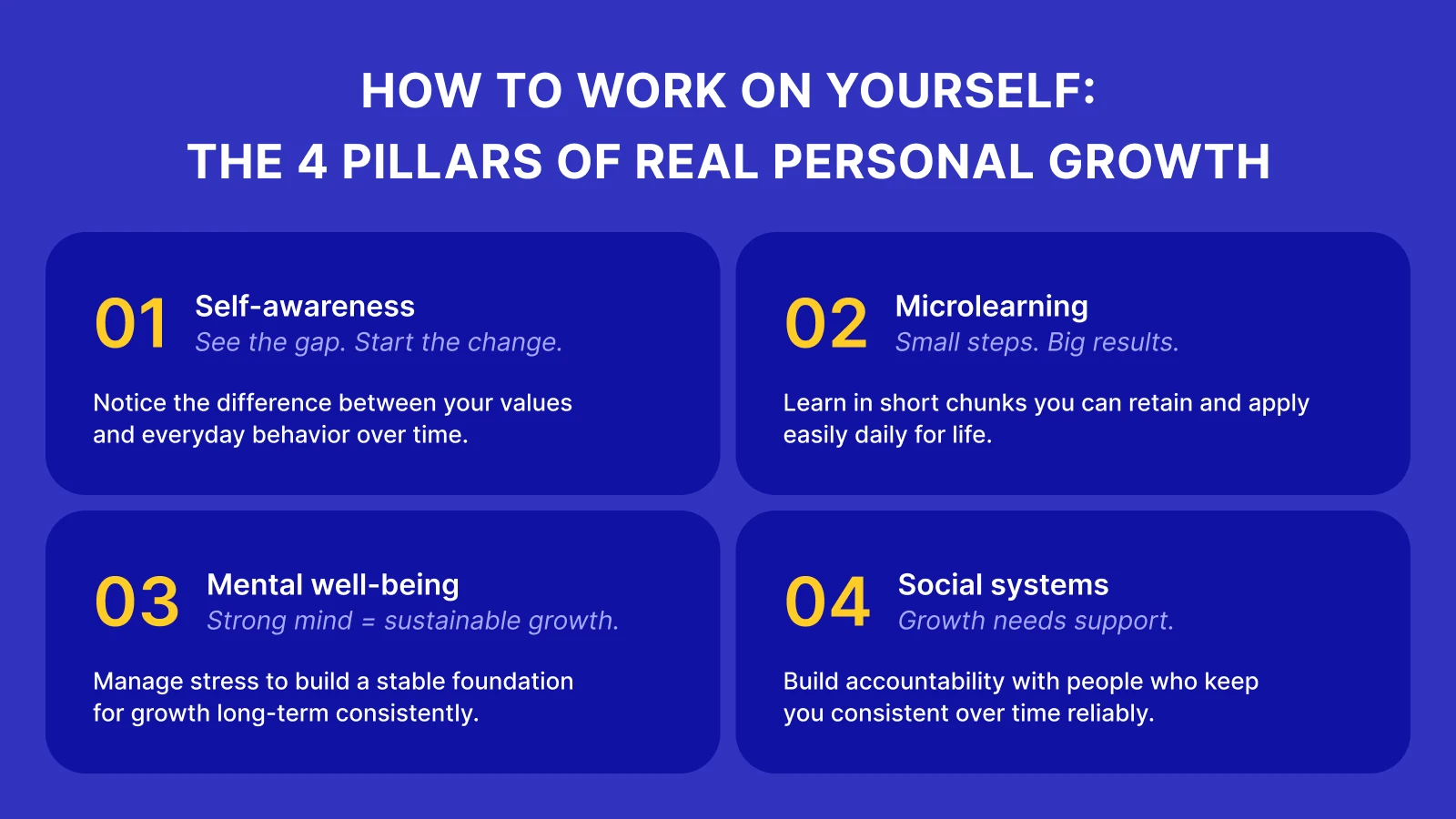
These pillars work together. Remove any one, and the structure becomes unstable.
📘 Build lasting growth with Headway.
Why traditional "self-help" fails (the science of the barrier)
The biggest barriers aren't laziness or lack of knowledge. According to a 2023 study published in Frontiers in Public Health examining university students' psychological help-seeking, the top obstacles were a lack of trust and difficulty with self-disclosure. Essentially, people struggle to be vulnerable enough to actually change.
This research found that trust in professionals was the highest-scoring barrier, followed by difficulties in self-disclosure. People knew they needed help. They just couldn't bring themselves to open up and do the uncomfortable work.
And this maps directly onto why your self-improvement attempts keep stalling. You can read every productivity book ever written, but if you can't be honest with yourself about your actual problems — your procrastination, your negative thoughts, and your bad habits — nothing changes. The insight stays theoretical. It never touches your real life.
The common advice is to "just try harder." But willpower isn't the problem. Willpower is a depleting resource. Every decision you make throughout your day chips away at it. By evening, you've got nothing left for the "important" stuff you swore you'd finally tackle.
It's better to build a system that removes the need for daily decision-making. You don't decide whether to brush your teeth every morning. You just do it because it's part of your routine. Your personal goals need the same treatment. They need to become automatic.
📘 The Headway app's daily learning streaks work this way. You don't decide each morning whether you'll invest in personal development. The app sends a reminder, you spend 5–15 minutes, and it becomes as routine as checking your messages. No willpower drain. No decision fatigue. Just a new habit that builds itself.


The 2026 micro-growth framework you can apply today
If traditional approaches keep failing, what actually works? A systems-first approach built on three science-backed principles that remove friction from your growth.
1. The microlearning advantage
Your brain wasn't designed for hour-long lectures or 300-page books consumed in marathon sessions. Working memory can hold roughly 3–5 chunks of information at once. That's a biological limit, not a personal failure.
That's why chunking works. When complex information is broken into smaller modules — each focused on a single concept — cognitive load stays manageable. You actually understand what you're learning. More importantly, you remember it.
A 2024 meta-analysis published in Journal of Multidisciplinary and Translational Research (JMTR) found that thoughtfully designed microlearning led to measurable gains in academic performance compared to traditional long-form courses. The word "micro" makes it sound like you're getting less. In reality, you're getting more — more retention, more applications, and more results.
That's why Headway condenses entire bestsellers into 15-minute audio or text summaries. It's not about cutting corners. It's about respecting how your brain learns. You can listen while commuting, during a coffee break, or before bed. The insights fit your life instead of demanding you rearrange your life around them.
📘 Learn smarter daily with Headway.
2. "Just-in-time" learning
Traditional reading is often "just-in-case" learning: you absorb information, hoping it'll be useful someday. The problem is that someday rarely arrives, and by the time it does, you've forgotten 80% of what you learned.
Just-in-time learning flips this. You learn what you need when you need it. Struggling with time management? Read a summary about building better routines this afternoon, then apply it before dinner. Having difficult conversations at work? Listen to a negotiation summary on your morning commute, then use those principles in your 10 am meeting.
Headway's personalized recommendations work this way. Based on your goals — whether improving self-confidence, building healthy relationships, learning a new language, or breaking free from perfectionism — the app suggests content that addresses what you're actually dealing with right now, not theoretical problems you might face later. It helps you become the best version of yourself without overwhelming you with information.
3. Building "plus-one" skills
AI can write emails, generate reports, and even produce passable creative work. What AI can't replace are the deeply human skills: empathy, psychology, high-level communication, and self-compassion. These are the skills that will matter more, not less, as automation advances.
Working on yourself in 2026 means prioritizing these plus-one capabilities. Understanding why people behave the way they do. Reading emotions accurately. Communicating in ways that build connection rather than just transmit information.
Books on emotional intelligence, relationships, and psychology are available as summaries in the Headway app, giving you concentrated wisdom about the skills that actually differentiate humans from algorithms. You don't need to become an expert. You need to become slightly better than you were yesterday. That's the plus-one approach.
📘 Grow emotional intelligence with Headway.
Overcoming the "academic anxiety" of life in 2026
The same 2023 study mentioned earlier found strong links between academic anxiety, study skills, and barriers to seeking help. Students with higher test anxiety reported more obstacles to personal growth.
Now extend this beyond classrooms. The pressure you feel in modern life — to perform at work, to maintain a social media presence that looks successful, and to be the best version of yourself at all times — creates the same anxiety pattern. You're not just anxious about tests. You're anxious about life.
If a student's GPA suffers because of their mental health, your career is limited by your growth system. Or rather, the absence of one.
The solution isn't trying harder. It's building structures that work even when you're exhausted, overwhelmed, or facing a bad day. It's accepting that wellness requires consistent small actions rather than occasional heroic efforts. Personal development apps can help create this structure when willpower fails.
That means setting goals that accommodate your real life. It means building self-care routines that survive stressful weeks. It means understanding that stepping outside your comfort zone doesn't require giant leaps. Instead, try small reaches that are repeated consistently, as those will get you further. Every good habit you build contributes to your mental well-being.
Headway's daily reminders create this structure automatically. You see your streak. You see your progress. The app tracks how many bestselling books you've absorbed and how consistently you've shown up. It's more effective than any to-do list because it removes the decision of what to work on. Over time, this external system becomes an internal habit. You don't need to rely on feeling motivated. You rely on a pattern that's already established.
📘 Build automatic habits with Headway.
Overcome the systemic inevitability with Headway
Let's return to where we started. You've read articles like this before. You've nodded along, felt inspired, maybe even saved it for later. And then nothing changed.
If understanding self-improvement were enough, you wouldn't still be searching for answers. Insight is free. Consistency is expensive.
What you need isn't more information. You need a system that enforces the consistency you've already proven you cannot maintain on your own.
The Headway app was built for exactly this problem. It doesn't just give you content. It gives you a daily routine, progress tracking, personalized recommendations, and the gentle accountability of a streak you don't want to break. You can read or listen to summaries during your workout, watch short videos with quizzes, follow structured self-development plans, and even use bedtime mode and focus sounds to make learning fit any moment.
📘 Download the Headway app and start working on yourself today.
Frequently asked questions about how to work on yourself
How do I begin working on myself?
Start smaller than you think you should. Pick one area of your life you want to improve (self-esteem, a new skill, mental well-being) and commit to 10–15 minutes of focused effort daily. Use an app like Headway to build this into a routine. The key isn't intensity; it's consistency over time. Track your progress so you can see momentum building.
How to work on yourself after a breakup?
Breakups create both pain and opportunity. Focus first on mental health basics: sleep, physical activity, and time with loved ones who support you. Resist the urge to immediately fix everything about yourself. That's often shame disguised as motivation. Instead, use this time for self-discovery.
Read about relationships and emotional patterns. Consider picking up a new hobby that's completely unconnected to your ex. Start a to-do list of small wins. Rebuild your sense of self-worth gradually.
How to work on yourself spiritually?
Spiritual personal development starts with self-reflection. Create a quiet space daily (even five minutes) for meditation, journaling, or simply sitting without screens. Pay attention to what gives you meaning and what drains you. Many find books on mindfulness and purpose helpful here. The Headway app has summaries on spiritual growth that condense wisdom traditions into practical insights.
How to work on yourself during a separation?
Separations are emotionally intense, so prioritize stability over transformation. Focus on maintaining healthy relationships outside your partnership. Get regular physical activity. Even short walks help stabilize mood.
Set small personal goals that remind you of your individual identity. Avoid major life decisions until emotions settle. Use this period for positive affirmations and building self-compassion while cultivating a positive mindset. Seek support from a mentor, therapist, or trusted friend.
How to work on yourself as a man?
Men often face pressure to suppress emotions, which blocks genuine self-improvement. Start by developing emotional vocabulary: being able to name what you feel. Work on communication skills in your relationships rather than defaulting to problem-solving mode. Challenge the negative thoughts that equate vulnerability with weakness. Focus on self-talk, stress management, and building deep friendships.
How to work on yourself as a woman?
Women often struggle with perfectionism and prioritizing others' needs over their own. Begin by setting boundaries that protect your time and energy. Practice self-love that isn't conditional on productivity or appearance. Address negative self-talk directly. Women tend to be harsher critics of themselves than they'd ever be of others. Build skills and confidence in areas traditionally discouraged for women.
How to work on yourself in a relationship?
Healthy relationships require two people committed to personal development, not just to each other. Communicate openly about your individual goals. Schedule time for your own growth activities. Don't let the relationship absorb everything. Work on communication skills together. Address your own negative thoughts and insecurities rather than expecting your partner to fix them. A good relationship gives you energy for self-improvement; it doesn't replace the need for it.