Self-growth
 Apps & Digital Tools
 Business & Career
 Success
 Growth Tools
 Psychology
 Communication
 Relationships

The room is dark, the to-do list is closed, and your thoughts have finally gone quiet — but your body didn't get the memo. Your jaw is set like you're about to negotiate, your shoulders are somewhere near your ears, and your legs keep finding new positions like they're auditioning for something.
Learning how to quiet your body to sleep is a different job than calming a racing mind. Mental noise responds to redirection; physical tension responds to signals — temperature, pressure, breath, release. You can't think a clenched jaw open. So this guide works from the neck down: how to discharge tension before you get into bed, how to switch your body into rest mode once you're there, and what to do when you wake at 3 a.m. with your heart drumming for no reason.
For racing thoughts, mental loops, and the overthinking side of sleepless nights, see our companion guide on how to quiet your mind to sleep.
Winding down is also easier with the right soundtrack. The Headway app includes a Before Bed mode with calming audio and binaural beats for sleep — plus 15-minute book summaries you can listen to while your body powers down.
📘 Make bedtime the softest part of your day with Headway.
Disclaimer: This article is for informational purposes only and is not a substitute for professional medical advice, diagnosis, or treatment. If sleep problems, pain, or restlessness persist, please talk to a doctor or a behavioral sleep specialist.
Quick answer: How to quiet your body to sleep
The short version: stop waiting for your body to relax on its own and start giving it unmistakable "power down" signals. Work through this sequence tonight:
Discharge tension before bed: A warm shower, light stretching, or a slow walk moves stress out of your muscles instead of into your mattress.
Cool the room, warm the feet: A core temperature drop is one of your body's strongest sleep triggers — help it along.
Pick one body-based technique: Progressive muscle relaxation, a long-exhale breath pattern, or a body scan — one, not a rotation.
Release the tension trio: Jaw, shoulders, hands. These three hold stress longest and un-clench last.
Reset if restlessness builds: If you're tossing and getting frustrated, leave the bed briefly and stretch or sit somewhere dim until heaviness returns.

Why does your body stay tense when you try to sleep?
If your muscles act like the workday never ended, there's a mechanical reason. Stress doesn't just live in your head — it's a full-body state. Under pressure, your sympathetic nervous system keeps muscles pre-tightened, heart rate slightly elevated, and breathing shallow, ready for action that never comes.
Lying down doesn't cancel that state; it just gives you nothing to do with it. Sleep researchers call this somatic hyperarousal — a body idling in fifth gear — and it stretches the time it takes to fall asleep even when your mind feels reasonably calm.
A few other culprits pile on:
Undischarged stress: Your body prepared for a fight or a sprint all day and never got either. The tension has nowhere to go, so it comes to bed with you.
A skipped cooldown: Going straight from laptop to pillow gives your nervous system zero transition time. Muscles need a runway, not a light switch.
Temperature mismatch: Your core temperature has to drop for sleep to start. A warm room, heavy dinner, or late workout can keep it stubbornly high.
Trained stillness-anxiety: If you regularly lie in bed tense and fidgeting, your body starts associating the mattress itself with restlessness.
Screen posture: An evening hunched over a phone leaves your neck, chest, and breathing pattern in "focus mode" — and your brain reads that posture as "stay alert."
The fix works on two fronts: give tension a physical exit before bed, then send your body clear "we're safe, power down" signals once you're in it.
How to relax your body before bed: The setup hour
Most of the battle is won before you're horizontal. A steady physical wind-down drains the tension your body would otherwise process at midnight — and tells your nervous system, night after night, that sleep is coming.
Take a warm bath or shower 1–2 hours before bed: It sounds backward, but heating your skin helps your core cool down afterward — and that temperature drop is a primary sleep trigger. Research on warm baths and showers before bed links them to falling asleep measurably faster.
Stretch what the day shortened: Two or three minutes on hips, chest, and neck — the areas that sitting and screens compress. Slow holds, no bouncing, nothing that raises your heart rate.
Move stress out on foot: A short, slow evening walk gives adrenaline somewhere to go. It's the difference between parking a car and stalling one.
Cut the late stimulants: Caffeine can linger in your system for eight hours or more, and alcohol relaxes you into shallower, more fragmented sleep. Neither is the shortcut it pretends to be.
Finish intense exercise early: A hard workout within an hour or two of bed raises core temperature and heart rate — great for the gym, wrong direction at 11 p.m. Keep evening movement gentle.
Cool the bedroom: Around 18°C (65°F) is the commonly recommended zone. A cool room does half the relaxation work for you.
If a full routine feels like one more task, our free printable Mindfulness Journal includes a body check-in section — print it once and keep it on the nightstand.
📘 Replace the bedtime scroll with a 15-minute listen on Headway.
How to release tension at night: Six techniques to use in bed
Once you're lying down, your job is translation: converting "tired" into "relaxed," because they're not the same state. Pick one technique and stay with it; hopping between methods keeps your body in task mode.
1. Do progressive muscle relaxation, toes to face
Progressive muscle relaxation (PMR) gives a tense body explicit instructions to let go. Starting at your feet, tense one muscle group for about five seconds — curl your toes hard — then release completely and notice the heaviness for ten seconds. Move upward: calves, thighs, stomach, hands, arms, shoulders, jaw, forehead.
The magic isn't the squeezing — it's the contrast. Each release teaches your body what "relaxed" actually feels like, and most of us have forgotten. A slack body tells your brain the coast is clear.
2. Slow your breathing (4-6 or 4-7-8)
Lie on your back or side and breathe in through your nose for a count of four. Then exhale slowly — through your nose or pursed lips — for a count of six to eight. The long exhale is the active ingredient: it stimulates the vagus nerve and shifts your nervous system toward its rest-and-digest mode. Your heart rate follows your exhale down. Continue for ten to twenty cycles, letting your belly rather than your chest do the work. If you lose count because you're drifting — congratulations, that's the point.
3. Run a body scan
A body scan is PMR's gentler cousin: no tensing, just attention. Start at your toes and slowly sweep your awareness upward, spending a few breaths on each region — feet, ankles, calves, knees — simply noticing warmth, weight, or contact with the mattress. Where you find gripping, don't force it open; just breathe toward it and move on. Tension often releases the moment it's noticed, like a kid who stops performing once the audience looks away. A guided sleep meditation can steer this for you if solo focus keeps sliding off.
4. Unclench the tension trio: jaw, shoulders, hands
Three places hold stress longest and release it last. Run this quick circuit: let your tongue rest heavy on the floor of your mouth, and your teeth come apart — a relaxed jaw hangs slightly open. Drag your shoulders down away from your ears and let the mattress take their weight. Uncurl your fingers until your hands lie open. Repeat the circuit two or three times; these three re-clenches quietly, and each release drops your body's overall alert level a notch.
5. Warm your extremities, cool your core
Sleep onset rides on a small drop in core body temperature — and oddly, warm feet help it happen. Warm skin at your hands and feet dilates blood vessels and lets your core offload heat faster. So: socks on, room cool, duvet light enough that you're not trapping warmth at your torso. If you tend to run hot, stick one foot out from under the covers — the least glamorous sleep technique with the most loyal fanbase.
6. Use deep, steady pressure
Firm, even pressure reads to your nervous system as safety — the same principle behind swaddling. A weighted blanket is the ready-made version; many people find it settles restlessness and the urge to keep shifting position. No weighted blanket? Try lying on your back with a pillow hugged to your chest, or on your side with a pillow pressed along your spine. The goal is the sensation of being held in place — your body stops scanning for a better position when the current one feels anchored.
📘 Let your body land somewhere softer — wind down with Headway.
Match the technique to the tension pattern
Different flavors of physical restlessness respond to different tools. Find your tonight-body in the left column:
What's happening in your body | Try this |
Muscles feel tight even though you're exhausted | Progressive muscle relaxation |
Heart beating faster than the moment deserves | Slow breathing with long exhales |
Jaw clenched, shoulders up, hands in fists | The tension trio circuit |
Too hot, kicking off covers | Cool room, light duvet, one foot out |
Restless, can't find a comfortable position | Deep pressure — weighted blanket or pillow anchor |
Vague full-body unease you can't locate | Body scan, toes to head |
Getting frustrated with the tossing | Leave the bed for gentle stretching in dim light |
Tired all day, awake all night?
Books that explain why — condensed into 15-minute summaries you can finish before bed.
What Headway users do instead of taking tension to bed
The advice "just relax before bed" is easy to nod at and hard to actually do — the day's residue doesn't leave on request. It helps to see how real people built routines that actually changed how their bodies wound down.
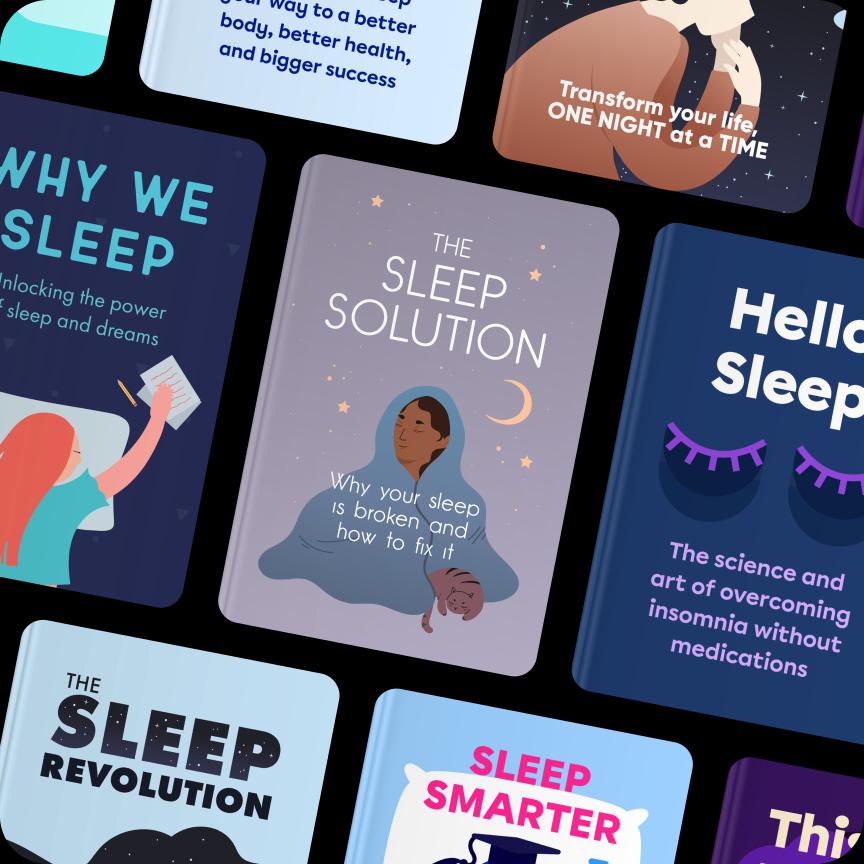
Nicky, a writer and editor, traded her social media time for Headway summaries — and her body noticed before she expected it to. By her third month, she felt noticeably calmer and less stressed. Then she read the summary of W. Chris Winter's 'The Sleep Solution' and put its advice to work:
"Within a few weeks, I noticed significant differences in my sleep quality."
That's the two-front fix from this article in miniature: less stimulating input in the evening, plus a few applied changes to how she slept — and the effect, in her words, reached every other area of her life.
Ivan Karačić, a developer, triathlete, and father of three, runs the kind of life where the body does all the heavy lifting — training sessions, work, and three kids leave no slack. Every learning format he tried failed to stick until he anchored Headway to a physical ritual: a 5:30 a.m. walk, same time every day. Over four months, he completed 120+ summaries without missing a day. The lesson transfers directly to your evenings: your body doesn't respond to intentions; it responds to anchors. Attach your wind-down to something physical you already do — the shower, the stretch, the lights going dim — and consistency stops requiring willpower.
📘 Give your evenings a soft landing, too — try Headway's audio mode.



Why forcing your body to relax backfires
Relaxation is the one instruction your body can't take as a command. Effort is arousal, and arousal is the opposite of drowsy — so the harder you try to go limp, the more supervised (and awake) your body feels. Three traps are worth naming:
Position roulette: Flipping every ninety seconds in search of the perfect posture keeps your muscles engaged and your brain refereeing. Pick a decent position and give it ten unglamorous minutes.
Tension policing: Repeatedly checking "am I relaxed yet?" re-tightens exactly what you just released. Run your technique once, gently, and let the result be whatever it is.
The comfort upgrade spiral: Adjusting the pillow, then the duvet, then the pillow again turns your bed into a project. Good enough is the standard; perfect is a stimulant.
Your only job in bed is to create good conditions and stop supervising the process. A still, heavy body is restorative even before sleep arrives — which conveniently takes the pressure off, which conveniently helps you sleep.
What to do when you wake up at 3 a.m. tense or overheated
Middle-of-the-night wake-ups have their own physics: you often surface with a racing heart, a clenched jaw, or a wave of heat — your body finishing a stress response you never felt start. The goal is to avoid feeding it:
Don't reach for the phone: Bright light and incoming information signal to your body that the day has started. It believes you.
Cool down first: Push the duvet back, expose your feet, take a few slow breaths. Overheating alone can hold you at the surface of sleep.
Do one release circuit: Jaw, shoulders, hands — the trio re-clenches during stressful sleep. Unclenching them is often enough to sink back down.
Rerun your most practiced technique: Whichever method you've used most, whether that's long exhales or PMR. Familiar is soothing; novel is stimulating.
Reset if you're churning: After roughly 20 minutes of restless frustration, move to a chair and stretch or sit in dim light — then return to bed when heaviness comes back. This protects the bed-equals-sleep association instead of eroding it.
When physical restlessness needs professional support
Occasional wired-and-tired nights are human. But it's time to bring in a professional if your body regularly won't settle, if it's been going on for months, or if daytime exhaustion, muscle pain, or persistent anxiety are eating into your life.
It's also worth knowing that nighttime restlessness isn't always tension. An irresistible urge to move your legs in the evening can be restless legs syndrome; loud snoring, gasping, or unrefreshing sleep can point to sleep apnea; and chronic pain fragments nights in ways that feel like a body that "won't relax." If your wind-down routine is solid but your sleep stays poor, a doctor may recommend a sleep study to rule these out. Nighttime tension tied to anxiety also deserves attention in its own right — treating the underlying condition often quiets the body, too.
The good news: the leading treatment for chronic sleep trouble isn't a lifetime of pills. Cognitive behavioral therapy for insomnia (CBT-I) is the first-line, evidence-based approach, and it addresses the physical side as well — including relaxation training and the bed-frustration association — usually within a handful of sessions with a behavioral sleep specialist.
If you want the deeper science of what sleep does for your body (and gentle motivation to protect it), Matthew Walker's 'Why We Sleep' is worth your time — Headway has the quick summary.
Turn bedtime into wind-down time with Headway
Learning how to quiet your body to sleep comes down to two habits: discharge tension before bed, then give your body one calm, familiar signal once you're in it. Neither requires discipline of steel — just a wind-down routine you like enough to repeat until heavy, restful sleep stops being the exception.
Headway can be that routine:
Before Bed mode: Calming audio designed for the last stretch of your evening.
Binaural beats for sleep: Steady, low-key soundscapes to fall asleep to, alongside ambient sounds and relaxing music.
A hands-free wind-down: Swap the feed for a 15-minute summary of books like 'Why We Sleep' — your eyes close, your hands rest, your body gets the stillness it's been asking for.
A daily habit that sticks: Streaks and personalized plans keep your wind-down consistent, which is what your sleep rhythm loves most.
📘 Tonight's tension can stay in today. Wind down with Headway.
Frequently asked questions on how to quiet your body to sleep
How can I relax my body immediately before sleep?
Take a warm shower, then get into a cool bedroom and run one round of progressive muscle relaxation — tense and release each muscle group from toes to face. Finish with slow breathing: inhale for four counts, exhale for six to eight. The combination of a post-shower temperature drop and deliberate muscle release is the fastest reliable route from tense to heavy.
Why is my body tense even though I'm exhausted?
Fatigue and relaxation run on separate tracks. Your muscles can be tired while your nervous system stays in its daytime alert mode — heart rate slightly up, muscles pre-tightened, breathing shallow. That state doesn't switch off just because you lie down; it needs a separate signal, which is what breathing, PMR, warmth, and pressure provide.
What is the fastest way to release muscle tension in bed?
Progressive muscle relaxation, done once, patiently. Tense each muscle group for five seconds, release for ten, and move from your feet to your face. If a full round feels like too much, run the short circuit: unclench your jaw, drop your shoulders, open your hands — the three places tension hides longest.
Does temperature really affect falling asleep?
Yes, more than almost anything else physical. Sleep onset is triggered partly by a drop in core body temperature, which is why a cool room (around 18°C / 65°F) helps, and an overheated one hurts. Warm feet speed the process by helping your core offload heat — the socks-in-bed crowd has physiology on its side.
Do weighted blankets actually help you sleep?
Many people find deep, even pressure genuinely settling — it reads to the nervous system as safety and reduces the urge to keep shifting position. Evidence is strongest for people whose restlessness has an anxious edge. If you sleep hot, look for a breathable version, since trapping heat works against the temperature drop your body needs.
Should I exercise before bed to tire my body out?
Not right before. Intense exercise raises core temperature, heart rate, and adrenaline — all useful at 6 p.m., all counterproductive at 10 p.m. Finish hard workouts at least a couple of hours before bed, and keep late-evening movement gentle: stretching, slow walking, easy mobility work.
Why do I wake up at night with my heart racing?
Often it's your body completing a stress response mid-sleep — surfacing with a raised heart rate, clenched jaw, or a wave of heat. Cool down first (duvet back, feet out), then run long-exhale breathing to bring your heart rate down with it. If it happens frequently, or comes with chest pain or gasping, mention it to a doctor.
When should I seek help for a body that won't relax at night?
Talk to a doctor or behavioral sleep specialist if your body regularly won't settle several nights a week for a month or more, or if daytime exhaustion and tension are affecting your work and mood. Mention specific symptoms — an urge to move your legs, snoring or gasping, pain — since restless legs syndrome, sleep apnea, and chronic pain all masquerade as "tension." Ask about CBT-I, the first-line treatment for chronic sleep trouble.