Self-growth
 Apps & Digital Tools
 Business & Career
 Success
 Growth Tools
 Psychology
 Communication
 Relationships

It usually doesn't hit during a peaceful Sunday brunch. The thought "am I in love" tends to land at weirder hours: 1 am with your phone face-down on the pillow, halfway through making coffee, in the parking lot after they've already driven off. People don't search for that question casually. They search for it because something inside them shifted, and they're scrambling to catch up to it.
Here's the honest version, before any sign list, love quiz, or Sternberg framework gets involved: love is harder to spot in yourself than rom-coms led us to believe. It often shows up quietly. It wears a few different masks at once. And it almost never hands you the kind of cinematic certainty most of us got promised growing up.
If you want help untangling any of this, the books that have actually mapped what love is and how to recognize it — Erich Fromm's 'The Art of Loving,' Bell Hooks' 'All About Love,' Amir Levine and Rachel Heller's 'Attached' — are condensed into 15-minute reads.
📘 Download the Headway app and read what experts have to say!
Am I in love? The short answer (TL;DR)
Here's a quick overview of the signs to watch out for:
If your interest in this person has held steady for months (not weeks), you feel safe being yourself around them, and you care about their well-being about as much as you're physically drawn to them, you're probably in love.
Love and infatuation look identical at the start. The split usually shows up around the 6- to 18-month mark. Infatuation fizzles. Love settles in deeper.
Real love is quieter than movies make it out to be. Daily care. Easy presence. The willingness to be inconvenienced for somebody else's sake.
If you're stuck asking the question on a loop, anxious and unable to land anywhere, you might be dealing with limerence (intense early-stage obsession), attachment anxiety, or some combination of both. Not actual love yet.
The more useful question isn't "am I in love?" It's: how do I feel when I'm with this person, not when I'm thinking about them?
What being in love actually means
When you're in love for real, there's a steady pull toward another person that's emotional, physical, and psychological all at once. Underneath that pull sits real attraction, genuine care about their well-being, the desire to be close, and a willingness to make their life easier even when it costs you something.
Psychologist Robert Sternberg's triangular theory of love breaks the experience into three pieces:
Intimacy. Closeness, connection, the feeling of being known by another person.
Passion. Physical attraction, desire, the magnetic pull.
Commitment. The choice to stay. To keep picking them on a regular Tuesday.
When all three show up and stay put, Sternberg calls that consummate love. When only one or two are present, you land somewhere else on the map. Strong passion without intimacy is infatuation. Commitment without passion is companionship. Intimacy on its own is friendship. Plenty of long-term relationships sit somewhere in the middle.
Helen Fisher, the anthropologist who's spent decades scanning the brains of people in love, draws a slightly different map. She points to three systems that run in parallel:
Lust, driven by testosterone and estrogen.
Attraction, fueled by dopamine and norepinephrine. This is the high-voltage rush of early romantic love.
Attachment, built on oxytocin and vasopressin. The slower bond that holds a long-term relationship together over the years.
None of those three is the whole picture on its own. Real love needs all of them showing up together. Still not sure how you feel? Take this quick "Am I in love" quiz to find out:
Seven signs you're genuinely in love
The list below isn't a scoring system for grading your feelings. It's a way to step back from the strong feeling you've been sitting with and notice what's actually happening underneath it. Don't expect to hit all seven. Most people in real love land on five or six, with the others growing in over time.
📘 Reading about love makes you better at recognizing it. Download Headway and start tonight.
1. You feel safe being yourself around them
Real love has a strange tell. You stop wanting to impress them. Not because you've stopped caring what they think, but because you trust they already see you. The version of you that shows up tired, mid-yawn, a bit cranky on a Sunday morning — that's the version they end up with.
If you find yourself relaxing into who you actually are around this person, instead of performing some shinier edition of yourself, that's love settling in.
2. Their well-being matters as much as your own
Not in a self-erasing way. In the quiet, daily way of paying attention. You notice when your love interest seems off. You think about what might make their week a little lighter. You start to figure out their love language without really meaning to — what makes them feel cared for, how they like to be checked on.
Their wins land in your chest as if they were yours. Love stretches the edges of what counts as "your life" to include theirs. Spending time on small things for them stops feeling like a chore.
3. You think about them — but not in a daydreaming, anxious loop
A misconception worth clearing up: thinking about someone constantly is not the same as loving them. Often, it's the opposite. Obsessive, intrusive, anxiety-tinted daydreaming is closer to limerence.
Real love includes the person in your mental life in a calmer way. You think about them. You enjoy thinking about them. But you don't feel like you'll come apart if a few hours pass without checking in.
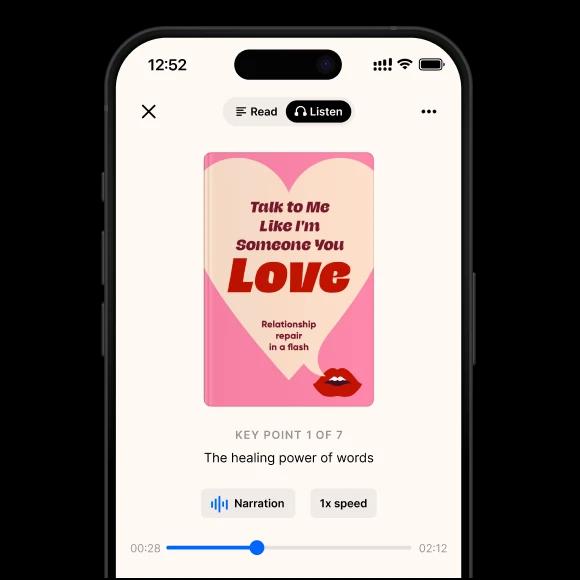
What separates real love from passing infatuation?
Top relationship experts explain it in just 15 minutes.
See what works4. You can picture an ordinary future with them
Not a fantasy. A Tuesday. A grocery list. Folding laundry while they make dinner. A boring drive to the dentist. If you can sketch out the unspectacular parts of life beside this person — the parts no one writes songs about — and the picture still feels good, that's a strong sign.
The cliché that someone you're in long-term love with is also your best friend? It comes from here. Every day with them is easy enough that you'd choose it on its own. It's a sign your feelings have crossed out of the honeymoon phase highs into something with longer legs.
5. Conflict starts to look different
You stop running from it. You stop escalating to win. You actually want to understand them, even when you're frustrated. The pull to repair becomes louder than the pull to be right. That's love changing how your nervous system handles the romantic relationship.
People with secure attachment styles tend to get there faster. Anyone can grow into it, though, with practice and a little self-awareness.
6. You feel more like yourself, not less
A lot of people get this one backward. Falling in love doesn't mean dissolving into another person. It means finding someone whose presence steadies you enough that you can be more fully who you already are. If you're with somebody and the result is that you're both attracted to them and more anchored in your own identity, that's a love-shaped place to be in.
7. The feelings have outlasted the early high
Early attraction is intense. It's also chemistry doing what chemistry does. The real test comes around the six-to-eighteen-month mark, when the dopamine starts to taper off, and you have to choose them with a clearer head.
If you still want them then — through their annoying habits, through ordinary weekends, through the slow erosion of newness — that's likely true love. Not the rom-com version. The real deal.
Love vs. infatuation vs. limerence
This is the comparison most articles skip, and it's the one that clears up the most confusion.
Infatuation is fast, intense, and largely projection. You don't know the person well enough yet to love them. What you're responding to is the idea of them — what they could be, what they seem to be, the shape they fill in your head.
It's especially common in the first weeks of online dating or a new crush, when there's almost no real information to push back against the fantasy. Infatuation usually fades within weeks or months as the actual person comes into focus.
Limerence is something more specific and harder to shake. The term was coined by psychologist Dorothy Tennov in the 1970s. It describes obsessive, painfully intense, intrusive thinking about a specific person, usually laced with anxiety about whether they feel the same.
Limerence can last anywhere from six months to two years, and research has shown it shares some neurochemistry with addiction. It is not love. It's a powerful, often miserable, attraction state that can either grow into love or burn itself out entirely.
Love is calmer. Steadier. Less consuming. It builds slowly instead of crashing in. It survives ordinary days, fights, distance, and time. The clearest sign you've crossed from infatuation or limerence into love isn't that the intensity climbs — it's that the intensity becomes less necessary.
You can be apart without unraveling. You can disagree without doom-spiraling. The thing has weight without weighing you down.
📘 The clarity you're searching for is in a book someone already wrote. Get it on Headway.



When the question is anxiety, not love
A lot of people typing "am I in love" into a search bar aren't asking from a calm place, wanting confirmation. They're asking because they're anxious. The anxiety usually comes from a few different places — anxious attachment styles, uncertainty about whether the other person feels the same, or a relationship that activates old fears you thought you'd outgrown.
If your version of asking the question sounds less like "I think I love this person" and more like "I have to figure this out tonight or I won't be able to sleep," what you're sitting with might not be love yet. It might be the fear of being wrong about love. It might be the panic of not knowing.
That panic tends to spawn other questions in the same loop. People in this state will start asking themselves things like why am I so emotional over a relationship that's only a few months old. Why am I so sensitive to every text that takes too long to come back? Why am I so dumb for letting someone get this deep under my skin? And the quieter, harder one — why do I feel empty even when we're together? Those aren't shameful questions.
They're usually signs that something deeper is asking to be looked at — often something attachment-related, sometimes connected to broader mental health patterns worth taking seriously.
If any of this hits home, talking to someone qualified can help. A licensed psychotherapist, family therapist, or counselor with an LCSW credential is far better equipped to untangle it than any article on the internet.
Consider this paragraph a soft disclaimer: a piece of writing can give you a vocabulary, but it can't replace the work relationship experts do one-on-one. Naming what's actually going on is the only way to tell the difference between feeling deeply and being scared of feeling deeply.
Try the book summaries that make sense of love on Headway!
The question "am I in love?" doesn't come with a quiz answer. But it does come with a long line of writers who've thought carefully about what love is, how to recognize it, and how to stay in it once it turns out to be real.
Erich Fromm's 'The Art of Loving' makes the case that love is a practice, not a feeling that happens to you. Bell Hooks' 'All About Love' reframes it as a commitment to another person's growth. Amir Levine and Rachel Heller's 'Attached' maps how attachment patterns shape what we feel and how we behave with the people we want closest.
Esther Perel's work — through her books and her popular podcast — adds another layer about desire, intimacy, and what keeps love alive over the long haul.
Headway condenses all of these love books into focused 15-minute reads, built for moments exactly like the one you're in right now. Curled up on the couch, wondering. Walking the dog, replaying old conversations. Lying awake at 1 am trying to work out whether this is the thing, or just feels like the thing.
📘 You're asking the right question. Headway has the right books to answer it – try the app today!
Frequently asked questions about being in love
How do I know if I am in love?
You're likely in love when your interest in the person stays steady over weeks and months, you feel safe being unguarded around them, and you genuinely care about their life going well. The clearest sign isn't intensity — it's consistency. Love stays present in ordinary moments, not just the dramatic ones, and it makes you feel more yourself, not less.
What are 5 signs of love?
Five signs you're in love: you feel calmer around them, not more anxious; their well-being matters to you as much as your own; you can picture an ordinary, unspectacular future together; conflict makes you want to repair, not win; and the feelings have outlasted the initial chemistry rush of the first few months without fading.
Am I in love or infatuated?
Infatuation is intense, fast, and built mostly on projection — you're responding to the idea of the person more than the person themselves. Love is steadier, calmer, and survives the moment you start seeing them clearly. If the intensity fades when you learn who they actually are, that was infatuation. If it deepens, that's love forming.
What are the 5 love languages?
Coined by Gary Chapman, the five love languages are words of affirmation, quality time, acts of service, physical touch, and receiving gifts. The idea: people give and receive love primarily through one or two of these. Knowing yours — and your partner's — helps you express care in a way that actually lands instead of getting lost in translation.
What is the 3 6 9 rule for dating?
The 3-6-9 rule is a checkpoint framework: at three months, you should know if you genuinely enjoy the person; at six months, whether your values and lifestyles align; at nine months, whether the relationship has long-term potential. It's not a strict timeline — more a reminder to honestly assess the relationship instead of drifting past warning signs.