Self-growth
 Business & Career
 Success
 Communication
 Healing
 Relationships
 Psychology
 Happiness

If you're searching for how to fix anxious attachment style, you're probably tired of feeling thrown off by mixed signals, emotional distance, or the constant need for reassurance. According to Simply Psychology, anxious attachment is an insecure attachment style marked by fear of abandonment, a heightened sensitivity to how close or distant someone feels, and a strong need for reassurance, especially when a partner seems too independent or hard to reach. It usually traces back to caregivers who were inconsistent, and early experiences where love felt like something you had to earn or chase rather than something you could count on.
It can show up in romantic relationships, friendships, family dynamics, and even work connections. You might overthink messages, fear rejection, feel clingy, or confuse emotional intensity with emotional closeness. You may even start to think you're broken, all while your nervous system had simply learned to scan for loss or danger before it learned to lean into connection.
As a relationship coach and a nervous system regulation specialist, I'd like to emphasize the hopeful part: insecure attachment isn't permanent. Adult attachment can shift through self-awareness, repeated safe experiences, and intentional new habits. In this guide, you'll learn how to fix anxious attachment style and move toward secure attachment using somatic tools, self-reflection, communication scripts, and practical ideas from Headway summaries like 'Letting Go,' 'The End of Stress,' 'How to Stop Worrying and Start Living,' 'The Mental Toughness Handbook,' and 'The Myth of Normal.'
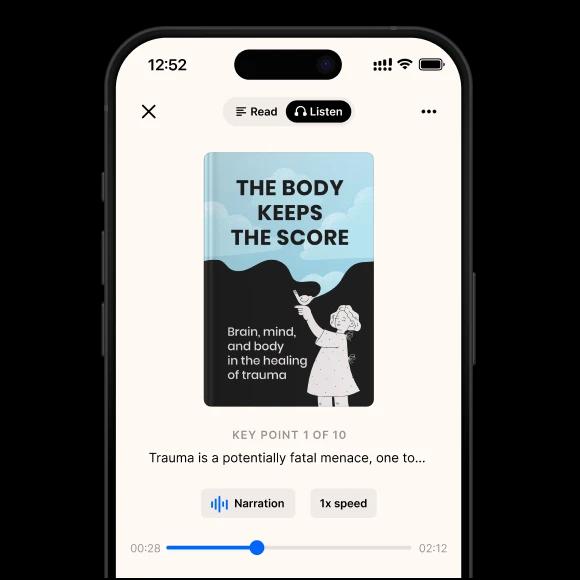
You can keep building these skills in small, manageable steps. Explore the Headway app for bite-sized insights you can use in daily life.
Quick summary: How to fix anxious attachment style
Here are the anxious attachment healing steps in short:
What anxious attachment actually is: A fear-based relationship pattern, not a character flaw.
Where it comes from: Inconsistent caregivers, early childhood experiences, and later relationship wounds can all wire an insecure attachment style into your nervous system.
Why you feel it in your body first: Deep breathing, grounding, and self-soothing calm a panic response faster than trying to think your way out of it.
What's keeping the cycle going: Low self-esteem, fear of rejection, and the need for constant validation feed each other.
How to start building something different: Clearer boundaries, honest communication, and self-compassion are what secure attachment actually looks like in practice.
Take the quiz: What stage of anxious attachment am I in?
Understand what anxious attachment style really is and why it hurts
Attachment theory goes back to John Bowlby, who showed how early bonds with caregivers shape our expectations of closeness, trust, and safety throughout life. When care is responsive and stable, children are more likely to develop secure attachment. When it's inconsistent, intrusive, neglectful, or unpredictable, kids adapt to that instead, and they carry that adaptation with them long after they've left home.
That's why anxious attachment style isn't just 'being needy.' Understanding how anxious attachment develops in adults matters here: it's a survival strategy shaped by early childhood experiences that keeps replaying long after those years are behind you.
If closeness once felt uncertain, your nervous system may now treat emotional distance as danger, even when the current situation is a lot less dramatic than your body believes.
If you've ever wondered why you get anxious when someone pulls away, this is the mechanism underneath it. People with anxious attachment often long for emotional closeness and intimate relationships, but they also fear abandonment so intensely that they can become hypervigilant. They may interpret neutral behavior as rejection, feel clingy, seek constant reassurance, or overfocus on whether loved ones are still emotionally available. This pattern creates pain not only in romantic relationships but also across mental health, self-esteem, and overall well-being.
Learn how to fix anxious attachment style by spotting the root causes
Identify root causes to heal your anxious attachment style. Take the quiz.
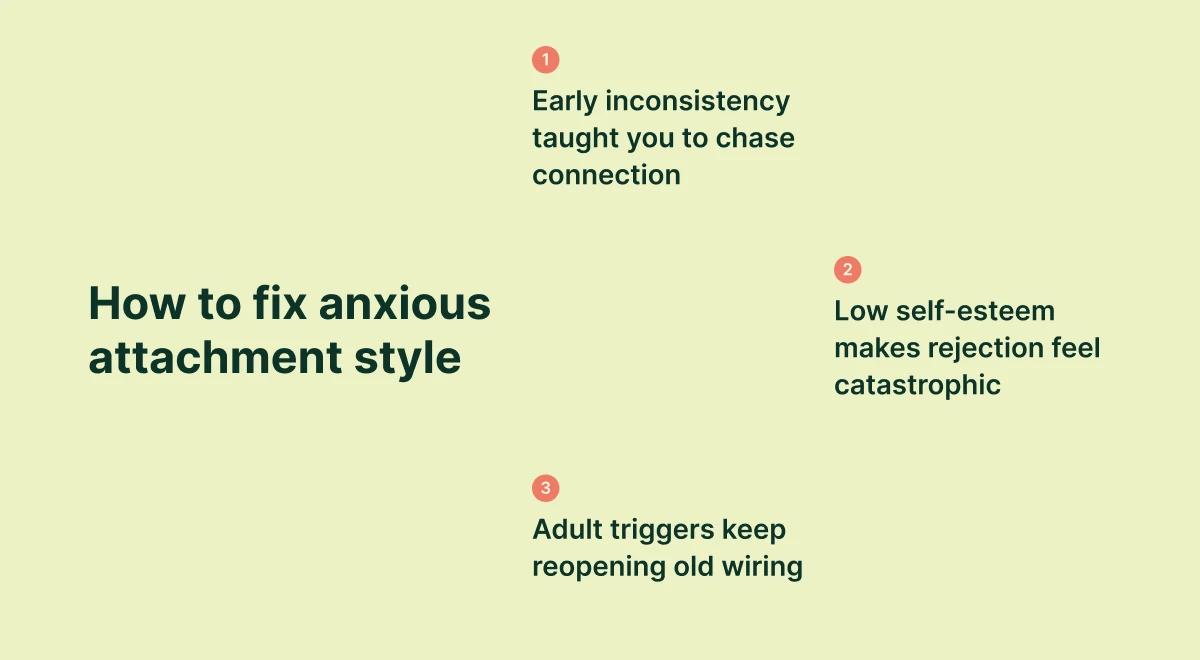
One: Early inconsistency taught you to chase connection
If your caregivers were warm one moment and unavailable the next, your nervous system was shaped accordingly. Love is now perceived as something unpredictable, and, therefore, something to be monitored closely. Chances are you are highly sensitive to the tone of people around you, and to subtle shifts in timing and emotional closeness. That pattern makes sense in childhood, but in adult relationships, it can leave you feeling constantly on alert.
Two: Low self-esteem makes rejection feel catastrophic
"Anxious preoccupied attachment in dating is often linked with a negative self-view and stronger dependence on others for validation. Small rifts aren't that small. More often than not, people with anxious attachment register these rifts as proof that they're too much or too easy to leave — and that's where emotional dependency in relationships quietly takes root.
Three: Adult triggers keep reopening old wiring
Later experiences also reflect in your attachment style. In my clients, I often see how painful breakups, childhood trauma, emotionally inconsistent partners, or relationships with avoidant attachment or fearful-avoidant dynamics can intensify these insecurities. Adult experiences can reinforce old patterns. At the same time, they can also help you build new ones and help you heal. The blunt truth is that what shaped you matters, and what you practice now matters even more.
How to fix anxious attachment style: Regulate your nervous system before fear takes over
If you want to know how to fix anxious attachment style, start here: regulate before you react. Anxious attachment nervous system triggers work fast — a nervous system in panic can't tell the difference between a genuine threat and delayed texting. It just knows the connection feels shaky and wants immediate relief.
This is why somatic work matters. Anxious attachment isn't just a thought problem, as many people assume. It's a full-body alarm state involving threat response, emotional regulation, and attention narrowing. Headway's summary of 'The End of Stress' is especially helpful here because it focuses on reducing overload and rewiring stress responses through practical habits.
Try this self-soothing reset.
Put both feet on the floor.
Notice your breath.
Place one hand on your chest and one on your stomach.
Notice sensations in your hands: temperature and texture.
Name what you feel in plain language: fear, shame, anger, loneliness, confusion.
Wait 90 seconds before sending a text, making an accusation, or asking for reassurance.
Breathing and body awareness can help interrupt the urge to either chase or collapse. Breathing also builds self-soothing skills, which, on a nervous system level, are a key difference between anxious and secure attachment. Securely attached people still get upset. They just recover faster and don't hand their entire nervous system over to another person's typing speed.
Neurodivergent-friendly note
If you're neurodivergent, these tools may work best when adapted to your sensory needs, energy levels, and communication style. Counting or slowing down your breath (as pop psychology often suggests) may help some people, yet irritate others. I'd suggest experimenting with alternatives. For instance, you can hold something cold, wrap yourself in a blanket, use noise-canceling headphones, or repeat one anchoring sentence, such as, "I am activated, not abandoned." Everyone's nervous system is different, and that's especially true if you're neurodivergent. For extra support, Headway's related articles on reducing stress, practicing mindfulness for anxiety, and sleeping better with anxiety can help you build a steadier baseline.
Rewire the beliefs that make love feel unsafe
One reason anxious attachment hurts so much is that it turns feelings into facts. If someone is tired, you may hear rejection. If someone is quiet, you may hear emotional distance. If someone needs space, your mind may leap to the idea of abandonment.
If you've been searching for how to stop spiraling in relationships, here's where CBT — cognitive behavioral therapy — can help. The goal is not to gaslight yourself into pretending everything is fine. Instead, you get an opportunity to separate the story in your head from the facts in front of you. Headway's summary of 'How to Stop Worrying and Start Living' is useful here. It focuses on reducing repetitive worry, staying grounded in the present, and interrupting spirals before they take over your evening.
Use this thought check
When anxiety spikes, write down these five things. Here's an example:
Trigger (what happened): My partner took five hours to reply.
Story (what your mind made it mean): They're losing interest.
Facts (what you actually know): They said they had a long workday.
Balanced response (what's more likely true): I feel activated, but there's no proof of abandonment.
Secure action (what to do next): I'll regulate first and communicate later if needed.
Once you've done this enough times, you won't need to write it down. Your brain will start running through it automatically. When I recommend this to clients, two goals are in mind: building self-awareness and strengthening self-reflection. Over time, it helps you respond to reality rather than to the fear of abandonment. That shift is one of the clearest paths from insecure to secure attachment.



How to fix anxious attachment style through clearer communication
Healing doesn't mean becoming so independent that you no longer need people. It means understanding your emotional needs well enough to communicate them honestly, and staying connected to yourself even when closeness feels uncertain.
Anxious attachment protest behavior — the texting spiral, the accusatory openers, the passive shutdown — is often the loudest signal that the nervous system is asking for reassurance it doesn't yet know how to request calmly.
Headway's summary of 'The Mental Toughness Handbook' teaches staying steady under pressure, tolerating discomfort, and responding intentionally rather than reactively. All of the above are core skills when anxious attachment makes communication feel high-stakes.
Try these secure scripts
Instead of: "Why are you ignoring me?"Say: "When communication changes suddenly, I notice I get anxious. A quick heads-up helps me stay grounded."
Instead of: "You never care enough."Say: "I feel disconnected right now and want to reconnect. Are you available later today?"
Instead of: "Fine, forget it."Say: "I'm feeling vulnerable and I need clarity, not guessing."
These scripts combine vulnerability, self-responsibility, and specificity. They also make room for healthy boundaries. If someone consistently can't meet reasonable emotional needs, it might not just be your wound talking. Sometimes it's an actual mismatch, and it's worth naming that honestly.
How to fix anxious attachment style with secure daily habits
Don't wait until you're perfectly healed to act differently. Secure attachment is built through repeated behavior, not through one dramatic insight at 2:14 AM while rereading and cringing at your old texts. Headway's summary of 'Letting Go' is helpful here because it focuses on noticing and releasing emotions without fighting them or letting them control you.
That matters because anxious attachment often involves reaching for immediate relief. Letting yourself feel fear without following the urge attached to it, that's at the core of the healing process. Small, steady behaviors do more to heal attachment than grand declarations that lead back to the same old spiral.
Secure habits to practice now
Pause before reaching for validation.
Practice self-compassion instead of self-criticism.
Build in self-care every day, before you reach the point of overwhelm.
Notice and pause before you start overexplaining.
Set boundaries early, before resentment builds.
Allow vulnerability without using oversharing to force intimacy.
Maintain routines, friendships, and interests outside the relationship.
Notice whether a bond feels safe, not just intense.
That's how secure attachment grows. You build an inner base strong enough that the connection becomes something you share, not something you beg to keep. That supports healthier, more fulfilling relationships with loved ones and with yourself.
Use life-specific strategies for where you are right now
For busy professionals
Work stress can intensify anxious attachment. Exhaustion reduces your emotional bandwidth. When you've spent all day being capable, your relationship can become the place where anxiety spills out. I recommend creating a short buffer zone after work: five minutes of slow breathing, a walk, or any simple transition ritual. Most importantly, stay away from emotionally loaded texting until your body has settled.
Jessica Teitelbaum, a Revenue Operations Specialist at Muck Rack working remotely from Fort Worth, Texas, is a good example of how small, protective rituals can shape a nervous system's baseline. Before finding Headway, she used to scroll through social media or watch TV during her morning coffee. She swapped that for a short Headway summary, a walk in the sun, and 10 minutes of Spanish practice — and told us it left her feeling "more intentional and purposeful from the very beginning of the day." That's exactly the kind of buffer an anxious nervous system needs: something predictable, self-directed, and steady, done before the day has a chance to hijack it.
For parents and caregivers
If you're raising children while healing your own insecure attachment style, you may feel extra guilt when you get triggered. Focus on repair, not perfection. Children benefit more from caregivers who can reconnect after a rupture and model self-awareness than from adults who never show emotion. Children can sense what's underneath regardless.
For college students
School stress, dating uncertainty, and social comparison can all intensify fear of rejection and low self-esteem. Having a broad support system helps. Don't make one person your entire source of validation, comfort, and identity. That's too much weight for any relationship and too much suffering for one nervous system.

Learn to manage academic pressure and social anxiety. Get practical insights.
For couples
If both partners want healthier relationships, name the cycle together. One partner may seek contact while the other pulls back. Anxious and avoidant attachment often lock into this pursue-withdraw dynamic. The goal isn't to win. It's to create enough safety that both people can stay present without attacking or disappearing.
For friendships and family ties
Anxious attachment doesn't only show up in dating. It can appear in friendships too. Many of my anxious clients tend toward overgiving, hypersensitivity, people-pleasing, or fear when someone becomes less available. The same basics still apply: ask clearly for what you need, regulate before assuming the worst, and notice when you're doing too much to hold the connection together. Ask yourself whether it feels mutual. Healing isn't only about being chosen. It's also about learning to choose relationships that feel steady, respectful, and reciprocal.
Compare attachment-healing practices and the results they create
| Practice | Immediate benefit | Long-term change |
|---|---|---|
Journaling | More self-awareness | Less emotional reactivity |
Mindfulness | More calm | Better self-soothing |
Deep breathing | Lower activation | Stronger emotion regulation |
Healthy boundaries | More safety | More secure attachment |
Self-compassion | Less shame | Better self-esteem |
Self-reflection | Clearer patterns | Healthier relationships |
These tools may look simple, and humans often find them offensively unglamorous. But repeated basic actions are exactly what reshape attachment responses over time.
Recognize the signs that your anxious attachment is healing
There's no fixed anxious attachment recovery timeline — healing isn't the absence of triggers, it's a different relationship with them. You may be moving toward secure attachment if you:
Recover faster after a conflict
Need less constant reassurance
Notice fear without instantly believing it
Choose healthy boundaries over panic-driven closeness
Stop chasing emotional unavailability
Feel more able to meet your own emotional needs
Communicate with more clarity and less protest
Tolerate some uncertainty without falling apart
Getting steadier within a connection, not robotic or cold but present and better-regulated, that's what this work is building toward.
Understand the science behind anxious attachment
Anxious attachment isn't just overthinking relationships. It's a learned pattern involving threat detection, emotional regulation, and expectations about closeness that are often shaped well before you ever had words for them.Your nervous system is shaped as you grow up. If the connection felt inconsistent early on, your brain may have learned to read distance, silence, or unpredictability as danger, something to stay hyperalert about. Doesn't it make more sense now why small relationship stressors can feel so intense sometimes?
Think of all those times a delayed text or a change in tone triggered your threat response before your rational mind had time to catch up. When that happens, emotional regulation becomes harder, and old beliefs, such as "I'm being abandoned" or "I'm too much," can start to feel true.
But attachment patterns aren't permanent. When it comes to nervous system healing, slower is often faster. The brain and nervous system change through repeated experience. Remembering to regulate when you get dysregulated, to challenge a catastrophic thought, or reorient yourself toward a steady connection with a safe person can go a long way. Lasting change happens not through a single breakthrough, but through repeated moments of safety, clarity, and repair.
So yes, regulation, cognitive reframing, and healthy relationships are how you help your system learn that closeness can feel safe without constant fear, chasing, or collapse.
Handle setbacks without slipping back into old patterns
You will get triggered again. A hard day, an avoidant partner, a breakup, burnout, sensory overload, or a moment of vulnerability can reactivate your default wiring. But worry not, because none of that diminishes your progress. It simply means your system needs repetition until it becomes your new wiring! Until then, remember to practice self-compassion.
When you regress, return to this sequence:
Pause the behavior before sending that extra text or starting a fight.
Name the emotion without shame.
Regulate the body with breath, movement, or grounding.
Check the thought for assumptions and catastrophizing.
Choose one secure action that protects your well-being.
Headway's summary of 'The Myth of Normal' is especially relevant here because it frames distress in context. None of the attachment struggles are random flaws. They're understandable responses to environments that didn't support real emotional safety. Many of my clients find that reading it helps them understand how those environments shaped them and begin healing what lies beneath.
Ready to build more secure bonds? Start with Headway
If your real goal is change, not just insight, you need tools you can use in the moment your fear of abandonment spikes. That's where Headway helps. Recognized as App of the Day in 30+ countries — including the US, UK, and Canada — and trusted by 55M+ learners, Headway gives you practical lessons from books you can absorb quickly and use in daily life, instead of leaving you alone with a bookmarked article and your finest spiral.
Start with these Headway summaries:
'How to Stop Worrying and Start Living' for breaking rumination and fear loops
'The End of Stress' for calming the body and rewiring stress responses
'Letting Go' for releasing emotional resistance and building self-compassion
'The Mental Toughness Handbook' for resilient communication under pressure
'The Myth of Normal' for understanding how trauma shapes connection and well-being
You can also deepen the work with Headway's related reads on what is a trauma bond, how to reduce stress and anxiety, how to practice mindfulness for anxiety, how to sleep better with anxiety, and how to reduce stress.
If you're ready to build a secure attachment style one practical step at a time, start with Headway!
FAQs about anxious attachment
What is anxious attachment style and how does it affect my relationships?
It's a way of relating born from fear of abandonment. It involves a strong pull toward closeness and a constant need for reassurance to feel safe. In relationships, it can show up as hypervigilance, clinginess, overthinking, and distress when someone feels emotionally distant or unavailable.
Can I change or heal my anxious attachment style?
Yes. Attachment patterns are learned, and learned patterns can shift. With self-awareness, repeated safe experiences, regulation skills, and more secure communication, you can become steadier and build healthier bonds over time.
What are common signs that I have anxious attachment style?
You may have it if you fear rejection, need constant reassurance, feel clingy in intimate relationships, or panic when someone pulls away emotionally. Common signs also include low self-esteem, overanalyzing communication, and struggling to self-soothe after conflict.
What strategies can I use to manage my anxious attachment?
Self-soothing, deep breathing, journaling, mindfulness, self-compassion, self-care, and healthy boundaries all help. It also helps to ask for your emotional needs directly, challenge catastrophic thinking, and reduce exposure to consistently inconsistent or avoidant dynamics.
How does my anxious attachment affect communication in relationships?
Anxious attachment tends to make communication more reactive, less direct, and more fear-driven. You may protest, seek validation, overtext, shut down, or read neutral behavior as rejection. Healing helps you communicate with more clarity, vulnerability, and steadier boundaries.
When should I get professional help for anxious attachment?
When your anxiety feels overwhelming, when relationship patterns keep repeating, and when childhood trauma and fear of abandonment are affecting your daily functioning and well-being. All of the above are good reasons to get help. Therapy supports emotional regulation, cognitive restructuring, and the development of a more secure attachment style.
What's the difference between relationship anxiety vs anxious attachment?
Relationship anxiety is situational — worry that shows up around a specific person, phase, or event, and often eases when things stabilize. Anxious attachment is a deeper pattern: a wired-in expectation that closeness is unstable, shaped by early experiences with caregivers. Relationship anxiety can happen to anyone; anxious attachment tends to repeat across partners until the underlying nervous-system response is addressed.