Self-growth
 Business & Career
 Success
 Communication
 Healing
 Relationships
 Psychology
 Happiness
Have you ever shouted at your child and later felt guilty about it? Maybe you had a long day when nothing was going well. Frustration had been building, and it only took one last straw for you to lose your temper. When your child knocked over a lamp, you shouted, "Don't be so careless!"
You can learn new methods for how to discipline a child without yelling or hitting. The intent here is not to sugar-coat parenting; discipline is hard. With effort and practice, you can build confidence in your own ability to discipline in healthy ways.
What you'll gain from this article are specific suggestions on how to discipline without yelling or hitting. We'll provide examples of better ways to discipline children from the toddler years through the teen years. You'll also receive a step-by-step plan that you can begin to practice.
And if you want to keep learning practical parenting techniques and personal growth tips in bite-sized, actionable formats, you can explore Headway's self-growth audio summaries — perfect for busy parents who want to grow while managing a full day.
The key steps on how to discipline a child without yelling or hitting
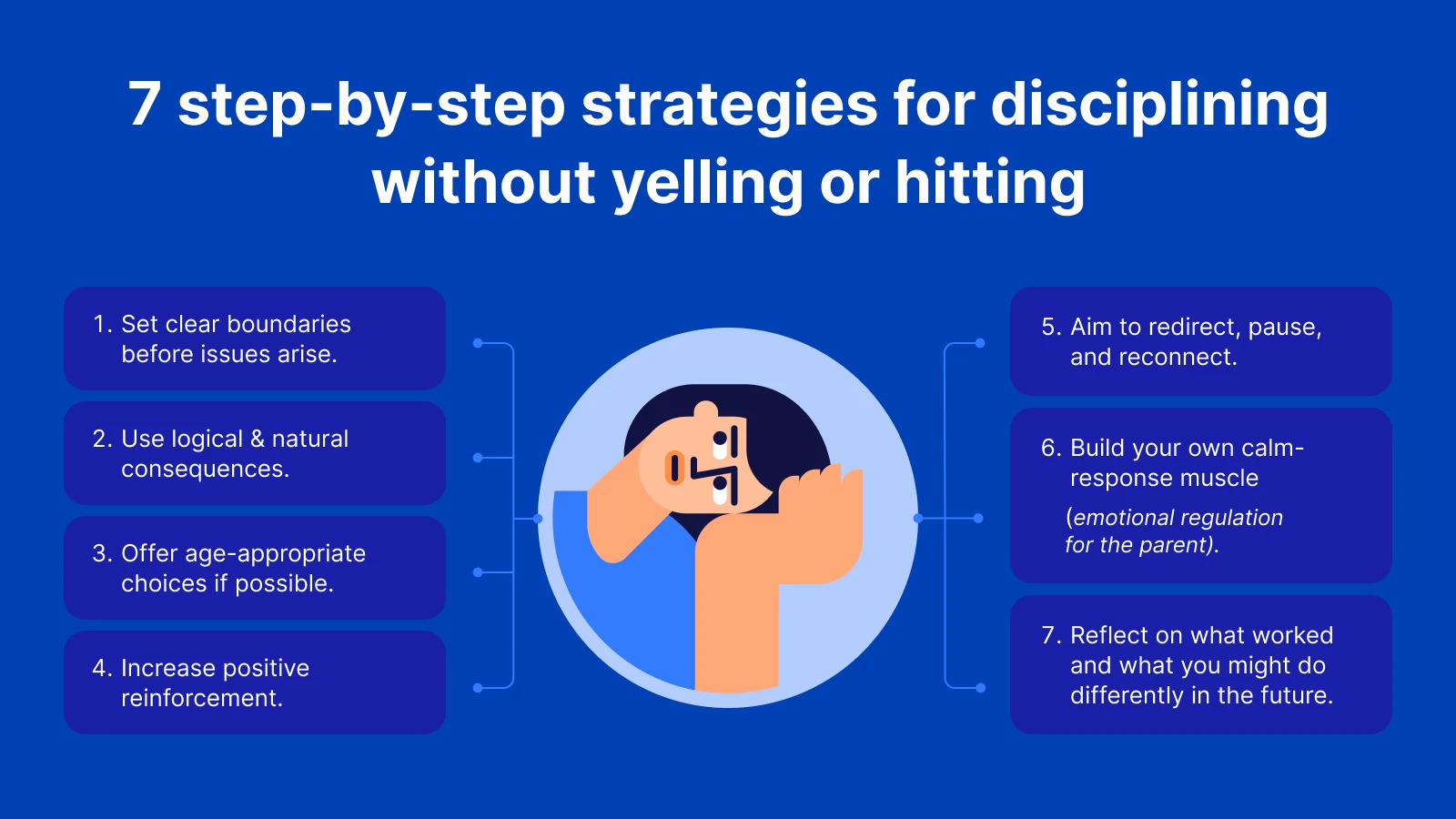
The seven core strategies may be summed up as follows:
Set clear boundaries and rules before issues arise.
Use logical and natural consequences instead of shouting or hitting.
Offer age-appropriate choices whenever possible.
Increase positive reinforcement and reduce reactive discipline.
Aim to redirect, pause, and reconnect.
Build your own calm-response muscle (emotional regulation for the parent).
Reflect on what worked and what you might do differently in the future.
Core step-by-step strategies for disciplining without yelling or hitting
1. Set clear boundaries and expectations for your child
The first step involves thinking about what is reasonable to expect from your child, based on their age and temperament. A child's brain is still developing throughout childhood and the teenage years. Attention span, ability to reason, and self-discipline take time to develop.
Clear and healthy boundaries are helpful to both you and your child. Establish boundaries that are appropriate to the child's age and maturity level. For example, time limits for using a smartphone would be lower for a 12-year-old than for a 16-year-old.
Tip to consider from 'The Whole-Brain Child' by Daniel J. Siegel, MD, and Tina Payne Bryson, PhD: It may be difficult for parents to know what is reasonable for children at different ages, particularly for first-time parents. It's critical to educate yourself first — by reading, talking with other parents, or consulting with healthcare providers.
2. Use logical and natural consequences when the child's actions need correction
Logical consequences are those that would occur naturally if the child didn't follow the rules or guidance offered to them. For example, a school-age child might refuse to wear a coat on a cold winter day. The natural consequence is that the child would be uncomfortably cold for that day, and then less likely to leave home without a coat next time.
Tip to consider, from 'The Explosive Child' by Ross W. Greene, PhD: When an explosive child lashes out, don't try to solve their screaming or hitting. Give them time to calm themself down.
📘 Master calm parenting strategies with Headway.
3. Offer choices and empower the child to make decisions appropriate for their age
A young child as young as four might be given the choice to select what to wear, what snack to have, or what chore to help with. The parents' role is to offer two or three choices that are all acceptable and in the child's best interests.
It's very empowering for a child to have some choice in their daily routines, given that so much of their life is out of their control.
Tip to consider, from 'No-Drama Discipline' by Daniel J. Siegel, MD, and Tina Payne Bryson, PhD: Discipline is about teaching self-control, not about being in control. By offering choices, you're giving the child a chance to make good choices for themselves.
4. Reinforce positive behavior and model emotional regulation
Making a simple comment about positive behavior is a powerful way to reinforce that behavior. If your 5-year-old surprises you by sharing their toys with a friend, you might comment that you noticed them sharing and how kind that was.
Learning to regulate our emotions requires that we first recognize the importance of this skill and understand how it affects our interactions with others. It's crucial that parents learn to regulate their own emotions so that they can interact with children in helpful ways, rather than acting out of frustration.
Tip to consider: Prioritize self-care by taking some time at the beginning of the day for a calming morning routine, even if it's just 10 minutes of silence.
5. Aim to redirect, pause, and reconnect
Instead of reacting immediately, take a moment to pause and take a deep breath to calm yourself. Redirect the child's behavior, particularly with toddlers and school-age children, when misbehavior begins.
A brief time-out for the child is one way to build a pause into a situation in which the current behavior needs to stop. Also consider the alternative, 'time-in,' in which the parent sits with the child to help them calm down during a tantrum or meltdown.
Following a pause during which the child calms down, the parent can calmly reconnect with the child and either let them return to their activity or ask them to complete the original request. When you follow through consistently, children learn what to expect.
Tip to consider: Listening to your child express their feelings and thoughts allows for a connection between you, and this emotional connection facilitates their listening to you.
📘 Master calm parenting with Headway.
6. Reflection prompt box
At the end of each day, give yourself a few minutes to reflect on how it went. Ask yourself:
What did I do differently today?
How did the child respond?
What will I adjust?
Tip to consider, from the article 'Fix Toxic Parenting: 7 Steps to Heal and Reconnect with Your Child': Acknowledge your own mistakes when you recognize them. Your parenting is affected by how you were parented, and you can learn better methods.
7. Celebrate progress
Behavior change isn't easy; give yourself credit for having worked on these strategies for the first week. With continued effort, you will see improvements in your parenting skills and in your child's behavior.



Age-adjusted discipline
How to discipline a child without yelling or hitting at different ages
Toddler (1–3 years)
During these years, children are just beginning to understand rules and to respond when told not to do something. By age 3, they can focus on one activity, although they are easily distracted. Emotionally, they depend on cues from the caregiver in order to manage their distress.
Tip for toddlers:
Teach basic rules to keep them safe. Understand that they cannot predict the consequences of their actions. Encouraging them to pick up toys or clean up after activities helps establish good behavior patterns from an early age.
Early school (4–8 years)
From ages 4 to 8, children develop a basic understanding of right versus wrong, typically based on the consequences of their actions rather than their intent. Their attention span enables them to focus on both an activity and spoken words at the same time. They can begin to use emotional regulation techniques such as deep breathing or asking for help. Physical activity during this stage is also necessary for brain development and emotional regulation. Setting a good example through your own problem-solving helps them learn effective discipline strategies.
Tip for early school-age children:
By ages 4–5, children can be taught to be aware of their emotions. The ability to recognize and name an emotion is the beginning of emotional regulation.
Pre-teen and teens (9–15 years)
During these years, children develop a sense of morals and an understanding that intent is a crucial aspect of human behavior. Emotionally, they tend to turn to their friends for support or to themselves when friends are not available.
Tip for pre-teens and teens:
Providing acceptable choices and building self-discipline become even more important due to increased time away from parents' supervision.
Why yelling or hitting backfires
Why it doesn't work and what it teaches instead
There is overwhelming scientific evidence that corporal punishment is harmful to children's physical and mental health. A 2021 Harvard University study showed that harm results from all forms of physical punishment, including spanking. The American Academy of Pediatrics strongly recommends against the use of harsh punishment of any kind.
Children who are physically punished show a heightened reactivity to mild threats, such as seeing angry expressions on the faces of adults. The heightened reactivity includes an increase in stress hormones, which lead to changes in the structure and function of their developing brains. These changes put them at a disadvantage in reaching developmental milestones and achieving healthy child development.
Children who are disciplined by hitting or yelling also face much higher risks to their mental health. They show higher rates of anxiety, depression, and low self-esteem than children raised with positive parenting methods.
Children who are physically punished are also more likely to become aggressive or violent, with this tendency lasting through adulthood. The use of violence against children reinforces violence and aggression in communities and makes it more likely to repeat from one generation to the next.
Discipline vs Punishment
Unfortunately, many people associate discipline with punishment, but there's a better way to think about it. If we consider that self-discipline and self-control are valued traits, wouldn't we see it as a parent's goal to teach self-control and self-discipline?
Teach vs Control
Punishment implies actions to discourage someone else's behavior and efforts to control the behavior of another. If self-control is the objective, parenting should involve teaching and guiding children to develop their own self-discipline.
Teaching children to cooperate with others and use self-control helps them become responsible adults who have their own moral compass. For more on this topic, see 'No-Drama Discipline' by Daniel J. Siegel, MD, and Tina Payne Bryson, PhD.
What a child learns when you yell or hit:
Shouting or hitting is how adults express anger or solve problems
All strong feelings are expressed with loud, angry responses
To feel fearful or anxious
That they are "bad," "unlovable," or "too much"
To tune you out, if yelling is frequent
That hitting others is an acceptable way to act
What children learn with positive discipline:
How to regulate their own emotions
That what you're saying is important and not to be tuned out
That they are respected and valued
That others should treat them with kindness and respect
That they are safe in their home
That they can come to you with their problems and ask for help
📘 Raise emotionally secure kids with Headway.
The foundation: Parent mindset and brain regulation
It starts with you: How your calm shapes their behavior
The parents' role is to model behavior for the child, helping them grow into responsible, caring, and well-adjusted adults. It's a practice that requires self-discipline by the parent: the ability to manage stress and avoid a reactive mode of responding to the child.
Your child is just learning how to manage their stress and their emotions. To achieve this, they need to have the different functions of their brain working together. Their instinctive reactions, decision-making skills, and relationship skills all need to be integrated over time.
Be patient with yourself as you learn how to discipline your child without yelling or hitting. Your calm may need some practice to handle the particular challenges of parenting. Try the following exercise when you notice that you've lost your calm.
Pause practice for parents
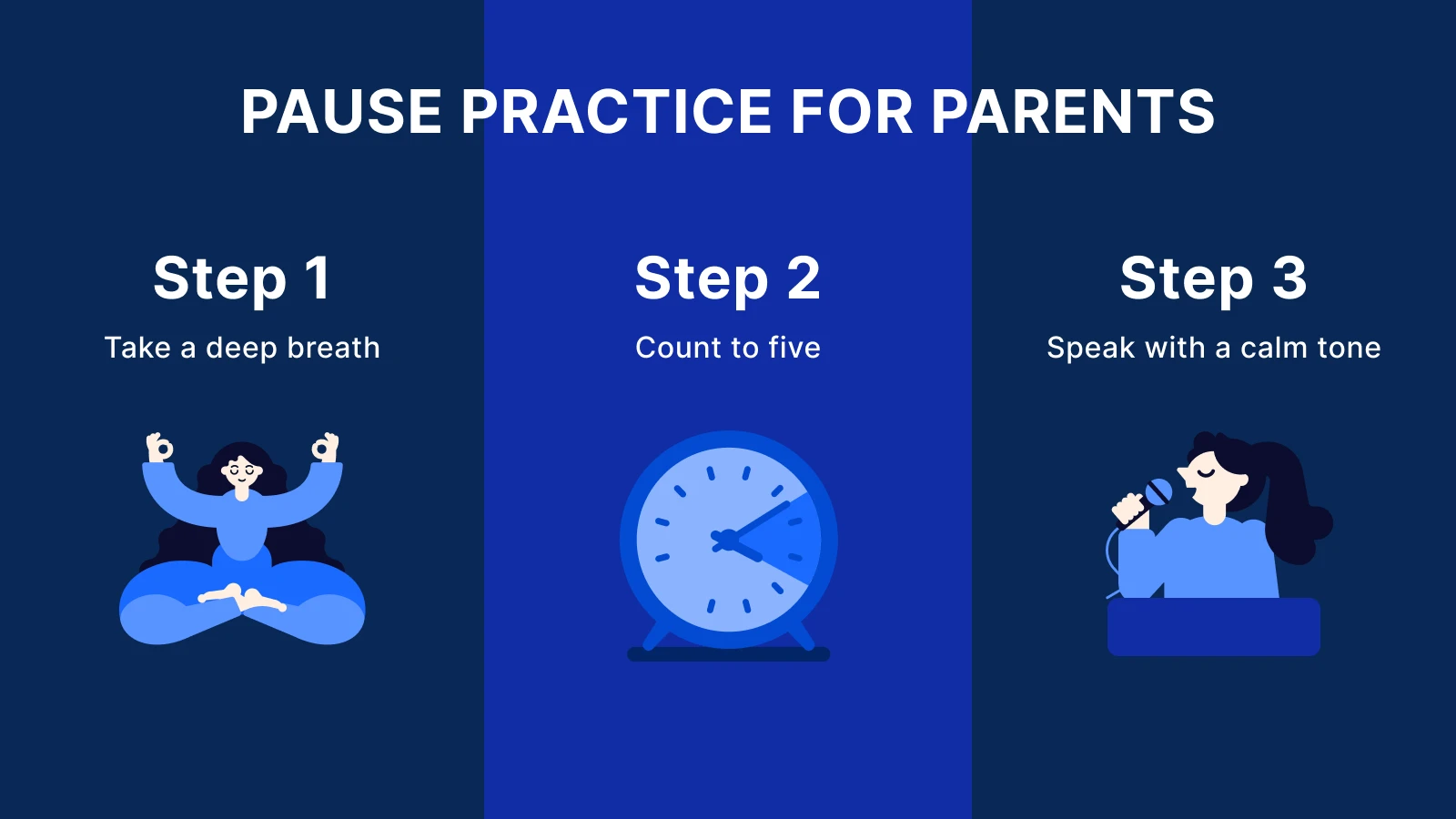
1. Take a deep breath (box breathing is one good technique)
Note: Some children may have special considerations that affect their behavior, such as ADHD. If you notice persistent challenges with your child at any year of age, consult with a healthcare professional for guidance.
2. Count to five
3. Speak with a calm tone
Turn these strategies into a daily parenting habit with Headway
You now have a road map for how to discipline a child without yelling or hitting. The core strategies described here are effective for teaching children to have self-discipline and self-control as they grow into adulthood.
Explore the Headway summaries mentioned here, as well as others, to deepen your knowledge and stay consistent with positive parenting skills. You might download the Headway app (free trial) to check out summaries of recommended books on parenting.
Frequently asked questions on how to discipline a child
Why is yelling or hitting bad for discipline?
Yelling or hitting is bad for discipline because these actions seriously harm children's physical and mental health while also making it less likely that the child will be able to listen to and learn from the parent. These acts do not teach emotional regulation or self-discipline.
How can I discipline my child without yelling or hitting?
Set clear boundaries and age-appropriate expectations. Use natural consequences whenever possible. Employ positive reinforcement. Build your own capacity to calm yourself when stressed. Model self-control by pausing before responding. Listen to the child and provide choices whenever possible.
What should I do if my child doesn't respond to calm discipline methods?
If your child isn't responding to calm, discipline methods, consider seeking help from a mental health provider. Your child might have additional challenges that need to be addressed, such as an attention deficit, a learning disability, or a temporary life situation that is overwhelming them.
Is it okay to yell occasionally?
Yes, it's okay to raise your voice occasionally, but not frequently. We all have days when our ability to cope with life stressors is tapped out. Even on those occasions, it's not okay to create fear or demean a child. Verbally abusive comments are never okay.
How do I stay consistent with non-punitive discipline methods?
One way to stay accountable is to share your goal with a trusted friend or relative who can offer encouragement and check in on your progress. Another way to stay consistent is to continue reading about the benefits of positive parenting methods.