Self-growth
 Business & Career
 Success
 Communication
 Healing
 Relationships
 Psychology
 Happiness
Let's be honest about something.
Most people aiming for a top job have absolutely no plan. They rely on vague ambitions, hoping that simply keeping their heads down and doing good work will eventually get them promoted. But in today's hyper-competitive business world, it won't.
If you want to learn how to become a CEO, realize the path isn't straightforward. You must build the right experiences, networks, and habits that signal you are ready for leadership.
I've coached countless professionals who aimed for the C-suite. The gap between those who make it and those who don't is rarely raw intellect. It almost always comes down to intentionality.
Winners don't just stay in their lane and wait for their turn. They master executive competencies. They execute a targeted strategy to get there.
That's exactly what this guide will help you build. To speed up your learning, I'll reference several game-changing strategies and learning tips.
The Headway app is one of the tools I recommend to clients who want to speed up their learning, as it gives them access to powerful book summaries in 15 minutes a day. I'll reference several of those books throughout this piece.
📘 Speed up your learning with powerful summaries on Headway!

Quick summary: Five key steps to becoming a CEO
Step 1: Start early with a growth mindset
Step 2: Gain experience across multiple functions
Step 3: Build your emotional intelligence (EQ)
Step 4: Network strategically with decision-makers
Step 5: Hone your decision-making skills under pressure
Seven steps to become a CEO: Your detailed roadmap
Stop leaving your executive trajectory to chance and start executing this proven, step-by-step blueprint to the top.
Step 1: Start early with a growth mindset
Here's something most people don't realize: you don't start becoming a CEO when you get the title. It starts years earlier, in how you approach your current job, handle feedback, and treat every role as a chance to learn, not just earn a paycheck.
Dean Graziosi puts it well in 'Millionaire Success Habits': the difference between highly successful people and those who struggle is almost entirely about their daily habits.
The person taking ownership of outcomes, asking for feedback, and seeking to understand the business one level above their job title is the person who gets noticed.
Start by reading like an executive. If you want to read like a CEO, focus on strategy, psychology, leadership, and your own business. Set aside 20 to 30 minutes a day. It might sound small. But over five years, it's enormous. Just do the math!
📘 Master executive competencies in 15 minutes daily with Headway!
Step 2: Gain experience across functions
This one trips up many high performers I work with. They're great at finance, marketing, or operations, so they keep getting promoted within those lanes. Then they wonder why they're not considered for the top job.
CEOs need to understand how the whole business works, not just their corner of it. That means deliberately seeking lateral moves, volunteering for cross-functional projects, and being willing to take a step sideways (or even backward) to build breadth.
The question to ask yourself right now: Do I understand how every major function in my company makes and spends money? If the answer is no, that's your next development goal. Remember that up isn't always just up.
Step 3: Build your emotional intelligence
To be direct, your emotional intelligence matters more than your IQ at the executive level. That's the truth.
Technical skills are just the basics. When you're aiming for a VP or C-suite role, everyone is smart and capable. What sets you apart is whether people trust you, want to work with you, and believe you understand group dynamics.
John Mackey's 'Conscious Leadership' makes a point that resonates with me every time I coach senior leaders: effective leadership is about genuinely caring for people and acknowledging the broader impact of your decisions. Leaders who treat people as headcount don't make great CEOs.
Leaders who treat them as the actual product of the company do.
Developing EQ isn't soft work. You have to practice active listening, get comfortable with conflict, and ask more questions than you answer. Create an environment where people tell you what you need to hear, not just what you want to hear.
Oh, and they notice when you're listening.
📘 Build your intentional path to the C-suite on Headway!
Step 4: Network strategically
Let's clear up a common mistake: most people don't network the right way.
Some people attend events, collect business cards, and connect on LinkedIn, but then wonder why their network doesn't help them. That's not real networking; it's just collecting contacts.
True networking means building real relationships with people you respect, helping others without expecting anything back, and staying visible to decision-makers.
Five real CEOs have shared what they consider the best career advice, and a recurring theme is that the right relationships, built over years, created opportunities that no amount of applying ever could.
The CEO role, whether in tech, finance, or even healthcare, is almost always filled by someone the board members already know or trust. Your job is to be in that circle before the seat is open. Advocacy means more than mentorship, so build that level of relationship.
Form one practical habit. Send one meaningful, non-transactional message per day to someone in your professional network. Not a pitch. A thoughtful follow-up, a relevant article, or a genuine congratulations.
Do that for a year and watch what happens. Never expect anything in return, just do it!
📘 Read like an executive starting today with Headway!
★★★★★ 172K+ reviews
Empower yourself with the best insights and ideas!
Get the #1 most downloaded daily growth app.
Get startedStep 5: Hone your decision-making skills
CEOs get paid to make decisions. Often hard ones. Often, with incomplete information and real consequences. If you're someone who needs 100% consensus before every call, or who agonizes indefinitely rather than committing, that's a pattern you need to work on now, not when you have the top job.
Start keeping a decision journal. Every significant call you make, write down the decision, your reasoning, and what outcome you expected. Review it monthly.
This part is one of the fastest ways to calibrate your judgment and catch your own blind spots before they cost you. It sounds like a lot of work, but it pays off in the end.
Reed Hastings built Netflix by questioning every assumption about an existing business model. He didn't just follow his passion; he stayed curious, experimented with bold ideas, and made calls that most people thought were wrong.
That kind of evidence-based conviction is what boards are looking for in a CEO.
📘 Build daily habits that compound over years on Headway!
Step 6: Lead with vision
Here's a question I ask every client who wants to move into the C-suite: Can you describe, in three sentences, where you want to take this company and why that direction is right?
Most people can't. And that's a problem.
CEOs are expected to set direction, not just manage day-to-day execution. That means developing the habit of thinking one, three, and five years out. It means reading enough about your industry and adjacent ones that you can see trends before they arrive.
And it means communicating that direction in a way that actually gets people moving.
The way leaders like Marcus Aurelius approached long-term thinking, grounding decisions in clear values and keeping the long view front and center, is a model that translates directly into modern executive leadership. Know where you're going. Be able to explain it to a ten-year-old.
📘 Learn 'Millionaire Success Habits' in minutes on Headway!
Step 7: Cultivate resilience
I'm not going to sugarcoat this: the road to becoming a CEO is full of setbacks. Failed initiatives. Bad quarters. Missed promotions. Bosses who don't sponsor you. Boards who pick someone else. If you're waiting for a clean runway, you'll be waiting forever. Thick skin matters here.
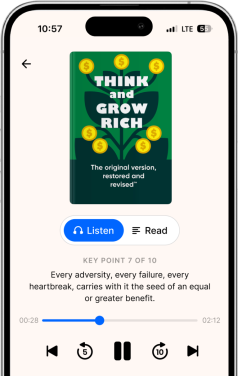
Napoleon Hill's 'Think and Grow Rich' is still one of the most referenced books in leadership, making a core argument that holds up: persistence in the face of failure is not stubbornness.
It's the single most consistent quality in people who eventually achieve their goals. The difference between people who become CEOs and those who plateau isn't talent. It's tolerance for ambiguity and the ability to get back up after a very public stumble.
Build your resilience now. Exercise. Sleep. Get a coach (yes, I'm biased). Surround yourself with people who challenge you and tell you the truth. Your future self will thank you.
📘 Develop leadership EQ with insights from Headway!
Eight daily habits of future CEOs: Find your secret to success
The gap between aspiring and arriving almost always comes down to daily discipline. Here are eight habits that build the skills you need, one day at a time. Nothing revolutionary here. Just the stuff that actually works.
1. Morning reflection and strategic planning (10 min)
Robin Sharma's 'The 5 AM Club' argues that winning the morning is the first step to winning the day.
You don't need to wake up at 5 AM like a Marine, but you do need to start with intention, not your inbox. Spend 10 minutes reviewing your top priorities before the day hijacks your attention.

Start your day with intention and get practical insights.
Trigger: Do this before you check your phone (as hard as that is).
2. Strategic reading (20–30 min)
CEOs are almost universally voracious readers. Use the Headway app to absorb key leadership and business insights in 15 minutes of focused listening. Over a year, that compounds into a serious competitive edge.
Trigger: Pair it with your morning coffee or commute.
📘 Trust beats intelligence at the top, learn how on Headway!
3. One real networking touch per day (5–10 min)
Skip the pitch or the connection request. Instead, send one meaningful, non-transactional message to someone in your network. Over time, this quietly builds valuable relationships.
Trigger: Schedule it right after lunch.
4. Deliberate delegation (throughout the day)
If you're still doing work that a more junior person could own, you're not building CEO skills; you're avoiding them.
Practice identifying what only you can do and letting go of the rest. This builds the trust, problem-solving skills, and team members' capacity that senior leaders depend on.
Trigger: Review your task list each morning and ask, "Who else could own this?" Then give it to them.
📘 Calibrate your judgment faster with Headway!
5. Daily decision log (5 min)
Each day, write down one important decision you made, your reasons for it, and what you expect to happen. Review these notes each month. This habit improves your judgment quickly.
Trigger: Five minutes before you close your laptop.
6. Microlearning through book summaries (15 min)
Use Headway to learn about a new topic each week, such as negotiation, financial literacy, communication, or building company culture. Future CEOs are generalists who develop expertise where it's needed.
Trigger: Listen during a workout or walk.
7. Physical and mental recovery (30+ min)
I can't stress this enough. CEOs who burn out don't make it. Exercise, sleep, and unplugged downtime are not luxuries.
'Conscious Leadership' explicitly calls out self-care as a cornerstone of sustainable leadership, and in my coaching work, the business leaders who neglect this are always the ones who hit a wall at exactly the wrong moment.
Trigger: Block it in your calendar like a board meeting.
📘 Build evidence-based conviction with Headway!
8. Weekly vision review (15 min)
Once a week, look at your long-term goals. Are your daily actions actually aligned with where you're going? Adjust as needed. 'Millionaire Success Habits' makes the point that understanding the why behind your actions is what keeps you going through the hard stretches.
Trigger: Sunday evening, before the week starts.



Who is a CEO?
A CEO (Chief Executive Officer) is the highest-ranking executive in an organization. They're ultimately accountable for the company's strategy, culture, performance, and direction. They answer to the board of directors and represent the organization externally. Everything flows through or past them.
Core CEO responsibilities include: setting strategic direction, building and leading the executive team, managing financial performance, communicating with investors and the board, and driving organizational culture.
How does a CEO differ from other C-suite and executive roles?
Think of it this way. The CFO owns the money. The COO owns the operations. The CMO owns the brand. The CTO owns the technology. The CEO owns the whole thing, including all of them.
They set the vision that every other function executes against, and they're accountable when any of it goes sideways. The buck stops with the CEO.
📘 Build tolerance for ambiguity with wisdom from Headway!
Seven core CEO skills you need to master
Raw talent won't earn you the corner office, but mastering this specific arsenal of executive skills absolutely will.
Leadership and communication: You can't lead what you can't articulate. Learning to speak like a CEO is a real skill, and it's learnable. Communication skills are critical.
Strategic thinking: Seeing the big picture, reading the market, and setting long-term direction.
Decision-making: Committing confidently in the face of uncertainty and owning the outcome.
Financial literacy: Understanding profit and loss (P&L), cash flow, capital allocation, and what your numbers actually mean.
Adaptability: Pivoting strategy, learning from failure, and not being precious about your ideas. Acting like a seasoned executive and an entrepreneur all in one day.
Emotional intelligence: Managing relationships, navigating conflict, and building a culture people want to work in.
Execution under pressure: Delivering results consistently, even when things are on fire. Leveraging previous work experience to get through tough situations.
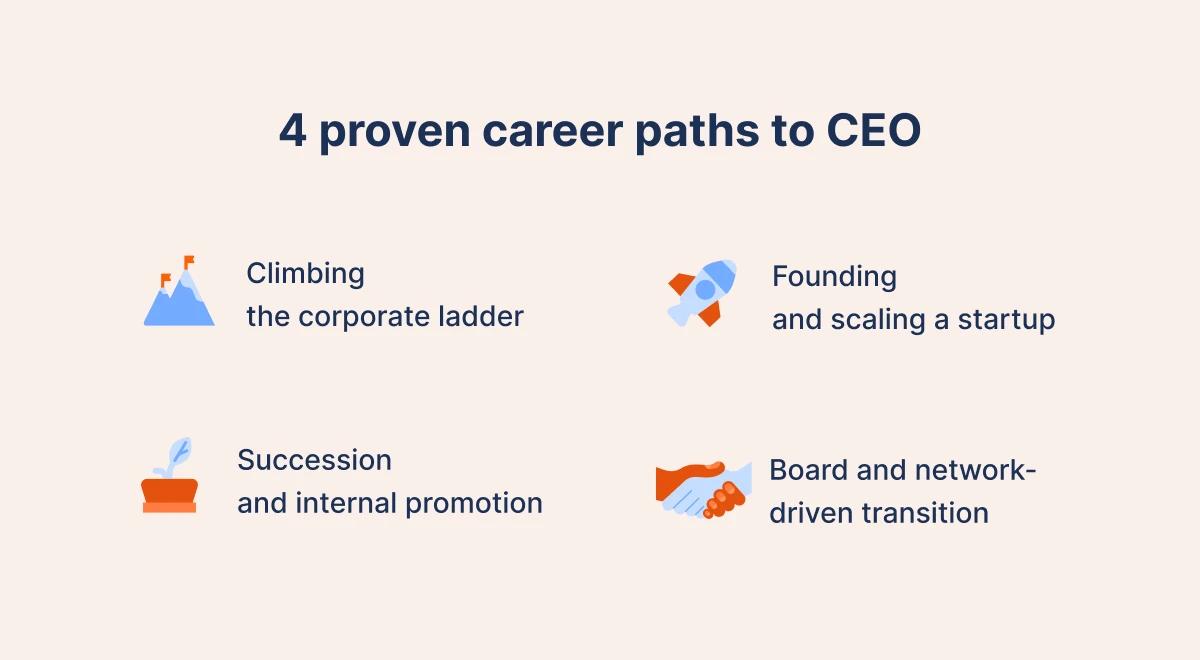
Four proven career paths to CEO
Forget the myth of a single corporate ladder; here are the four distinct, battle-tested routes you can actually take to claim the top job.
Map out your leadership journey — take our quiz.
1. Climbing the corporate ladder
The classic route. Join a company, perform well, get promoted, build a track record across functions, and earn your way into the top job.
Pros: Deep institutional knowledge, visible track record, internal sponsorship.
Cons: Can take over 20 years; you're subject to organizational politics and timing. Timeline: 15–25 years.
2. Founding a startup
Start your own company or join a startup in a senior role where becoming CEO is a real possibility.
Pros: Fastest path to the title; the most compressed learning environment.
Cons: High failure rate, no safety net, and relentless pressure. Timeline: 3–10 years to a meaningful scale.
📘 Get back up after setbacks using strategies from Headway!
3. Internal promotion through succession programs
Many large companies have formal programs to identify and develop future leaders. Being chosen early can speed up your path to CEO.
Pros: Structured mentorship, stability, visibility to the board.
Cons: Competitive; requires patience. Timeline: 10–18 years.
4. Transition via board or network
Executives who build strong board relationships as advisors, non-executive directors, or investors often find CEO opportunities through those connections. Boards hire people they already trust.
Pros: High signal, pre-existing credibility.
Cons: Takes years to build the network first. Timeline: 15–20+ years.
📘 Start with 'The 5 AM Club' and win your mornings on Headway!
Education, experience, and skills: Your CEO timeline
Timing matters, so here's what to focus on at each stage of your career to be ready when the opportunity comes.
Years 1–5: Build the foundation
Master your craft. Demonstrate high performance. Take on your first leadership responsibility, even if it's a team of two.
Pursue an MBA or other master's degree, or even a bachelor's degree, or executive education if it gives you access to the network and roles of a CEO you need. Start thinking like an owner, not just an employee.
Years 5–15: Expand and accelerate
Here's where most aspiring CEOs make or break their trajectory. Cross functions deliberately.
Take on P&L responsibility. Look for what researchers have called "career catapults," turnaround situations, large-scale transformation projects, roles with scope that's far beyond your current experience.
These are the experiences that build the track record boards actually look for.
Years 15+: Position for the top
By now, the most important work is reputation management, stakeholder alignment, and being the obvious internal candidate, or building the external profile that makes you a credible external one.
Boards want evidence of sustained performance, resilience under pressure, and the ability to lead at a level they can trust.
📘 Absorb leadership insights during your commute with Headway!
Your eight-week CEO learning routine from top experts
One of the most practical things you can do right now is commit to a structured reading plan. Here's an eight-week program built around five books, all available on the Headway app with daily checklists and reflection prompts you can actually use.
Weeks 1–2: Leadership mindset
'Conscious Leadership' (10 min/day). Focus on what it means to lead with purpose, not just performance metrics. Reflection prompt: Am I making decisions based on my values or just based on what makes me look good?
'Think and Grow Rich' (10 min/day). Napoleon Hill's framework for persistence and goal-setting is old but holds up. Reflection prompt: What belief about myself is the biggest obstacle to the next level?
Daily checklist:
☐ Listen to the summary
☐ Write one leadership insight
☐ Identify one action that reflects your values
Weeks 3–4: Decision-making and strategy
'No Rules Rules' (10 min/day). Reed Hastings built one of the world's most innovative organizations by hiring exceptional people, giving them real freedom, and holding them to real accountability.
There's a lot to learn here about what good culture actually looks like versus what most companies pretend it looks like. Reflection prompt: Where in my team am I tolerating mediocrity because the conversation feels uncomfortable?
📘 Start the 8-week CEO plan today on Headway!
Daily checklist:
☐ Listen to the summary
☐ Log one significant decision and your reasoning
☐ Identify one assumption you might be wrong about
Weeks 5–6: Productivity and growth habits
'Millionaire Success Habits' (10 min/day). Get honest about which of your daily habits are actually moving you forward and which ones are just comfortable routines dressed up as productivity.
Reflection prompt: What is one thing I do every day that I would never advise a client to do?
Daily checklist:
☐ Listen to the summary
☐ Track one new habit
☐ Write down your why behind this goal
Weeks 7–8: Rhythm and resilience
'The 5 AM Club' (10 min/day). Build the morning routine that sets the tone for how you show up all day. Reflection prompt: How do I start my day, and does it reflect the leader I want to become, or the one I'm trying to move past?
📘 All five books in one place, ready to learn on Headway!
Daily checklist:
☐ Wake up 20 minutes earlier than usual
☐ Complete your morning reflection
☐ Review your goals before the first meeting of the day
Real CEO stories: Leadership in action
One of the stories I keep coming back to in 'Conscious Leadership' is the NASA janitor. When President Kennedy asked a janitor at NASA what his job was, the man said he was helping put a man on the moon. He wasn't mopping floors. He understood the mission.
That kind of purpose-driven thinking, connecting what you do every day to something larger, is exactly the mindset that separates top executives who rise to CEO from those who plateau.
Reed Hastings is another example worth studying.
He built Netflix not by being the most technically gifted person in the room, but by staying relentlessly curious, questioning business models that everyone else accepted as fixed, and being willing to make bets that looked wrong before they looked right.
Adaptability, conviction, and a tolerance for being misunderstood are real CEO traits.
So, what's the common thread? It's not a perfect background or elite schooling. It's adaptability, resilience, and the ability to bring other people along with you.
📘 Build your executive knowledge base daily with Headway!
Become a successful CEO with Headway book summaries
The fastest-developing leaders I work with have one thing in common: they read constantly, and they apply what they read. Not just passively absorbing ideas but actively testing them in their work.
The Headway app makes this genuinely easy, with expert-curated summaries of the world's best leadership and business books, designed to be consumed in 15 minutes or less. Whether you're working through 'Conscious Leadership,' 'No Rules Rules,' or 'Think and Grow Rich,' you can build your executive knowledge base one day at a time, even on the busiest weeks.
Start the eight-week plan above. Come back to it. Adjust. And if you want a thought partner to help accelerate the path, let's talk.
FAQs
How do you become the CEO of a company?
Most CEOs get there through one of four paths: climbing the corporate ladder across multiple functions (often starting from an entry-level position), founding a startup, earning an internal promotion through a succession program, or being brought in through a board or network relationship. In every case, cross-functional experience, consistent high performance, and strategic visibility are non-negotiable.
What is a CEO's job salary?
It varies enormously by company size and industry. In the US, large public company CEOs often earn base salaries over $1 million, with total compensation including bonuses, equity, etc., reaching several million annually. Leaders at smaller companies, startups, and nonprofits earn significantly less. Don't pick the goal because of the salary. Pick it because you actually want to lead organizations.
How does anyone become a CEO?
There's no single path. While many candidates hold a traditional business degree or have graduated from prestigious MBA programs, others dropped out of college entirely. What they all share is sustained high performance, the ability to learn from failure, years of experience, and the highly developed soft skills necessary to get other people to follow them willingly into leadership roles. That last one matters more than most people realize.
Is being a CEO a good job?
For people who are driven by impact, building things, and high-stakes leadership, yes, it can be deeply fulfilling. Still, the role of CEO is relentlessly demanding, with high accountability, public scrutiny, and very few places to hide when things go wrong. It suits people who thrive under pressure and genuinely want to be responsible for something bigger than themselves.
What jobs lead to the CEO?
The most common functional backgrounds among Fortune 500 CEOs are operations, finance, sales, general management, and increasingly, business administration. Roles like COO, CFO, Division President, and Managing Director are frequent stepping stones because they build the exact cross-functional expertise a CEO needs to thrive. Technology and product backgrounds are increasingly common paths as well.
How long does it take to become a CEO?
On average, it takes 15 to 25 years to reach a large-company CEO role, though startup founders can get there much faster. The timeline depends heavily on the industry, company size, and how deliberately you've built cross-functional and leadership experiences along the way.
What if I want to be a startup CEO?
If your goal is driven by entrepreneurship, start by finding a problem you understand deeply and can't stop thinking about. Build functional skills in product, sales, or technology to round out your skill set. Find co-founders who cover your weaknesses. Get a mentor who's done it before. And commit to learning faster than everyone around you, because in a startup, the feedback loops are brutal and the cost of learning slowly is very high.