Self-growth
 Business & Career
 Success
 Communication
 Healing
 Relationships
 Psychology
 Happiness
What happens when an assassin stops running from her past and finally claims her true name? 'Heir of Fire,' the third book in Sarah J. Maas's 'Throne of Glass' series, is where everything changes. Celaena Sardothien travels to Wendlyn, faces her deepest fears, and begins her transformation into Aelin Galathynius. Keep reading as we break down the plot, characters, and themes that make this book the turning point of the entire series.
If you love stories that combine personal growth with epic adventures, you'll find plenty more on the Headway app. Join 50 million users enjoying short, easy-to-read summaries on different topics, making it simple to dive into inspiring content anytime.
'Heir of Fire' summary — quick overview
'Heir of Fire' by Sarah J. Maas is about transformation and survival. Here, we'll discuss the storyline, the complexity of the characters, and the themes in the book. Maas's work aligns with Headway's vision, which is to give readers the knowledge necessary for personal development and growth.
This article contains many spoilers. These spoilers may be particularly helpful if you've already read the book and are looking for an in-depth analysis.
Some key points:
'Heir of Fire' is the third book in Sarah J. Maas's 'Throne of Glass' series, marking a shift in tone and scope.
It introduces new characters like Rowan Whitethorn and Manon Blackbeak, while expanding the world beyond Adarlan.
Themes of identity, trauma, rebellion, and self-development make this book a turning point in Celaena's journey.
Love short and informative reviews?
Dive into 2k+ book summaries and discover something new every day.
ContinueBook at a glance: Basic details about 'Heir of Fire'
What is 'Heir of Fire'?
'Heir of Fire' is a young adult fantasy novel by Sarah J. Maas, and it follows mainly Celaena Sardothien as she journeys to Wendlyn, where she confronts her past and begins to embrace her true identity as Aelin Galathynius, heir to Terrasen. Several other characters step into the spotlight too — and we’ll explore their roles in more detail shortly.
Quick facts: What you need to know about book three
Series number: Throne of Glass #3
Author: Sarah J. Maas
Publication date: September 2, 2014
Genre: YA Fantasy, Romance, Adventure
Page count: Approximately 565 pages
Perspective: Third-person multiple POV
Plot summary: How Celaena becomes Aelin across three storylines
The plot of 'Heir of Fire' consists of three parallel storylines, each with its own individual focus and style. One part follows Celaena as she travels across Wendlyn, others focus on the power plays occurring in Adarlan and the emergence of witches from the Ferian Gap.
Each of these arcs carries significant emotional weight for the overall storyline, helping to flesh out the characters, develop their relationships, and expand the series' setting. We've grouped the events into four sections, based on character and location, to gain a better look at the plot.
Part one — Wendlyn & the Fae
Celaena's time in Wendlyn is focused on her emotional rebirth. She trains at Mistward, a Fae fortress in the mountains, where Rowan's methods force her to confront truths she has long buried: her guilt over surviving the attack on her family, many years ago, as well as Nehemia's death. These two traumas make her feel unworthy of her destiny.
At Mistward, she finds unexpected allies like Emrys, the wise cook who offers her comfort and guidance. Surrounded by Fae warriors and demi-fae who serve at the fortress, she begins to understand the complexities of Fae society. Along with unlocking her fire magic, she discovers her inner strength, highlighting the importance of mentorship and discipline.
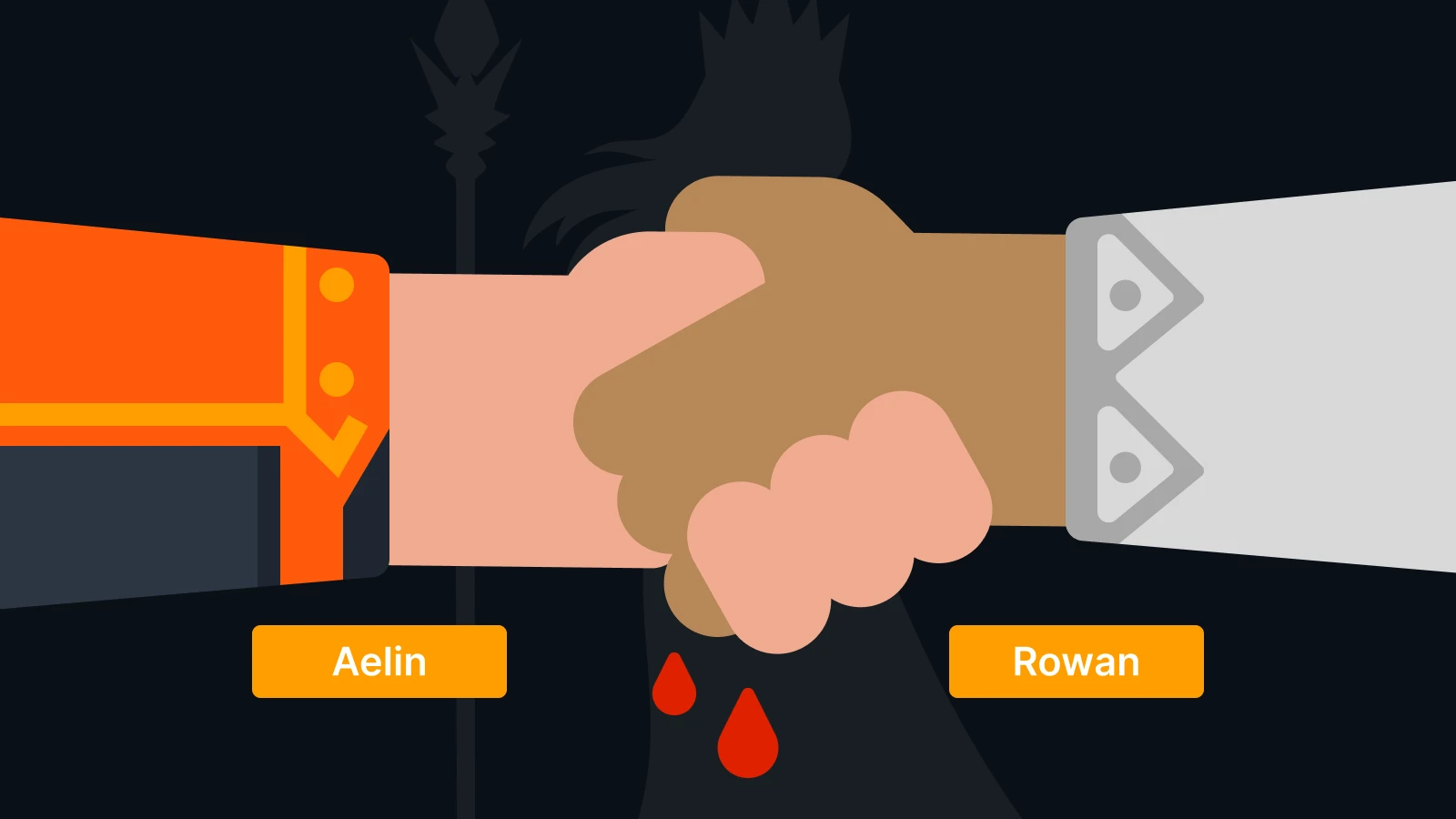
Celaena and Rowan's relationship evolves into one of profound trust, and both characters begin to heal once they embrace their vulnerability. Wendlyn becomes not only a place of renewal and discovery, but also a battlefield, as the two confront an unexpected enemy that feeds on their pain. Together, they face Maeve, the Fae queen of Doranelle, and Rowan takes a blood oath to the future queen Aelin, making their bond stronger.
Part two — Adarlan & the stakes
In Rifthold, the king begins abusing his power more openly, and political tensions rise. Chaol is torn between protecting Celaena and remaining loyal to the ruling family, while Prince Dorian struggles to control his magic. He finds solace in one of the healers, Sorscha, who slowly becomes more than a friend.
Chaol and Dorian's friendship starts to break, with both of them keeping secrets from each other. The captain doesn't tell him about Celaena's identity, and the prince is afraid to mention his magic. The tension between them mirrors the rising conflict between the king and the rebels in Adarlan.
Part three — The Ferian Gap & Manon
The Gap is where the strongest aerial force is created, where witches are paired with wyverns to create a new type of army. Manon is a new addition in book three. She is heir to the Blackbeak Clan of Ironteeth witches, alongside the Yellowlegs and Blueblood clans, and known as the "White Demon" for her lethal skills. Yet her bond with Abraxos, a wyvern considered unfit for battle, shows a compassionate side that could become a weakness for a Wing Leader of the Thirteen (the elite coven).
The action in the Ferian Gap, with the introduction of the witches' culture and traditions, expands the series' universe. It also underlines the king's ambition to dominate magic and use it as a weapon, whether terrestrial or aerial.
The ending & setup for what's next
The ending places our characters in completely new positions, and it opens the door to new challenges. Celaena finally accepts her role as Aelin Galathynius, heir of Terrasen, and Rowan pledges his loyalty. However, their paths separate, for now at least.
In Adarlan, Dorian's magic spirals out of control when the king kills Sorscha, while Chaol gives up his position and joins the resistance. Manon is named the leader of the wyvern army, and she is ready to receive orders.
The ending brings together all the storylines, and the action moves from characters who follow their own objectives to a global conflict.



Key characters you should know: Who drives the story forward
The strongest aspect of 'Heir of Fire' is the complexity of its characters, as each one represents a certain theme. Sarah J. Maas alternates between personal struggles and the accomplishment of larger goals, as most epic fantasy stories do. But let's look in detail at each key player and see how they contribute to the plot.
Celaena Sardothien / Aelin Galathynius: Celaena's journey pushes her to face her past and finally accept her true identity as heir of Terrasen. She goes through a painful transformation process, where she confronts memories long buried, but it's the only way to release her powers. She finds friends and allies and discovers the king's plan. All of this contributes to her growth, with Celaena/Aelin representing the struggle between who we are and what we are meant to become.
Rowan Whitethorn: Rowan is introduced as a tough Fae warrior tasked with training Celaena in using her powers. He is the symbol of discipline and plays an important role in Celaena's growth. Yet with every dangerous situation they face, their relationship becomes stronger, and Rowan finally pledges his allegiance to her. His introduction helps the reader understand Fae culture, with its ancient traditions rooted in the time of Queen Mab and the old Fae kingdoms.
Dorian Havilliard: As the crown prince of Adarlan, Dorian struggles with understanding and containing his magic while distancing himself from his best friend in the process. He wants to be a better king than his father and deals with the fear of being consumed by power. His character shows that leadership is not about privilege, but sacrifice. He cannot be seen in public with certain people, and he cannot express his unfiltered opinions.
Chaol Westfall: As the captain of the Guard, he is torn between his love and loyalty to Celaena and his duty to the crown. He is one of the most conflicted characters. By the end of the book, he sees her with completely different eyes, and this change, as well as the events in the final chapters, influences Chaol and Aelin's relationship in the next book. However, his moral choices don't change. He remains a believer in Prince Dorian as the ideal king, and he fights for that vision until the end.
Manon Blackbeak: Manon is heir to the Blackbeak witch clan, and she is described as ruthless and ambitious. As another main character in the story, she represents the duality of the human character, with her strong personality showing emotion when it comes to Abraxos. She finds a part of herself in the wyvern, which is why she fights for and alongside him. Manon becomes the image of a true leader, one who must remain feared and, at least apparently, merciless.
Aedion Ashryver: As the general of the King of Adarlan's Northern Army, he is also Aelin's cousin. Initially introduced as a fierce, yet charismatic warrior, supporting the king and doing his bidding, Aedion is actually loyal to Terrasen and its people. He is a symbol of hope, also known as the "Wolf of the North." Aedion's introduction extends the plot beyond Celaena/Aelin's journey, showing that while she trains in Wendlyn, others are fighting to preserve her legacy.
📘 Discover your true identity with Headway.
Major themes & takeaways: What 'Heir of Fire' teaches about growth and power
Through its themes, 'Heir of Fire' becomes a meditation on identity and the choices that define us. Some of the characters refuse their destiny, while others fight for what they believe in until the last moment. The personal growth described in the novel aligns with Headway's mission of learning through introspection.
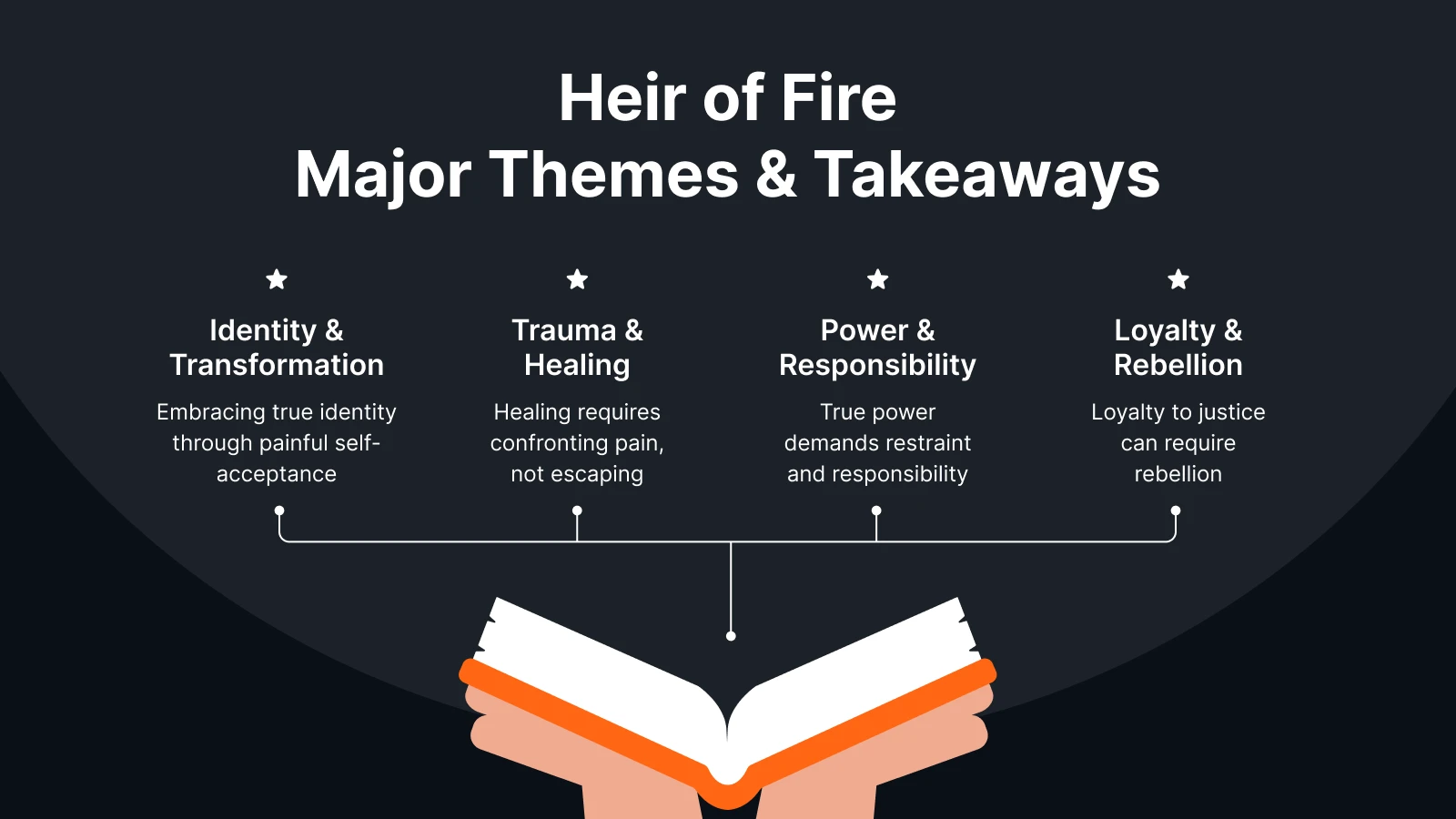
Identity & Transformation: As a central theme in the book, this transformation is visible in Celaena's journey to embrace her true Fae form and identity as Aelin Galathynius. In Wendlyn, through Rowan's training, she finally acknowledges who she is meant to be, claiming her authentic self. Rising from the ashes of her past pain and trauma, she becomes the heir of ash and fire, reborn with purpose. This journey shows that growth often requires us to confront uncomfortable realities.
Trauma & Healing: Woven into Celaena's grief over Nehemia's death and Rowan's own scars, healing proves to be a painful process. The strongest enemy they face, the valg, feeds on their pain. The novel suggests that trauma cannot be ignored or buried; it must be acknowledged and worked through. This theme resonates as a reminder that growth often comes from facing pain directly, rather than running from it.
Power & Responsibility: Dorian's character arc shows the theme of power and responsibility. Once he discovers his magic, he becomes afraid of losing control. The idea that power is an obligation, not a right, stresses the true essence of leadership — using power for the common good and not selfishly for personal purposes.
Loyalty & Rebellion: Through Chaol and Aedon, we see the strength that comes with loyalty. The rebellion subplot reinforces that loyalty to justice often requires rebellion against tyranny. Chaol is captain of the Guard and thus bound to the king, but his loyalty to Celaena pulls him in the opposite direction. Aedion lives a dangerous double life, apparently working for the king, while becoming a point of reference for those who seek a change in leadership.
Why this book matters: How 'Heir of Fire' shifts the entire series
The third book in the 'Throne of Glass' series shows how each character evolves, in preparation for the war that is soon to start. This 'Heir of Fire' summary reveals how the series shifts upward, with the transformation of Celaena's personal journey into a global rebellion:
Introduction of Rowan & Manon: They are two of the most influential characters introduced. Rowan becomes Celaena's mentor and ally. Later in the story, he becomes much more involved, with their connection being deeper than they expected. Manon adds a whole new dimension, representing the witches' culture and their role in the larger war.
Expansion to Wendlyn & Witch Clans: By moving Celaena to Wendlyn, the author expands the world beyond Adarlan's borders. Readers are introduced to Fae traditions and ancient magic that enrich the experience inside the universe. The king's influence now stretches beyond his empire, as he builds his army of witches at the Ferian Gap. This element is key in any epic fantasy story.
Tone Shift Toward Epic War: The earlier books were focused on Celaena's survival, but 'Heir of Fire' shifts the tone toward an epic war. With the addition of the wyvern armies and Fae warriors, the tension is elevated in preparation for the grand battle.
Stakes Raised for Adarlan's Empire: The king's tyranny becomes more and more oppressive, and the rebellion must grow stronger. Aedion is a figure of reference, having a strong belief in Aelin's return. In his desire to protect her, Chaol joins him as well. This escalation ensures that the series moves toward its climax, where the fate of kingdoms hangs in the balance.
Should you read it now? When to pick up 'Heir of Fire'
Because of the importance of this book in the overarching series, it is recommended that you read the preceding books before diving into this one. The recommended order is provided below, so that you can follow the entire saga without missing anything or being confused or spoiled.
Do you need to read the first two books? Why starting from the beginning matters
Yes. For a better understanding of Celaena's transformation and the source of her grief, 'Throne of Glass' and 'Crown of Midnight' must be read first.
Correct reading order for the series
The 'Throne of Glass' series consists of eight books (seven main novels plus one prequel collection). The recommended order is:
'The Assassin's Blade' (2014, prequel novellas)
'Throne of Glass' (2012)
'Crown of Midnight' (2013)
'Heir of Fire' (2014)
'Queen of Shadows' (2015)
'Empire of Storms' (2016)
'Tower of Dawn' (2017) — takes place parallel to 'Empire of Storms'
'Kingdom of Ash' (2018) — the finale
By following this order, you follow Celaena/Aelin's arc chronologically, while also experiencing Chaol's side story ('Tower of Dawn') at the right moment.
Channel your inner Aelin with growth-focused books on Headway
To conclude this summary, 'Heir of Fire' takes Celaena's development to new levels. We've shown you the role each character has in preparation for her return, as well as the themes they represent. The 'Throne of Glass' series is considered one of the most influential works of modern fantasy, as it brought forward romantasy, a literary genre. It also prepared the path for two other major series, 'A Court of Thorns and Roses' and 'Crescent City.'

If you want to learn more about how you can shape your personality to unlock your potential, take advantage of the 15-minute summaries on the Headway app. Books such as 'Mindset' by Carol S. Dweck or 'Limitless Mind' by Jo Boaler can be a great starting point!
Download Headway today and start your own transformation journey — just like Celaena became Aelin, you can become the best version of yourself.
Frequently asked questions about 'Heir of Fire'
What number is Heir of Fire in the series?
'Heir of Fire' is the third book in the 'Throne of Glass' series by Sarah J. Maas. It comes after 'Throne of Glass' and 'Crown of Midnight.' This part is the turning point where the story gets darker, the world expands, and the main character's real power and identity finally begin to unfold.
How many chapters are in 'Heir of Fire' summary?
There are 67 chapters in the novel 'Heir of Fire' by Sarah J. Maas. The book is structured as a long, emotionally charged journey: training, internal fractures, new alliances, and the heroine's slow transition from loss to strength.
Does Celaena become Aelin in this book?
Yes, in 'Heir of Fire,' Selene embraces her true identity — Aelin Galatinia. It's not a sudden transformation, but an internal awakening: she stops running from her past and begins to see herself as a queen and recognize the power that her name carries.
What is the Wyrdkey?
The Wyrdkey is a magical artifact in the Throne of Glass series. It allows its wielder to open portals between worlds and control immense power. Created from dark magic, Wyrdkeys distort reality and come at a high price for their wielder.
Is this a good standalone read?
No, it cannot be read as a standalone. The book relies heavily on the events of the first two books. Without them, the emotional depth and meaning of the heroine's transformation would be lost. It is better to read the series in order to fully experience her journey.
Do Rowan and Celaena get together in 'Heir of Fire'?
Not romantically — at least not yet. In 'Heir of Fire,' Rowan and Celaena build a deep bond forged through brutal training, shared trauma, and mutual respect. Their connection is intense but remains a powerful friendship in this book. The slow burn is real, and Sarah J. Maas makes you feel every moment of it.