Self-growth
 Apps & Digital Tools
 Business & Career
 Success
 Growth Tools
 Psychology
 Communication
 Relationships


A Princeton psychologist once ran five experiments in which the same ideas were rewritten with needlessly long words. Readers rated the authors of the simpler versions as more intelligent, not less. So if you have been wondering how to become a well-spoken person, the vocabulary upgrade you were planning is probably the wrong first move.
A well-spoken person is someone a listener can follow the first time, without rereading or asking again. Most people who want to sound more articulate reach for a thesaurus, and that is the wrong lever. What breaks is mechanical: how you order a thought, how fast you deliver it, and what you do in the second before you answer.
You know the moments. A question lands in a meeting, and your answer circles the runway. A status update turns into five minutes. A sentence starts well and falls apart halfway. None of that is about accent or being an extrovert, and all of it responds to conscious effort. Below: a self-audit, one structure, three numbers to track, and a two-week schedule.
A quick note before you start: this is a practice guide, not clinical advice. How fast your speaking skills improve depends on how often you practice, so results vary. Headway is a microlearning app, not a speech therapy or medical tool. If unclear speech is new or worsening, see a doctor or a speech-language pathologist.
Quick summary: The short version of what actually moves the needle
Five moves make up the whole method for how to become a well-spoken person, in this order. The rest of the article is how to do each one.
Record 90 seconds of yourself talking, then count fillers and words per minute.
Say your point first, then the reason, an example, and the point again.
Trade filler words for a silent pause of two seconds.
Aim for about 150 words per minute, slower than nerves will push you.
Swap one piece of jargon per conversation for words a stranger would follow.

What listeners notice first: From your opening line to your body language
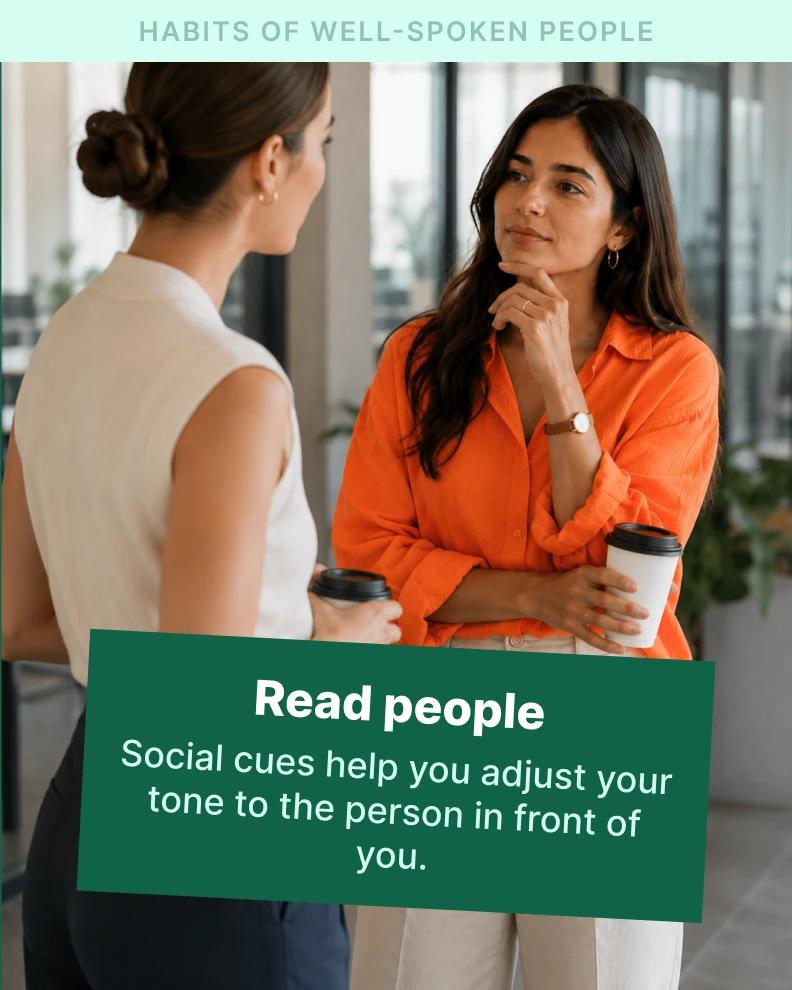
Being well spoken means a listener can follow your point the first time you say it. Four qualities register with them: whether your answer has a shape they can track, whether the pace lets them keep up, whether your words cost them effort, and whether you seem settled. That last one is what most people mean by sounding confident.
Notice what is not on that list. Not accent. Not vocabulary size. Not volume. An introvert who thinks before answering clears the bar as easily as the loudest member of the room, because a prepared sentence beats a fast one. Over a career, being easy to follow leaves a better impression than a wide vocabulary ever has.
Most of that reading happens before you finish your opening line, which is why picking up on body language affects you as much as the sentence itself. Being aware of your hands and keeping a steady tone of voice buys you the few seconds your first point needs to land.
Every one of the four qualities is trainable, which is the helpful part. None asks you to become a different person, and none waits on confidence arriving first. The ability to communicate effectively is built, not issued at birth, and you can begin today. Being engaging follows from being easy to follow, not the other way round.
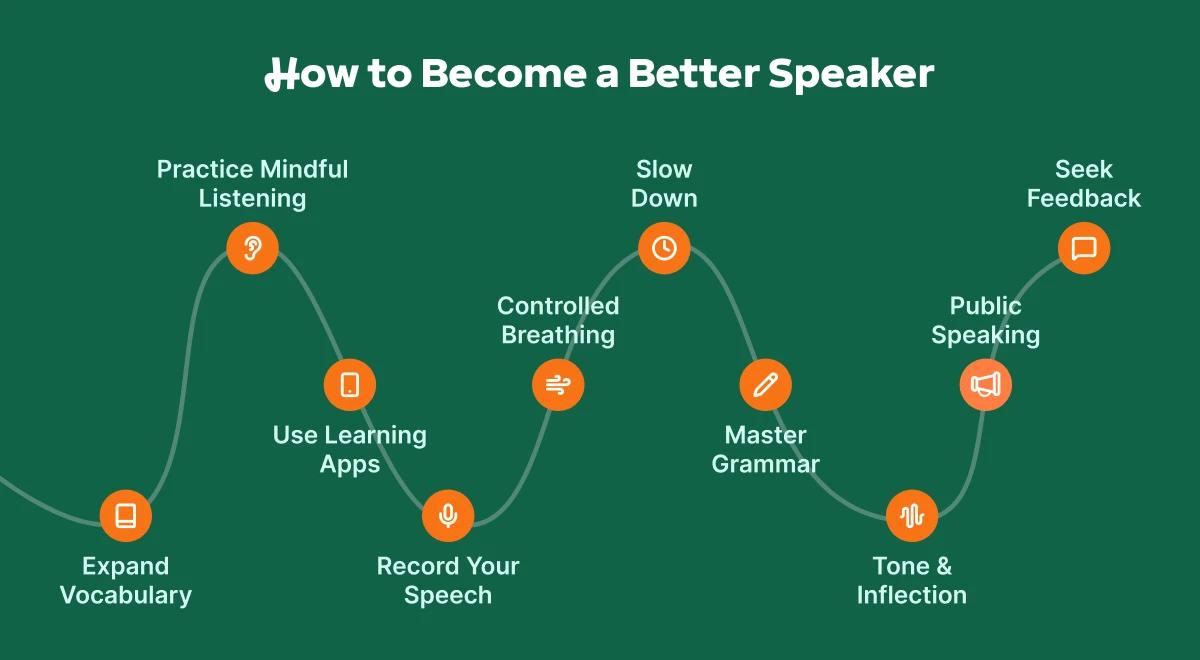
Identify which part of your speaking is actually breaking
Guessing wastes weeks. If you want to speak clearly and confidently, a recording will identify where to start in 90 seconds. Here is the audit, and it is worth taking the time to do.
Pick one question you actually get asked, like "What do you do for work?" or "What went wrong on this project?"
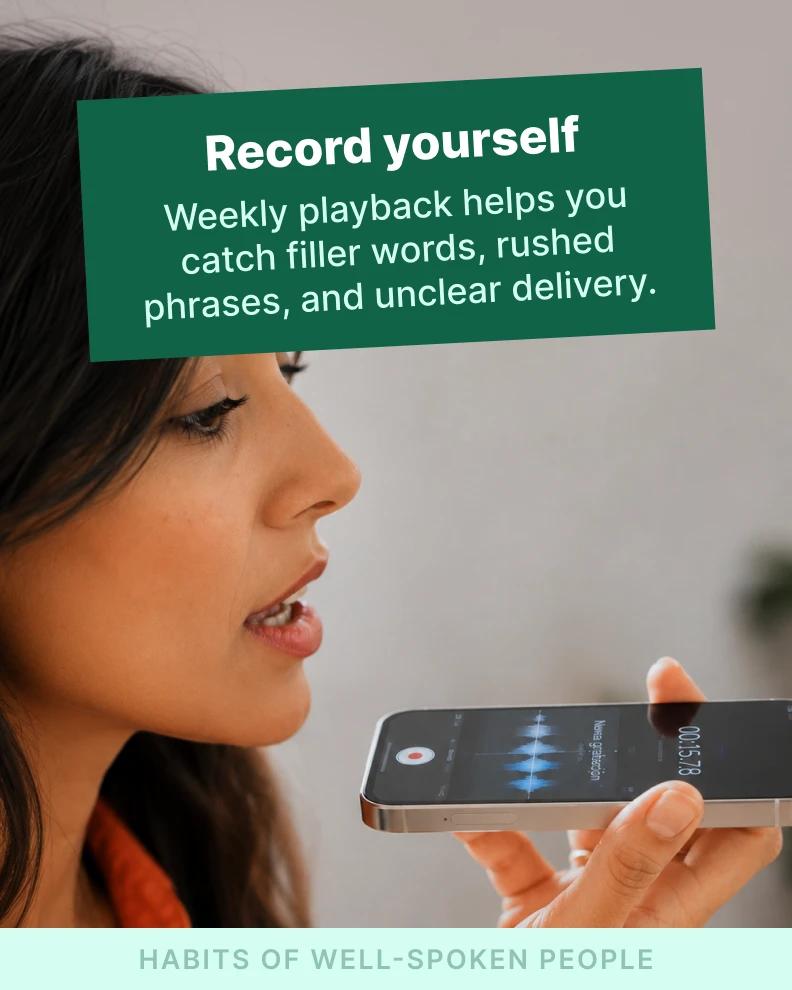
Record yourself answering it for 90 seconds on your phone. One take, no restarts.
Play it back and tally every "um," "like," "you know," and "basically." Divide by 1.5 to get fillers per minute.
Play it again, count the words you said, and divide by 1.5 for your words per minute.
Then listen once more, not for numbers, but for the exact moment you lost the thread. One of these four will be obvious:
The answer never arrives. You talk around the topic for 40 seconds, and the listener still does not know what you think. That is structure.
The words blur together. Endings drop off, syllables run into each other, and people ask you to repeat things. That is pace and articulation, not vocabulary.
The gaps fill with sound. Every pause gets an "um" because silence feels like failure. Those are fillers.
The sentence collapses halfway. You start confidently and run out of road. That is planning under pressure.
Fix one at a time, and start with structure. Speed and filler words often sort themselves out once a thought has a shape to sit in, because most rushing is really improvising. Choose your first target carefully and leave the rest alone for now.
Write both numbers down with the date next to them. On their own, they mean very little. Next to a second pair two weeks later, they tell you whether anything actually changed. Remind yourself to run the same count on day 7.



Say the point first: A four-part answer that stops the rambling
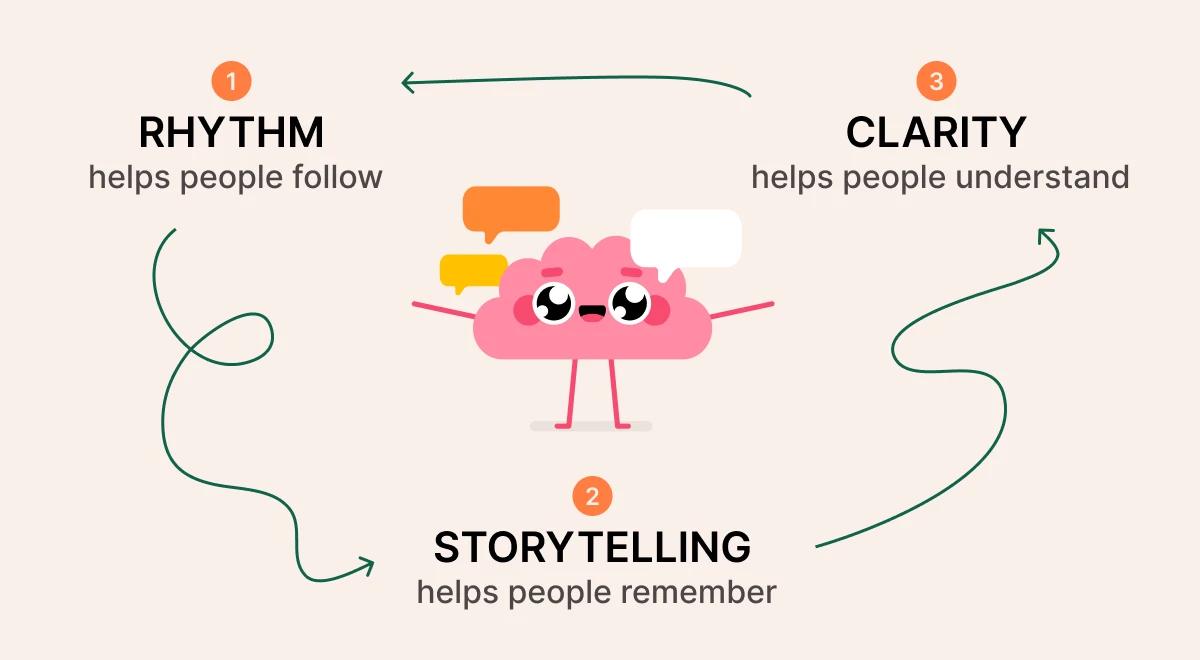
PREP stands for point, reason, example, point. You say your conclusion, give the reason behind it, ground it in one example, then land on the conclusion again. It takes about 30 seconds, and it is the fastest way to organize your thoughts when speaking. A great speaker is mostly someone who decided where to focus before starting to talk.
Here is the same answer to "how is the project going?" twice. First without a structure:
"So we had the handoff from design on Tuesday, and then QA found something in the export flow, which I think came out of the migration, and Priya is out this week, so we have been going back and forth, and the date might move, but I need to check with her first."
Now with one:
"We will miss Friday by about three days. QA found a bug in the export flow after the migration. We caught it Tuesday, and the fix needs Priya, who is back Monday. So: three days late, and I will confirm the new date Monday."
Same facts, half the words. Starting with the conclusion tells the listener what to file the next 30 seconds under, which is why they stop drifting. It also gives you a route back: if you lose your place, you already said the point once and can say it again.
Keep supporting points to two or three. Readers can scan back up a page; listeners cannot, so anything past the third key point gets dropped. Two well-made statements carry further than five rushed ones.
Here is which structure fits which moment, and the first sentence that gets you into it.
| Situation | Structure to use | Your first sentence | Time it takes |
|---|---|---|---|
Asked your opinion in a meeting | Point, reason, example, point | "I'd go with the second option, and here's why." | 30 to 45 seconds |
Giving a status update | Headline, then the exception | "We're on track for Friday. One thing changed." | 20 seconds |
Explaining your work to someone outside it | Everyday comparison, then the detail | "It's the part that decides who sees what." | 45 seconds |
Disagreeing with someone | What you agree with, then the single objection | "I'm with you on the timing. My worry is the cost." | 20 seconds |
Asked a question you cannot answer yet | Say what you know, name what you'll check | "Two of the three I can answer now." | 15 seconds |
📘 Try one communication summary on Headway!
Why plain words land better than impressive ones
Back to that Princeton study. Oppenheimer took texts including graduate school applications and a sociology dissertation abstract, swapped in longer words, and watched judged intelligence fall. He also found that most undergraduates admitted padding their vocabulary on purpose to seem smarter.
That study tested writing, and writing gets a second pass. Speech does not. Your listener cannot scroll back, so an expensive word costs more out loud than it does on the page. Sitcoms have mined this for years; half of Sheldon Cooper's lines in 'The Big Bang Theory' work because nobody in the room wants the long version.
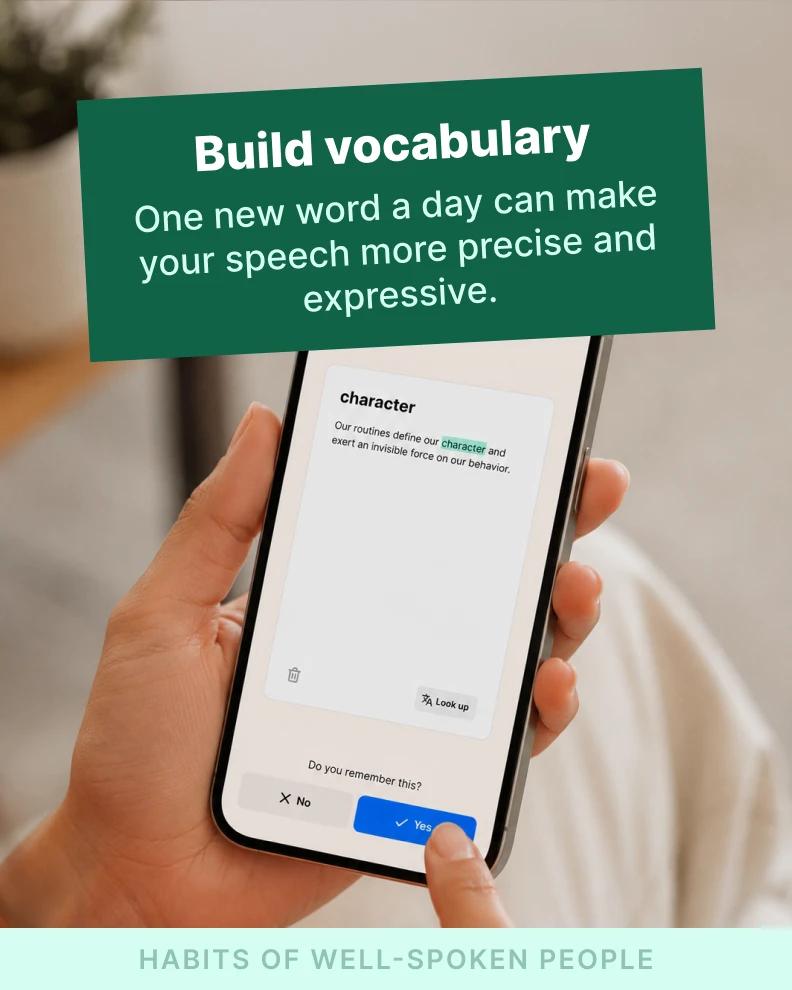
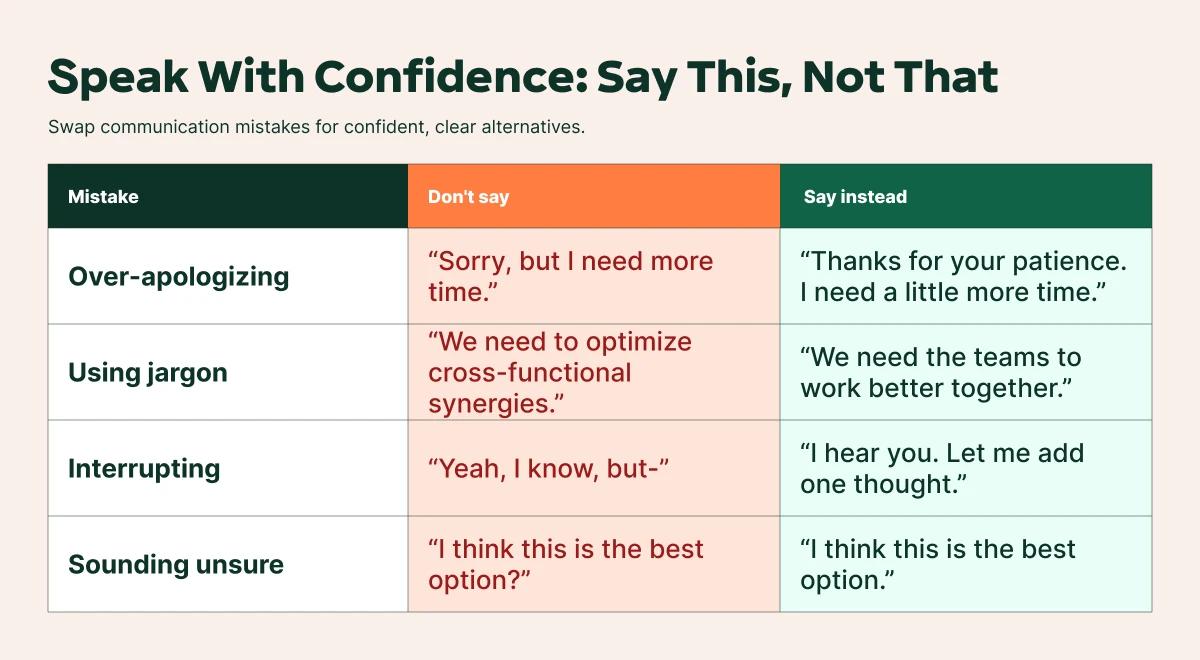
The drill is small. Take one sentence of your own jargon, the kind you say weekly, and explain it again in layman's terms, as you would to a friend who does not share your job. Do this once a day across different subjects, and precise word choice starts arriving on its own.
Two examples of how that sounds. "We need to align on the Q3 deliverable cadence" becomes "we should agree how often we ship this quarter." "The onboarding funnel has a drop-off at step three" becomes "people quit signing up on the third screen."
One honest caveat: technical terms earn their place with people who share them, and stripping them out for a room of specialists wastes everyone's time. Strive for clarity, not for simplicity on principle. The test is never the word; it is the person in front of you, which is the same muscle as reading what the room needs in any conversation.
Three numbers to track: Pace, filler words, and pause length
Tracking beats vibes. Three numbers cover most of it.
About 150 words per minute. The National Center for Voice and Speech puts the average conversational rate for US English speakers near 150, and most guidance for presenting sits a little below that. Nerves push you well past it, so the target usually feels too slow from the inside.
Half your current filler count. Zero is a bad goal and makes you self-conscious mid-sentence. Halving is achievable in two weeks, and it is the number that moves fastest.
Two full seconds of silence. Two seconds feels endless to you and reads as deliberate, even reassuring, to everyone else. Practice holding one on purpose until it stops feeling like a mistake.
Replacing a filler is a physical move, not a mental one. Close your mouth. Let the silence sit. Start the next sentence. Your first playbacks will feel cringeworthy, then they stop. Tone of voice and vocal variety can wait, because pace, fillers, and pauses do the early work.


What to do in the four seconds after someone asks you something
Thinking on your feet is mostly buying time without looking evasive. Four moves do it, and each one has a line you can say out loud.
Repeat the question back. "So you're asking whether we push the date or cut scope." You get four seconds and confirm you understood.
Ask one narrowing question. "Do you want the short answer or the whole history?" This is active listening doing double duty, because you learn which answer to build while the asker feels heard.
Announce the shape. "Two things come to mind." You have committed to a structure before you know the content.
Say the honest version. "Give me a second, I want to get this right." Almost nobody minds, and it sounds more confident than filler does. The interaction survives a two-second gap.
What changes when it is public speaking
The mechanics do not change here, but the body gets louder. Take one breath before the first word rather than talking on the tail of an inhale. If your voice shakes, speaking slightly louder than feels necessary settles it faster than trying to relax does.
Those two moves hold for public speaking and interviews as much as for meetings, and so does everything else about nerves before a talk.
If speaking anxiety is disrupting your work or your daily life, a licensed mental health professional can help you with that directly.
When a sentence goes wrong halfway through
Everyone does this, and almost nobody practices the recovery. You hear yourself losing the thread, push on anyway, and the sentence trails into nothing. A visible repair reads as control, even in a challenging conversation. Trailing off reads as uncertainty.
Stop at the end of the clause, not in the middle of a word.
Say "Let me start that again."
Restate the point in one sentence, then continue.
Two habits create the problem. The first is starting a sentence before you know how it ends, which is a speed issue more than a thinking one. The second is stacking qualifiers at the front, so by the time you reach the verb you have forgotten which one you were heading for.
In practice, it sounds like this:
"The reason we moved the date, which, well, there were a few things going on, so, let me start that again. We moved the date because QA found a bug on Tuesday."
Five exercises taken from books on speaking well
Each of these targets a different failure mode from the audit. Refer back to your own recording before you pick one. They are drills, not reading assignments.
Strip it to one line. 'Made to Stick' by Chip Heath and Dan Heath argues that an idea survives only if someone can repeat it tomorrow. Take the thing you most often fail to explain and write it as one sentence a colleague could pass on without you. Build detail on top of that sentence, never underneath it.
Write the through-line before the words. Chris Anderson's 'TED Talks' treats the single thread of an idea as the thing you plan first, before the audience or the slides. Give yourself 10 minutes: one line for the through-line, then rehearse out loud three times. Rehearsing in your head does not count; your mouth is the part that trips.
Cut, then live with the short version. 'The Elements of Style' by William Strunk Jr. and E. B. White is famous for one instruction: omit needless words. "At this point in time we should probably consider moving the date" becomes "we should move the date." Pick a sentence you say weekly, cut it, and use only the short version for a week.
Keep two openings in your pocket. Phil M. Jones works in persuasive speaking, and 'Exactly What to Say' builds its approach around first sentences decided in advance. For the meeting you know is coming, bank two: "Here is the short version." and "Before I answer, one thing is worth knowing." Improvise the middle, never the opening.
Quiet the commentary first. Ethan Kross writes in 'Chatter' about the inner monologue that spins before a hard conversation. His point is practical: that noise eats the working memory you need for structure. Ask afterward what the voice was predicting, because the way you talk to yourself gets specific once you write it down.
All five are on Headway as summaries, a reasonable way to see whether a book is worth the full read before you commit. If building communication skills from the source appeals more, there are longer reads on communication worth your time.
Two weeks of short reps, and what to check on day 14
Ten minutes a day, fourteen days. The point is not volume; it is that deliberate practice with a measurement at each end beats an hour of reading aloud with no feedback.
| Day | What you do | Time |
|---|---|---|
Day 1 | Record the baseline answer, count fillers and words per minute | 10 min |
Days 2 to 6 | Read aloud for five minutes, record one 90-second answer, do one live rep | 10 min |
Day 7 | Recount both numbers from a fresh recording, compare with Day 1 | 10 min |
Days 8 to 13 | Same daily reps, with one failure mode as the target | 10 min |
Day 14 | Record the Day 1 question again, count again, compare | 10 min |
The live rep is the part people skip, and it is the one that transfers. Order coffee in a full sentence. Answer a colleague's question with the point first. These low-stakes conversations cost nothing when they go badly, which is exactly what makes them useful. Conversational skills grow in the cheap moments, not the expensive ones.
Rotate through these five prompts for the recorded rep, one per day:
Explain your job to a twelve-year-old.
Describe a decision you made last month and why.
Argue the opposite of something you believe.
Summarize the last thing you read in four sentences.
Answer "what went wrong?" about a real project.
Be honest about what fourteen days buys you. The numbers move, filler count first, and your pace settles. A good command of your own pace is the first thing you will notice. What does not disappear is the jolt when a question arrives from nowhere; that takes a year of reps, and it shrinks the whole time.
On day 14, put the two pairs of numbers side by side, then rebuild one sentence from your first take using PREP. Seeing the same thought in two shapes is what makes the method stick.
Where to put your next 10 minutes
Record 90 seconds today and count two things. That one step will tell you more about becoming a better speaker than another article will, including this one.
The rest is mechanical, which is the good news. You are not trying to become charismatic or to improve your vocabulary overnight. You are putting your point at the front, slowing down by about 10 percent, and trading a few "ums" for silence.

People notice inside a month. That is what becoming a better communicator looks like from the inside: smaller and duller than expected, and countable.
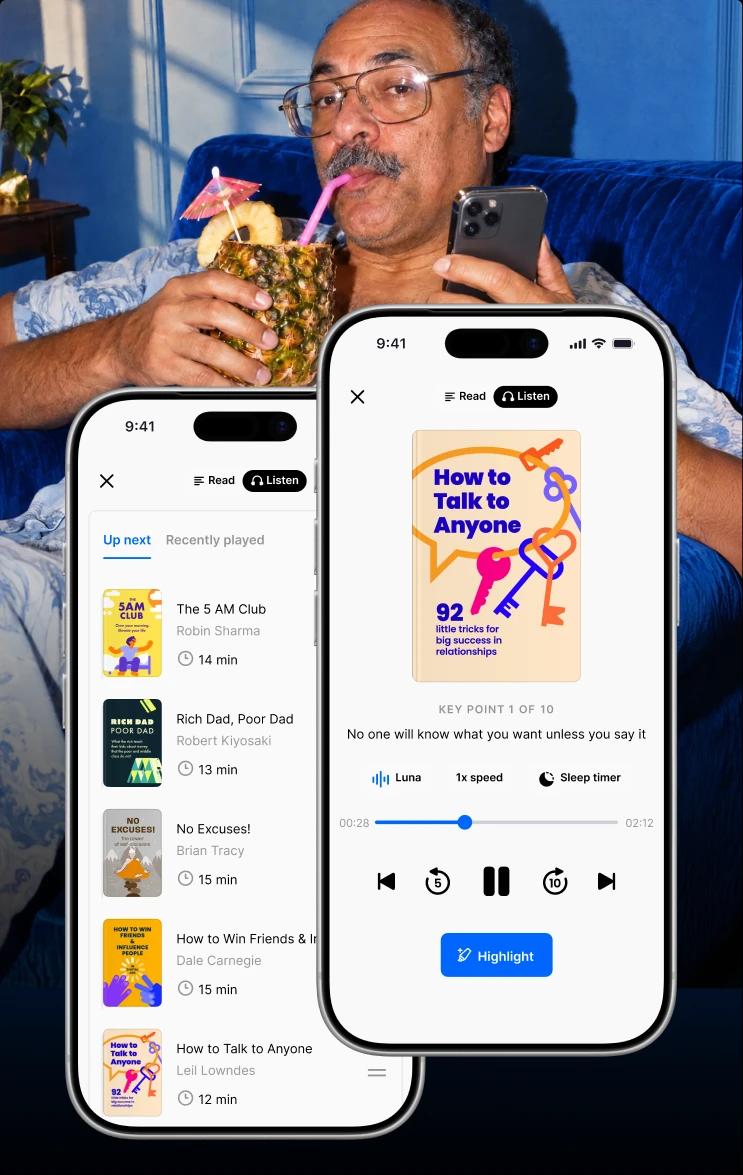
The books behind these drills run 200 pages each, and you need five ideas from them. If short sessions suit you better, Headway has them as 15-minute summaries in text and audio, so you can take one on a commute and spend the rest of your 10 minutes practicing.
FAQs about how to become a well-spoken person
What is the 3-2-1 rule for speaking?
The label covers more than one method, so check which one is meant. Communication coach Vinh Giang teaches a 3-2-1 framework for unprepared answers: three steps, two types, one thing. A separate version is a rehearsal drill where you give the same talk in three minutes, then two, then one, keeping only what survives each cut. Both force selection over fluency.
Does putting a pen in your mouth help pronunciation?
It is a warm-up some voice coaches use. You hold a pen between your teeth, read a paragraph aloud while your tongue and lips work harder than usual, then take it out and read the same lines again. The pen itself changes nothing. The gain comes from a few minutes of deliberate enunciation practice, which you can get without the pen.
Do tongue twisters improve pronunciation?
They train one thing well: coordination at speed. Repeating a tricky sequence slowly, then faster, teaches your tongue and lips to hit consonants cleanly while you are moving quickly. What they will not do is organize your thinking, repair a rambling answer, or settle your nerves. Treat them as a two-minute warm-up before something that matters, not as the practice itself.
Why do I struggle to enunciate words?
Usually, you are speaking faster than your mouth can keep up with, so word endings get clipped. Tiredness, a dry mouth, dental work, and talking while distracted all add to it. Slowing down and reading aloud daily helps most people. If unclear speech is persistent or worsening, the American Speech-Language-Hearing Association points you to a speech-language pathologist.
How do you stop slurring your words?
First, separate habit from symptom. Habitual slurring usually traces back to speed, fatigue, or alcohol, and it eases once you slow down and rest. New or sudden slurred speech is different. The American Speech-Language-Hearing Association advises calling 911 for any sudden change in speech, and seeing a doctor promptly for any new difficulty talking, since it can signal a stroke.
What are the three C's in speech?
Most teachers of public speaking give them as clear, concise, and consistent, though you will also see confident or credible swapped in. The useful part is not the list but the order: say it clearly, say it in fewer words, then say it the same way next time. Consistency is what turns one good answer into a reputation.
Why do I struggle to speak to people?
Two different problems hide in that question. One is mechanical, which is what this article fixes. The other is social: the interaction itself feels risky, so you rehearse and then freeze. If that is the one you recognize, begin with low-stakes conversations where the connection matters less, and speak to a licensed professional if it limits your daily life.
How do you talk like an intelligent person?
Not by borrowing vocabulary. Listeners read intelligence off three qualities: whether your statements are specific, whether you can change your mind out loud, and whether you say what you do not know. Vague confidence leaves a weaker impression than a carefully limited claim. Explaining a hard subject properly and simply is the strongest signal there is.
Do intelligent people talk more?
Not necessarily, and the two get confused because the volume of speech is easy to notice and the quality of it is not. A quiet member of a team can be carrying the sharpest thinking in the room. What people respond to is whether a contribution lands and is related to the question asked, not how many you make.
How do I become more articulate?
Read more than you talk — it widens the words you have to pull from. Then slow down. Most people rush and trip over half-formed thoughts. Pause, finish the sentence in your head, then say it. Reading short nonfiction summaries on Headway helps too; you pick up how clear thinkers phrase things and start borrowing the rhythm.