Self-growth
 Apps & Digital Tools
 Business & Career
 Success
 Growth Tools
 Psychology
 Communication
 Relationships

You know the feeling: the dry mouth in the minutes before a talk, the sudden urge to be anywhere else. The right public speaking tips can shrink that dread fast, and you're in good company if you feel it.
A community study in the Archives of General Psychiatry found public speaking was the most commonly feared social situation, ahead of heights and deep water, with about one in three people reporting excessive nerves.
This guide is a practical playbook, covering what to do before, during, and after you speak. The advice comes from speakers and researchers like Chris Anderson, Olivia Fox Cabane, and Katty Kay and Claire Shipman, whose books have coached millions through stage fright.
You'll find the core ideas from those books, and thousands more, in 15-minute summaries on the Headway app. It's a simple way to keep training between talks.
*Disclaimer: This article is for general informational purposes, and results vary from person to person. Headway is a microlearning and daily growth app, not a medical or therapy tool. If public speaking anxiety significantly disrupts your work or daily life, a licensed mental health professional can offer support tailored to you.*

Quick summary: The public speaking tips that matter most, in one glance
If you only take five of the best public speaking tips into your next talk, take these.
Public speaking tips work best in three stages: prepare, deliver, recover.
Know your audience before you write a single line of your speech.
Slow your speaking pace, because pauses read as confidence.
Replace filler words with silence and a breath.
Open with a story or a stat, and close with one memorable line.
Each one gets a full breakdown below, so keep reading for the complete guide.
Why speaking in front of people feels so hard
Public speaking anxiety, sometimes called glossophobia, is the fear of speaking in front of an audience. It shows up because your brain reads a room full of staring faces as a social threat, so it fires the same fight-or-flight response it would use for real danger. Your pulse climbs, and the lines you rehearsed feel suddenly out of reach.
The study above confirms how common the fear of public speaking is. One in three people report excessive nerves before a talk, and even seasoned speakers describe the same jolt of adrenaline. The difference is what they do with it.
Learning how to overcome your fear of public speaking starts with a reframe: nerves are energy, and energy can be aimed. The same chemicals that make your hands shake also sharpen your focus. Every technique in this article gives that energy somewhere useful to go. That mindset shift is also the first step toward becoming a well-spoken person in every setting, on stage or off.
📘 Start turning nervous energy into steady stage presence with Headway!
Before you say a word: Preparation tips that do half the work
Most on-stage panic gets solved days earlier, at your desk. If you want to know how to prepare for a speech, follow these steps.
Run a quick audience analysis. Write down what your listeners already know and what they want from you. Note where they might push back, too. When you know your audience, half your wording decisions make themselves, and the same habit sharpens your communication skills at work far beyond formal talks.
Build a simple speech structure. Pick one core message and support it with three main points. Plan a clear opening and closing before you draft anything else. A tight structure is also how to remember a speech without memorizing it word for word, because each point cues the next.
Rehearse in real conditions. Reading silently is planning, and speaking out loud is practice. If you're wondering how to practice public speaking at home, stand up and run the talk aloud with a timer going. Do this three to five times before the real thing.
Prepare speaker notes as cue words. A few trigger words per point keep you flexible, while a full script tempts you to read. Treat visual aids the same way, as support for the audience rather than a teleprompter for you.
Spoken-aloud repetition is the core of public speaking practice. By the day itself, the talk should feel like one more rep.
Calming the nerves: What to do in the 10 minutes before you speak
If you've searched how to calm nerves before public speaking, treat these four moves as your hallway checklist. Presentation anxiety peaks in the final minutes, and each move takes the edge off fast.
Take slow, deep breaths with a longer exhale than inhale. Four counts in, six counts out, repeated five times, tells your nervous system the threat has passed.
Reset your body. Roll your shoulders back and unclench your jaw.
Rename the feeling. Say "I'm ready" instead of "I'm nervous." Your body can't tell excitement from fear, so give it the better label.
Warm up your voice. Hum a few notes or say your opening line out loud once.
Some adrenaline will stay, and it helps; sharper senses come with it. For anyone wondering how to stop being nervous when presenting, aim for calm enough rather than perfectly calm. Knowing how to speak confidently in public means working with that buzz, and these public speaking techniques give your body a job so your mind can focus on the talk.
📘 Get calm-down routines that fit a coffee break on Headway!
Delivery tips: Your voice, your body, and the filler-word problem
The way you deliver a speech carries as much weight as the words in it. These public speaking tips and techniques cover speech delivery from two angles: what the audience hears and what they see.
Start with what they hear. Slow your speaking pace below what feels natural, because nerves compress time and rush your words. Add vocal variety by shifting pitch on the words that matter, and build voice projection by speaking to the back row. Clean articulation follows once you slow down.
Now, what they see. Your body language talks the whole time you do. Plant your feet and keep an open posture. Step out from behind the podium when the setup allows.
Use hand gestures on key points and rest your hands at your sides otherwise. For eye contact, hold one friendly face for a full thought, then move to another. When you make eye contact this way, the room reads it as connection, and that kind of nonverbal communication builds trust before your argument does.
Then there's the "um" problem. If you've been searching for how to stop saying um, the fix is a silent pause and a breath. Filler words rush in when you fear silence, but a pause reads as thought, and it gives your audience time to catch up.
| Nervous habit | What the audience notices | Quick fix |
|---|---|---|
Filler words (um, like, so) | You sound unsure of the point | Pause and breathe instead of filling the gap |
Rushing your pace | Ideas blur together and get lost | Mark two spots in your notes to slow down |
No eye contact | You seem disconnected or anxious | Hold one face per sentence, then shift |
Frozen hands or fidgeting | Attention drifts to the movement | Rest hands at your sides; gesture on key points |
Flat, monotone voice | Even good content feels boring | Vary pitch and volume on the words that matter |
Stage presence sounds mysterious, but it's the sum of these small, effective public speaking tips practiced until they're automatic.
How to open strong and close so people remember
A big part of how to give a good speech comes down to the first thirty seconds and the last fifteen. Skip the flat "Today I'm going to talk about..." opener. A strong speech opening is the first line that earns attention, and you have three reliable options.
Lead with a surprising statistic that reframes your topic.
Tell a short personal story or an interesting anecdote that sets up your point.
Ask a sharp question the audience can't answer yet.
Any of the three will grab your audience's attention faster than an agenda slide, because storytelling and curiosity drive audience engagement in a way bullet points can't. If you're studying how to engage an audience, watch a few TED Talks and count how many open with a story or a question. Signpost your main points early, then return to them at the end.
Your speech conclusion deserves the same care. A close that trails off with "so, yeah, that's all I have" erases twenty good minutes. Land one clear takeaway line instead, the single sentence you want repeated in the hallway afterward. In persuasive speaking especially, that final line is the ask, so write it before you write anything else.
When it goes sideways: Blanking, tough questions, and impromptu moments
Wondering what to do when your mind goes blank? Pause and breathe, then glance at your cue words. If the thread is still gone, restate your last point in new words. Repetition sounds like emphasis to the audience, and it buys your brain the seconds it needs.
Next, the question you can't answer. If you're unsure how to handle questions during a presentation, use three steps. Acknowledge the question as a fair one. Offer to follow up with a real answer after the talk. Redirect to the nearest point you can speak to with confidence. No one expects you to know everything, but everyone notices how you handle the gap.
Then there's the impromptu speech, the "say a few words" moment with zero warning. Impromptu speaking gets easier with a pocket frame: make one point, give one reason, share one example, and stop. Speaking under pressure rewards small, finished thoughts over long, wandering ones.
Across all three situations, recovering smoothly matters more than never stumbling. Audiences forget the wobble and remember the composure.
📘 Test recovery tactics from the world's best communication books on Headway!
Practical tips from book summaries
Learning how to be a good public speaker speeds up when you borrow from people who've studied thousands of talks. The best speaking advice already lives in a handful of standout books, and Headway book summaries let you pull the core idea from each in about 15 minutes, so you can test what works before committing to a full read. One takeaway and one small exercise from each:
Study what great talks have in common, from 'TED Talks' by Chris Anderson
Tip: Build your talk around one idea worth spreading rather than a data dump. Exercise: Write your core message in a single sentence. If you can't, the talk isn't ready yet.
Borrow presence, from 'The Charisma Myth' by Olivia Fox Cabane
Tip: Presence comes from learnable behaviors like warmth and focused attention, and anyone can practice them. Exercise: Before you speak, give one person your full attention for 10 seconds.
Lead with a story, from 'Unleash the Power of Storytelling' by Rob Biesenbach
Tip: A short, specific story sticks where bullet points slide off. Exercise: Replace your opening slide with a 30-second story that makes the same point.
Learn from speeches that landed, from 'Speeches That Changed the World' by Simon Sebag Montefiore
Tip: Memorable speeches repeat a simple phrase and speak to one clear feeling. Exercise: Find one repeatable line in your talk and place it at the opening and the close.
Treat confidence as a practice, from 'The Confidence Code' by Katty Kay and Claire Shipman
Tip: You build confidence through action and small risks, long before you feel ready. Exercise: Volunteer for one low-stakes speaking moment this week before the big one.
Public speaking tips for your exact situation
General advice helps, but your context changes the playbook. Pick your row below.
Public speaking tips for work
Public speaking tips for presentations at work start with respect for the room's time: one clear recommendation backed by evidence, then next steps. Strong presentation skills and effective communication get noticed fast, and they compound with networking into real career momentum. Speaking up well in meetings is one of the quickest ways to become a top performer, and if your ambitions run all the way up, the path to becoming a CEO runs straight through rooms like these.
Public speaking tips for students
Class presentations reward structure and timing. Rehearse against the clock and cut anything that doesn't serve your main points. Nerves spike in the first minute, so practice your opener until it's automatic and let it carry you through.
Public speaking tips for introverts
Preparation is your home turf, so use it. Over-rehearse the structure, then treat the talk as a series of one-to-one conversations, holding eye contact with a single person per thought. Be yourself on stage, because connecting with your audience beats performing for them. The same approach powers talking to anyone in smaller rooms, too.
Public speaking tips for nervous speakers
These public speaking tips for beginners come down to exposure in small doses. Start with a toast among friends or a two-minute update in a meeting before any bigger public speaking engagement. A group like Toastmasters International gives you a low-stakes room to practice in every week, and your public speaking skills grow with each rep.
The wedding toast
Keep it under three minutes and build it around one story about the couple. End warm and sit down while they still want more.
Why Headway works for building speaking skills
Public speaking confidence grows through steady input, and Headway is built for exactly that rhythm. A few features do the heavy lifting:
Audio and text summaries let you absorb a communication book on your commute or read it on a lunch break.
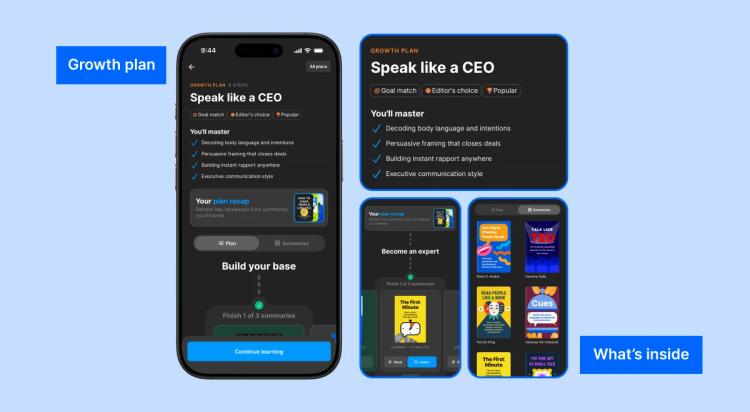
Personalized growth plans build a learning path around your goal, so a "confident speaker" plan surfaces the right titles in order.
Spaced repetition and highlights bring key ideas back at the right intervals, which is how techniques become habits.
Offline mode keeps summaries available on flights and in dead zones before a big talk.
CarPlay and Android Auto support turns drive time into prep time.
Daily streaks keep the practice going on busy weeks, when skills usually stall.
What Headway users say about speaking and leading
Advice means more once you see it working in real routines. A few Headway users shared how the app shapes their communication skills and leadership:
"I was looking for a way to stay intellectually sharp without overwhelming my schedule. Headway promised something I value deeply: precision over volume." (Deyvis Bebicaci, Entrepreneur & Leadership Advisor)
"Recently, a leadership insight I consumed that same week influenced how I handled a team alignment issue. Instead of giving instructions, I asked guiding questions, and the team arrived at the solution on their own." (Abdelrahman Mohamed Soliman, Cost Control Manager)
📘 Try the app 60 million learners use to grow every day on Headway!



Turn spare minutes into speaking practice with Headway
Prepare with structure, then let pauses and eye contact carry the delivery. When something wobbles, recover without apology. Those public speaking tips compound: that cycle is how to get better at public speaking, one talk at a time, and the techniques above come from books that have coached generations of speakers. Reading remains one of the smartest ways to train your brain for the stage.
Few people have time to read every communication book, though, and that's where Headway earns its spot on your phone. Each 15-minute summary gives you a book's core ideas in audio or text. Personalized recommendations point you to the next right title, and spaced repetition keeps what you learn from fading. Summaries alone won't make anyone a great speaker, but they make every practice minute count and help you pick which full books deserve your shelf.

If you're serious about learning how to become a better public speaker, start today. Download the Headway app, set your growth goal, and walk into your next talk with more tools than nerves.
FAQs about public speaking tips
How much should I practice before giving a speech?
Aim for three to five full run-throughs, out loud, standing, and timed. That's usually enough to know your structure cold without sounding memorized. Practice means performing the talk in real conditions, so include your opener and your closing line every time. Spread rehearsals across several days, because spaced practice beats one long cram session for retention.
Can I get better at public speaking if I'm naturally shy?
Yes. Speaking is a learnable skill, and shyness doesn't block the mechanics of structure and pacing. Learning how to overcome fear of public speaking works the same way for shy people as for anyone else: small, repeated exposure. Start with two-minute talks in safe rooms, and let each success teach your body that the stage is survivable.
What is the 10-20-30 rule for presentations?
The 10-20-30 rule, popularized by Guy Kawasaki, says a slide deck should have about 10 slides, run no longer than 20 minutes, and use fonts no smaller than 30 points. The limits force discipline: fewer slides sharpen your argument, and big fonts stop you from reading paragraphs off the screen while your audience reads ahead.
How long should a good speech be?
Shorter than you think. Most attention research and TED's own 18-minute cap point to the same range: 10 to 20 minutes for a standalone talk, and 2 to 3 minutes for a toast. If your material runs longer, break it up with a story or a question every few minutes, because engagement resets the clock on people's focus.
How do I stop saying "um" and other filler words?
Pause and breathe instead of filling the gap. Filler words rush in when silence feels scary, so train yourself to treat a two-second pause as part of your delivery. Record one rehearsal and count your fillers, then rehearse again while deliberately pausing at each transition. Most speakers cut their filler count in half within a few sessions.
What should I do if my mind goes blank during a speech?
Pause and breathe first, because the blank usually clears in seconds. Glance at your cue words to find your place, and if the thread is still missing, restate your last point in fresh words. The audience hears emphasis, and your memory gets time to reboot. Nobody grades a pause as harshly as you do.
How can I calm my nerves before public speaking?
Start with breathing: a longer exhale than inhale for about a minute. Then reset your posture, shoulders back and jaw unclenched. Say your opening line out loud once to warm up your voice. These public speaking tips work in the final minutes because they send your body signals of safety it can't ignore.
What are the main types of public speaking?
Most speaking falls into four types: informative (teaching or explaining), persuasive (changing minds or driving action), demonstrative (showing how something works), and ceremonial (toasts and tributes). Each type shifts your goal and tone, but a clear structure and a strong closing line carry across all four, which is why the same core public speaking skills keep paying off.