Self-growth
 Business & Career
 Success
 Communication
 Healing
 Relationships
 Psychology
 Happiness
Snowy weekend can be the best weekend you’ve had in months. The Danes figured this out centuries ago. They have a word for it — hygge (pronounced hoo-gah) — which roughly translates to the art of creating warmth and contentment when the world outside turns cold and hostile. Candles. Blankets. Hot drinks. Good company or comfortable solitude. And always, always, a good book.
These five books are perfect for a snowy weekend. Not because they’ll make you more productive or teach you to optimize your morning routine. Because they’ll wrap around you like a warm blanket and remind you that sometimes the best thing you can do is simply be still.
‘The Comfort Book’ by Matt Haig
If there’s a single book designed for exactly this moment, it’s this one. Matt Haig wrote ‘The Comfort Book’ as a collection of notes to his future self during his darkest times — gentle reminders that things are not always as bleak as they seem. The result reads like a warm conversation with a wise friend who’s been through hard winters before.
The book doesn’t follow a strict structure. Short reflections sit alongside lists, personal stories, and insights drawn from philosophy, science, and Haig’s own experience recovering from severe depression. You can open it anywhere and find something that lands. That’s what makes it perfect for a snowy day — you don’t need sustained concentration, just a willingness to receive small doses of comfort.
Haig understands something most self-help authors miss: sometimes you don’t need a strategy. You need someone to tell you it’s okay to feel what you’re feeling and that this too shall pass. When the power’s flickering and the world feels uncertain, that’s exactly the kind of company you want.
‘Ikigai: The Japanese Secret to a Long and Happy Life’ by Héctor García and Francesc Miralles
Hygge is Danish, but ikigai is its Japanese spiritual cousin. Where hygge focuses on creating cozy moments, ikigai asks a deeper question: what makes your life worth living? The authors traveled to Okinawa — home to one of the world’s highest concentrations of centenarians — to find out how people there think about purpose and meaning.
What they found wasn’t a productivity system or a self-optimization framework. It was something gentler: people who wake up with a reason to get out of bed, who stay connected to their communities, who find satisfaction in small daily rituals. The book offers practical exercises for discovering your own ikigai, but the real value is in the philosophy itself — the idea that meaning doesn’t have to be grand to be genuine.
A snowy weekend is the perfect time to ask yourself these questions. What brings you joy? What are you good at? What does the world need from you? The answers might surprise you — and you finally have the space to sit with them.
‘The Book of Joy’ by the Dalai Lama and Desmond Tutu
Imagine eavesdropping on a conversation between two of the most joyful people on earth — both of whom have experienced profound suffering. That’s essentially what this book offers. In 2015, Archbishop Desmond Tutu traveled to Dharamsala, India, to celebrate the Dalai Lama’s 80th birthday. Over five days, they discussed joy, suffering, and what it means to find happiness in a troubled world.
The result feels less like a self-help book and more like sitting in on a conversation between two wise, old friends who happen to be spiritual giants. They tease each other. They laugh — a lot. They share personal stories of loss and hardship. And they offer insights that feel both profound and completely practical: how to reframe adversity, why gratitude matters, what forgiveness actually looks like in daily life.



What makes the book work is the warmth between them. You’re not being lectured by distant authorities. You’re witnessing genuine friendship between two people who’ve spent their lives learning how to be happy despite circumstances that should have crushed them. On a day when you’re stuck inside and the news feels heavy, their joy is contagious.
‘Braiding Sweetgrass’ by Robin Wall Kimmerer
If the snow is falling outside, this book helps you reconnect with the earth from the comfort of your living room. Robin Wall Kimmerer is both a professor of environmental biology and a member of the Citizen Potawatomi Nation. She weaves together indigenous wisdom and scientific knowledge to explore our reciprocal relationship with nature — and the result is unlike anything else you’ve read.
Kimmerer writes about pecans falling from trees, the way sweetgrass responds to harvesting, and the lessons hidden in a handful of wild strawberries. Her prose is meditative and rich, the kind of writing that makes you slow down and notice things you’ve walked past a thousand times. She asks what it would mean to treat the natural world not as a resource to be extracted but as a gift to be received with gratitude.
Reading this while watching snow blanket the world outside creates a particular kind of magic. The storm that’s disrupting your life is also part of the larger living system Kimmerer describes. There’s comfort in that perspective — the reminder that you’re embedded in something vast and ancient and beautiful, even when it’s inconvenient.
‘The Art of Stillness’ by Pico Iyer
A snowy weekend forces you to stay put. This book celebrates exactly that. Pico Iyer is a travel writer who has visited some of the most remote corners of the earth. His conclusion after decades of movement? The greatest adventure might be going nowhere at all.
Iyer explores the transformative power of silence and solitude, drawing on everyone from Leonard Cohen (who spent years in a Zen monastery) to Emily Dickinson to the monks he’s met in his travels. The book is deliberately short — you can read it in a single sitting — and that brevity is part of the point. In an age of constant stimulation, Iyer argues, the most radical thing you can do is simply be still.
There’s profound validation in reading this while trapped by the weather. The storm has given you a gift you didn’t ask for: enforced stillness. Instead of fighting it, this book invites you to embrace it. To put down your phone. To let the silence expand. To discover what’s waiting in the space between activities.
Start the cozy weekend now with Headway!
The forecasters say another storm might hit by the weekend. More cold, more snow, more days when the world outside feels impossible to navigate. You have a choice in how you meet that: with frustration or with intention.
The Danes don’t dread their long, dark winters. They lean into them. They light candles, pour hot drinks, gather with people they love (or settle into comfortable solitude), and let the outside world do what it’s going to do. They’ve turned scarcity into abundance — and you can too.
Pick one of these books. Find a blanket. Make something warm to drink. And let the snow fall. This weekend doesn’t have to be lost time. It could be the most restorative few days you’ve had all year.
📘 Ready to turn being snowed in into the coziest weekend of the year? Start your reading list with Headway’s bestselling book summaries — perfect for warming your mind while the world turns white outside.

Frequently asked questions on cozy reading
What is hygge, and how do you pronounce it?
Hygge (pronounced hoo-gah) is a Danish concept that describes a feeling of coziness, contentment, and well-being through simple, intentional living. It’s about creating warm, relaxing environments and enjoying meaningful moments — especially during cold, dark winters. Think soft lighting, warm drinks, comfortable blankets, and good company (or comfortable solitude). The word dates back to the early 1800s in Denmark and is considered a defining feature of Danish cultural identity.
What is the current winter storm affecting the US?
Winter Storm Fern struck the United States in late January 2026, dumping over a foot of snow across a 1,300-mile swath from Texas to Maine. The storm caused widespread power outages affecting hundreds of thousands of people, canceled more than 17,000 flights over the weekend (the most since the COVID-19 pandemic), and has been linked to dozens of deaths. Another winter storm is forecast to potentially hit the eastern US by the end of the week.
What does ikigai mean?
Ikigai is a Japanese concept that roughly translates to “reason for being” or “purpose in life.” It represents the intersection of what you love, what you’re good at, what the world needs, and what you can be rewarded for. In Japanese culture, finding your ikigai is associated with longevity, fulfillment, and daily satisfaction — not through grand achievements, but through meaningful daily rituals and connections.
Who is Robin Wall Kimmerer?
Robin Wall Kimmerer is a botanist, professor, and enrolled member of the Citizen Potawatomi Nation. She’s a Distinguished Teaching Professor of Environmental Biology at SUNY and the founder of the Center for Native Peoples and the Environment. Her book ‘Braiding Sweetgrass’ became a New York Times bestseller and is celebrated for weaving together indigenous wisdom with scientific knowledge to explore humanity’s relationship with the natural world.
What is ‘The Comfort Book’ about?
‘The Comfort Book’ by Matt Haig is a collection of reflections, notes, lists, and stories designed to provide solace during difficult times. Haig wrote it as a reminder to his future self that things are not always as dark as they seem. Drawing from philosophy, science, personal experience, and wisdom from around the world, the book offers warmth and reassurance for anyone seeking hope or a path through uncertainty. It became a New York Times bestseller and was named one of The Washington Post’s best feel-good books.
What is Headway?
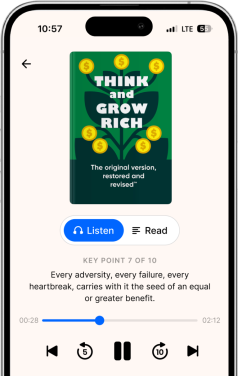
Headway is one of the world's most downloaded microlearning apps, with over 55 million users. It transforms bestselling books into summaries you can read or listen to — crafted by professional writers, not AI.
The app offers 2,500+ summaries across productivity, leadership, relationships, mental health, welness and personal growth. Features include personalized learning plans, gamified challenges, interactive shorts with quizzes, spaced repetition flashcards, and offline access. Available on iOS and Android.