Self-growth
 Business & Career
 Success
 Communication
 Healing
 Relationships
 Psychology
 Happiness
If you're reading this, you've probably decided it's time to sharpen your skills.
Maybe you want to learn Python to automate your boring tasks, or perhaps you're aiming for a total career pivot into data science. Whatever the motivation, you almost immediately hit the same dilemma every other modern learner faces: the great Coursera vs Udemy debate.
It's a frustrating choice because both are giants in the world of online courses, yet they feel completely different. One feels like a digital Ivy League, while the other is more of a massive, chaotic marketplace where you can learn anything from web development to sourdough baking. Pick the wrong one, and you waste time and money.
At Headway, we believe in making learning efficient. We're going to give you a straight-up comparison of these two online learning platforms so you can decide which one actually fits your learning goals and your budget.
Coursera vs Udemy: Quick verdict
If you just need the bottom line, here it is. For structured, accredited learning from top universities and industry leaders, choose Coursera. For affordable, immediately applicable tech skills or creative hobbies that you want to learn at your own pace, choose Udemy.
Think of it this way: Coursera is where you go to get a rigorous qualification (even online degrees). Udemy is where you go to learn a specific tool (like a new JavaScript framework) over a weekend.
Here are the crucial differences of the Coursera vs Udemy debate in a nutshell:
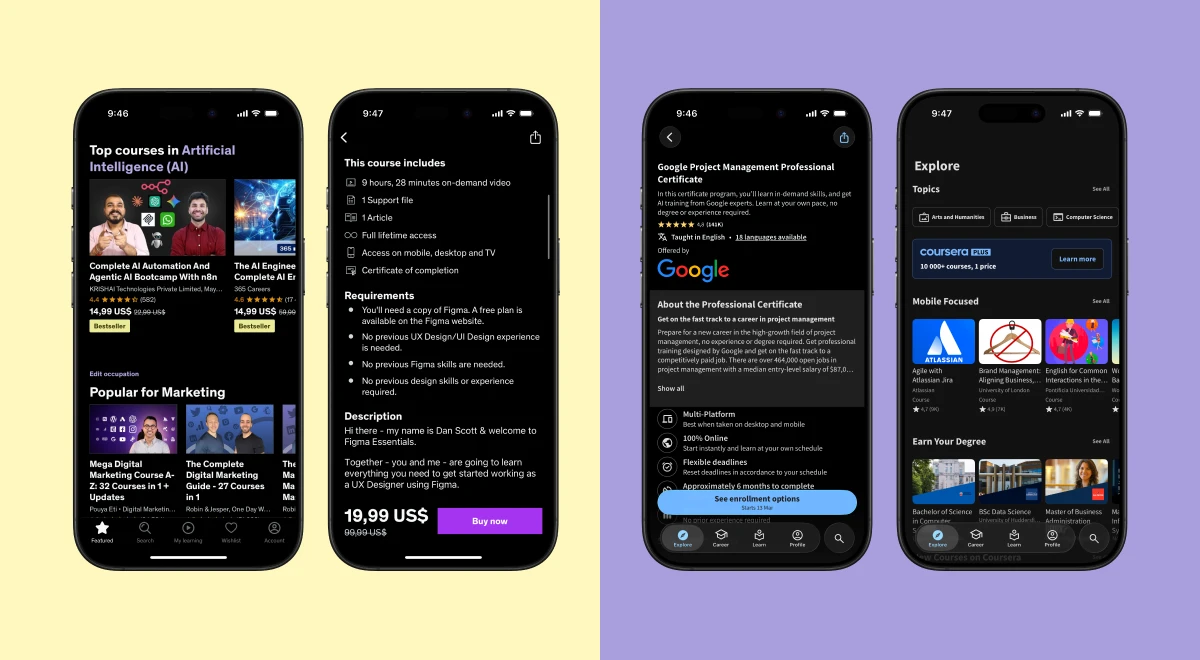
Academics vs marketplace: Coursera courses are developed with partners like Stanford and IBM. Udemy offers content created by independent instructors.
Credibility: Coursera certificates hold academic and professional weight. Udemy certificates are mostly just proof of completion.
Cost model: Coursera relies heavily on a subscription model (Coursera Plus). Udemy is pay-per-course.
📘 Don't have 40 hours for a course? Get the core insights of top nonfiction books on Headway instead.
Coursera vs Udemy: Top comparison table
Here's a quick Coursera vs Udemy comparison to help you see the trade-offs at a glance.
| Feature | Coursera | Udemy |
|---|
Course origins | Top universities and companies (Stanford, Google, IBM) | Independent experts and practitioners |
Learning style | Structured and academic | Flexible, self-paced, and varied |
Popular Topics | Data science, computer science, and business | Web development, design, marketing, and personal development |
Credibility | University-branded professional certificates and online degrees | Non-accredited certificates of completion |
Assignments | Graded assignments, quizzes, and peer-reviewed work | Mostly video-based with some basic quizzes |
Pricing Model | Subscriptions, audit mode, and pay-per-course | Individual courses (often heavily discounted) |
Access | Access ends when the subscription ends | Lifetime access to purchased courses |
Best For | Upskilling for a new career, academic rigor | Learning a specific tool quickly, and creative skills |
While video lectures are great for visual learners, those who prefer to absorb new information during their commute should check if Audible is a more practical fit for their lifestyle.
What is Coursera, and what is Udemy?
Coursera offers a very specific experience. Founded in 2012 by two Stanford professors, it's basically an academic hub. They aren't just hosting random videos; they partner with top universities like the University of Michigan and tech giants like Microsoft to build a course structure that feels "official." When you take Coursera courses, you're often following a curriculum designed for degree programs or professional certificates.
On the flip side, Udemy is a massive marketplace. Think of it as the "YouTube of paid education" but with more in-depth content. Anyone with a skill can create Udemy courses, which means you get a massive variety. Want a deep dive into Python from a senior engineer at AWS? It's there. Want a course on how to fix a kitchen sink? That's also there. It's a self-paced wild west where the best instructors rise to the top through popular courses and student reviews.
The biggest Coursera vs Udemy shift is in the vibe. Coursera is your classroom; Udemy is your workshop. One is for upskilling with academic backing; the other is for grabbing new skills you can use at work tomorrow morning.
If you love the idea of high-speed learning but don't have hours for a full course, find out whether a book summary app like Headway or Blinkist is a better fit for grabbing the core ideas on the go.
Comparison criteria sections: The deep dive
1) Courses and content quality: Academic rigor vs real-world speed
When we talk about high-quality content, it depends on what "quality" means to you. If you need in-depth, peer-reviewed material, Coursera is the winner. Their data science and computer science tracks are legit. You'll find graded assignments, heavy-duty quizzes, and even discussion forums where you can debate the finer points of machine learning with other learners. It's not just watching; it's doing.
Udemy courses are different. Because it's a marketplace, the quality varies wildly. But, for things like web development, JavaScript, or cybersecurity, you can find some of the most current, real-world information out there. But why is that? Because an independent instructor can update their Python course in an afternoon, while a university might take a year to get a new syllabus approved. For tech skills that change every month, Udemy is often faster.
For those who find traditional online classrooms a bit dry, our Imprint review explores a much more interactive and visual way to master complex topics right from your phone.
2) Pricing and payment options: Subscriptions vs ownership
Here's where people get the most confused. Coursera pricing is a bit of a maze. You can buy individual courses, but most people go for the subscription model. Coursera Plus gives you unlimited access to thousands of courses for a yearly fee. They also have financial aid for those who need it and a 7-day free trial on the monthly plan (the annual plan comes with a 14-day money-back guarantee instead). If you're a serious student, the subscription usually makes more sense than paying per course.
Udemy uses a pay-per-course model, so when you buy a course, you get lifetime access. Udemy also offers a 30-day money-back guarantee, which is great because you can "audition" an instructor. Never pay full price on Udemy, though — they have sales every other week where over $100 courses drop to as low as $15.
For a beginner on a budget, those sales are worth watching for. Recently, they've added a Personal Plan subscription for some popular courses, but the "buy it and keep it" model is still what they do best.
📘 Support your Coursera studies with the biggest ideas in psychology and productivity on the Headway app.
3) Certificates and credibility: Does a digital piece of paper actually matter?
Let's be real about certificates of completion. If you put a random Udemy certificate on LinkedIn, it shows you have initiative, but it doesn't always "validate" the skill in the eyes of a recruiter. Udemy certificates are basically a pat on the back. They prove you watched the videos, but since the assignments aren't usually peer-reviewed or strictly graded, they don't carry much academic weight.
Coursera certificates, on the other hand, are a different beast. Since they come with a logo from Stanford, IBM, or the University of Michigan, they actually mean something in a job interview. If you're looking at degree programs or a master's degree online, Coursera is the one that's going to get you there. Companies like Microsoft and IBM use these professional certificates to vet talent.
So, if your learning goals involve getting a new job in cybersecurity or machine learning, the extra rigor of a Coursera course is usually worth it.

4) Learning experience and flexibility: "At my desk" vs "On my own terms"
The learning style between the two is night and day. Coursera feels like school. You have graded assignments, specific learning paths, and sometimes even hard deadlines. You might be working on guided projects where you use a split-screen to code while the instructor talks. It's very structured. If you thrive on pressure and clear instructions, you'll love it.
Udemy courses sit at the deep end of self-paced learning. Where something like Blinkist gives you the key ideas from a book, Udemy walks you through the full material at your own pace. You get lifetime access, so you can buy a software engineering course today and finish it in 2028 if you want. There are no expiration dates.
Most Udemy offers are very project-based, which is great for beginner developers who want to build a portfolio. You're not just learning the theory of JavaScript; you're building a weather app. It's less about the "why" and more about the "how."

5) Career impact and outcomes: The ROI of your time
When we talk about upskilling, we're talking about ROI. A 2026 Coursera vs Udemy comparison shows that for high-level tech skills and management, Coursera has the edge. Their specialization tracks are designed to take someone from a total beginner to job-ready.
That said, Udemy is the secret weapon for niche skills. If you need to learn a specific AWS tool or an obscure Python library for a project due on Monday, Udemy is your best bet. It's the "just-in-time" education platform. Many learners use Udemy to supplement their online degrees or bootcamps because the instructors are often people working in the field right now, not just academics.
6) AI and future skills trends: Where is all this going?
Let's talk about the elephant in the room: AI. By now, everyone is trying to learn machine learning or how to use generative AI in their workflow. If you look at Coursera and Udemy, you'll see that both platforms are pivoting hard.
Coursera is doubling down on "big names." They're working with Microsoft and IBM to create huge specialization programs that are essentially bootcamps for the AI era. These are serious professional courses that teach high-level tech skills, meant to be added to your LinkedIn profile to prove you won't be replaced by a robot.
Udemy is more like the "front lines." If a new AI tool drops on a Monday, there's usually a course for it by Wednesday. It's the best place for software engineering professionals who just need to know how to integrate a specific API. While edX focuses on heavy academic research, Udemy is where you go when you just need to get the job done.
📘 Try Headway for 15 minutes a day and see how much your perspective changes without the course-load stress.
7) Decision guide: Coursera vs Udemy, which is better?
Look, there's no "perfect" platform. It's about what you need right now. If you're still staring at the screen, wondering where to put your credit card information, run through this checklist:
Go with Coursera if:
You want a name-brand university like Stanford on your résumé.
You're pursuing online degrees or even a full-time master's degree.
You prefer peer-reviewed work and high academic standards.
You have the budget for a subscription model like Coursera Plus.
Go with Udemy if:
You want to learn Python or JavaScript for a specific project this weekend.
You prefer self-paced learning without the pressure of assignments.
You like the idea of lifetime access to your study materials.
You're a beginner just testing the waters of a new hobby.
Go with microlearning if:
Your track record with online courses isn't great.
Your schedule changes from week to week.
You want steady progress without deadlines.
You're tired of feeling guilty about abandoned courses.
Try Headway, a secret weapon for the busy learner!
At the end of the day, the Coursera vs Udemy choice depends on your end goal. If you need the world to know you were trained by the best, Coursera is worth every penny of the Coursera pricing. The Coursera certificates are a legitimate career asset.
But if you just want to get your hands dirty with real-world tools and learn at your own pace, Udemy is hard to beat. Just remember to use that 30-day money-back guarantee if your learning style doesn't click with your instructor. There's no harm in trying.
Whichever you choose, just start. But let's face it: taking a 40-hour course on cybersecurity is a huge commitment. Most of us start with good intentions and then "life" happens. Here's where Headway comes in. Think of the app as your supplemental brain.
While you're working through a deep specialization on Coursera, you can use Headway to grab the "big ideas" from books on productivity, leadership, or even the psychology of learning. It's about keeping that momentum alive. If you're burnt out on coding, listening to a 15-minute summary of a career-growth book helps you remember why you're upskilling in the first place.
📘 Get unlimited access to the world's best ideas — start your journey with Headway today.
FAQs about Coursera vs Udemy
Is Coursera or Udemy more recognized for a résumé?
Recruiters generally view Coursera with more respect because its courses are verified by prestigious universities. You should absolutely list these certificates on your résumé to show formal dedication. In a comparison of Udemy, Coursera, and LinkedIn Learning, Coursera wins for academic credibility. The other two are mostly seen as self-driven professional development.
Is Udemy better than Coursera for learning new skills?
It really comes down to your pace. If you need a quick, $15 tutorial on a niche tool, Udemy can't be beat. But if you want a solid academic foundation, you'll find it lacking. You're choosing speed and variety with one, and rigor with the other.
What are the main disadvantages of using Udemy?
The biggest catch with Udemy is that anyone can upload a course, meaning quality is hit-or-miss. You might end up with outdated information or poor audio. In any thorough Udemy vs Coursera comparison, it's clear that Udemy lacks the university-backed grading and professional weight that employers actually value when they're looking for verified expertise on a job application.
Can I put a Coursera certificate on my résumé?
Yes, and you definitely should, especially if it's a Professional Certificate or a Specialization. Unlike a simple "completion" badge, these show that you've passed graded assignments and peer reviews. They signal to hiring managers that you've completed a structured curriculum from a reputable source, making your technical skills look more legitimate during the interview process.
What are the disadvantages of Coursera?
The main drawback of Coursera is the cost and the pressure. Most advanced courses require a monthly subscription, which adds up if you don't finish quickly. Also, the academic rigor can be frustrating for people who just want a quick tip. It's a serious time commitment that doesn't offer the "buy once, keep forever" simplicity that many hobbyists prefer.