Self-growth
 Business & Career
 Success
 Communication
 Healing
 Relationships
 Psychology
 Happiness
How often do you find that your best ideas come when you talk with a friend or a coworker? Research shows that the power of cooperative learning helps us achieve more when we work in small groups rather than by ourselves.
This method helps learners use teamwork to hit their learning goals while ensuring everyone in the group stays sharp and involved. And when you want to share knowledge with your team, you need quick access to the world's best ideas from experts like Scott Young, Benedict Carey, or Chip and Dan Heath.
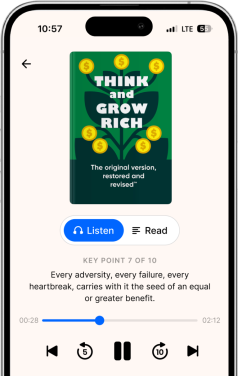
Headway acts as a bridge for your group, providing the perfect material for face-to-face interaction without the need to read hundreds of pages. Using cooperative learning strategies like the jigsaw method becomes easy when everyone can listen to a different 15-minute summary and teach the rest of the group.
Download the Headway app and learn smarter now!
Quick answer: What is cooperative learning?
Cooperative learning is a way of organizing group work so that students work together to finish specific tasks. The system creates positive interdependence, meaning that if one person succeeds, the whole team does.
You might see this happen in high school or higher education, and the approach works well for adults in the workplace.
The idea grew from the work of experts like Kagan and Johnson, who found that collaborative learning beats solo study almost every time.
There are different types of cooperative learning. Formal groups stay together for a long time, while informal groups might only meet for one class discussion. Both help you build interpersonal skills and achieve group goals.
The science behind cooperative learning
We will look at how our brains react when we talk to others and why face-to-face contact helps us think more clearly.
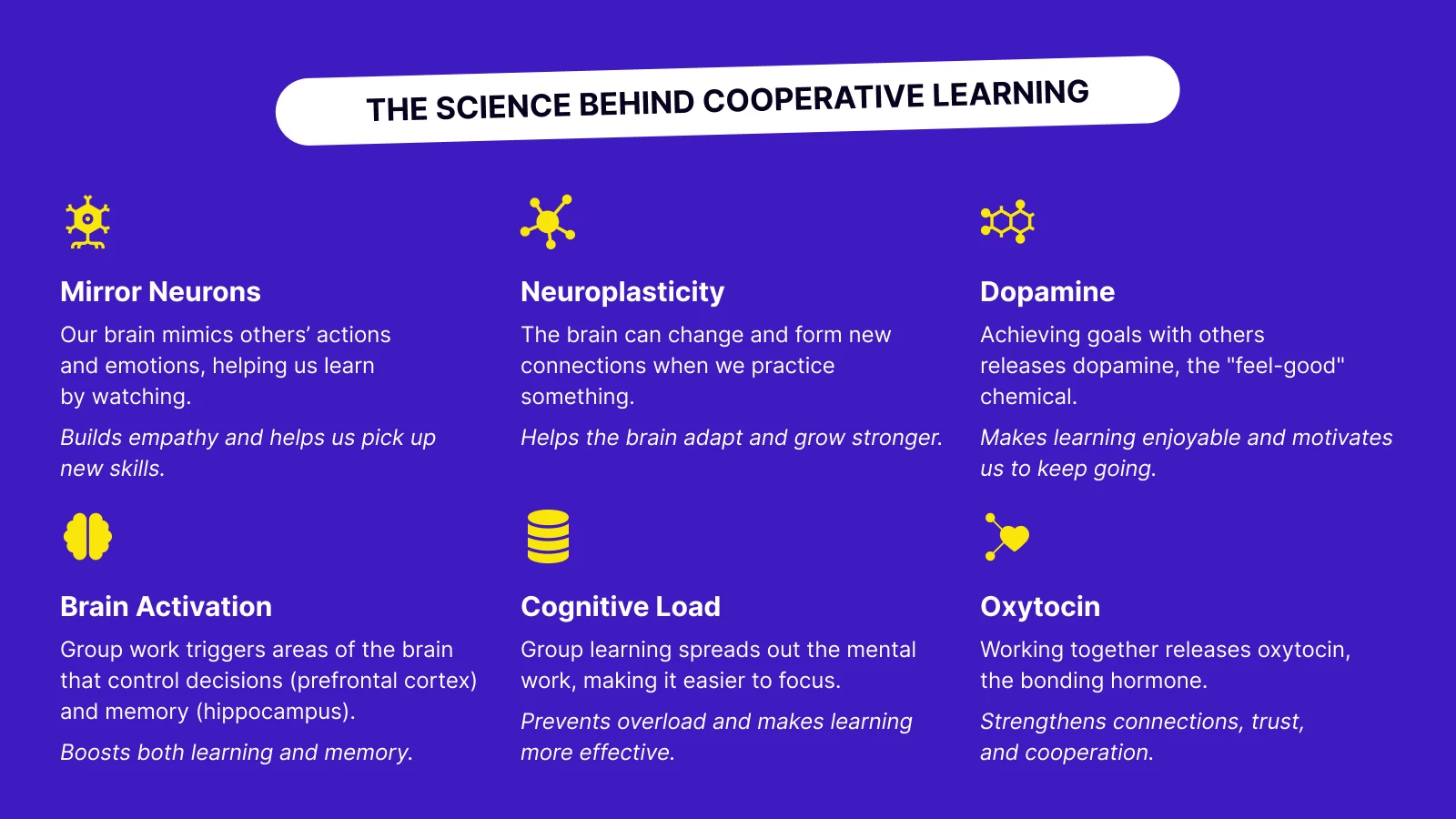
Science shows that when we use cooperative learning structures, we activate metacognition, which is thinking about how we think.
When we explain a concept to team members, our brain has to organize that information in a new way. Explaining makes the learning experience much richer because you become an active teacher.
Research suggests that promotive interaction, in which people encourage one another, leads to better problem-solving and greater decision-making power. This practice is why many people look for educational apps that offer ways to share knowledge.
When you use cooperative groups, your brain releases chemicals that make you feel more connected and motivated to finish the task.
How cooperative learning can enhance your learning experience
In this part, we share some easy ways to bring group learning into your life so you can get better results.
One of the best cooperative learning activities is the pair-share technique, where you talk about a new idea with one other person before sharing it with a larger crowd. Pair-share builds your social skills and helps you avoid feeling overwhelmed.
The technique also allows for individual accountability, because you have to be ready to explain your part of the work to your partner.
To make pair-share work in real life, you should set clear roles within your learning group. Clear roles prevent one person from doing all the work and ensure that conflict management happens early on.
When everyone knows their job, group skills improve, and the whole team hits their learning goals much faster than they would alone.
Moving from theory to real-life success
Many people read about these ideas but never use them in their careers or personal lives. Let's bridge that gap.
In your career, cooperative learning looks like "Communities of Practice." These are groups of coworkers who meet to solve a hard problem or gain a new skill together. Instead of taking a solo course, you use informal cooperative learning to share shortcuts and tips.
Communities of Practice transform the office into a place of growth, where team members rely on one another to stay ahead.
In your personal life, you can apply cooperative learning to fitness or hobbies. If you join a running club, you rely on shared goals and positive interdependence to keep yourself moving. When you use learning apps and track your progress there, you create a digital version of group work that keeps you honest and helps you reach your dreams faster.
Five benefits of cooperative learning in group settings
We will talk about how working with others helps you become a better leader and a more creative thinker. Working in student groups allows for more innovation because two heads are usually better than one when it comes to decision-making.
The elements of cooperative learning do more than help you pass a test; they build social skills that last a lifetime. With free microlearning apps, you can gather quick facts and bring them back to your group to keep the learning process fast and exciting.
Key advantages for your growth
Stronger social skills: You learn how to listen and adapt to different personalities.
Better conflict resolution: Handling different opinions helps you balance shared goals.
Increased innovation: Working in a content area with others leads to more creative ideas.
Faster progress: Using the best learning apps together helps you cover more ground in less time.
Higher motivation: Knowing your team members count on you keeps you moving forward.
Five common pitfalls in cooperative learning
Even the best plans can go wrong, so here we talk about how to keep your group on the right track. It is important to have a plan for group processing at the end of each session, where you talk about what went well and what did not.
If you struggle to stay on track, you might need to find out how to focus on studies as a group to keep distractions away. Recognizing these issues early helps you maintain positive interdependence and keeps the energy high.
Challenges to watch for
Lack of individual accountability: This happens when one person does all the work while others just watch.
Poor conflict management: If the group cannot agree, the group's goals will suffer.
Unequal participation: Some group members might feel left out if student roles are not clear.
Social loafing: Without specific tasks, some people might not contribute their fair share.
Communication gaps: A lack of face-to-face interaction can lead to big misunderstandings.
To fix these problems, you must use essential elements of the model, like the jigsaw method. The jigsaw approach ensures that every person is a vital part of the team.


Five proven techniques to reach your goals through cooperation
Use these practical exercises to turn your small groups into powerhouses of growth.
1. Build your network with 'The Education Of Millionaires'
In 'The Education of Millionaires,' Michael Ellsberg talks about how important it is to build a network of people who can teach you what school did not. Ellsberg describes a form of base groups where you support each other over a long time.
Practical exercise: Identify three skills you lack that are vital for your learning goals. Reach out to three people who excel in those areas and suggest a weekly meetup. Weekly meetups create positive interdependence, where you swap your business wisdom.
2. Use strategic collaboration from 'Ultralearning'
If you want to get better at specific tasks quickly, 'Ultralearning' by Scott Young is a great resource. He shows how intense focus and collaborative learning can help you pick up new skills in months instead of years.
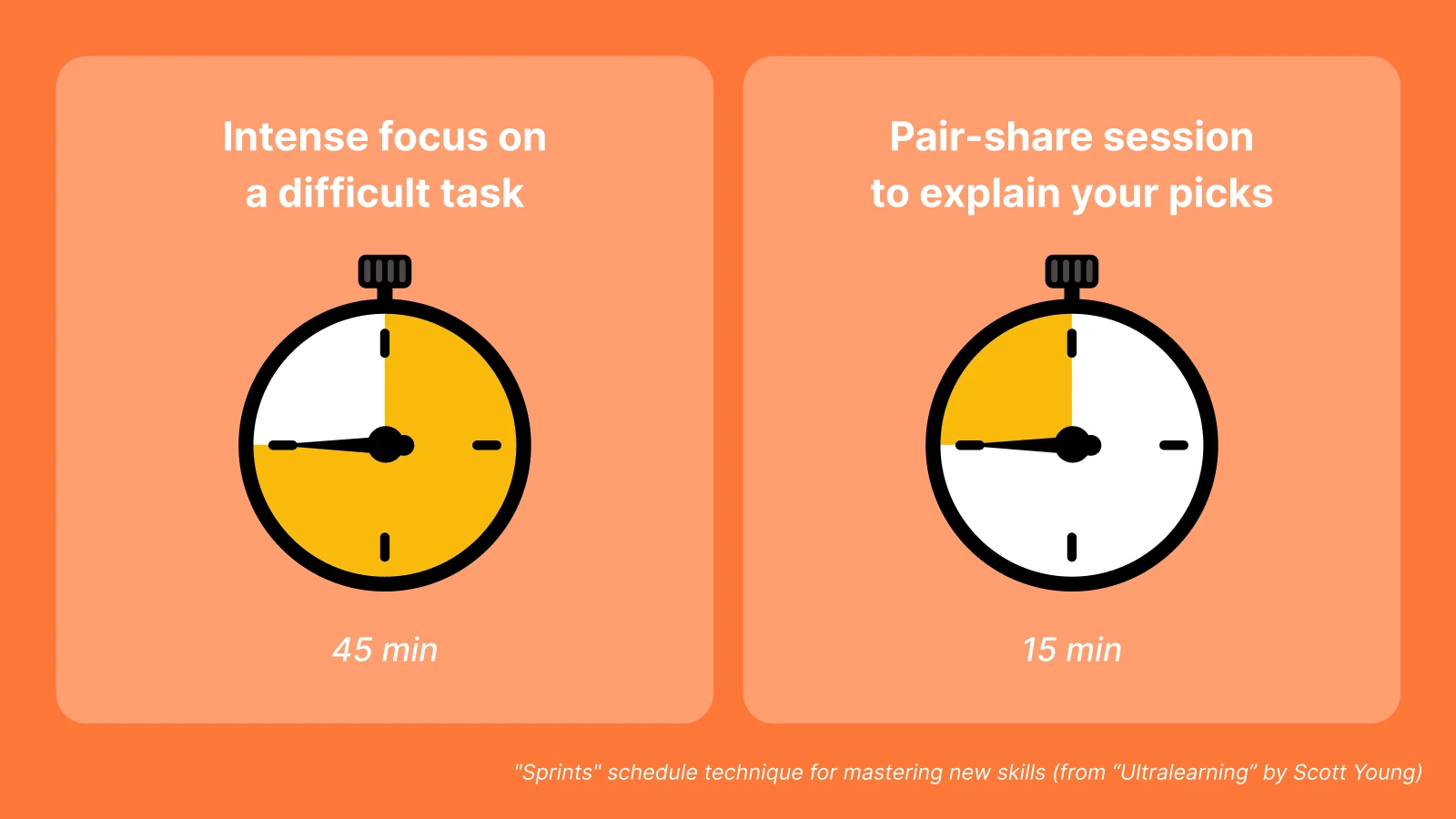
Practical exercise: Set a "Sprints" schedule with your team members. For one class period, focus intensely on a difficult task, then spend 15 minutes in a pair-share session to explain what you just picked up.
3. Create sticky ideas with 'Made To Stick'
Making your ideas stick is a big part of group processing. In 'Made to Stick', Chip and Dan Heath explain how to communicate so people remember what you said. Clear communication matters for face-to-face interaction in student groups.
Practical Exercise: During your next group work session, use the "SUCCESs" model to present your part of the jigsaw task. Ask your group for promotive interaction feedback. Did the idea stay in their minds? Presenting this way improves your social skills.
4. Gain knowledge beyond the classroom with 'Don't Go Back To School'
The book 'Don’t Go Back to School' by Kio Stark explores how to gain skills using the world around you. She highlights how interpersonal skills and community-led group work are often more effective than basic classroom instruction.
Practical exercise: Organize a "Learning Safari" with your cooperative groups. Go to a location related to your content area, like a museum or a market. This learning experience builds decision-making skills.
5. Apply brain science with 'How We Learn'
Understanding the key elements of how our brains function is essential for any learning process. 'How We Learn' by Benedict Carey explains that things like sleep and changing your environment help you retain information.
Practical exercise: Practice "Perceptual Learning" by changing your environment for cooperative learning activities. If you usually meet in an office, move your team or class discussion to a park. Changing locations helps the brain stay alert and makes it easier to manage conflict resolution.
Create your own cooperative learning plan in four steps
To get the most out of your group, you need a structured approach. Using the Headway app makes it easy to organize your learning experience with your friends or colleagues.
Step 1: Set your growth plan. Start by choosing a specific goal in the Headway app, such as "Leadership" or "Healthy Habits." Use the personalized Growth Plans feature to ensure all group members are following a similar path toward a common goal.
Step 2: Assign book summaries. Divide the weekly reading list among your team members. One person might listen to a summary on conflict management, while another focuses on decision-making. This is the jigsaw method in action.
Step 3: Interactive knowledge swap. Use the interactive elements in Headway, like the spaced-repetition flashcards, to test each other during your face-to-face interaction. Testing each other ensures individual accountability while making the session feel like a game.
Step 4: Group processing. At the end of the week, have a group discussion about how the insights apply to your specific tasks. Use the Headway progress tracker to celebrate how much you have grown as a team.
Build your skills fast with Headway book summaries
Cooperative learning is a powerful way to develop new skills and achieve your goals. Working in small groups and focusing on positive interdependence helps you turn any learning experience into a chance for major growth.
The Headway app is the perfect tool for bringing new ideas to your group activities. With many summaries, you can find the best insights on teamwork and social skills in just 15 minutes.
Headway makes it easy to stay informed and share valuable lessons with your friends or coworkers without spending hours reading every day.
Download the Headway app today and start using summaries that will help you lead your group to success. Join millions of others who use microlearning to build a better life, one bite-sized book at a time.
FAQs
What are the 5 principles of cooperative learning?
The five essential elements are positive interdependence, individual accountability, face-to-face interaction, social skills, and group processing. These key elements make sure that group members work together fairly. When these are in place, adult students learn more because the common goal is clear and everyone has a job.
What are examples of cooperative learning?
Common cooperative learning strategies include the jigsaw method, where each person learns one part of a topic and teaches it to the group. Another is pair-share, where two learners talk about a problem before joining a class discussion. These group activities are great for building teamwork in any content area.
What are the pillars of cooperative learning?
The pillars are similar to the core elements of cooperative learning created by Johnson. They focus on making sure group work is structured so that everyone participates. This includes setting group goals, practicing conflict resolution, and ensuring that the learning process involves every person in the small groups.
Is cooperative learning effective?
Yes, cooperative learning works well for high school and higher education. Research shows that collaborative learning leads to higher grades and better problem-solving skills. Because it builds interpersonal skills and metacognition, learners tend to remember facts longer than when they study on their own.
Is cooperative learning good for introverts?
It can be invaluable because it uses small groups, which feel safer than a full class. In cooperative groups, introverts often share their ideas during face-to-face interaction. Techniques like pair-share give them a chance to think and discuss quietly, way before the class discussion begins.