Self-growth
 Business & Career
 Success
 Communication
 Healing
 Relationships
 Psychology
 Happiness
You've probably seen the trailer for the new Breakup Season movie making rounds on social media. It's the one where a woman gets dumped right before Christmas and has to navigate the holiday season on her own. Marketers are calling it the perfect romantic comedy for anyone who's ever been single during the holidays, and it's already generating buzz as this year's must-watch holiday movie.
But here's the thing: Breakup season doesn't just relate to a film with a romantic comedy (rom-com) premise. It's a well-documented pattern that relationship researchers have observed for years. If you've noticed more couples splitting up as the year ends or right after the New Year, you're not imagining things.
Why do so many relationships implode during these specific months? And if you're going through a breakup right now, how do you move from heartbreak to breakthrough?
Download Headway to access 15-minute book summaries that'll help you understand attachment, heal faster, and build the relationship skills you actually need, starting today.
Breakup season is not just a movie
The Breakup Season film follows a predictable arc: girl meets guy, girl gets dumped, and girl finds herself again (probably with a montage and a killer playlist). It's the kind of Christmas movie you'd watch while eating ice cream and texting your friends about your own dating disasters.
But step away from the popcorn for a second. The reason this romantic comedy resonates so well is that it reflects a genuine aspect of life. Breakups spike during two particular windows every year, and if you're reading this article in late fall or early spring, you're right in the middle of one of them.
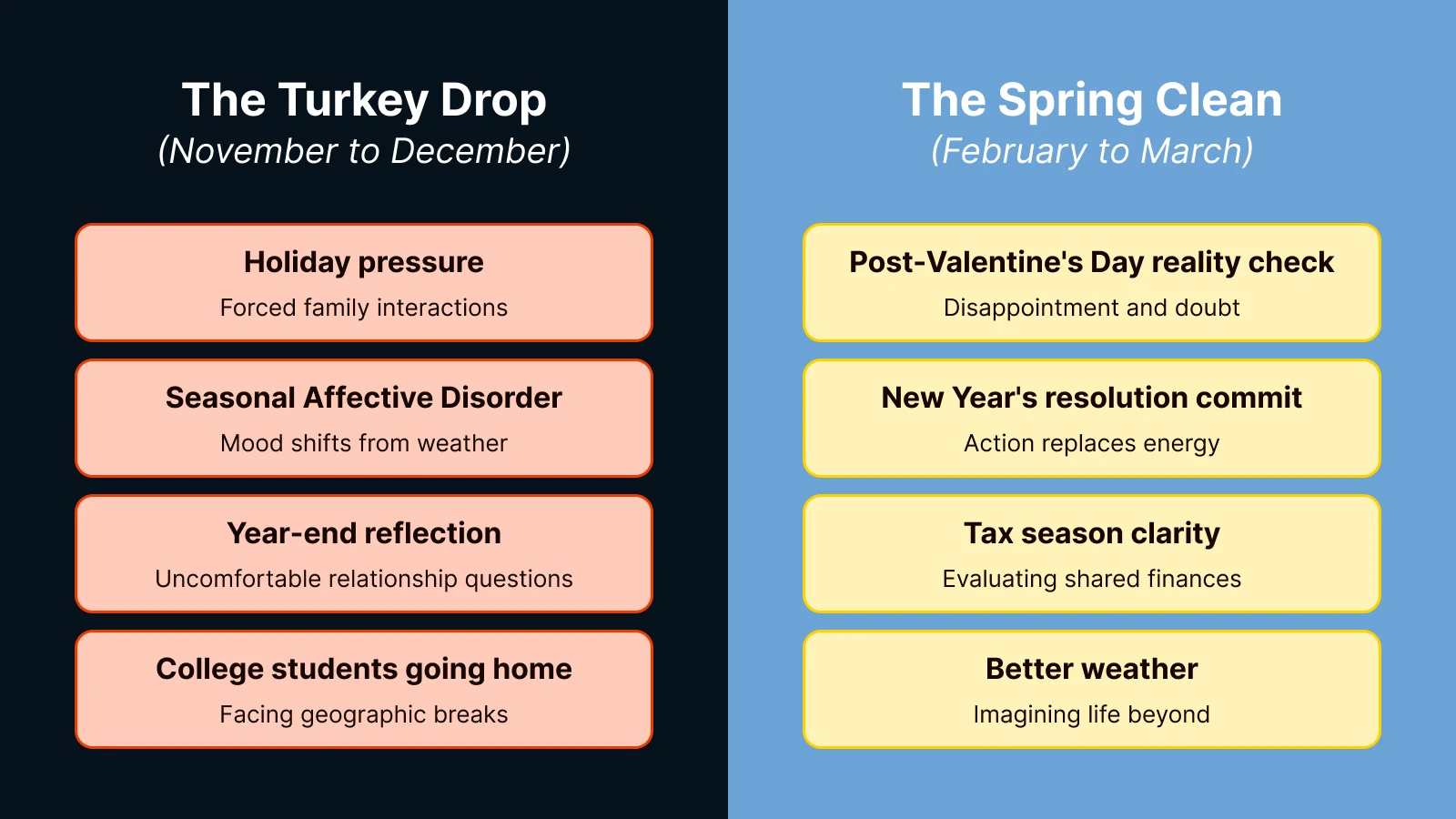
Whether you live in Los Angeles or New York, the patterns are the same. Relationship experts call these periods "The Turkey Drop" (November-December) and "The Spring Clean" (late February through March). If your relationship is on shaky ground, times like these can feel like emotional danger zones.

The "science" of breakup season
So why do relationships crash and burn during these specific times? Let's break this pattern down:
The Turkey Drop (November to December)
Holiday pressure: You're expected to meet each other's families and pretend everything's just great while wearing ugly sweaters.
Seasonal Affective Disorder (SAD): Shorter days and less sunlight can tank your mood, so even small irritations might feel unbearable.
Year-end reflection: The New Year forces people to assess their lives. "Is this relationship where I want to be next year?" becomes an uncomfortable question to answer.
College students going home: The first time many college couples face a geographic break coincides with Thanksgiving break — hence the name "Turkey Drop."
The Spring Clean (February to March)
Post-Valentine's Day reality check: If Valentine's Day felt forced or disappointing, people start questioning whether they're in the right relationship.
New Year's resolution follow-through: That "New Year, New Me" energy from January finally translates into action by March.
Tax season clarity: Nothing makes you evaluate shared finances (and futures) quite like tax season.
Better weather equals more options: As days grow longer and social calendars fill up, people start to imagine life beyond their current relationship.
These patterns show up consistently whether you're listening to a breakup-themed podcast, scrolling through breakup day posts on social media, or just noticing your own friends suddenly becoming single.
📘 If you're searching for clarity, not noise, Headway can help. A few minutes a day with the right ideas can give you perspective and the confidence to choose what's next.



Are you part of the break up season?
Sometimes, it's hard to tell whether what you're feeling is just holiday stress or a sign that the relationship has reached its natural end. A few honest questions can help bring you that clarity:
When things finally slow down, do you still look forward to seeing your partner?
Are your arguments about practical stuff (like travel plans or family schedules) rather than deeper issues about values?
Can you picture next year's holidays feeling lighter if you set better boundaries?
On the other hand, this time might be more than a rough patch if the idea of another year together fills you with dread:
If you're staying because breaking up right now feels too cruel, awkward, or inconvenient.
If the fighting has stopped, not because things are better, but because you've stopped caring.
If you keep imagining how different (or freer) life might feel on your own.
In the end, the line between a tough season and a relationship that's over often comes down to one simple question:
Do you actually want to work on this relationship, or do you want out but feel stuck because of timing?
What's the path from breakup to "breakthrough"?
Here's what no romantic comedy will tell you: a breakup, however painful, is also data. It's information about what you need, what you're willing to tolerate, and who you're becoming.
The leading role in your life story isn't the person who left — it's you. And this moment, right now, is your chance to rewrite the script.
Instead of numbing out with another holiday movie marathon at your local Circle Cinema, what if you used this time to actually understand yourself? What if you figured out your attachment style, identified your patterns, and built real emotional skills?
That's not "self-help speak." It's practical. Breakup season can become your breakthrough season if you're willing to do the work.
Check out the "anti-rebound" reading list
Here are five book summaries that you should read or listen to on Headway instead of texting your ex at 2 AM:
1. 'Attached' by Amir Levine and Rachel Heller
2. 'Get the Guy' by Matthew Hussey
3. 'The Breakup Bible' by Rachel Sussman
4. 'Psychopath Free' by Jackson MacKenzie
5. 'Women Who Love Too Much' by Robin Norwood
These aren't just comfort reads — they're tools for growth. And you can absorb the key insights from each one in about 15 minutes on Headway, which means that you can start rebuilding yourself today, not six months from now when you've "had time to process."
📘 Get these summaries and over 2,000 more on Headway. Your post-breakup reading list is waiting.
Your new season starts now with Headway
So yes, breakup season is real. But you know what else is real? Your ability to turn this ending into a beginning.
The calendar year might be closing out, but a new chapter of your life is opening. One where you understand yourself better, where you don't settle, and where you know your worth and won't compromise it for someone who can't see it.
This part isn't like a scene in a romantic comedy where you run through an airport to win someone back. This moment is the part where you choose yourself for the first time, and that's a much better story.
Breakup season can be your breakthrough season. Download Headway today and start building the next version of yourself.
Frequently asked questions about breakup season
What is breakup season meaning?
Breakup season is the time of year when relationships tend to fall apart more often than usual. It usually happens twice: once around late fall and the holidays (November to December), and again as winter fades into spring (February to March). Stress, emotional overload, darker days, and end-of-year reflection all collide, and relationships that were already shaky often can't hold up under the pressure.
When is breakup season?
Spring wins. March and April consistently see the highest number of breakups. There's something about more daylight, better moods, and a fresh-start feeling that makes people reassess their lives, including who they're with. November and December also bring a spike, but spring is when many people finally admit, "This isn't working anymore."
Is breakup season a real phenomenon?
Yes, it's real. Researchers and therapists noticed this pattern long before social media named it. Facebook data showed clear spikes in relationship status changes during February through March and November through December, and therapists report a surge of clients questioning their relationships at the same time every year.
What are the five stages of a breakup?
The five stages mirror grief: denial (this isn't really happening), anger (how could they do this?), bargaining (maybe if I change…), depression (will I ever feel okay?), and acceptance (I'm ready to move forward). These stages don't happen in a linear sequence, so you might cycle through them multiple times.
What is the movie Breakup Season about?
It's a rom-com about getting dumped right before Christmas, which is the worst timing imaginable. The main character has to survive the holidays alone, stumble through heartbreak, rediscover herself, and (of course) probably fall in love again by the end. This movie takes something very real and painful (winter breakups) and wraps it in cozy lighting, emotional montages, and a comforting, predictable ending.