Self-growth
 Apps & Digital Tools
 Business & Career
 Success
 Growth Tools
 Psychology
 Communication
 Relationships

You closed your laptop at seven, answered forty messages, sat through five calls, and moved nothing important an inch.
That gap between effort and output is what sends most people looking for the best books for productivity in the first place. Books to become more productive sell by the millions for a reason. The frustrating part is that the advice usually works — for about nine days. Then a launch slips, a kid gets sick, and the color-coded calendar quietly dies.
Psychologists have a name for what happens next. Tracking what they call the setback effect, Pam ten Broeke and Marieke Adriaanse found that a single small lapse in self-regulation made people more likely to fail again soon after, and less likely to succeed. Across everyday goals including exercising and saving money, the mechanism that showed up most consistently was a drop in self-efficacy — the belief that you can pull it off at all.
So the missed morning isn't the damage. The quiet conclusion you draw from it is. What separates productivity books that work from the rest is whether they hand you a system that survives a bad week and gets you back to the desk on day ten. The 17 titles below do that. Each one is available as a 15-minute summary on Headway, so you can test a framework before you commit a weekend to a 300-page book.
➡️ What is Headway and how does it work?
📘 Match a system to your week with Headway.

Quick answer: What are the best books for productivity?
The Headway editorial team picks 'Deep Work' by Cal Newport for protecting focus, 'Getting Things Done' by David Allen for clearing mental clutter, and 'Atomic Habits' by James Clear for making the change stick. Start with the one that matches your actual bottleneck — attention, task overload, or follow-through. Reading three nonfiction books about all three problems at once is how most reading lists stall in February.
| Book title | Best for | The system it hands you |
|---|---|---|
'Deep Work' | Constant interruption | Scheduled blocks of undistracted, focused work |
'Getting Things Done' | A head full of open loops | Capture every task in one trusted external list |
'Atomic Habits' | Plans that collapse by week three | Tiny habits stacked onto cues you already have |
'First Things First' | Urgent work crowding out important work | Weekly planning built around roles, not tasks |
'The Power of Full Engagement' | Running out of gas by 2 pm | Energy rituals with deliberate recovery |
'Slow Productivity' | Doing everything and finishing nothing | Fewer projects at once, judged on quality |
📘 Start with your bottleneck on Headway.
Why most productivity books never change your week
The books that improve productivity share a trait that has little to do with the quality of their advice. Reading about a system feels like progress, which is the trap. You finish a chapter on time blocking, feel briefly in control, and go right back to a calendar shaped by other people's requests. Nothing changed except your mood.
The second problem is volume. Israel Erick López Andrade, a freelance writer and editor with more than twenty years of experience, described the loop plainly: hours of courses and videos consumed, very little left over that he could use. Content stacked up. Capability didn't.
So treat the best books on productivity as a menu rather than a syllabus. Pick one, run its system for two weeks, and only then move on.
Best self-help books on habits and productivity: Systems that survive a bad week
Motivation is a terrible operating system. The best books for building better habits replace it with cues, loops, and evidence about how behavior change works in practice.
1. 'Atomic Habits' by James Clear
James Clear's argument is that outcomes lag behind systems. Instead of setting a goal to get fit or write more, you make the smallest version of the behavior obvious, attractive, easy, and satisfying — his four laws of habit formation. Environment does most of the heavy lifting. If the running shoes are by the door and the phone charges in another room, willpower barely has to show up.
The math is what sticks with people. Enrique García Galán, a software engineer and PhD researcher, had read the book years ago and forgotten most of it. Revisiting the summary, he highlighted the line about a daily 1% improvement or decline compounding to 37 times better or worse across a year, and built his morning routine around it. If you want a broader shelf of titles in this vein, our list of the best books for self-improvement covers the neighboring ground.
2. 'The Power of Habit' by Charles Duhigg
Charles Duhigg breaks every habit into a three-part loop: a cue, a routine, and a reward. Once you can name all three, changing a behavior stops being a matter of grit and becomes a matter of substitution. You keep the cue and the reward, and swap only the routine in the middle.
The book is at its best on keystone habits — single changes that drag other improvements along behind them. Duhigg tracks the idea through a company that cut injury rates and, in the process, reorganized how it communicated. For anyone trying to stop procrastinating without white-knuckling it, diagnosing the cue is the first useful move.
3. 'Smarter Faster Better' by Charles Duhigg
Duhigg's follow-up is one of the more science-backed productivity books on this list, and it covers ground the habit literature skips: motivation, goal setting, decision-making, and how teams get sharper. His point on goals is practical. Pair a stretch goal with a specific next step, or the ambition just sits there looking impressive.
He also digs into mental models — the running story good operators keep about what should happen next, which is why they notice fast when something goes sideways. If the psychology behind these findings interests you more than the tactics, psychology books for beginners is a reasonable next stop.
Best books for focus and productivity in a distracted job
Attention is the resource everything else depends on. Among books to improve focus, Cal Newport wrote the three most useful, and they work as a sequence — from deep focus at work to what your phone does to the rest of your day.
4. 'Deep Work' by Cal Newport
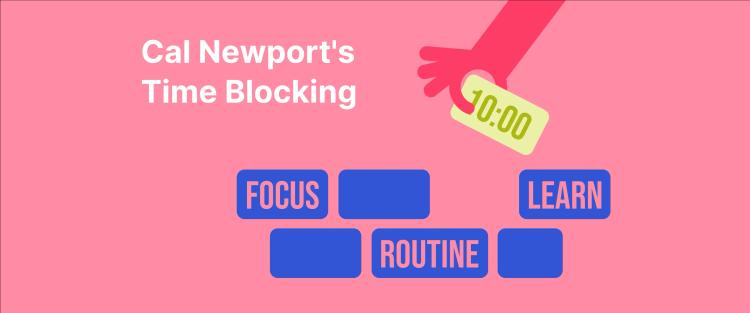
Newport separates deep work, which is cognitively demanding and hard to replicate, from shallow work, which is logistical and endlessly available. Most knowledge worker days are shallow by default. His fix is scheduling: put focused work on the calendar in blocks, defend those blocks, and let the shallow tasks fill what's left rather than the reverse.
Olena Khodos, a content marketing manager whose team covers productivity tools for a living, ran this as an experiment. She read the Headway summary, pulled out the core concepts, and rebuilt her workday around uninterrupted blocks instead of task-switching. Her verdict was that testing Newport's principles changed how she structures her day — and she documented the whole thing publicly rather than filing it away.
5. 'Digital Minimalism' by Cal Newport
Here Newport moves from work hours to everything else, and the subject becomes attention management rather than scheduling. The core practice is a thirty-day declutter: step back from optional technologies, notice which ones you genuinely miss, and reintroduce only those, with rules attached. What replaces the scrolling matters as much as the removal — he pushes hard on high-quality leisure that demands something of you.
Enrique's story is this book in miniature. Twenty minutes of automatic morning scrolling, redirected into one book summary a day, held for a year. He reported 58 summaries absorbed and, more to the point, more control over where his attention goes. The time was already in his day. Only the destination changed.
6. 'Slow Productivity' by Cal Newport
Newport's most recent argument is the least flattering to hustle culture: do fewer things, work at a natural pace, and obsess over quality. Visible busyness became a proxy for value once work moved to screens, and the proxy is a bad one. Overload doesn't just feel awful; it degrades the output you're overloaded producing.
This is the book for anyone circling burnout while still hitting deadlines. The practical piece is limiting work in progress — not the number of things you're committed to, but the number you're touching this week. Everything else waits in a queue where it can't fragment your attention.
Best productivity and time management books for getting things done
Focus is useless if you can't remember what you owe people. Among books on time management, these four are the canon on capture, prioritization, and follow-through.
7. 'Getting Things Done' by David Allen
GTD rests on one insight: your brain is bad at storage and good at thinking, so stop asking it to do both. David Allen's system moves every commitment out of your head and into a trusted external structure through five steps — capture, clarify, organize, reflect, and engage. The weekly review is the part people skip and the part that makes it hold.
Two smaller rules earn their keep immediately. If a task takes under two minutes, do it now. And define the physical next action, not the project, because "prepare Q4 report" is a source of dread while "open last quarter's file" is something you can do. GTD is the most complete task management framework here, and also the most demanding to set up.
8. 'The Checklist Manifesto' by Atul Gawande
Atul Gawande, a surgeon, argues that the failures of skilled professionals are rarely failures of knowledge. They're failures of application under complexity — knowing what to do and missing a step anyway. Aviation solved this decades ago with checklists. Medicine came to it late, and the surgical safety checklist he describes cut complications sharply.
For your own work, the lesson is to stop trusting memory for recurring processes. A short checklist for a client handoff, a deploy, or a monthly close takes twenty minutes to write once and saves the same embarrassing mistake forever.
9. 'The 7 Habits of Highly Effective People' by Stephen R. Covey
Covey's framework is older than most of this list and has outlasted almost all of it. His first three habits ask you to be proactive, begin with the end in mind, and put first things first. That third one introduces the time management matrix that quietly runs half the productivity industry: sorting work by urgency and importance, then noticing how little of your week goes to what's important but not urgent.
The book's real subject is character rather than efficiency, which is why it survives. Habits four through six deal with cooperation and listening, and habit seven — sharpen the saw — is an early argument for renewal that the burnout literature would arrive at decades later.
10. 'First Things First' by Stephen R. Covey
Covey and his co-authors expand the third habit into a full method for prioritizing tasks around what matters instead of what's loudest. You start from roles and values, choose a small number of important-but-not-urgent goals each week, and place those before the calendar fills.
Abdelrahman Mohamed Soliman, a lead cost control engineer, lived the before-and-after. His days ran on urgency: instant email replies, defensive reactions, problems corrected after the fact. Decision fatigue kept pushing him toward whatever was closest to hand.
Twenty minutes of structured learning each morning gave him a sequence instead — assess, prioritize, align, act. The line from a colleague that stuck with him: "You don't rush decisions anymore — you frame them."
Best productivity books for professionals and entrepreneurs
If you have some control over what work reaches you, the biggest gains come from removing tasks rather than doing them faster. These four are the productivity books for entrepreneurs and senior operators.
11. 'The 4-Hour Workweek' by Tim Ferriss
Strip away the lifestyle-design packaging, and Ferriss leaves you with a sharp operating question: which of these tasks should exist at all? His DEAL sequence runs through definition, elimination, automation, and liberation, in that order, because automating work that shouldn't exist is just faster waste.
The tactics that transfer cleanly are batching similar work, applying Pareto's principle to your client list, and setting a real information diet. Ferriss is also blunt about money as a means to control your time, a theme our roundup of personal finance books picks up in more detail.
12. 'Tools of Titans' by Tim Ferriss
This is a reference book pretending to be a reading book. Ferriss distills routines, tactics, and habits from more than two hundred podcast guests — athletes, investors, writers, founders — into short profiles you can graze rather than read straight through.
Treat it as a sampling menu. You skim, find three practices worth a week-long trial, and ignore the rest without guilt. These profiles aren't memoirs, incidentally, and the distinction matters more than people assume — our explainer on memoir vs. autobiography sorts out which form does what.
13. 'Tribe of Mentors' by Tim Ferriss
The companion volume runs on constraint. Ferriss sent a fixed set of questions to a wide range of accomplished people and printed the answers, so you get many short takes on the same problems: what to do in a bad quarter, which purchase under a hundred dollars was worth it, what advice to ignore.
The value is in the disagreements. Read twenty answers about morning routines, and you stop looking for the correct one, which is the healthiest thing that can happen to someone six productivity books deep.
14. 'So Good They Can't Ignore You' by Cal Newport
Newport goes after "follow your passion" and replaces it with career capital: build rare and valuable skills first, then trade them for autonomy and interesting work. It reframes what productivity is for. Efficiency that produces nothing anyone values is a hobby.
The craftsman mindset he describes — asking what you can offer rather than what the job offers you — is also a decent antidote to career restlessness. Deliberate practice on a hard skill beats another search for the right role.
Books for self-discipline and productivity that respect your energy
Time management assumes the hours are interchangeable. They aren't. A 2 pm hour after four back-to-back calls is worth a fraction of a 9 am one, which is where these three come in.
15. 'The Power of Full Engagement' by Jim Loehr and Tony Schwartz
Loehr and Schwartz spent years with professional athletes before turning to executives, and they brought one finding with them: performance depends on managing energy across four domains — physical, emotional, mental, and spiritual. Time is fixed. Energy can be spent, depleted, and rebuilt.
Their central move is oscillation. Athletes alternate hard effort with real recovery, while most professionals grind at a flat medium and call it discipline. The fix is rituals — specific, scheduled, boringly repeatable — that renew each type of energy before it runs out rather than after.
16. 'The 4-Hour Body' by Tim Ferriss
Not a productivity book on the cover, extremely relevant underneath. Ferriss applies the minimum effective dose to sleep, food, and training: find the smallest input that produces the result and stop there. The self-experimentation streak is heavy, so read it as a catalog of testable ideas rather than a prescription.
The sleep chapters do the most work for knowledge workers. Track something, change one variable, and check whether your afternoons improve before you buy another planner. Worth noting that some protocols here are aggressive — treat medical claims as a starting point for a conversation with a doctor, not a plan.
17. 'The 7 Habits of Highly Effective Families' by Stephen R. Covey
Productivity that only functions between nine and six isn't sustainable productivity, and work-life balance is the part most of this genre waves at and skips. Covey applies the same principles to family life: a shared mission statement, protected weekly time, and problem-solving that treats disagreement as data instead of a threat.
Ivan Karačić, a freelance software developer, triathlete, and parent of three, built exactly this kind of arrangement. His learning window is a 5:30 am walk while the house is asleep — over 120 summaries in four months, and about 90 hours of otherwise dead time converted. He didn't quit anything to find the slot. He anchored it to a walk he was already taking.
📘 Build a week you can repeat on Headway.
How to choose your first productivity book and finish it this month
Seventeen titles is a list, not a plan. The most practical productivity books are the ones aimed at a problem you already have, so narrow the field by whatever cost you the most time last week and give it fourteen days before adding anything else.
Best productivity books for beginners: Start with 'Atomic Habits' or 'The 7 Habits of Highly Effective People'. Both give you a frame for everything that follows.
Best productivity books for procrastination: Of the books to stop procrastinating, pair 'The Power of Habit' to find the cue with GTD's next-action rule to shrink the task you're avoiding.
Best productivity books for students: 'Deep Work' and 'Digital Minimalism', in that order. Study sessions and phones are the whole game.
Best productivity books for professionals: 'First Things First' is the strongest of the books for prioritizing tasks, and 'The Power of Full Engagement' helps when the calendar is full, and you're empty.
Productivity books for entrepreneurs: 'The 4-Hour Workweek' for elimination, 'Slow Productivity' so growth doesn't cost you your health.
One more filter, borrowed from Olena: pre-read before you commit. She skims a summary first to answer a single question — is there real substance here, or a clever title? Books that pass get her full attention. Books that don't get closed without ceremony, which is how she moved through twenty business books in three months without giving up her evenings.
And if the reading habit itself is the thing that keeps breaking, that's a separate problem with its own fix. Our guide to reading for motivation is a better use of your next hour than another productivity system.



Turn the top productivity books into a system that holds, with Headway
Seventeen books at eight hours each is 136 hours of reading. Nobody with the problem these books solve has 136 spare hours, which is the joke at the center of the genre.
Headway closes that gap by giving you the core framework of each title in about 15 minutes, in text or audio, with Growth Plans that string related ideas into a sequence and a streak that keeps your personal productivity habit visible.
The five readers in this article weren't unusually disciplined people. They found 15 or 20 minutes that already existed — a walk, a commute, the stretch after breakfast that used to go to scrolling — and pointed it somewhere useful. More than 55 million people across 170 countries now use the app the same way, working through a library of 2,500+ summaries.
The best productivity books to read are the ones you'll finish and apply. Pick your bottleneck, run one system for two weeks, and let the rest of the list wait.
📘 Find your first framework with Headway.
Frequently asked questions about the best productivity books
What are the best productivity books of all time?
'The 7 Habits of Highly Effective People', 'Getting Things Done', and 'Deep Work' have the strongest claim. Covey's book shaped how we talk about urgency and importance, Allen's built the task management standard most apps still copy, and Newport's named the focus problem that defines modern knowledge work. Each one introduced vocabulary the rest of the field now borrows without attribution.
Which productivity books work in practice?
The ones built on a repeatable procedure rather than a philosophy. Productivity techniques stick when a book tells you what to do on Monday morning. GTD gives you five concrete steps, 'Atomic Habits' gives you four laws to apply to a specific behavior, and 'The Power of Full Engagement' gives you rituals to schedule. If a book leaves you inspired but unable to name tomorrow's first action, it won't survive contact with a busy week.
What are the best books for time management specifically?
'First Things First', 'Getting Things Done', and 'The 4-Hour Workweek' cover the three real levers. Covey handles prioritization, Allen handles capture and follow-through, and Ferriss handles elimination and delegation. Read in that order, they move you from a full calendar you didn't choose to a shorter one you did. 'Deep Work' then protects the hours you freed up.
How many productivity books should I read before I start?
One. The failure mode in this category is reading five books, absorbing five conflicting systems, and running none of them. Choose the title that matches your current bottleneck, apply it for two weeks, and judge it by whether your Friday looks different. Only then pick up the next book, with a specific gap you want it to fill.
Are there good productivity books for overwhelmed people?
'Slow Productivity' fits this case best, because it reduces your load instead of optimizing it. Newport's rule of limiting how many projects you touch at once brings relief within days, well before any new tool would. 'The Power of Full Engagement' also helps, since overwhelm is often an energy problem wearing a scheduling costume, and no calendar tweak fixes a body running on four hours of sleep.
Do book summaries work for learning productivity systems?
They work well for frameworks, which is most of this genre. Most productivity books carry one or two core ideas across two hundred pages of case studies, so a summary delivers the structure you need to run a test. Full books earn their time when the stories themselves persuade you, or when you want the research behind a claim before betting a quarter on it.
What's the difference between productivity habits and a productivity system?
A habit is one behavior on a cue, like reviewing tomorrow's tasks before you close the laptop. A system is the set of rules deciding what enters your list, what gets priority, and what gets dropped. Habits fail alone because a good routine pointed at the wrong work is just efficient waste. Build the system, then habituate its steps.
Which productivity book should I read if I keep procrastinating?
Start with 'The Power of Habit' to identify the cue that triggers avoidance, then borrow Allen's next-action rule to shrink the task until starting feels trivial. Procrastination usually signals a task defined too vaguely to begin, not a character flaw. "Write the proposal" stalls indefinitely. "Open the template and fill in the client name" tends not to.