Self-growth
 Apps & Digital Tools
 Business & Career
 Success
 Growth Tools
 Psychology
 Communication
 Relationships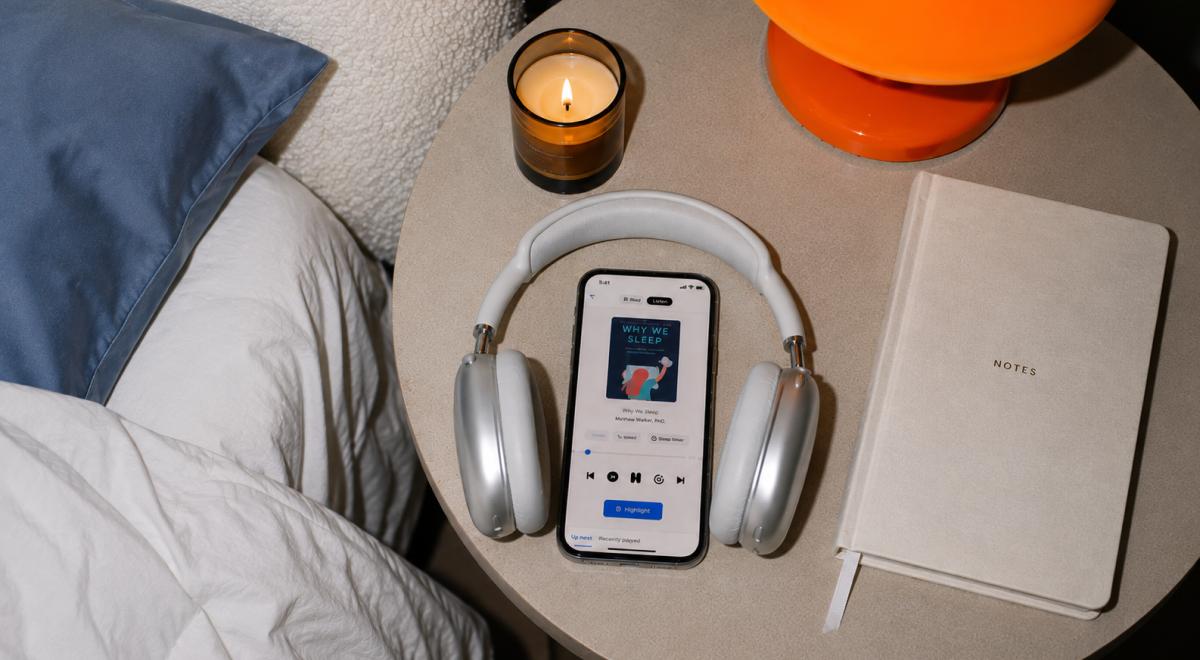

There's a reason humanity's oldest sleep technology is a person telling a story in the dark. Your eyes stay closed, the room stays dark, and a steady voice gives your restless attention something calm to hold — while your own thoughts, finally outcompeted, fade into the background. An audiobook at bedtime is that ancient trick with better production values.
But the choice of book matters enormously. A thriller at 11 p.m. is a caffeine substitute; the right calm listen is a lullaby with a vocabulary. This guide covers what makes an audiobook genuinely bedtime-worthy, how to listen so it puts you to sleep instead of keeping you up — and 21 of the best bedtime audiobooks available on Headway as 15-minute summaries, in both audio and text.
For the techniques side of falling asleep — breathing patterns, muscle relaxation, cognitive shuffling — see our full guide on how to quiet your mind to sleep.
📘 Make bedtime the quietest part of your day with Headway.
Disclaimer: This article is for informational purposes only and is not a substitute for professional medical advice, diagnosis, or treatment. If sleep problems persist, please talk to a doctor or a behavioral sleep specialist.
Quick answer: What makes a great bedtime audiobook
The short version: calm content, calm voice, clear ending. Use this checklist tonight:
Choose low-stakes material: Reflective nonfiction, gentle philosophy, familiar favorites — nothing with cliffhangers or plot twists worth staying awake for.
Prefer short and finite: A 15-minute summary ends on its own; an autoplay queue doesn't. Your wind-down needs an off-ramp, not an invitation.
Keep the volume just above a whisper: The narration should be easy to drift away from, not something your attention has to chase.
Set a sleep timer: Audio that plays all night can fragment your sleep even after it helps you fall asleep.
Re-listen without guilt: Familiar material soothes; novelty stimulates. Falling asleep before the end is the point, not a problem.

Why audiobooks work at bedtime
Audiobooks have a structural advantage over every other wind-down format: they ask nothing of your body. No light hitting your eyes, no screen posture, no page to hold — you lie still in the dark, exactly as sleep requires, while the content does its work.
The work itself happens on two channels. First, attention: lying in the dark with nothing to do is precisely when your brain's self-referential chatter gets loudest, and a narration gives your attention a gentler track to follow — the same mental bandwidth your racing thoughts want is now occupied by something that doesn't matter by design. Second, physiology: a slow, warm reading voice paces your breathing and reads to your nervous system as safety. It's the mechanism behind every bedtime story you've ever been told, and it never stopped working on you.
The trap is that audio can also do the opposite. Content engineered for engagement — plot momentum, dramatic narration, episode hooks — recruits your alertness instead of dissolving it. Which is why the list below skews heavily toward the calm, the reflective, and the quietly fascinating.
How to listen so it actually puts you to sleep
A few setup choices make the difference between a listen that ends your day and one that extends it:
Queue the book before you're in bed: Choosing content is a decision, and decisions are alertness. Pick your listen during your wind-down, so bedtime itself involves nothing but pressing play.
Phone out of reach after play: Start the audio, set the timer, put the device face-down out of arm's reach. The narration is the wind-down; the screen is the risk.
One earbud or a soft speaker: If you share a bed, a single earbud or a quiet speaker on your side keeps the peace. Avoid anything that requires fiddling in the dark.
Slow the playback if needed: Bedtime is the one context where 0.9x beats 1.5x. A slower pace settles breathing; a rushed one subtly hurries you.
Same book, same slot, most nights: Repetition trains the association. When your brain learns that this voice means the day is over, drowsiness starts arriving on cue.
📘 Replace the bedtime scroll with a 15-minute listen on Headway.

The 21 best bedtime audiobooks on Headway
Every title below is available on Headway as a 15-minute summary you can listen to with your eyes closed — or read in text mode with the lights low, if that's the night you're having. They're grouped by what your evenings need most.
Sleep science worth falling asleep to
1. 'Why We Sleep: Unlocking the Power of Sleep and Dreams' — Matthew Walker
The modern classic of sleep science: neuroscientist Matthew Walker walks through what happens across a night of sleep and dreams, and why it underpins memory, immunity, mood, and long-term health. Few books have done more to move sleep from afterthought to priority.
As a bedtime listen, it works on motivation: fifteen minutes on what sleep is doing for you makes protecting the next eight hours feel like the obvious move. Start here if you need a reason before you'll accept a routine.
2. 'Sleep Smarter' — Shawn Stevenson
Stevenson delivers a rapid-fire toolkit of lifestyle strategies for better sleep — light, temperature, caffeine timing, evening routines, and the bedroom environment itself. It's the most tactical title in the science group.
Choose it if you want tonight-applicable wins. The summary format suits it perfectly: the strategies without the padding, short enough to finish before the first one takes effect.
3. 'The Sleep Revolution: Transforming Your Life One Night at a Time' — Arianna Huffington
Written after her own collapse from exhaustion, Huffington's book takes aim at the culture that treats sleeplessness as a badge of honor — and lays out what better sleep gives back in health, judgment, and daily life.
Choose it if your sleep debt is really a values problem: you could sleep, but everything else keeps winning. It supplies the cultural permission slip some high performers need before any technique will stick.
4. 'Hello Sleep: The Science and Art of Overcoming Insomnia Without Medications' — Jade Wu
Behavioral sleep psychologist Jade Wu offers a medication-free path out of insomnia, built on the same principles as CBT-I — the first-line clinical treatment for chronic sleep trouble. Her reframe: sleep isn't an enemy to defeat but a friendship to repair.
Choose it if your nights involve clock-watching, dread, or effort. It's the most therapeutic listen on this list — warm, evidence-based, and specifically written for the person hearing it at midnight.
5. 'The Sleep Solution: Why Your Sleep Is Broken and How to Fix It' — W. Chris Winter
Sleep specialist W. Chris Winter dismantles the most common sleep problems — and the myths that make them worse — with the calm of a doctor who has seen it all fixed before. His central reassurance: your sleep is almost certainly more repairable than it feels at 2 a.m.
Choose it if worry about sleep has become part of the problem. Winter is the antidote to sleep panic, and listeners tend to come away with both a lighter attitude and a concrete plan.
For body-clock battles
6. 'The Power of When' — Michael Breus
Sleep doctor Michael Breus argues there's no universally perfect schedule — only the one that matches your chronotype. Identify whether you're wired early, late, or in between, and you can time sleep, meals, work, and exercise to run with your biology instead of against it.
Choose it if standard sleep advice has always felt like it was written for someone else. Night owls in particular find this one vindicating — and immediately useful.
7. 'The Circadian Code' — Satchin Panda
Circadian biologist Satchin Panda shows how deeply your internal clock runs the show: when you eat, see light, and move shapes how you sleep — and how you feel all day. A misaligned rhythm often masquerades as insomnia.
Choose it if your schedule is chaotic — shift work, late meals, weekend lie-ins, midnight screens. Resetting the rhythm frequently fixes sleep as a side effect.
Mindfulness for a racing mind
8. 'Wherever You Go, There You Are: Mindfulness Meditation in Everyday Life' — Jon Kabat-Zinn
From the founder of mindfulness-based stress reduction, this is the book that brought meditation to the mainstream — simple, unpretentious practices for meeting the present moment without needing a cushion or a retreat.
Choose it if racing thoughts are your main sleep thief. Kabat-Zinn's spacious, unhurried prose is itself the kind of voice worth drifting off to, and the practices transfer directly to the pillow.
9. 'Mindfulness: An Eight-Week Plan for Finding Peace in a Frantic World' — Mark Williams and Danny Penman
A structured, clinically grounded program: eight weeks of short daily practices designed to lower stress and interrupt the mental spirals that frantic lives produce. It's mindfulness with a syllabus.
Choose it if you prefer a plan to a philosophy. The week-by-week structure gives your evenings a standing appointment — and a wind-down routine you didn't have to design yourself.
10. 'Peace Is Every Step: The Path of Mindfulness in Everyday Life' — Thich Nhat Hanh
The beloved Zen teacher's gentlest introduction to presence: breathing, walking, washing dishes — every ordinary moment as a doorway to calm. There is no argument to follow, only an invitation to slow down.
Choose it as pure bedtime listening. The tone is so unhurried that the content and the effect are the same thing; many readers use it less as a book than as a nightly companion.
11. 'Calm: Working Through Life's Daily Stresses to Find a Peaceful Center' — Denise Marek
Marek blends personal insight with simple, doable exercises for defusing everyday stress — the accumulated static of deadlines, worries, and what-ifs that follows you to bed.
Choose it if your sleep problem is really a stress problem with a nighttime shift. It meets you at the practical level: small techniques, gentle tone, no prerequisites.
12. 'Breathe to Succeed' — Sandy Abrams
Abrams makes the case that your breath is the fastest lever on your nervous system — and teaches short, practical techniques for using it to calm the body and slow racing thoughts.
Choose it for the most literal bedtime utility on this list: the techniques can be practiced while falling asleep. Listen once, then use the long-exhale patterns nightly, with or without the audio.
Stillness and old wisdom
13. 'The Art of Stillness: Adventures in Going Nowhere' — Pico Iyer
A travel writer's counterintuitive love letter to not traveling: Iyer explores what silence, stillness, and stepping away give back in clarity and peace, drawing on monks, artists, and his own retreats.
Choose it if you want beauty rather than advice. Short, meditative, and gorgeously written, it's the closest thing here to a true bedtime story for grown-ups.
14. 'Stillness Is the Key' — Ryan Holiday
Holiday draws on Stoic and Buddhist thought to argue that a settled mind is the engine behind good judgment, great work, and genuine contentment — and that rest, solitude, and sleep are disciplines, not indulgences.
Choose it if you take your rest more seriously when it's framed as an edge. For a certain kind of ambitious overthinker, this is the only permission slip for powering down that actually works.
15. 'Tao Te Ching' — Lao Tzu
Twenty-five centuries of readers have found the same thing in these brief verses: an invitation to simplicity, balance, and moving with life rather than against it. It resolves nothing and rushes nowhere — which is precisely its power at 11 p.m.
Choose it when you want your last input of the day to be timeless and plot-free. Its short, reflective passages are practically designed for the drift into sleep.
16. 'Meditations' — Marcus Aurelius
The private journal of a Roman emperor, never meant for publication: reminders to himself about perspective, self-discipline, and keeping tranquility when circumstances refuse to cooperate.
Choose it if your midnight thoughts tend toward frustration — with people, setbacks, or yourself. There is something profoundly settling about hearing the most powerful man of his era coach himself to let things go.
17. 'Think Like a Monk: Train Your Mind for Peace and Purpose Every Day' — Jay Shetty
Drawing on his years in an ashram, Shetty translates monastic practice into modern tools: managing anxiety, breaking negative thought patterns, and building a daily architecture for peace.
Choose it if your overthinking has a self-critical edge. The lessons on detaching from unhelpful thought loops apply to no hour of the day more than the one you spend trying to fall asleep.
Soft landings
18. 'The Alchemist' — Paulo Coelho
The world's favorite fable: a young shepherd's journey toward his personal legend, told in prose so simple and warm it reads like something remembered rather than invented. Tens of millions of readers have used it as comfort literature.
Choose it when you want narrative without stakes. It's a story in the truest bedtime sense — gentle momentum, no dread, and an ending that leaves the room quieter than it found it.
19. 'The Book of Joy: Lasting Happiness in a Changing World' — Dalai Lama and Desmond Tutu with Douglas Abrams
A week of conversations between two old friends — the Dalai Lama and Archbishop Desmond Tutu — on how joy survives hardship. Laughter, grief, and eight pillars of lasting happiness, recorded near the end of two extraordinary lives.
Choose it when the day has been heavy. It's difficult to carry your own worries to sleep while listening to these two carry theirs so lightly.
20. 'The Hidden Life of Trees: What They Feel, How They Communicate' — Peter Wohlleben
A forester reveals the slow social world of the forest: trees that feed their neighbors, warn each other of danger, and live on timescales that make every human deadline look brief. It is science writing at walking pace.
Choose it as the ideal "quietly fascinating" bedtime listen — genuinely interesting, entirely unthreatening, and set at a tempo your nervous system can only slow down to meet.
21. 'The Comfort Book' — Matt Haig
Exactly what the title promises: short reflections, reminders, and reassurances collected by Haig for the hard days and harder nights. There is no structure to follow and no progress to make — just perspective, offered gently.
Choose it for the worst nights specifically. When the mind is too loud for science and too tired for philosophy, a kind voice saying true, comforting things is the entire assignment.
Match the audiobook to your night
Not sure where to start? Find your tonight-brain in the left column:
What's happening tonight | Start with |
Racing thoughts you can't switch off | 'Wherever You Go, There You Are' or 'Think Like a Monk' |
Anxiety about the sleep itself | 'Hello Sleep' or 'The Sleep Solution' |
You want practical fixes, fast | 'Sleep Smarter' |
Your schedule fights your body clock | 'The Circadian Code' or 'The Power of When' |
Frustration with people or the day | 'Meditations' or 'The Book of Joy' |
You want a story, not advice | 'The Alchemist' or 'The Hidden Life of Trees' |
It's been a genuinely hard day | 'The Comfort Book' or 'Peace Is Every Step' |
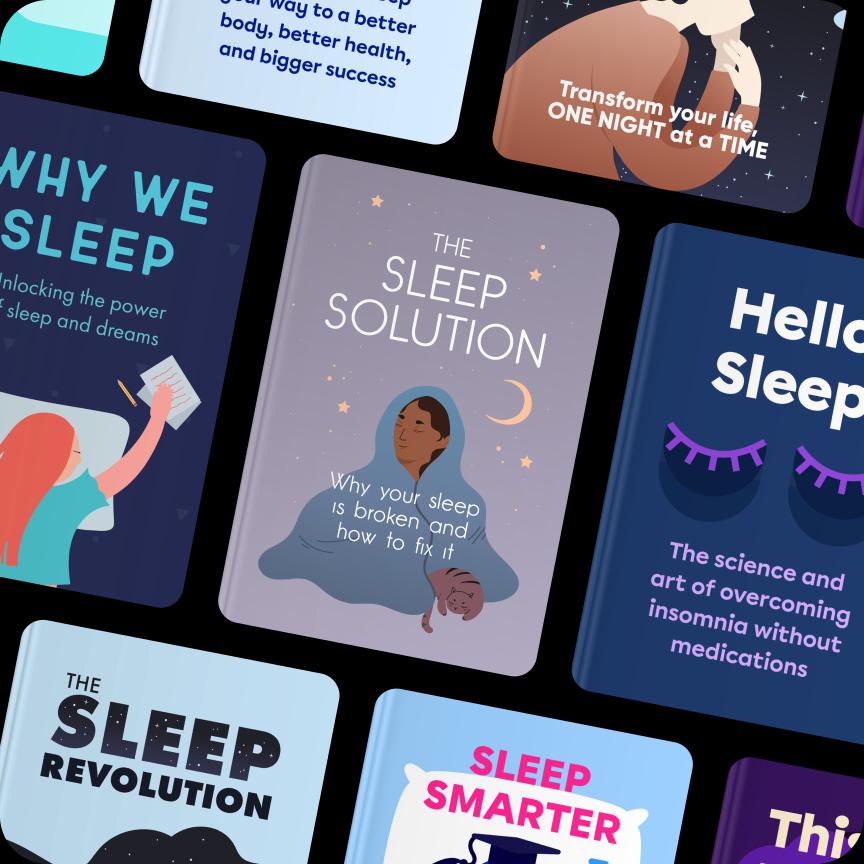
Tired all day, awake all night?
Books that explain why — condensed into 15-minute summaries you can finish before bed.
What Headway users listen to instead of the bedtime scroll
Swapping the feed for a calm listen sounds simple; making it stick is the real work. It helps to see how real people did it.
Ivan Karačić, a developer, triathlete, and father of three, is proof of what the audio format alone can carry: after every other learning method failed to stick, he anchored Headway's audio summaries to a daily walk and completed 120+ of them in four months without missing a day. The same hands-free, eyes-free quality that fits a walk fits a dark bedroom — audio asks nothing of your body, which is exactly what bedtime requires.
Jessica Teitelbaum, a revenue operations specialist, made the swap on the input side: she traded her social media window for one focused Headway summary.
"It's a small change, but it's helped me feel more intentional and purposeful."
She made the change at breakfast, but the mechanics transfer to 10 p.m. unchanged — one calm, finite piece of input instead of an endless feed, with the added bonus that what you hear at night tends to echo more softly than what you scroll.
📘 Give your evenings better material — wind down with a summary on Headway.



Why the wrong audiobook backfires
If audio helps sleep, why did that true-crime series keep you up until 2 a.m.? Three traps are worth naming:
Momentum content: Plot-driven books, thrillers, and serialized podcasts are engineered to make the next chapter feel necessary. Your brain stays subscribed long after you press pause.
Performance narration: Dramatic, multi-voice, high-dynamic-range audio is wonderful entertainment and terrible sedation. At bedtime, flat and warm beats vivid and gripping.
The endless queue: Autoplay converts "one chapter" into "consuming until you pass out" — which is collapse, not sleep, and your sleep quality knows the difference.
The fix is curation plus a hard stop: one calm, finite listen, a sleep timer, and then silence. Your only job after pressing play is to stop supervising the process.
What to do when you wake up at 3 a.m.
Middle-of-the-night wake-ups tempt you straight to the phone — and the feed will happily finish the job of waking you. Instead:
Don't open anything with a feed: Messages and bright screens tell your brain the day has started. It believes you.
Skip the clock check: Knowing it's 3:47 changes nothing except your stress level.
Return to familiar audio if you need it: A summary you've heard before, volume just above a whisper, timer on. Familiar is soothing; novel is stimulating.
Park urgent thoughts on paper: One sentence, then let it wait for your morning self.
Reset if you're spiraling: After roughly 20 minutes of frustrated wakefulness, move to a chair and do something calm in dim light — then return to bed when sleepy.
When bedtime listening isn't enough
Audiobooks are a wind-down tool, not a treatment. It's time to bring in a professional if you regularly struggle to fall or stay asleep, if it's been going on for months, or if daytime exhaustion, irritability, or persistent anxiety are eating into your life.
Racing thoughts also aren't always the real culprit. Sleep disorders like sleep apnea or restless legs syndrome — and physical issues like chronic pain — can fragment your nights in ways no narrator can fix. If your sleep habits are solid but your sleep quality stays poor, a doctor may recommend a sleep study to rule these out.
The good news: the leading treatment isn't a lifetime of pills. Cognitive behavioral therapy for insomnia (CBT-I) is the first-line, evidence-based approach for chronic sleep trouble, usually delivered in a handful of sessions with a behavioral sleep specialist. 'Hello Sleep' on this list is built on its principles — a sensible first listen while you decide.
Turn bedtime into listening time with Headway
The best bedtime audiobook is the one that ends before your patience does and asks nothing of your body while it plays. That's the shape of every title above — and the format Headway is built around.
Headway can be that nightly ritual:
Audio and text for every title: Listen with your eyes closed in the dark, or read a few screens with the lights low — every summary works both ways, so the format fits the night you're having.
15 minutes, then it ends: No cliffhangers, no autoplay, no negotiation. One calm, complete idea, and then quiet.
A shelf built for this hour: All 21 titles above — from 'Why We Sleep' to 'The Comfort Book' — ready in summary form, with thousands more alongside them.
A daily habit that sticks: Streaks and personalized plans keep your wind-down consistent, which is what your sleep rhythm loves most.
📘 Tonight deserves a better narrator than your own thoughts. Wind down with Headway.
Frequently asked questions on the best bedtime audiobooks
What are the best audiobooks to fall asleep to?
The best bedtime audiobooks are calm, low-stakes, and finite: reflective nonfiction like 'The Art of Stillness', gentle wisdom like 'Peace Is Every Step' or 'Tao Te Ching', slow-paced science like 'The Hidden Life of Trees', and comfort reads like 'The Comfort Book'. Avoid thrillers, true crime, and anything with plot momentum — content designed to grip you will.
Is it OK to fall asleep listening to an audiobook?
Yes, for most people — the risk isn't falling asleep to audio but audio that plays all night, which can fragment sleep even without fully waking you. Use a sleep timer, keep the volume just above a whisper, and choose narration without sudden loudness changes. Losing your place is fine; re-listening to familiar material is actually more sleep-friendly than new content.
Do audiobooks help with insomnia?
They can help with the racing-mind side of sleeplessness by giving your attention something calm to follow instead of your own thoughts. But audiobooks are a wind-down aid, not a treatment: if you've struggled to fall or stay asleep several nights a week for a month or more, talk to a doctor about CBT-I, the first-line treatment for chronic insomnia.
Should I listen to fiction or nonfiction before bed?
Whichever you can disengage from. Gentle fiction like 'The Alchemist' works because the stakes stay low; reflective nonfiction works because there's no plot to chase at all. What matters more than genre is momentum — if you're tempted to stay awake for what happens next, it belongs in your daytime queue.
Are book summaries better than full audiobooks at bedtime?
For the specific job of falling asleep, the short format has a real advantage: a 15-minute summary is complete and self-ending, so there's no "one more chapter" negotiation and no autoplay pulling you forward. Many people pair the two — summaries on Headway for the nightly wind-down, full audiobooks for daytime listening when staying awake is the goal.
What should I listen to at night instead of scrolling?
Anything calm, finite, and low-stakes: a 15-minute book summary, a familiar chapter, or quiet ambient sound. The two properties scrolling lacks are an end point and low stakes — feeds are engineered to be endless and provocative, which is the exact opposite of a wind-down. A summary of 'Stillness Is the Key' ends; the feed never does.
How loud should a bedtime audiobook be?
Just above a whisper — loud enough to follow without straining, quiet enough that your attention can let go of it. If you share a bed, use a single soft earbud or a small speaker on your side. The narration should feel like something happening nearby, not something performed at you.
When should I seek help for sleep problems?
Talk to a doctor or behavioral sleep specialist if you struggle to fall or stay asleep several nights a week for a month or more, or if daytime exhaustion and persistent anxiety are affecting your work and mood. Ask about CBT-I — cognitive behavioral therapy for insomnia — the first-line treatment for chronic sleep trouble. Bedtime audio can support treatment, but it doesn't replace it.