Self-growth
 Business & Career
 Success
 Communication
 Healing
 Relationships
 Psychology
 Happiness
Notice how the same bad habits keep showing up, no matter how many times you try to quit them?
Bad habits examples are repetitive negative behaviors that harm your health, productivity, relationships, or goals. Everyone's got them, from scrolling social media before bed and hitting snooze to eating junk food and putting things off until the last minute.
These patterns can have a serious impact on your physical health and mental well-being. Bad habits stick because they offer something — stress relief, distraction, and comfort — even when they're harming you.
In this article, you'll learn about 20+ common bad habits across productivity, health, relationships, and money. You'll see why procrastination, negative self-talk, and poor eating habits refuse to go away, and what they're actually costing you, like enough sleep, good health, self-esteem, and mental health.
Want to change instead of just reading about it? Headway gives you 15-minute summaries from books on breaking bad habits and building better ones. Learn proven strategies without spending hours.
📘 Download Headway and start replacing what's holding you back!
Quick answer: What is the psychology of bad habits?
Bad habits form because your brain is constantly looking for ways to save energy. Every habit follows a consistent loop: cue, routine, and reward. Here's how it works:
A cue sparks the behavior (like when you're feeling stressed, bored, or anxious). The routine is the bad habit itself (such as scrolling through social media, snacking on junk food, or procrastinating until the last minute). The reward is what your brain receives (distraction, comfort, or a temporary break from negative thoughts).
Your brain doesn't really differentiate between good and bad habits; it simply remembers, "This worked before, so let's do it again." That's why checking notifications can become such an automatic action.
Why are the most common bad habits sticking with us?
Cues are often emotional (stress, boredom, low self-esteem)
Rewards show up immediately (even small ones)
Your brain automates them to save mental energy
Breaking the loop takes more effort than repeating it
Understanding this doesn't fix bad habits overnight, but it shows why willpower alone tanks. You're fighting how your brain evolved. Changing bad habits means messing with the cue-routine-reward cycle, not just white-knuckling through cravings.
Eight top bad habits examples and impacts: Quick table
Here's a snapshot of everyday bad habits, what they're costing you, and how to start fixing them.
| Bad habit example | Life impact | Quick fix |
|---|
Procrastination | Kills productivity, spikes stress at the last minute | Do the hardest task first (Eat-the-frog method) |
Excessive screen time | Wrecks sleep patterns, drains mental health | Set a screen curfew for 1 hour before bed |
Skipping meals | Drops energy, messes with physical health | Prep breakfast the night before |
Negative self-talk | Tanks self-esteem, feeds mental health issues | Replace with neutral statements instead |
Checking smartphones first thing | Hijacks focus before the day starts | Leave the phone outside the bedroom |
Binge-watching | Burns too much time, ruins sleep | Set the episode limit before you start |
Gossiping | Damages relationships, kills trust | Redirect the conversation or leave |
Impulse spending | Creates money stress, blocks goals | Wait 24 hours before buying anything |

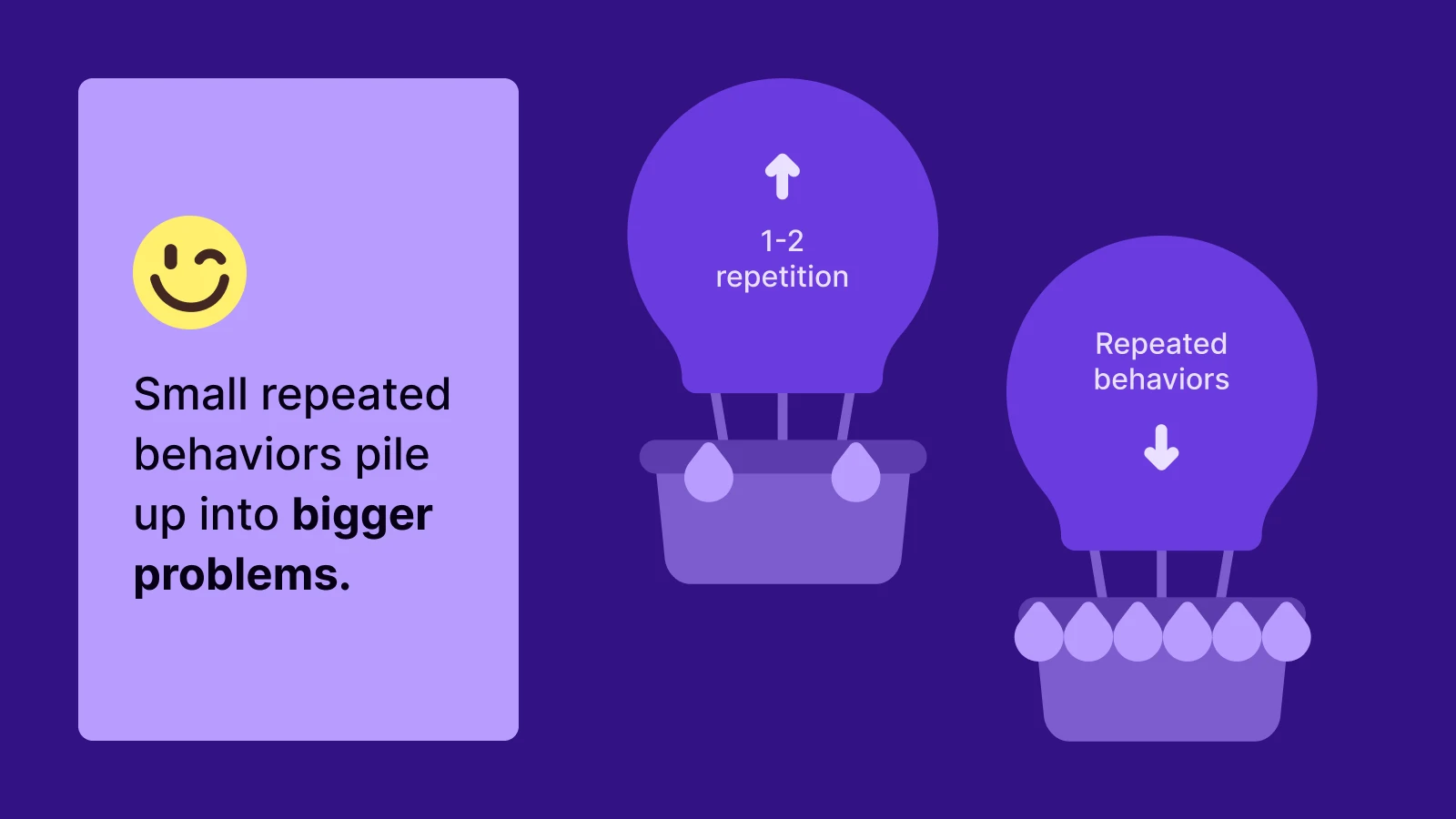
Each of these examples of bad habits shows up differently depending on your life, but the pattern stays the same — small repeated behaviors pile up into bigger problems. You don't need to overhaul everything to break a bad habit. Pick one from this list, and then try the quick fix for a week.
📘 Headway gives you 15-minute summaries on building better habits. Download now.
Over 20 bad habits examples by life domain
Let's break down the most common bad habits by where they wreck your life. Some kill productivity. Others mess with your physical health or mental well-being. Many do both.
A) Productivity
Procrastination: Putting things off until the last minute trades calm for panic. Now, deadlines become emergencies, work quality suffers as you rush, and stress piles up.
Constant multitasking: Switching between tasks messes with your cognitive function. Your brain needs time to refocus every time you jump. You're doing three things poorly instead of one thing well.
Checking notifications constantly: Every ping pulls your attention. It takes an average of 23 minutes to get back into deep work after checking your phone. Do that ten times, and you've wasted hours.
Working around the clock: Skipping breaks is a fast track to burnout. Your brain needs downtime to function. Keep pushing through exhaustion, and your work quality drops, tasks take longer, and you end up with more to fix later.
Always saying yes: Agreeing to every request leaves no space for what really matters. You feel busy, but you're not being productive. You're just juggling tasks that aren't your top priorities.
Not setting boundaries: That's a guaranteed way to let others take control of your time. Without clear limits, you'll face constant interruptions, find yourself working late to catch up, and start feeling pretty resentful.
Overthinking your decisions: Getting stuck in analysis paralysis wastes more time than making the wrong choice. Spend an hour debating, and that's an hour you could have used to actually get things done.
B) Health and well-being
Skipping meals: Your body needs fuel after sleeping. Skip breakfast, and your energy crashes mid-morning, leading you to reach for junk food or caffeine. Your eating habits spiral from there.
Poor sleep patterns: Going to bed at random times confuses your body. You're not getting enough sleep, even when you're in bed for eight hours, because quality tanks without consistency.
Excessive screen time before bed: Blue light from smartphones disrupts melatonin production. Your brain thinks it's daytime. Falling asleep takes forever, and you wake up groggy.
Eating junk food when stressed: Stress triggers cravings for sugar and fat because they offer quick comfort. But unhealthy eating when stressed creates a cycle — temporary relief, then energy crashes and guilt, leading to more stress.
Skipping physical activity: Sitting all day wrecks your physical health. No movement contributes to high blood pressure, weight gain, and lower energy. Exercise isn't just fitness; it's a coping mechanism for mental health.
Nail biting: Anxiety or boredom triggers this habit. It damages your nails, spreads germs, and becomes an automatic stress response that doesn't actually relieve anything.
Ignoring health problems: Putting off doctor visits lets small issues become serious ones. Avoiding doesn't make problems disappear; it just makes them harder and more expensive to fix.
C) Relationships and communication
Interrupting people: Cutting someone off signals that you don't value what they're saying. This behavior erodes trust and makes people reluctant to talk to you.
Negative self-talk: Constantly criticizing yourself leaks into how you treat others. Low self-esteem makes you defensive, jealous, and unable to accept compliments. This poisons relationships.
Avoiding conflict: Dodging uncomfortable conversations doesn't keep the peace. Problems fester, resentment builds, and eventually things explode worse than if you'd spoken up early.
Gossiping: Talking about people behind their backs destroys trust. Everyone assumes that if you gossip about others, you gossip about them too.
Being chronically late: Repeatedly showing up late tells people their time doesn't matter. Even when you don't mean it that way, it's disrespectful and erodes relationships.
D) Money and success
Impulse spending: Buying things without thinking wrecks financial stability. You're reacting to emotions or social media ads instead of making intentional choices.
Saying yes too much: Overcommitting spreads you too thin. You can't do good work juggling ten things. Saying yes to everything means saying no to focus.
Lack of planning: Winging your week or money means you're always reacting. No plan means no progress because urgent stuff fills the space first.
Waiting for motivation: Motivation is a feeling, and feelings are unreliable. Waiting to feel like doing something means you won't do it. Building better habits means acting when you don't feel like it.
📘 Ready to change instead of just reading about it? Get Headway for bite-sized strategies on habits and behavior change.
How to break bad habits the smart way
You can't break a bad habit by just trying harder. Willpower runs out. What works is changing how the habit operates in your brain.
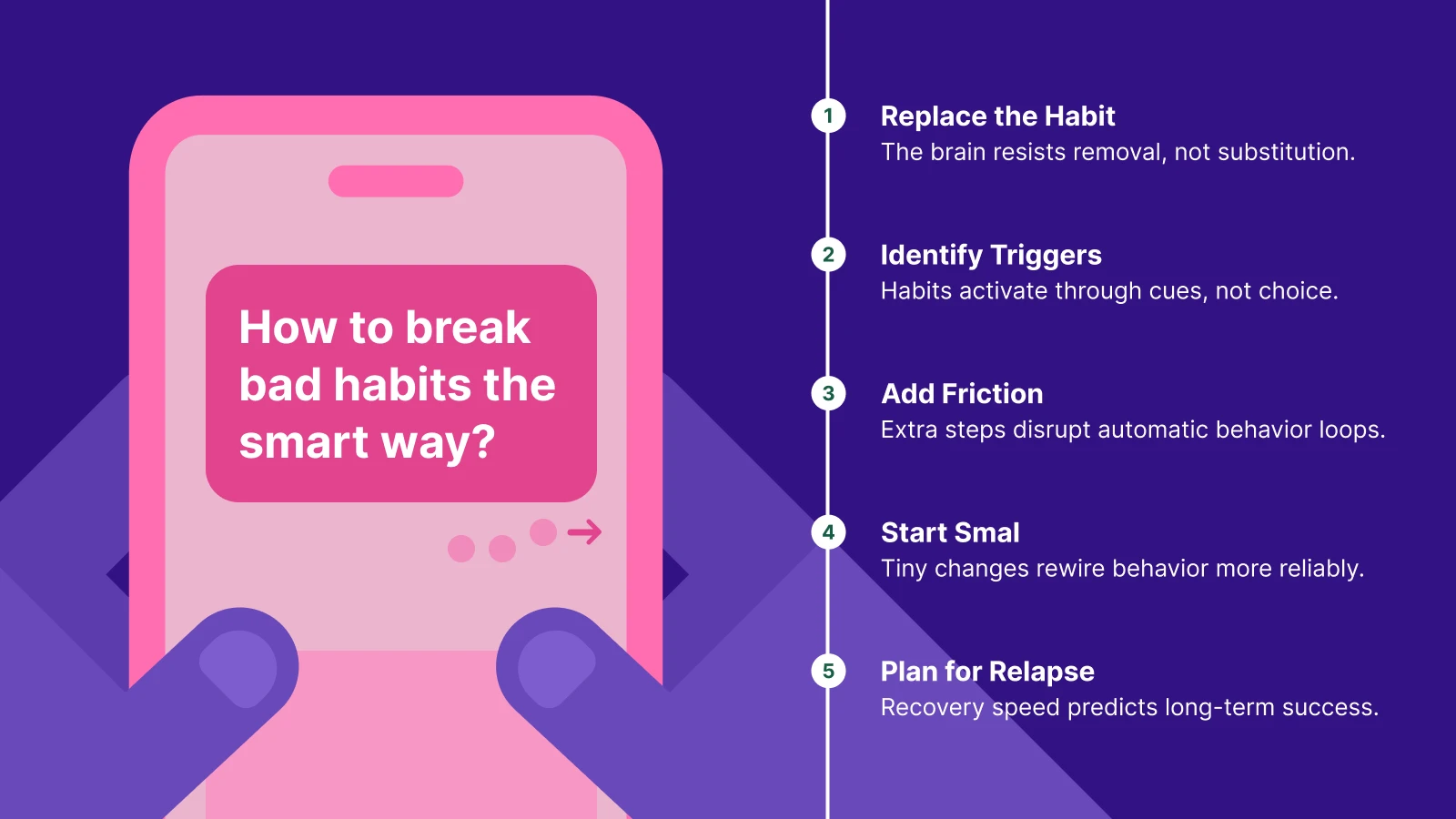
1. Replace instead of remove
Don't try to stop a bad habit cold. Your brain hates empty space. Replace the routine with a new behavior that offers a similar reward. Are you stressed and always grabbing junk food? Swap that habit for deep breathing or a quick walk. It still gets you relief without tanking your physical health.
2. Identify your triggers
Bad habits don't pop up randomly. A cue sets them off, such as boredom, stress, or certain times and places. Track when your bad habit shows up for a week. Once you know the trigger, you can interrupt it before the routine starts.
3. Make bad habits harder to do
Add friction. Want to reduce your social media use? Delete apps from your smartphone. Log out after each session. Move your phone to another room. These extra steps give your brain a chance to pause and choose differently.
4. Start with micro-changes
Stop trying to fix everything at once. Pick one bad habit. Make the smallest change possible. Want better sleep patterns? Go to bed ten minutes earlier, not two hours. Small wins build momentum and self-esteem without crushing you.
5. Expect and plan for relapse
You're going to slip. That's normal. One slip doesn't erase progress. The difference between people who break bad habits and those who don't is what happens after they mess up. Get back on track the next day instead of giving up because "it's already ruined."
Building a new habit takes time. Studies say 21 days or 66 days, but it depends on the habit and you. What matters more than timeline is consistency and self-compassion when you screw up. Practice self-awareness about your patterns. Use coping mechanisms that don't create new problems.
📘 Habit experts started by understanding how the brain works — download Headway and learn how to break bad habits in 15 minutes.
How changing these habits could transform your life
Breaking even one bad habit creates ripple effects. Fix your sleep patterns, and suddenly you've got energy for physical activity. Stop procrastinating, and stress drops, which helps your mental health. Cutting screen time and relationships improve because you're actually present.
Small changes compound. Most people underestimate how much these examples of bad habits cost them over time. Negative self-talk doesn't just sting in the moment — it shapes how you see yourself and every decision after. Unhealthy eating habits don't just mess with physical health today — they increase the risk of high blood pressure and mental health issues later.
You're not trying to become someone with zero bad habits and only good habits. That's fake. What works is replacing one negative behavior at a time with a better one. Practice self-compassion when you slip. Build self-awareness about what triggers your patterns.
Changing bad habits isn't about willpower. It's about understanding how your brain works and working with it, rather than fighting it. When you do that, everything else — productivity, well-being, confidence — starts shifting without forcing it.
Speed up habit change with the Headway app!
Reading about bad habits is one thing. But actually changing them takes more than just knowing what to fix; you need to understand why they stick and how new behavior actually forms.
Headway gives you 15-minute summaries from books on habits, psychology, and behavior change. Learn from people who've studied how to break a bad habit, replace negative thoughts with better coping mechanisms, and build new behaviors that last.
Fighting procrastination?
Trying to fix sleep patterns?
Working on negative self-talk?
Struggling with the same loops?
📘 Download Headway and start replacing what's holding you back with habits that work for you instead of against you!
FAQs about bad habits examples
What are the 10 bad habits?
The 10 bad habits are: poor sleep, procrastination, doomscrolling on social media apps, unhealthy eating, overspending, smoking, overthinking, negativity, perfectionism, and nailbiting. These are the most common bad habits, but the list can go on forever.
What's the worst habit?
It is difficult to determine which habit is the worst. Most experts agree that, when it comes to physical health, it's smoking, and in terms of mental health, it's high stress. There are many more habits that can be damaging to your health, but these two are among the worst.
What is the most common bad habit?
The most common bad habit is probably overeating or comfort snacking. Many sources cite this as the most reported habit worldwide. Also, it mostly concerns overeating sugars (cakes, muffins, and candy), but junk food is included too.