Self-growth
 Apps & Digital Tools
 Business & Career
 Success
 Growth Tools
 Psychology
 Communication
 Relationships

If you've ever found yourself in an anxious time, lying awake at 2 a.m. with a feeling of dread you can't explain, you already know what it means to be anxious for nothing. The racing thoughts. The tight chest. These are real symptoms of anxiety, and they are wearing people out. You're not alone, and you're not broken.
Pastor and bestselling author Max Lucado wrote 'Anxious for Nothing' to address this feeling directly — drawing on Philippians 4:6 – 7 and the peace of God that surpasses all understanding. But the healing toolkit doesn't stop with faith. Somatic trauma work, CBT, nervous system regulation, and self-compassion practices all point toward the same destination: a mind that can finally rest.
I've pulled the most practical techniques from seven bestselling books, all available as short summaries on Headway, so you can start using them today.
Whether you're dealing with chronic worry or just feel constantly on edge, this guide is for you.
Disclaimer: This article is for educational purposes only and does not constitute medical or psychological advice. Please consult a qualified professional for personal mental health support.

Quick summary: Why anxiety isn't that scary
Here's what you'll learn:
Anxiety often comes from uncertainty and loss of control
Gratitude helps interrupt anxious thought loops
Your nervous system needs safety, not perfection
Small daily habits can reduce overwhelm over time
Reading calming ideas trains healthier thinking patterns
Seven practical exercises — one per bestselling book — are included below
Professional support matters; books and summaries help, but therapy also matters
📘 Start your journey toward peace and get Headway today.
What does "anxious for nothing" actually mean?
'Anxious for Nothing' is both a bestselling book by Max Lucado and a mindset approach focused on calming worry through gratitude, emotional awareness, faith, and intentional thinking. The word anxious traces back to the Latin anxius — troubled in mind — and Lucado asks whether that troubled state has to be permanent.
His framework draws on Philippians 4:6 – 7, which calls believers to "rejoice in the Lord always" and to bring their concerns before Christ Jesus with thanksgiving, trusting in the peace of God that surpasses understanding. Not a vague, wishful calm, a practiced, chosen one.
In a secular context, I'd say this phrase has a broader meaning. Its goal is simple: living without chronic, controlling fear. Hear me out – it does not imply a life without challenges, but one where worry no longer calls the shots. It seems many people recognize the paradox — we're safer than ever, yet more anxious than any previous generation. And that gap demands an explanation.
📘 Ready to stop overthinking? Try Headway and find your calm.
Why does anxiety feel worse today than ever before?
You are not imagining it. Research published in the National Library of Medicine confirms that anxiety disorders rank among the most prevalent mental health conditions globally — and modern life keeps adding fuel. Think about what the average nervous system processes before 9 a.m.:
Information overload: Dozens of notifications, trending news, and competing demands before the first coffee
Social comparison: A curated feed of other people's highlight reels, which makes ordinary life feel inadequate by comparison
Doomscrolling: A daily habit that actively trains the brain toward forebodings — expecting threat as the default setting
Chronic low-grade stress: Financial pressure, deadlines, relationship friction — nothing catastrophic alone, all of it relentless together
Nervous system overstimulation: Artificial light, screens, disrupted sleep, and constant noise. The physical signs show up as shortness of breath, muscle tension, or restlessness, you can't quite place
Add it all up, and you get a generation of people running a survival stress response as their everyday operating system. That's not a character flaw. It's a nervous system doing exactly what it was designed to do, just without an off switch.
What keeps your brain locked in survival mode?
Here's a quick-reference breakdown of the most common triggers and what they actually do inside your body:
| Trigger | What it does to your brain | 💡 What Helps |
|---|---|---|
Sleep deprivation | Spikes cortisol; kills emotional regulation | Consistent sleep schedule, no screens before bed |
Overthinking | Locks the brain in a threat-scanning loop | Thought-reframing (CBT) exercises |
Phone addiction | Disrupts dopamine; prevents recovery | Scheduled phone-free windows daily |
Perfectionism | Creates constant internal inadequacy | Self-compassion practice + realistic goals |
Unprocessed trauma | Stores stress somatically; triggers hypervigilance | Somatic release + professional support |
📘 Don't let stress rule your life, test Headway to build a resilient nervous system.
This is the hidden psychology behind anxious thinking
Anxiety follows predictable patterns. The symptoms of anxiety most people recognize, the feeling of dread, the shortness of breath, the mental playback of worst-case scenariosl, are surface expressions of deeper cognitive habits. Once you can name the pattern, you can start to shift it.
As a somatic practitioner, the first thing I notice is where these thought patterns live in the body — the braced jaw, the raised shoulders, the stomach that clenches before a difficult conversation even begins. The mind and body aren't separate here. They're running the same program.
The most common anxious thinking patterns:
Catastrophizing: The mind skips straight to the worst possible outcome, treating it as inevitable
Hypervigilance: A nervous system scanning constantly for threat, even when the environment is objectively safe
Negative prediction bias: A chronic pattern of forebodings — expecting bad outcomes as the default
Emotional avoidance: Pushing feelings away instead of letting them move through the body naturally
Mental playback: Replaying difficult conversations or past mistakes on a loop, reinforcing fear rather than resolving it
Trauma responses: Fight, flight, freeze, or fawn patterns activating in everyday situations that echo past experiences
Use this table when an anxious thought takes over:
| Anxious thought | Healthier reframing |
|---|---|
"Everything will go wrong" | "I can handle uncertainty — I've done it before" |
"I must control everything" | "Not everything requires immediate certainty" |
"I'm failing" | "I'm learning to feel safe again" |
"Something bad is about to happen" | "My nervous system is activated — that's different from real danger" |
📘 Decode your anxious triggers and gain control with Headway.
Quiz: What kind of anxious thinker are you?
Anxiety shows up differently for different people. Some spiral; some go numb. Some catastrophize; some avoid. Understanding your pattern helps you pick the right tool. Three quick questions:
Start with the body-awareness check-in (from 'Heal Your Body') and the 5-4-3-2-1 grounding method (from 'The Body Keeps the Score').
📘 Discover the best tools for your specific needs, explore Headway now.
The C.A.L.M. method from 'Anxious for Nothing' helps calm your mind
Lucado's 'Anxious for Nothing' offers a four-part framework rooted in Philippians 4 that's practical for anyone, with or without a faith background. Each step maps onto something the nervous system actually needs.
C — celebrate what is good
Lucado draws on the biblical call to "rejoice in the Lord always" — not as a performance of happiness, but as a deliberate choice to notice what is genuinely good. From a somatic lens, this interrupts the threat-detection loop. Gratitude activates the ventral vagal state — the neurological "safe and social" mode, allowing the body to exhale finally. You don't need to feel grateful. You just need to look.
Try this: Each morning, name three things that are actually true and present — even if it's just: "I slept. I'm breathing. There's light."
A — ask for help instead of spiraling
Reaching out — whether in prayer to Christ Jesus, in an honest conversation with a friend, or in a session with a therapist — directly reduces the cortisol load of trying to carry everything alone. The nervous system is built for co-regulation. One calm person can genuinely help settle another's system. You're not designed to process fear in isolation.
For more practical strategies: how to manage stress.
L — leave your worries behind
This is not toxic positivity. It's about completing the stress cycle. Once you've acknowledged a worry and taken whatever action is genuinely available, the nervous system needs a clear signal that it's done — otherwise it keeps the threat response open. Holding on isn't vigilance. It's just suffering.
Practical tool: Write the worry down, then physically place the paper in a "worry box" or close a journal. It's a small somatic signal with a real neurological effect—more tools for reducing stress.
M — meditate on better thoughts
Philippians 4:8 names the qualities of thoughts that are worth dwelling on. Those thoughts are true, noble, right, pure, and admirable. Secular mindfulness research lands in the same place, actually. The direction of your attention shapes your emotional state and experience of reality. Happiness can not be forced. You can, however, choose not to let the anxious mind default to the worst possible channel.
One anchor thought, returned to repeatedly, can rewire the default pattern over time. For more on that process: how to rewire your anxious brain.
📘 Apply the C.A.L.M. method to your daily routine with expert support on Headway.
Here are seven practical exercises to calm anxiety naturally
Each exercise comes directly from a bestselling book. One per book. All actionable. Pick one and try it today.
1. The self-talk reset
Ravikant's practice is simple to the point of feeling almost too easy: choose one loving thought and return to it repeatedly until it becomes the default. The reason it works is physiological. Chronic anxiety is often underpinned by a false story — that you are fundamentally unsafe, not enough, or unwanted. Repeating a truer story slowly overwrites it.
The Mirror Ritual: Stand in front of a mirror. Look at your own eyes. Say: "I am learning to feel safe again." Not "I'm fine." Not "I'm okay." Notice the physical response — where in your body does that sentence land?
Swap: "I am failing" → "I am learning to feel safe again."



2. The Thought-Reframing Exercise (CBT)
Burns' work is rooted in Cognitive Behavioral Therapy (CBT) — one of the most researched approaches to anxiety treatment. His core insight is straightforward: anxious thoughts are not facts, they're hypotheses. And hypotheses can be tested with evidence.
The Exercise: When an anxious thought arises, write it down.
Then complete this table:
| Fear / Anxious thought | Evidence FOR it | Evidence AGAINST it |
|---|---|---|
"I'm going to embarrass myself." | I stumbled in one meeting last month | I've spoken dozens of times confidently |
"Everything is falling apart." | One thing went wrong today | Multiple things are working fine right now |
"No one actually values me." | Someone didn't reply to my message. | Several people have reached out this week |
Most anxious predictions have far less evidence than they seem to. The table makes that visible.
3. The body-awareness check-in
Hay's central claim — that the body holds emotional truth — is not simply a philosophical statement; it is in human anatomy. Anxiety shows up physically before it becomes a conscious thought. Shortness of breath, a tight stomach, clenched teeth: these are signals and never some random sensations.
The Exercise: Close your eyes. Three slow breaths. Ask yourself: "Where is anxiety living in my body right now?" Scan for:
Jaw tension or teeth-clenching
Stomach tightness or nausea
Chest pressure or shortness of breath
Shoulders raised toward your ears
A restless or braced feeling in the legs
Find it. Breathe toward it. That's the whole exercise. You don't have to fix anything — just acknowledge. That acknowledgment alone begins to reduce the intensity, because it tells the nervous system it has been heard.
4. The emotional release practice
Hawkins' central argument is that emotional energy needs to move. Anxiety intensifies when we resist feeling it — when we push it away, intellectualize it, or distract ourselves from it. The "name and release" method offers a structure for letting it flow through instead.
Name and Release Journaling:
Set a timer for five minutes
Write: "Right now, I feel..." — and keep going without editing
Let fear, anger, grief, or shame arrive on the page. None of it is wrong.
When the timer ends, write: "I allow this to be here. I allow it to pass."
Close the journal. Physically close it. That action matters.
More tools that work well alongside this practice: how to reduce stress and anxiety.
5. The future-anchor technique
Haig wrote his memoir during one of the darkest periods of his life. Back then, he was barely able to leave his bedroom; he was truly convinced – the future held nothing for him. You know what helped him? Intentional and slow learning to hold onto specific future moments. It was not an abstract hope, but rather some concrete things: a walk he wanted to take, a meal he looked forward to.
The Exercise: Write three specific future moments you are genuinely curious or hopeful about. Small is fine:
"The next time I eat my favorite meal"
"The morning I wake up and actually feel rested"
"A conversation I haven't had yet with someone I care about"
Please put the list somewhere visible. Whenever your anxiety spikes, go ahead and read it. Heads up: it is not meant to help you escape the pain. Instead, it serves as a reminder to your nervous system: the story isn't finished yet.
6. Nervous system calming through mindfulness and grounding
Van der Kolk's research showed that trauma and anxiety are stored in the body in ways that pure reasoning can't reach. The 5-4-3-2-1 method works by redirecting the nervous system's attention from internal threat-scanning to external sensory reality — a grounding technique rooted in mindfulness that requires no equipment and takes under two minutes.
The 5-4-3-2-1 Method:
Five things you can see: Look around slowly. Name each one out loud if you can.
Four things you can physically touch: The texture of your sleeve—the surface under your feet.
Three things you can hear: Traffic, a fan, your own breath.
Two things you can smell: Anything in the air around you.
One thing you can taste: Even just the inside of your mouth.
Sensory attention is neurologically incompatible with dissociation. This doesn't erase anxiety — it brings you back to the present.
7. Creating a calmness menu
Haig's book is a collection of small truths, odd facts, and gentle observations. I recommend reading this book whenever everything feels too big. His underlying idea: the right sentence at the right moment can shift everything. This exercise asks you to build your own version.
Build Your Personal Comfort Toolkit — one item per category:
A body practice: Walking, stretching, a warm shower — something physical that reliably helps
A sensory anchor: A smell, texture, taste, or sound that signals safety to your nervous system
A go-to sentence: One short phrase that has genuinely allowed you to find your grounding before
A person to call: Someone whose voice or presence helps regulate your state
A piece of media: A specific song, podcast episode, or film that reliably shifts your mood
I want to emphasize the following: you have to build this list before you need it. You see, people tend to forget that their decision-making collapses the moment anxiety peaks. What I like about pre-selected tools is that you can reach for something real even when the prefrontal cortex is offline.
Can reading actually help reduce your anxiety?
Yes — and the data is surprisingly strong. A University of Sussex study found that six minutes of reading reduced stress levels by up to 68% — more than music, more than a walk. But the mechanism matters. It's not just a distraction. Reading about anxiety, frustration, or overwhelm creates psychological control — the sense that you understand your situation and have genuine options for responding to it.
For anxious minds, long-form reading can feel impossible. A 300-page book is a lot to ask of a nervous system that's already maxed out. That's where Headway's bite-sized summaries fill a real gap — not as a shortcut, but as an access point. You get the most actionable ideas from books like 'The Body Keeps the Score' or 'Letting Go' in a format your brain can actually absorb on a hard day. The listen-and-read option helps too. Some days, reading feels like too much. Listening doesn't.
Read about how to deal with frustration as a starting point — one of the most useful entry points for anyone whose anxiety comes packaged with irritability or a low frustration threshold.
How to stop anxiety from controlling your daily life
Anxiety becomes a real problem not just when it's intense, but when it starts making decisions for you, shrinking your world, dictating who you can be, and canceling things before they begin. Five micro-strategies that target that pattern:
Build calming micro-routines
Rhythms regulate nervous systems. Even five minutes of morning routine — movement, slow breathing, a glass of water — signals to the body that the day has a reliable shape. It's not about productivity. It's about predictability. The body relaxes when it knows what comes next.
Reduce Uncertainty Triggers
You can't eliminate uncertainty. But you can reduce it where it's unnecessary. Identify the specific unknowns that most spike your anxiety and ask: Is there one small action — one email, one decision, one conversation — that would reduce this? Usually yes. And it's smaller than the dread.
Train your attention with mindfulness
Anxiety is a habit of attention. A mind trained to scan for threat keeps scanning, even in safety. Mindfulness practice — even five minutes of deliberate, non-judgmental attention each day — gradually retrains that default. Not forced positivity. Just presence. More tools on how to reduce stress and anxiety.
Protect your nervous system
The nervous system is a biological organ. Sleep, movement, connection, quiet — these aren't luxuries. They're maintenance. When people treat anxiety as purely a thinking problem, they miss the body entirely. Your nervous system does not respond to logic. It responds to conditions.
Stop consuming stress constantly
News and social media are not neutral inputs. They are processed by the nervous system as potential threats — all day, every day, with no natural endpoint. Intentional limits around stress consumption are a form of nervous system protection, not ignorance, for a practical approach to reducing stress.
📘 Regain control of your daily routine with Headway.
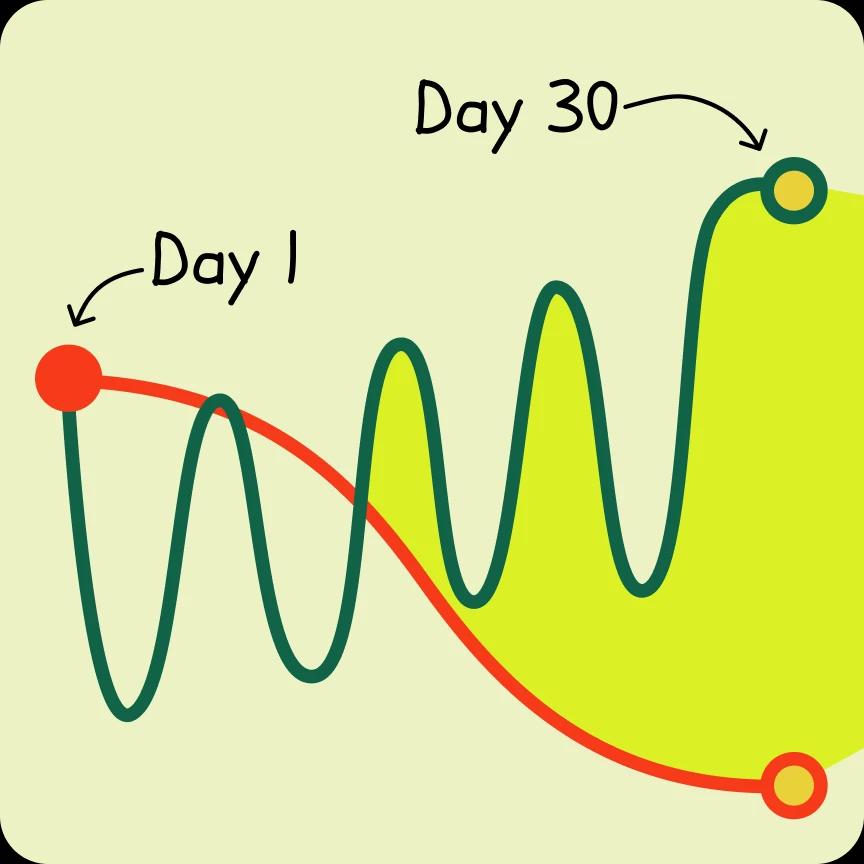
See how far consistent learning can take you.
Get actionable insights from your very first 15-minute summary.
Get the planThese are the signs your anxiety may need professional support
The exercises in this article genuinely help. But they're most effective alongside — not instead of — professional support when anxiety has become severe or persistent. Conditions like Generalized Anxiety Disorder (GAD) often require clinical input that self-help alone can't fully address. Reach out to a qualified mental health professional if you notice:
Panic attacks — sudden, overwhelming physical episodes of fear
Persistent sleep disruption that doesn't improve with rest
Physical symptoms: shortness of breath, chronic headaches, digestive problems, or heart palpitations without a clear medical cause
A constant undercurrent of dread that doesn't shift with self-help
Emotional numbness or feeling disconnected from your own life
Anxiety that is meaningfully limiting your work, relationships, or daily functioning
A note: Books and summaries can be genuinely transformative — but if you're struggling, please speak to your doctor or a licensed therapist. You deserve proper support, not just coping strategies.
📘 Remember, you aren't alone, start your healing on Headway.
Stop the spiral and start healing with Headway book summaries
Anxiety does not define you. Yet, do not expect healing to be a one dramatic breakthrough – it's not. The more I work with people's nervous systems, the more I see it as a series of ordinary decisions. One time, it's the breath you take before reacting. Another time, it's the journal entry instead of the spiral. The one sentence you read that makes the next hour feel possible.
Sometimes one idea is enough to interrupt everything. That's what the right summary can do — without asking you to read 300 pages on a day when reading feels impossible.
Headway gives you the most actionable ideas from 'The Body Keeps the Score', 'Letting Go', 'Reasons to Stay Alive', and more, in a listen-and-read format designed for exactly the kind of days when your nervous system has nothing left. Short enough to finish. Useful enough to return to.
Stop feeling anxious for nothing!
FAQs about anxiety
Is 'Anxious for Nothing' based on the Bible?
'Anxious for Nothing' by Max Lucado is drawn directly from Philippians 4:6 – 7, which calls believers to bring their concerns before Christ Jesus with gratitude and trust in the peace of God. The book is grounded in Christian faith, but its themes — presence, gratitude, releasing control — apply meaningfully across secular and spiritual contexts alike.
What is the main message of 'Anxious for Nothing'?
Lucado's central message is that anxiety does not have to be your permanent state. Through the C.A.L.M. framework — Celebrate goodness, Ask for help, Leave your worries, Meditate on better thoughts — you are offered practical, spiritually grounded tools for moving from chronic fear toward the peace of God and genuine daily calm.
Can reading help reduce my anxiety?
Yes. Reading for as little as six minutes has been shown to reduce stress meaningfully. More specifically, reading about psychology and emotional health creates a sense of understanding and agency — the opposite of the helplessness anxiety feeds on. You'll find book summaries particularly useful if sustained focus is hard on high-anxiety days.
What are the best books about anxiety and healing?
Some of the most impactful include 'The Body Keeps the Score' by Bessel van der Kolk (trauma and the body), 'Feeling Great' by David D. Burns (CBT-based cognitive reframing), 'Letting Go' by David R. Hawkins (emotional release), and 'Reasons to Stay Alive' by Matt Haig (honest, personal, and deeply readable). All are available as summaries on Headway.
What causes chronic anxiety?
Chronic anxiety — including GAD — typically involves a mix of genetic predisposition, early life experiences, unresolved trauma, nervous system dysregulation, and chronic stress. Research from the National Library of Medicine confirms that anxiety disorders have multiple contributing factors and respond best to multi-modal approaches: therapy, lifestyle changes, and self-help practices working together.
How do I quickly calm my anxious thoughts?
One of the most common techniques is the 5-4-3-2-1 grounding method (redirects attention through sensory mindfulness), slow diaphragmatic breathing (activates the parasympathetic nervous system), and physical movement (helps complete the stress cycle). For longer-term relief, the CBT-based reframing exercises and somatic practices in this article foster lasting change.
Can gratitude reduce my anxiety?
Absolutely, and neuroscience supports it. The beauty of gratitude is that it activates the prefrontal cortex and the brain's reward circuitry. Both of those are suppressed during periods of anxiety. As a somatic practitioner, I'll never get tired of reminding my clients: the point is not to force positivity. It's all about developing an ability to notice one true, present thing ("I'm breathing. I'm here. I made it through yesterday.") Such a skill can gradually shift your nervous system out of threat mode. Small observations. Repeated daily. That's the practice.