Self-growth
 Apps & Digital Tools
 Business & Career
 Success
 Growth Tools
 Psychology
 Communication
 Relationships
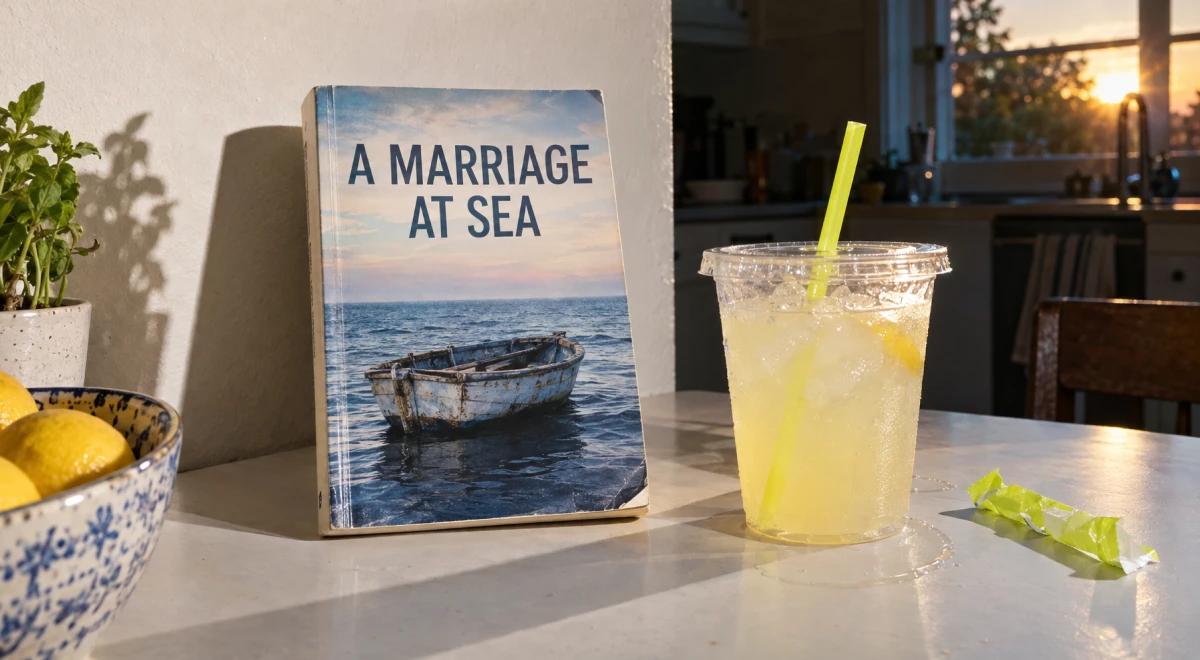

Anyone else get hooked on a book title before even opening it? That happened to me with 'A Marriage at Sea'. A marriage is something people usually survive on land, so putting one on a raft in the Pacific made me need to know who comes out of it still married.
Sophie Elmhirst's retelling follows Maurice and Maralyn Bailey, a British couple whose yacht, the Auralyn, was struck by a whale in 1973, the date on its first chapter. They drifted for 118 days.
A raft isn’t everyday life, though. So who cracks, who holds on, and what turns the story around? I read it, checked the facts, and I’m sharing the key twists below, with spoilers flagged.
Content warnings before you open it
Some scenes may be disturbing. Check these before starting the book.
Killing and eating animals: The Baileys butcher turtles and fish and eat them raw (Part 2, Ch. 5).
Suicidal thoughts: Maurice weighs suicide on the raft (Part 2, Ch. 8) and again in his later years (Part 5).
Illness, death, and loss: Part 5 covers Maralyn's cancer and death, a pregnancy loss, and Maurice's last years.
Mood: The short sentences carry the couple's flat, desolate quiet.

Who does what on a shared raft: A role ledger from the book
A role ledger is a plain table of who took on which job and where the book shows it. Maurice and Maralyn make an odd couple, so I tracked how that played out on the raft.
Task or role | Who took it on | Where in the book | What it shows about the partnership |
Navigation | Maurice | Part 1, Ch. 4 (sextant on the Atlantic crossing); Part 2, Chs. 2 and 3 (raft position fixes) | His technical skill kept working after his confidence didn't. In Ch. 2, he floats rowing south but leaves the call to Maralyn, and he sees that his captaincy is over (p. 67). |
Rationing food and water | Maralyn | Part 2, Chs. 2, 3, and 7 | She counts 33 tins, sets a one-pint daily water ration each, and writes a meal timetable. Elmhirst says Maralyn's insistence on rhythm and habit helped them survive (Nieman Storyboard). |
Repairs and pumping | Both, with Maralyn logging the pumping | Part 2, Ch. 6; the pumping runs through Part 2 | Maurice swaps the broken sea anchor for oilskins and makes a signal flag. Maralyn's datebook records "Pumping every 20 mins all thro night" (New York Review of Books). |
Finding food | Both | Part 2, Ch. 5 | Maralyn suggests killing a turtle and makes a fishhook from a safety pin. Maurice knocks out the turtle, and she finishes the job. Fishing becomes a daily routine. |
Morale | Maralyn held on to hope, and Maurice sank into despair | Part 2, Chs. 1, 4, 8, and 10 | Maurice privately thinks they're doomed but tells her rescue is likely (Ch. 1). After ships pass, she predicts a "large black Russian container ship" (p. 97). In Ch. 10, she reads aloud and starts games. |
Record keeping | Maralyn kept the diary and calendar, and Maurice kept the watch | Part 2, Ch. 6 | She draws a calendar on the canopy. He tracks time by his watch and resets it by the sun. The diary later became a main source for Elmhirst. |
Night watch | Both, in turns | Part 2, Ch. 9 | They keep watch even when it feels pointless, treating it as the ship's most symbolic duty. |
Spoiler flag: the roles flip after the sinking. On the yacht, Maurice was captain and navigator, and Maralyn handled provisions (Part 1, Ch. 3). Adrift, Maurice blames himself for the loss, and Maralyn takes charge.
Reading pace, section by section: Where it sprints and where it slows
The book moves fastest before the voyage, and critics split on the stretch after the sinking. I'd flag one thing first: the book opens on the morning of the whale strike, then rewinds.
Reception is strong overall. Book Marks counts a rave across 15 reviews. So the disagreement is about rhythm, not quality. Check this pace map and decide for yourself.
Before the voyage: The first third is action-packed, with the couple's relationship and trip planning moving at top speed.
On the raft: The pace falters after the sinking, but short chapters and tight sentences keep the book moving briskly.
After the rescue: The pace falters further, and the aftermath keeps things as fascinating as the survival scenes.
The Patagonia voyage: The Baileys' later trip to Patagonia is covered only briefly.
If you want only the raft, know that the book spends real pages on the lead-up and the aftermath.


Key lessons from the book and what each one teaches us
Elmhirst writes about two real people in such extraordinary circumstances. Still, the lines worth saving are about ordinary things, like leaving a place and choosing a partner. These five are listed on Goodreads, and three appear here as short excerpts.
Survival as a refusal to surrender
Elmhirst writes that survival depends less on feats of endurance than on "the absence of surrender."
That's a claim about what it takes to stay alive. At Nieman Storyboard, Elmhirst says a large part of how the Baileys survived was Maralyn's insistence on rhythm and habit, with set meals and days that had a shape. So surrender isn't one big moment. It's a choice that can wear down one person while the other holds on to hope.
The pull of being someone else somewhere else
"It is an irresistible thought, that we might be someone different somewhere else."
Sophie Elmhirst, 'A Marriage at Sea'
That's the escape fantasy in a single sentence: a new place as a new self. Elmhirst said Maurice's fantasy of supreme isolation turned out to be a myth, and that what usually gets us through is another person. Keep that in mind as Maurice and Maralyn set sail.
Choosing and being chosen
Sharing a home isn’t the same as being chosen. In a 2010 analysis of 148 studies, simply living with someone, compared with living alone, was the weakest link among the measures compared.
Elmhirst writes that two people have to "choose and be chosen," and that the choices must land at roughly the same time.
That makes love a timing problem, a more modest idea than destiny. On a tiny rubber raft, being chosen loses its romance. It becomes logistics, because there's exactly one other person to choose.
Leaving a place for the last time
Elmhirst notes that "seeing a place for the last time" tends to erase its imperfections.
The Baileys left England on June 28, 1972. Maurice felt liberated, while Marilyn cried at her last sight of the Devon cliffs. A house or a whole country looks better once you know you won't be back.
Signs that only show up afterward
"Signs tend to reveal themselves only in retrospect."
Sophie Elmhirst, 'A Marriage at Sea'
The book hands you hindsight up front, since it opens as the Auralyn sank beneath them before it rewinds. The Baileys had no such hindsight. For couples, the takeaway is small. A pattern you can only name afterward is easier to catch if you talk about it earlier.
Four true sea-survival books next to this one
If the raft chapters are what you came for, these four true stories cover similar ground from different angles. Details come from publisher and library listings.
Book | Author | Who was adrift or stranded | What it focuses on | Pick it if you want... |
'Adrift: Seventy-Six Days Lost at Sea' | Steven Callahan | One man alone on an inflatable raft in the Atlantic, 1982 | A solo drift after his sloop capsized six days out | The one-person version of a raft story |
'Unbroken' | Laura Hillenbrand | Louis Zamperini and pilot Phil Phillips, 47 days on a raft in 1943 | The raft, then captivity as prisoners of war | A story that keeps going long after the rescue |
'In the Heart of the Sea' | Nathaniel Philbrick | The crew of the whaleship Essex, sunk by a sperm whale in 1820 | More than ninety days in three small boats, plus whaling history | The whale strike that inspired 'Moby-Dick' |
'Endurance' | Alfred Lansing | Ernest Shackleton's crew, 1914 to 1917 | Months on ice and in open boats after pack ice crushed their ship | A full crew and one leader instead of a couple |
Sea stories also work as fiction. Homer's sea epic gets a full treatment in the Odyssey. On land, Kristin Hannah's novel of an isolated family in Alaska deals with domestic abuse and PTSD. It's a heavy read and not a marriage story to hold up as a model.
Five questions the book leaves you with, and the summary that takes each further
Headway has a summary of each book below, in text and audio. Each one picks up a question the Baileys' story raises.
Why do we pick partners who are nothing like us?
'Getting the Love You Want' by Harville Hendrix, Ph.D., and Helen LaKelly Hunt, Ph.D., argues that we tend to choose partners who echo our early caregivers, which is why couples replay the same argument. It suits readers who keep asking why we love difficult people and want a framework instead of a hunch.
Why do two people cope with stress so differently?
'Attached' by Amir Levine, M.D., and Rachel Heller, M.A., sorts people into three attachment styles and shows how partners can react to stress in opposite ways.
Here's where it doesn't apply: the Baileys and their relationship.
What does a day look like when the day is all you control?
'Make Your Bed' by Admiral William H. McRaven opens with one small task, making your bed each morning, which takes a few minutes. The idea is that one finished job gives a bad day a floor to stand on.
The raft version is Maralyn's timetable: set meals, a one-pint daily water ration each, and a calendar drawn on the canopy (Part 2, Chs. 2 and 6).
How do two people talk when the stakes are high?
'Crucial Conversations' is by Kerry Patterson, Joseph Grenny, Ron McMillan, and Al Switzer. It defines a crucial conversation as one with high stakes, clashing opinions, and strong emotions. The common mistake it names is going quiet or turning aggressive when the topic gets heated.
Is dropping everything for a dream a good idea?
In 'Four Thousand Weeks', Oliver Burkeman's take on limited time pushes back on a common hope: that a different life somewhere else removes your limits. Every yes still closes off a no.
He isn't against adventure, though. He argues for choosing trade-offs on purpose, which fairly describes what the Baileys did when they swapped a settled life for a boat.
📘 Listen to these book summaries on Headway!
One question to take away from the raft
My verdict: ‘A Marriage at Sea’ is worth your time if you want a character study of a partnership more than a pure survival thriller. The raft chapters are pretty tense, the before-and-after take their time, and the harder scenes are undeniably real.
Whatever held the Baileys together was stranger and plainer than love, and I’m still turning that over. Call it love or call it logistics, it kept them afloat.
FAQs about 'A Marriage at Sea'
Is 'A Marriage at Sea' the same book as 'Maurice and Maralyn'?
It's one book under two titles, per the US edition's copyright page. Chatto & Windus published the UK edition in 2024 as 'Maurice and Maralyn: A Whale, a Shipwreck, a Love Story'. Riverhead Books released the US hardcover on July 8, 2025, and a paperback followed on June 30, 2026. Titles and subtitles differ between the two editions published, so match yours before comparing pages.
Is the book 'Marriage at Sea' based on a true story?
Yes. The Bookseller says Elmhirst used press coverage, friends' testimony, the couple's diaries, and Maralyn's galley handbook. She also drew on the Baileys' own books, including '117 Days Adrift' (1974), which says 117 days; most modern sources say 118. Wikipedia dates the rescue to June 30, 1973. NPR and a chapter guide put the departure in June 1972, though one obituary says early 1973.
What happened to Maurice and Maralyn Bailey?
After the rescue, the Baileys returned to England and published '117 Days Adrift' in 1974. They later sailed again on a new yacht, the Auralyn II, on a 14-month voyage to Patagonia. Maralyn died of cancer on May 21, 2002, at age 61. Maurice died in December 2017, per Wikipedia. These details come from public records, so they stay spoiler-light.
How does the book 'Marriage at Sea' end?
Spoiler: The South Korean fishing boat Weolmi 306 picks up the Baileys after its captain first ignores the raft, then turns back, per a chapter guide. Later chapters follow Maralyn's death and Maurice's last years, and an epilogue returns to a late interview with him. The Wall Street Journal's reviewer found the final act more reflective than the rest.
What is the difference between 'A Marriage at Sea' and 'Maurice and Maralyn'?
They're the same book under two titles. Chatto & Windus published it in the UK in 2024 as 'Maurice and Maralyn: A Whale, a Shipwreck, a Love Story'. In the US, Riverhead Books, the shipwreck publisher behind the American edition, released it as 'A Marriage at Sea' on July 8, 2025. The UK edition runs 272 pages, and the US edition runs 256.
How many pages are in the book 'A Marriage at Sea'?
Publisher and retailer listings give 256 pages for the Riverhead hardcover and the 2026 paperback. One library catalog record for the US edition lists 246. A Center Point large print edition also came out in 2025. The audiobook runs about 5 hours 50 minutes, per retailer listings. UK editions may differ, so check yours.
Is there a movie about Maurice and Marilyn Bailey?
Not yet. The Bookseller reported that Dakota and Elle Fanning's production company, Lewellen Pictures, optioned the film rights alongside the UK book deal. An option holds the rights without promising a movie, and the sources checked show no cast or release date. Look for fresh news before you plan a watch night.