Self-growth
 Business & Career
 Success
 Communication
 Healing
 Relationships
 Psychology
 Happiness
Public interviews reward confidence. Books reward honesty. When CEOs sit down to write, they stop giving answers that sound good — and start explaining what actually worked, what failed, and what changed them.
And if you’re here, it’s probably not just because you’re curious about famous leaders. You might be thinking about your own growth. About decisions that feel heavier than they used to. Or about how success looks different once you’ve already achieved some of it.
At Headway, we see this pattern constantly: people don’t look for more information. They look for ideas that help them think better about work and life.
These five CEOs shared exactly that — but only in their books.
Quick takeaway: 5 book-only lessons from global CEOs
Leadership is about clarity, not control → ‘The Ride of a Lifetime’ by Bob Iger
Long-term thinking requires short-term flexibility → ‘Invent & Wander’ by Jeff Bezos
Culture is what you tolerate, not what you say → ‘No Rules Rules’ by Reed Hastings
Paranoia can be a strategy — if it’s disciplined → ‘Only the Paranoid Survive’ by Andrew Grove
Business can scale without losing its soul → ‘Conscious Leadership’ by John Mackey
These aren’t motivational slogans. They’re frameworks shaped by real pressure — and you can explore all of them in the Headway app.
Book 1: ‘The Ride of a Lifetime’ by Robert Iger (Disney)
The advice he explains only in his book
Great leadership is about calm, not charisma. In interviews, Iger is often praised for vision. In his book, he emphasizes something quieter: emotional steadiness.
He describes how trust at Disney wasn’t built through bold speeches, but through:
Clear decision-making
Respectful communication
Consistency under stress
People followed him not because he was loud, but because he was predictable in the best way.
Why this matters for your career
As responsibility grows, emotional reactions become expensive. The higher you go, the more your ability to stay calm becomes a competitive advantage.
📘With Headway, you can explore this idea across leadership summaries on decision-making, trust, and executive presence — and see how different leaders apply the same principle.



Book 2: ‘Invent & Wander’ by Jeff Bezos (Amazon)
The advice hidden across years of writing
Be stubborn on vision — flexible on details. ‘Invent & Wander’ collects Bezos’s shareholder letters, and one pattern repeats relentlessly: long-term thinking only works if you’re willing to change how you execute.
Amazon didn’t win by being right early. It won by:
Running experiments
Accepting visible failure
Adjusting tactics without abandoning purpose
Why this matters for your career
Most people confuse consistency with rigidity. Hold your direction tightly — and your methods loosely.
📘This idea appears across Headway summaries on innovation, strategy, and adaptability, helping you recognize it wherever it shows up.
Book 3: ‘No Rules Rules’ by Reed Hastings (Netflix)
The advice that rarely fits into interviews
High performance matters more than comfort. Hastings is unusually honest about tradeoffs. In ‘No Rules Rules’, he explains that Netflix optimized for talent density, not harmony.
That meant:
Radical candor
Fewer rules
Letting go of good people when standards changed
It’s uncomfortable — but it’s intentional.
Why this matters for your career
Psychological safety doesn’t mean avoiding hard conversations. The best cultures don’t eliminate tension — they use it productively.
📘Headway summaries often connect this idea with books on feedback, leadership, and organizational design.
Book 4: ‘High Output Management & Only the Paranoid Survive’ by Andrew S. Grove (Intel)
The advice Grove made famous
Paranoia isn’t fear — it’s awareness. Grove wrote about strategic inflection points long before pivots became fashionable. His message was simple: companies fail when leaders ignore weak signals.
His paranoia was disciplined:
Metrics over intuition
Systems over heroics
Preparation over optimism
Why this matters for your career
Ignoring small problems doesn’t make them disappear — it makes them expensive. Pay attention before urgency forces your hand.
📘This perspective shows up across Headway summaries on productivity, systems thinking, and operational excellence.
Book 5: ‘Conscious Leadership’ by John Mackey (Whole Foods)
The advice rooted in values, not trends
Purpose scales better than control. Mackey argues that businesses don’t have to choose between profit and principle. In fact, purpose-driven companies often outperform because people care more — not less.
The book reframes leadership as:
Stewardship, not dominance
Meaning, not manipulation
Long-term trust, not short-term extraction
Why this matters for your career
Burnout often comes from working without meaning — not from working too hard. The more responsibility you have, the more purpose matters.
📘Headway connects this idea with summaries on values, motivation, and meaningful work.
The pattern behind these CEOs' books
Seen together, these books point to a shared philosophy:
Clarity beats controlLearning beats certainty
Purpose beats pressure
What’s striking is how often these same ideas appear across very different authors and industries. That’s why reading across books matters. One book can inspire you. Multiple perspectives help you think more clearly.
Explore the ideas — not just the CEOs
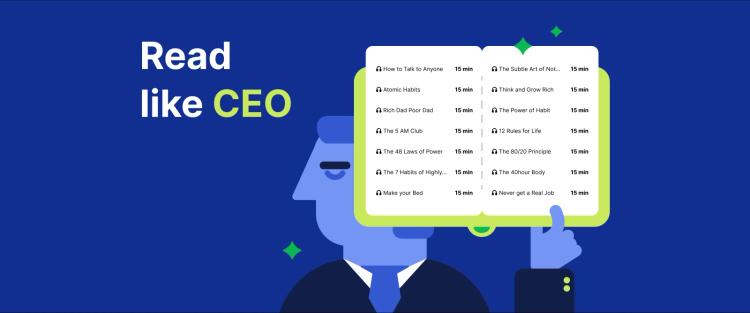
You don’t need to read every book cover to cover to benefit from them. With Headway, you can explore key ideas from thousands of books — including those written by global CEOs — in about 15 minutes per summary. That makes it easier to:
Spot patterns across authors
Apply ideas faster
Decide which books deserve deeper time
📘 Explore Headway and read based on what you need now — not just what’s popular.
Frequently asked questions on books written by CEOs
What are the best books for CEOs?
The best books for CEOs aren’t about hacks — they’re about judgment. ‘The Ride of a Lifetime’ shows why leadership is about clarity, not control. ‘Invent & Wander’ proves long-term thinking needs short-term flexibility. ‘No Rules Rules’ reframes culture as what you tolerate. ‘Only the Paranoid Survive’ turns disciplined paranoia into strategy. ‘Conscious Leadership’ shows how businesses can scale without losing their soul.
Are these books useful if I’m not a CEO?
Yes — and often even more so. These books train strategic thinking, decision-making, and ownership long before you get the title. Reading them early helps you see how leaders think under pressure, manage trade-offs, and build systems. You don’t need a corner office to benefit from CEO-level mental models.
What are the top 10 leadership books?
The “top” leadership books usually share one trait: they change how you think. Classics often include ‘The Ride of a Lifetime, Only the Paranoid Survive’, ’High Output Management’, ‘Good to Great’, ‘No Rules Rules’, ‘Principles’, ‘Leaders Eat Last’, ‘Dare to Lead’, ‘The Hard Thing About Hard Things’, and ‘Start With Why’. Each sharpens a different leadership muscle.
Which billionaires have written books?
Quite a few — and they’re surprisingly candid. Bob Iger (‘The Ride of a Lifetime’), Jeff Bezos (‘Invent & Wander’), Reed Hastings (‘No Rules Rules’), Ray Dalio (‘Principles’), Phil Knight (‘Shoe Dog’), and John Mackey (‘Conscious Leadership’) have all documented how they think, decide, and recover from failure at massive scale.
Is it true that CEOs read a lot?
Yes, but not randomly. CEOs read to think better, not to escape. Most use reading as a compression tool — learning from decades of experience in hours. They focus on strategy, psychology, history, and biographies, using books to stress-test decisions and avoid repeating other people’s expensive mistakes.
What do CEOs read daily?
Daily reading for CEOs is usually lightweight but intentional: industry news, market signals, internal dashboards, and curated insights. Many pair this with short book summaries to keep learning consistent despite time pressure. The goal isn’t volume — it’s staying oriented, informed, and mentally ahead of the next decision.