Self-growth
 Business & Career
 Success
 Communication
 Healing
 Relationships
 Psychology
 Happiness
Ever feel like you're just winging it while building a business?
The entrepreneurial journey is usually half excitement and half "what on earth am I doing?" That's why reading is such a superpower. The best books for entrepreneurs provide actionable frameworks, mindset shifts, and proven strategies founders use to build, scale, and lead successful businesses.
Whether you're launching your first business or scaling a seasoned startup, you shouldn't have to learn every hard lesson through trial and error. This list of 25 must-read titles is curated based on real-world practicality and growth outcomes.
From refining your business strategy to mastering entrepreneurship at a high level, these books are your mentors in paper form. It's about getting the perspective of people who have already fought the battles you're facing.
📘 And if you're short on time, tools like Headway can help you grab the core lessons fast so you can get back to work.
Quick answer: What are the books for entrepreneurs?
If you're looking for a shortcut to the top shelf, here's the quick breakdown of what makes a business book worth your time:
What are the best books for entrepreneurs? They are titles that offer a practical guide to solving real problems, from finding your "why" to managing cash flow and scaling teams.
Key benefits: These books help you develop mental toughness, create a sustainable business strategy, and build resilience against the inevitable "hard things" that come with a small business.
Who they are for: Aspiring founders, small business owners, and scaling leaders who want to stop guessing and start following proven models.
Top 5 recommended books right now:
'The Lean Startup' by Eric Ries (Best for testing business ideas)
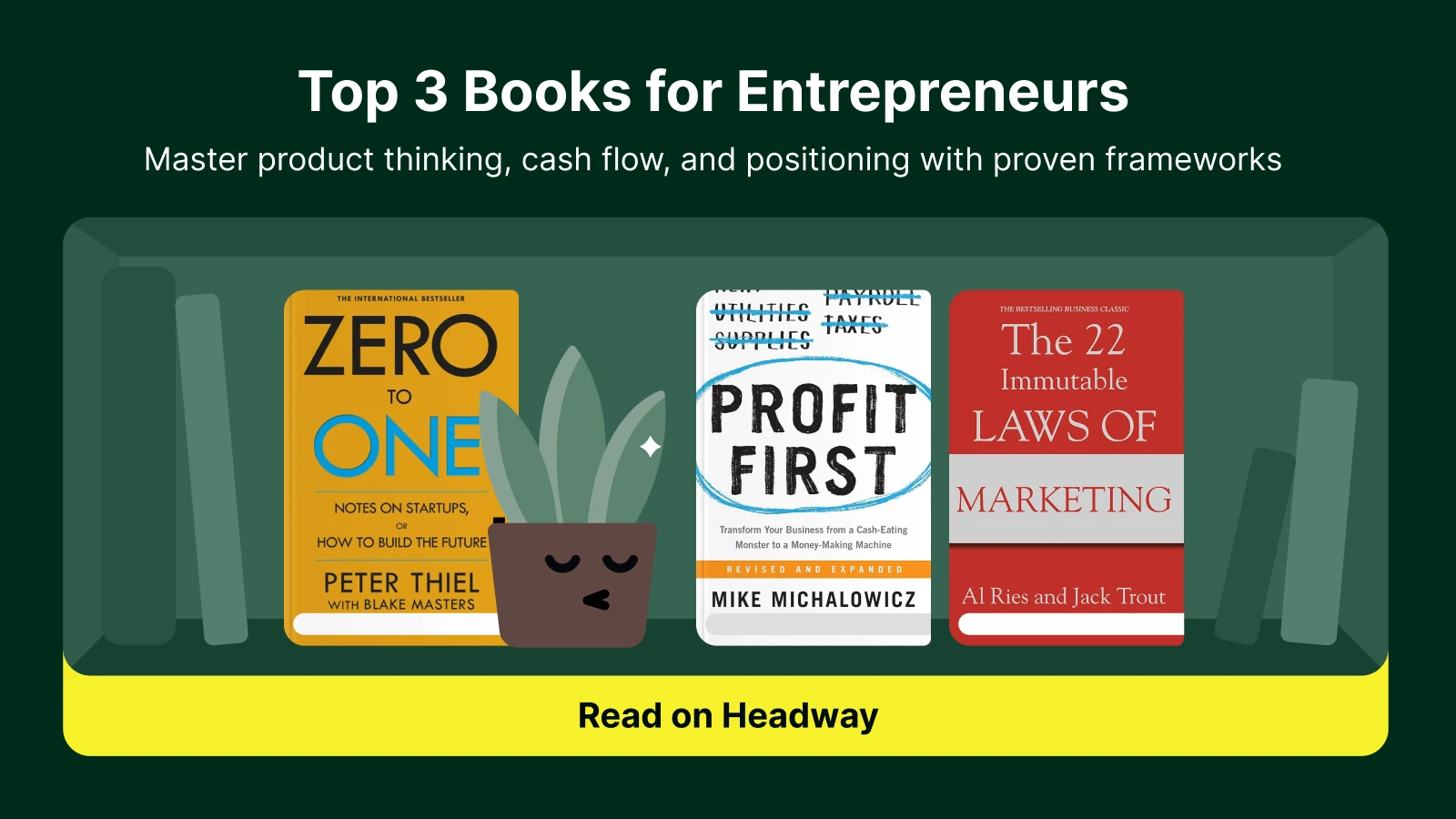
'Zero to One' by Peter Thiel (Best for innovation)
'Start with Why' by Simon Sinek (Best for purpose)
'The Hard Thing About Hard Things' by Ben Horowitz (Best for leadership)
'Atomic Habits' by James Clear (Best for personal performance)
Top 25 best books for entrepreneurs
We've rounded up 25 titles that cover everything from the day you have your first business idea to the day you're managing a massive team. These aren't just best-selling titles because of good marketing; they actually have the meat you need to build a small business.
1. 'The Lean Startup' by Eric Ries
The bible for modern entrepreneurship. Instead of spending a year building something nobody wants, you use a "build-measure-learn" loop to test your business ideas fast.
Why it matters: It stops you from wasting money and time on products that will fail.
Actionable takeaway: Build a Minimum Viable Product (MVP) and get it in front of one customer today.
📘 Don't spend years building something nobody wants. Grab Headway to master 'The Lean Startup' in minutes and start testing your ideas today.
2. 'Zero to One' by Peter Thiel
A deep dive into innovation. Peter Thiel argues that if you're just copying someone else, you're going from 1 to N. Going from 0 to 1 means creating something genuinely new.
Why it matters: It shifts your mindset from competing to dominating a new market.
Actionable takeaway: Ask yourself: "What valuable company is nobody building?"
3. 'The Hard Thing About Hard Things' by Ben Horowitz
Finally, a book that admits building a business is hard. Ben Horowitz talks about the times when there are no easy answers, and everything is on the line.
Why it matters: It gives you the mental toughness needed for the "trough of sorrow."
Actionable takeaway: When things go wrong, be honest with your team. Don't sugarcoat the bad news.
4. 'Good to Great' by Jim Collins
A massive research project turned into a book. Jim Collins looks at why some companies stay average while others become successful businesses.
Why it matters: It explains the "Hedgehog Concept" and the importance of getting the right people on the bus.
Actionable takeaway: Figure out what you can be the best in the world at, and stop doing everything else.
5. 'The E-Myth Revisited' by Michael E. Gerber
Michael E. Gerber explains why most small business owners are actually just "technicians" who have had a "managerial seizure."
Why it matters: It teaches you to work on your business, not in it.
Actionable takeaway: Write down the step-by-step process for one task in your business so someone else can do it.
6. 'Start with Why' by Simon Sinek
Simon Sinek argues that people don't buy what you do; they buy why you do it.
Why it matters: It's essential for branding and finding a co-founder who actually cares.
Actionable takeaway: Define your "Why" in one sentence that has nothing to do with making money.
7. 'The Mom Test' by Rob Fitzpatrick
A must-read for anyone in the early stages of a startup. Rob Fitzpatrick shows you how to talk to customers without being lied to.
Why it matters: It keeps you from getting "false positives" on your bad ideas.
Actionable takeaway: Never ask "Is this a good idea?" Ask about the person's past behavior instead.
8. 'Measure What Matters' by John Doerr
It's about how Google and Intel use Objectives and Key Results (OKRs) to stay focused.
Why it matters: It gives you a simple business strategy for tracking progress.
Actionable takeaway: Set three ambitious objectives for the next quarter and define how you'll measure them.


9. 'The Personal MBA' by Josh Kaufman
Essentially, a four-year business degree distilled into a single, great book.
Why it matters: You don't need an expensive MBA to understand the fundamentals of value creation.
Actionable takeaway: Study the "5 Parts of Every Business" and find which one is currently your weakest link.
10. 'Profit First' by Mike Michalowicz
Mike Michalowicz flips accounting on its head. Instead of Sales – Expenses = Profit, it's Sales – Profit = Expenses.
Why it matters: It ensures your small business stays healthy and you actually get paid.
Actionable takeaway: Open a separate bank account for profit and put 1% of every sale there starting today.
📘 Is your business actually making money? Use Headway to absorb the 'Profit First' system and finally get paid what you're worth.
11. 'The 7 Habits of Highly Effective People' by Stephen Covey
A timeless classic that focuses on character over personality hacks.
Why it matters: Stephen Covey provides the foundation for personal leadership.
Actionable takeaway: Be proactive. Focus only on the things you can actually control.
12. 'Rich Dad Poor Dad' by Robert Kiyosaki
Kiyosaki explains the difference between assets and liabilities in a way that sticks.
Why it matters: It changes how you view money and real estate as a tool for freedom.
Actionable takeaway: Stop buying trinkets and start buying things that put money in your pocket.
13. 'The Millionaire Fastlane' by MJ DeMarco
A blunt, no-nonsense look at how to build wealth through a business that scales.
Why it matters: It trashes the "slow lane" advice of saving pennies for 40 years.
Actionable takeaway: Look for "CENTS" (Control, Entry, Need, Time, Scale) in your business model.
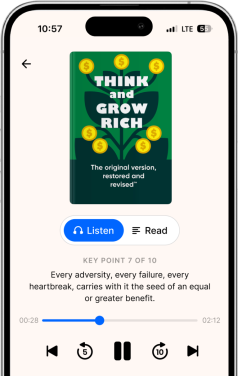
14. 'Think and Grow Rich' by Napoleon Hill
The original bestseller on the power of mindset and persistence.
Why it matters: It's the root of almost all modern self-improvement books.
Actionable takeaway: Form a "Mastermind" group of people who are smarter than you.
15. 'The 4-Hour Workweek' by Tim Ferriss
Ferriss showed the world how to automate a "muse" business and escape the 9-to-5.
Why it matters: It's the ultimate guide to lifestyle design and outsourcing.
Actionable takeaway: Identify the 20% of tasks causing 80% of your stress and delete them.
16. 'Rework' by Jason Fried and David Heinemeier Hansson
A manifesto for the "anti-startup." It argues that you don't need venture capital or a big office.
Why it matters: It's a breath of fresh air for small business owners who want to stay lean.
Actionable takeaway: "Ignore the details early on." Just get the thing built.
17. 'How to Win Friends and Influence People' by Dale Carnegie
Still, the best must-read for anyone who has to deal with other humans (which is every founder).
Why it matters: It's the foundation of sales, leadership, and networking.
Actionable takeaway: Become genuinely interested in others rather than trying to be interesting.
18. 'High Output Management' by Andrew Grove
Considered the "management manual" by Ben Horowitz and almost every Silicon Valley CEO.
Why it matters: It teaches you how to run a team like a well-oiled machine.
Actionable takeaway: Realize that a manager's output = the output of the units under his supervision.
19. 'Shoe Dog' by Phil Knight
The memoir of the creator of Nike. It's a raw look at the messy reality of building a business.
Why it matters: It reminds you that even the biggest brands started with massive debt and constant fear.
Actionable takeaway: "Keep going." Don't stop until you get where you're going.
20. 'Crucial Conversations' by Patterson, Grenny, McMillan, Switzler
Learn how to talk to people when the stakes are high and emotions run hot.
Why it matters: Essential for resolving conflict with a co-founder or early employee.
Actionable takeaway: When a conversation gets tense, step back and make the other person feel safe.
📘 Work on your business, not in it. Download Headway to learn the 'Crucial Conversations' frameworks and the importance of crucial conversations.
21. 'The 22 Immutable Laws of Marketing' by Al Ries and Jack Trout
Short, punchy rules for positioning your brand so it actually sticks in people's minds.
Why it matters: It prevents you from making huge mistakes in your business strategy.
Actionable takeaway: It's better to be first than it is to be better. Find a category where you can be first.
22. 'Crossing the Chasm' by Geoffrey Moore
Explains the gap between early adopters and the "early majority" market.
Why it matters: It's the roadmap for scaling a tech startup.
Actionable takeaway: Pick a "beachhead" market, a niche group you can dominate before moving on.
23. 'Principles' by Ray Dalio
The rules for life and work from one of the world's most successful investors.
Why it matters: It advocates for "radical transparency" in your company culture.
Actionable takeaway: Create a "system" for your life so you don't make the same mistake twice.
24. 'The Psychology of Money' by Morgan Housel
A look at how our personal history and ego affect our financial decisions.
Why it matters: It helps you avoid the "greed" traps that kill successful businesses.
Actionable takeaway: Realize that wealth is what you don't see, such as the cars not bought and the investments kept.
25. 'Lost and Founder' by Rand Fishkin
An honest, sometimes painful look at the other side of venture capital and startups.
Why it matters: It balances out the "hustle culture" that you see on social media.
Actionable takeaway: Be careful whose advice you take. What works for a VC-backed giant won't work for your small business.
📘 Your schedule is a nightmare, but your growth shouldn't stop. Try Headway to get the core lessons from 25 business books while you commute.
Core entrepreneurial competencies and book mapping
Founders usually have to be "jacks-of-all-trades," but let's be real: nobody is naturally good at everything. You might be a genius at coming up with business ideas, but a total disaster at managing a team. Or maybe you're great at the "doing" but have no clue about business strategy.
The trick is to treat business books like a specialized toolkit. You don't pull out a hammer to fix a lightbulb. Here's a quick breakdown of which great books help you master the specific skills you need for entrepreneurship.
| Competency | Focus area | Recommended books |
|---|
Mindset and resilience | Surviving the emotional roller coaster. | 'The Hard Thing About Hard Things', 'Think and Grow Rich' |
Launch and product | Getting from an idea to a real startup. | 'The Lean Startup', 'The Mom Test', 'Zero to One' |
Growth and scaling | Turning a tiny project into a big player. | 'Good to Great', 'Crossing the Chasm', 'Measure What Matters' |
Systems and finance | Making sure you actually make money. | 'Profit First', 'The E-Myth Revisited', 'Rich Dad Poor Dad' |
Leadership | Managing people without losing your mind. | 'The 7 Habits of Highly Effective People', 'High Output Management' |
Recommended reading paths based on your stage
You shouldn't just grab a random book off Amazon and hope for the best. Where you are in your entrepreneurial journey changes what you should be reading. If you're still working a 9-to-5, reading about managing 500 people is just a distraction.
Path 1: The aspiring entrepreneur (Pre-launch)
You have a bunch of ideas, but you haven't pulled the trigger yet. Your goal is to stop overthinking and start doing.
Goal: Validate your idea and get your head in the game.
The stack: 'The Personal MBA' → 'The Millionaire Fastlane' → 'Start with Why.'
Why: You need to understand how money actually works (MJ DeMarco is great for this) before you get lost in the weeds.
Path 2: The first-time founder (Launch stage)
You're in it now. You have a product or a service, but you're probably working 80 hours a week and feeling overwhelmed.
Goal: Find "Product-Market Fit" and build a basic system.
The stack: 'The Lean Startup' (Eric Ries) → 'The Mom Test' (Rob Fitzpatrick) → 'The E-Myth Revisited.'
Why: You need to make sure people actually want what you're selling before you burn through your savings.
Path 3: The growth-stage leader (Scaling)
Your small business is working. Now you need to hire people, build a culture, and stop being the person who answers every single email.
Goal: Scale yourself out of the daily operations.
The stack: 'The Hard Thing About Hard Things' (Ben Horowitz) → 'Measure What Matters' (John Doerr) → 'Profit First.'
Why: Here's where things usually break. You need Mike Michalowicz to fix your cash flow and Jim Collins to help you pick the right team.
Path 4: The seasoned operator (Legacy and innovation)
You've got a successful business. Now you're looking at what's next, whether that's real estate, investing, or starting a second company.
Goal: Long-term wealth and high-level strategy.
The stack: 'Principles' → 'Zero to One' (Peter Thiel) → 'The 7 Habits of Highly Effective People.'
Why: At this stage, it's all about high-level decision-making and staying ahead of the curve.
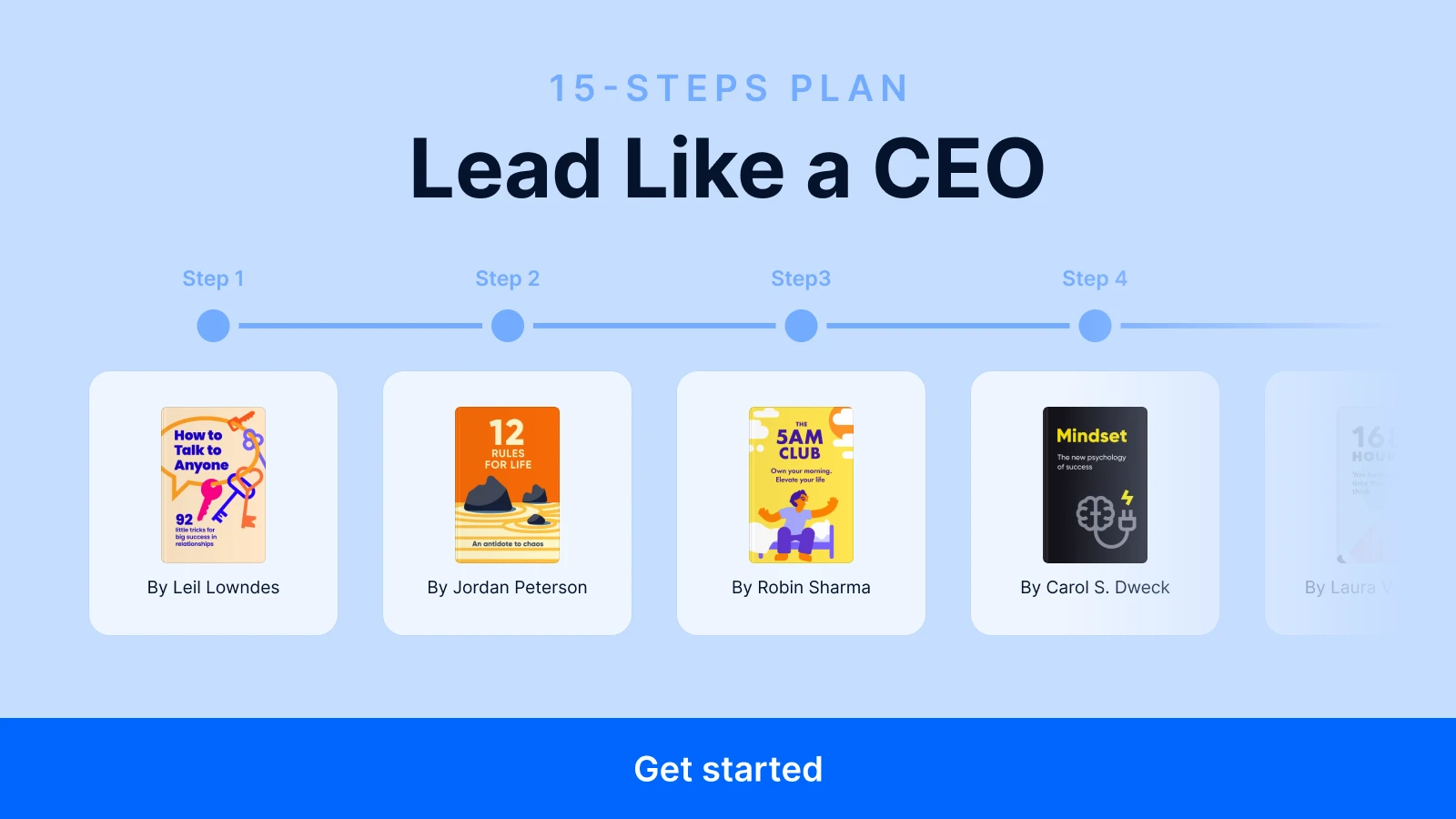
📘 Don't just read about success — actually achieve it. Get Headway today and turn your biggest business challenges into your greatest wins.
What you can do to extract and apply lessons faster
The biggest mistake most small business owners make is "passive reading." You finish a book, feel smart for ten minutes, and then go right back to your old habits. If you want a real takeaway, you have to treat reading like a business experiment.
Here's a simple way to actually use what you read:
The one-action rule: Every time you finish a chapter, write down one thing you can change in your business today. Just one.
Use different formats: If you're busy, audiobooks are perfect for your commute. If you're at the gym, find a podcast where the author is being interviewed. It's a great way to hear them explain the concepts in plain English.
Summarize to remember: You don't always need to read the entire book to get the value. That's why Headway is such a game-changer. You can get the key ideas from the best books in about 15 minutes.
Think of it like this: if you can learn the "MVP" framework from Eric Ries in 15 minutes instead of five hours, you've just saved yourself half a day of work. Use summaries to "vet" books before you buy them on Amazon, or to refresh your memory on a best-selling classic you read years ago.
Build habits that every entrepreneur needs with Headway!
The entrepreneurial journey never really ends. There is always a new problem to solve, a new competitor to beat, or a new system to build. The 25 best books for entrepreneurs aren't magic spells, but they are the best way to avoid making the same mistakes that thousands of people have made before you.
Whether you're taking advice from Dale Carnegie on how to talk to people or following Napoleon Hill's advice on persistence, the goal is the same: building a business that gives you freedom and adds value to the world.
Don't let these books just sit on your shelf. Pick one, grab the key takeaways, and apply them. If you want to speed up the process and stay sharp while running your own business, check out the summaries on Headway. It's the fastest way to get the knowledge you need so you can get back to what really matters — growing your business.
📘 Download Headway and build the mindset of a successful entrepreneur!
FAQs about the best books for entrepreneurs
What books do successful entrepreneurs read?
Successful founders don't just read fluff. They go for high-impact titles like 'The Lean Startup' by Eric Ries or 'Zero to One' by Peter Thiel. They look for practical frameworks to solve real-world problems. Whether it's business strategy, psychological mindset, or financial systems, they choose books that offer a clear roadmap to building a more resilient, profitable business.
Do CEOs read a lot of books?
Yes, and it's not just a hobby. Most top CEOs, like Warren Buffett or Bill Gates, read about fifty books a year. For them, it's about staying sharp and spotting trends before the competition does. They treat reading as part of their daily work schedule, using summaries or audiobooks to keep their knowledge fresh without wasting time.
What books do CEOs read?
CEOs usually focus on leadership, culture-building, and high-level execution. You'll often find 'High Output Management' or 'Good to Great' on their nightstands. They need to understand how to manage people and scale systems effectively. They also dive into biographies of past leaders to learn how to handle the "hard things" that come with running a massive, successful business.
Is 30 too late to become an entrepreneur?
Not at all. In fact, many legendary founders didn't start until their 30s or 40s. At 30, you have more real-world experience and emotional intelligence than a 20-year-old. You've likely seen how businesses fail from the inside. Using that wisdom to launch your own business is a massive advantage that younger founders simply haven't yet built.