Self-growth
 Business & Career
 Success
 Communication
 Healing
 Relationships
 Psychology
 Happiness
Many science fiction audiobooks run longer than 40 hours. 'Dune' clocks in at around 21 hours, depending on the narrator. The 'Lord of the Rings' trilogy runs closer to 60 hours. That's a serious commitment. Pick the wrong book or narrator, and you could waste days you'll never get back.
That's where Headway's book summaries can help you. They give you the core concepts and story beats in minutes. Whether it's Paul Atreides navigating spice politics on Arrakis or Frodo's impossible quest, you can preview the big ideas before committing. Use them to decide whether a full audiobook is worth your time, or check out our curated list below.
Top 16 best sci-fi audiobooks at a glance
We created a quick reference for the top-rated titles currently dominating the charts. Each one was chosen based on production quality, narrator reputation, and listener ratings on platforms like Amazon, Goodreads, and Reddit, alongside coverage from Audible and major publishing sources:
| Book title | Author | Best for | Estimated duration | Why it fits well with audio |
|---|---|---|---|---|
1. 'Project Hail Mary' | Andy Weir | First-time listeners | 16h | Alien communication uses audio cues |
2. 'The Martian' | Andy Weir | Logic-driven survival | 10h 59m | Log entries suit spoken format |
3. 'Red Rising' | Pierce Brown | Political hierarchy | 16h | Accents signal class structure |
4. 'Skyward' | Brandon Sanderson | Action-focused sci-fi | 15h 28m | Energetic narration fits flight combat |
5. 'Dune' | Frank Herbert | Deep world-building | 21h 2m | Multi-cast narration separates factions |
6. 'Leviathan Wakes' | James S. A. Corey | Space politics | 20h 56m | Belter dialects clarify factions |
7. 'The Lord of the Rings' | J. R. R. Tolkien | Epic fantasy sagas | ~60h (trilogy) | Single narrator maintains continuity |
8. 'All Systems Red' | Martha Wells | Short listens | 3h 17m | Dry internal monologue fits audio |
9. 'Old Man's War' | John Scalzi | Dialogue-heavy plots | 9h 41m | Conversational pacing |
10. 'This Is How You Lose the Time War' | Amal El-Mohtar | Short, abstract sci-fi | 4h 16m | Letter format supports pauses |
11. 'Children of Time' | Adrian Tchaikovsky | Evolutionary concepts | 16h 31m | Vocal shifts separate species |
12. 'Parable of the Sower' | Octavia E. Butler | Social collapse | 12h | The diary format suits narration |
13. 'Fourth Wing' | Rebecca Yarros | Full-cast fantasy audio | 22h | Graphic audio separates voices |
14. 'Foundation' | Isaac Asimov | Idea-driven sci-fi | 8h 17m | Measured pace supports theory |
15. '2001: A Space Odyssey' | Arthur C. Clarke | AI and space exploration | 6h 42m | Clinical delivery fits the tone |
16. 'Stranger in a Strange Land' | Robert A. Heinlein | Social commentary | 16h 6m | Character voices clarify debate |
The modern masterpieces: Best for newcomers
We're in a golden era of sci-fi audiobooks. When a narrator is really clicking, a book can transport you to another planet, making hours pass in what feels like minutes. If you're new to the genre, start here. These titles have high production values and narrators who make even complex stories easy to follow:
1. 'Project Hail Mary' by Andy Weir: A New York Times bestseller in audio form
Narrated by: Ray Porter
Estimated duration: 16 hours
Listener rating: 4.9 (over 238,000 ratings)
This audiobook, narrated by Ray Porter, runs just over 16 hours and holds a 4.9 rating from more than 238,000 listener reviews on Audible. The story relies on first-person problem-solving rather than big action scenes. Porter's narration stays steady throughout the technical sections, so you don't need to look at any diagrams to follow along. The book is a New York Times bestseller, and a film adaptation starring Ryan Gosling, directed by Phil Lord and Christopher Miller, is set for March 20, 2026.
Why the audio version works
Audiobook forum threads frequently cite Porter's delivery as the reason listeners finish the full runtime. The production also has sound effects to represent the alien language, turning a complex concept into an audible pattern that's easy to follow without text.
Key audio features:
One narrator throughout, so there's no mental adjustment between chapters.
Sound cues replace the written symbols for the alien language, so nothing gets lost.
Each chapter breaks at natural points, which helps with pacing.
Runtime stays under 17 hours, so it's manageable from start to finish.
2. 'The Martian' by Andy Weir: A science-driven audiobook built around survival logs
Narrated by: Wil Wheaton
Estimated duration: 10 hours and 59 minutes
Listener rating: 4.8 (over 41,000 ratings)
If you've seen the 2015 film adaptation and liked Matt Damon as Mark Watney, the audiobook is a natural next step. Wil Wheaton brings a sharp, sarcastic energy to Watney's voice that fits the character well.
The book hit The New York Times Best Sellers list in November 2014 and has stayed as one of the most replayed sci-fi audiobooks since. Most listeners across audiobook forums cite the narration style as a key factor in the audiobook's popularity. Wheaton keeps a dry, technical tone during the science and engineering sections. You don't need any visual aids to follow along. The logic tracks on its own.
Why the audio version works
The audiobook is structured as an engineer's survival log entries. Each entry is its own complete unit. You can pause anywhere and pick it up later without getting lost. And at under 11 hours, it's one of the shorter hard sci-fi titles on this list.
Key audio features:
Log-entry structure lets you pause and resume listening.
Technical terms are pronounced clearly throughout.
Each chapter's length stays short enough for brief listening sessions.
Runtime remains under 11 hours, making it easier to get through than most.
3. 'Red Rising' by Pierce Brown: Class divisions come through the narrator's voice
Narrated by: Tim Gerard Reynolds
Estimated duration: 16 hours
Listener rating: 4.6 (over 8,000 ratings)
The audiobook presents a dystopian caste system where your rank shapes everything about how you speak and act. Tim Gerard Reynolds uses clear accent differences across groups, including an Irish-accented delivery for the Reds, which tells you exactly where each character sits in the hierarchy. No long explanations needed.
Why the audio version works
Listener feedback often highlights how Reynolds' narration communicates power dynamics entirely through tone. You just hear who's in charge, and this technique is the same approach central to dystopian works such as '1984,' where control is conveyed through language. It works especially well when you're not looking at the screen.
Key audio features:
Accent differences signal each character's place in the social order.
First-person narration keeps the perspective consistent.
Character voices stay the same across the whole series.
The style appeals to listeners who also enjoy fantasy audiobooks.
4. 'Skyward' by Brandon Sanderson: High-octane flight school
Narrated by: Suzy Jackson
Estimated duration: 15 hours and 28 minutes
Listener rating: 4.8 stars (over 42,900 ratings)
In this space opera, humanity is trapped on a planet called Detritus, under constant attack from an alien force known as the Krell. The story follows Spensa, the daughter of a disgraced pilot, as she fights to join the flight academy and clear her father's name. Suzy Jackson's narration is celebrated for its high energy and brassy tones, which suit Spensa's stubborn, rebellious character well.
Sanderson's stories often focus on how people work together under extreme pressure. Pair this with the 'Sapiens' summary to understand how shared myths, like the pilot legends in 'Skyward,' allow civilizations to survive against overwhelming odds.
Why the audio version works
Jackson builds real tension during the dogfight sequences. She's especially good with M-Bot, a neurotic, sarcastic spaceship AI. The contrast between Spensa's fiery determination and M-Bot's quirky, mechanical humor makes the dialogue-heavy cockpit scenes genuinely fun to listen to.
Key audio features:
Jackson adjusts her pace and energy to match the intensity of aerial combat.
M-Bot gets a distinct voice that balances the story's heavier military themes.
Jackson captures the emotional stakes well, making the coming-of-age arc feel personal.
The must-read epics: Best for long commutes
These are marathon listens that require sustained attention and a commitment to deep world-building, similar to long-form must-read books like 'Dune' for epic sci-fi fans. They have dense storylines, massive casts, and a lot of lore to track. Narration quality is everything here. A strong narrator keeps you anchored, while a weak one loses you. So, here are the ones worth the time commitment:
5. 'Dune' by Frank Herbert: Complex world-building carried by multiple voices
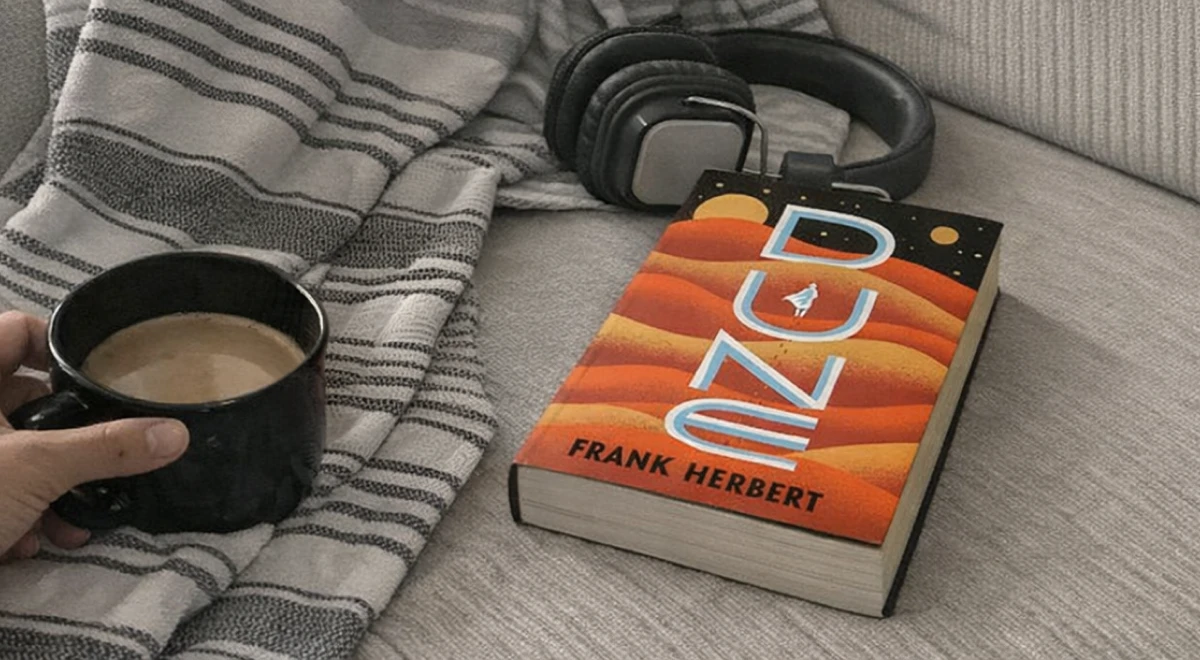
Narrated by: Full cast Scott Brick, Orlagh Cassidy, and others
Estimated duration: 21 hours and 2 minutes
Listener rating: 4.7 (over 126,000 ratings)
This space opera covers political power, resource control, ecology, love, and war across multiple generations. Because the story is so dense, several editions use multi-cast narration. Each major faction gets its own narrator. With distinct voices for different factions, like the noble Atreides or the cruel Harkonnens, you can track who's in power without a printed character list. This audio-first approach has been used since the late 1990s, and it still works.
Because of its scope, many listeners test-drive the story first. You can get a feel for the spice politics, and prophecy by watching the movie to see if this epic fits your taste.
Why the audio version works
A full cast reduces the mental effort needed to keep track of complex names and titles. That matters a lot across a 21-hour listen where your attention will naturally drift.
Key audio features:
Distinct voices separate major houses and political roles.
Smart chapter breaks suit a standard daily commute.
Narrators use a consistent pronunciation guide for Herbert's invented language.
6. 'The Expanse: Leviathan Wakes' by James S. A. Corey: Follow space politics by dialect
Narrated by: Jefferson Mays
Estimated duration: 20 hours and 56 minutes
Listener rating: 4.7 (over 33,000 ratings)
This audiobook marks the start of a series focused on grounded space politics. Jefferson Mays uses distinct speech rhythms to separate Belter dialects from Earth and Mars. These vocal patterns signal social divisions between planetary factions without the story having to spell it out. Reedsy's listener research highlights this dialect work as a key reason for the series' clarity.
If you're curious about how civilizations evolve, you can read the 'Homo Deus' summary and see how humanity has solved critical problems with science and technology. It provides a factual lens on the power struggles and technological themes running through the series.
Why the audio version works
Mays maintains a consistent tone that fits the noir-style mystery at the heart of the story. You can tell characters apart by pronunciation alone, which prevents confusion during fast scene changes. That consistency helps you stay oriented across the full 20-hour runtime.
Key audio features:
Distinct speech patterns distinguish Belters, Martians, and Earthers alike.
One narrator allows for a consistent atmosphere throughout the book.
Auditory pauses signal shifts between political settings.
The same narrator appears across all nine books, so returning characters sound familiar.



7. 'The Lord of the Rings' by J.R.R. Tolkien: Enjoy cinematic narration
Narrated by: Andy Serkis
Estimated duration: around 60 hours across all volumes
Listener rating: 4.9 (over 316,000 ratings)
This edition lines up the character voices with the films. Andy Serkis gives each figure a distinct tone, from Gollum's gravelly voice to Gandalf's authoritative speech. Listeners who know the films will feel at home immediately. The performance spans three volumes but keeps the same energy all the way through.
If you enjoy long sagas with complex lore, check out our list of Books Like Game of Thrones for more epic stories with intricate worlds and political power struggles.
Why the audio version works
One narrator across all three volumes means you never have to adjust to a new voice. That consistency reduces mental fatigue across what is, realistically, a 60-hour commitment.
Key audio features:
Serkis uses specific accents to keep the fellowship members distinct.
A single narrator ensures smooth transitions between books in the trilogy.
Dramatic delivery supports strong listener retention over the full runtime.
Quick and smart fixes: Best for busy minds
Think of book audio summaries as a free test drive before you commit. You can sample a book's core ideas in minutes. That way, you'll know whether the physics in 'Cosmic Queries' by Neil deGrasse Tyson or 'A Brief History of Time' by Stephen Hawking will hold your attention before you sign up for a massive cosmic odyssey.
Shorter audiobooks reduce the time commitment the genre usually demands. These novellas and short stories work well when your schedule is unpredictable:
8. 'All Systems Red' by Martha Wells: Finish a story in one sitting
Narrated by: Kevin R. Free
Estimated duration: 3 hours and 17 minutes
Listener rating: 4.5 (over 22,000 ratings)
This novella begins the famous 'Murderbot Diaries' series. Kevin R. Free uses a restrained delivery that matches the protagonist's internal commentary. The source novella won both the Hugo and Nebula awards for Best Novella, a testament to the quality of the writing beneath the audio.
If you enjoy stories about the laws of the universe, check out the 'Brief Answers to the Big Questions' summary for a factual perspective on how humanity uses physics to understand its place in the cosmos. It may even help you appreciate the grand scale of the environments found in Tolkien's work.
Why the audio version works
The runtime is under four hours, so you can finish it in one sitting. This format lowers the entry barrier for new listeners. Free delivers the internal monologue clearly, so the character's thoughts are easy to follow.
Key audio features:
This whole story fits in a single afternoon.
The narrator captures the protagonist's dry, distinctive personality.
Award-winning source material, confirmed by major science fiction organizations.
9. 'Old Man's War' by John Scalzi: Dialogue-driven sci-fi
Narrated by: William Dufris
Estimated duration: 9 hours and 41 minutes
Listener rating: 4.6 (over 28,000 ratings)
This audiobook emphasizes conversational pacing rather than long descriptions. Dialogue carries the plot, which makes it easier to follow while performing other tasks. This book also ranks among the most replayed science fiction audiobooks across major audio platforms.
Why the audio version works
The structure works well for background listening. William Dufris uses clear speaker transitions to signal when different characters are talking. That clarity makes it practical for commutes and daily routines.
Key audio features:
Dialogue carries the story, so you follow through with character interactions.
Clear speaker transitions, so you always know who's talking.
Moderate chapter lengths support frequent stops and easy retention.
10. 'This Is How You Lose the Time War' by Amal El-Mohtar: Listen to twisted letter-based stories
Narrated by: Cynthia Farrell, Emily Woo Zeller
Estimated duration: 4 hours and 16 minutes
Listener rating: 4.3 (nearly 5,000 ratings)
This audiobook uses an epistolary format, meaning the story is told through a series of letters. These letters create natural breaks that work really well in audio. You can listen in short bursts, allowing you to stop and start as your schedule permits.
Why the audio version works
The production uses two narrators to ground the abstract concept of time travel. Cynthia Farrell voices Red with a sharp, disciplined tone, while Emily Woo Zeller provides a more fluid, lyrical delivery for Blue. You can tell immediately which agent is writing, even as they jump between centuries. The short total runtime and letter-based structure make the book easy to understand during short listening sessions.
Key audio features:
Two distinct voices represent the different letter writers.
The letter-based structure provides clear stopping points.
Mind-bending concepts: Best for deep thinkers
These audiobooks ask more of you. The ideas are complex. The timelines are long. Professional narration does much of the cognitive heavy lifting, and these narrators show us why we should pay attention. Here are our picks:
11. 'Children of Time' by Adrian Tchaikovsky: Understand non-human minds
Narrated by: Mel Hudson
Estimated duration: 16 hours and 31 minutes
Listener rating: 4.65 (over 40,000 ratings)
The story runs two parallel timelines: a dying human civilization and an uplifted spider society on a terraformed planet. It spans thousands of years, tracking both species as they evolve and change. Mel Hudson uses distinct tonal shifts to separate the cold, logical humans from the sensory, instinct-driven spiders.
For more on how species evolve and survive, you can explore the 'Sapiens' summary: A Brief History of Humankind. It gives you real-world context for the leaps described in this epic.
Why the audio version works
The spiders share names across generations, which could easily cause confusion. Hudson's vocal cues prevent that. You know whether you're following a human or a spider perspective from the first few seconds of a chapter. That vocal clarity is what makes the long-term evolution arcs manageable without a printed family tree.
Key audio features:
Distinct vocal styles identify whether a chapter follows humans or spiders.
Hudson keeps a steady pace during the technical biology sections.
The audio bridges the gap between human logic and alien instinct effectively.
12. 'Parable of the Sower' by Octavia E. Butler: Survival through diary entries
Narrated by: Lynnette R. Freeman
Estimated duration: 12 hours
Listener rating: 4.7 (over 14,000 ratings)
The story follows Lauren Olamina, a teenager with hyperempathy who can feel others' pain, as a near-future California society collapses due to climate change and inequality. The narrative is built from diary entries that trace the birth of a new belief system called Earthseed.
Why the audio version works
The diary format makes the narration feel like a personal confession, not a distant story. Lynnette R. Freeman keeps a grounded, steady tone that aligns with Lauren's survivalist mindset. The first-person narration lets you absorb heavy themes without the distraction of external dialogue tags.
Key audio features:
The narration feels like reading a handwritten journal out loud.
A steady, somber tone matches the story's harsh setting.
Clear delivery makes complex social themes easier to follow while multitasking.
13. 'Fourth Wing' by Rebecca Yarros: The immersive dragon rider experience
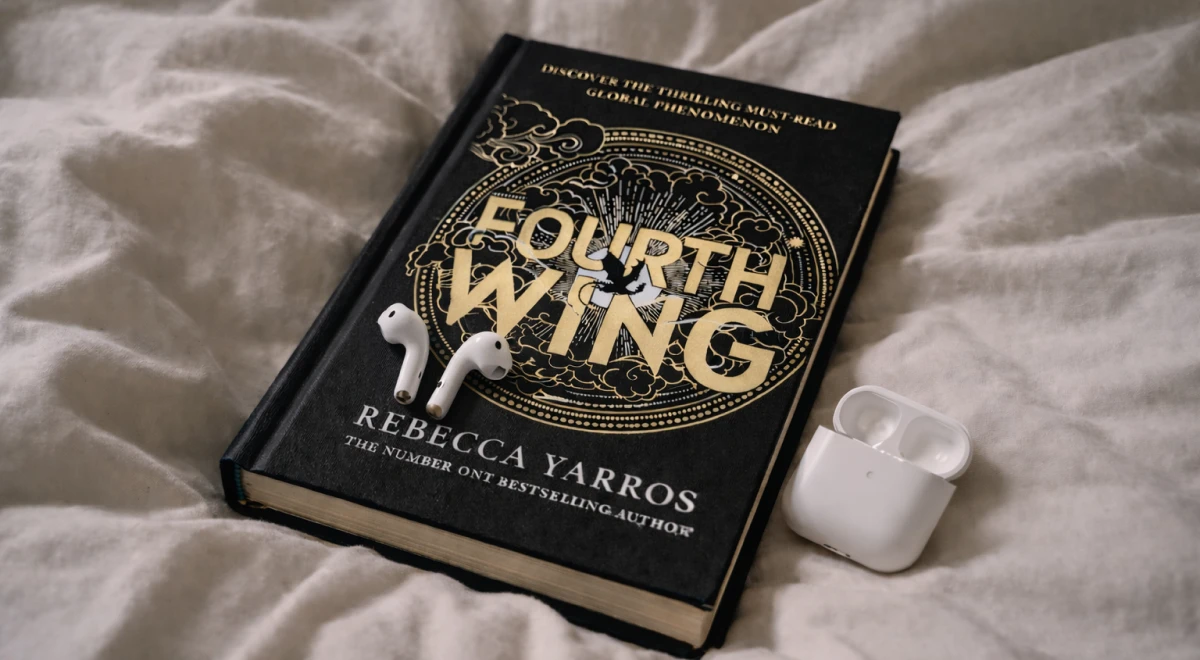
Narrated by: Rebecca Soler, Teddy Hamilton, and Full Cast (Dramatized Adaptation)
Estimated duration: 12 hours and 15 minutes (Part 1), overall 22 hours
Listener rating: 4.7 (over 55,000 ratings)
This fantasy series has become a phenomenon, largely because of its high-end Graphic Audio production. Unlike a standard audiobook, Graphic Audio uses a 'Movie in Your Mind' approach, featuring a full cast of actors, cinematic music, and immersive sound effects. All of that brings the dragon-filled war college of Basgiath to life.
If you usually prefer a podcast-style narration, such as Stephen Fry's warm delivery, this dramatization may offer a huge but rewarding change. The story is a gripping duology, following Violet Sorrengail's survival in a world as harsh as the seismic settings of 'The Broken Earth' by N.K. Jemisin.
Why the audio version works
The Graphic Audio format is great at capturing the chaotic action of dragon flight and combat. Because the production uses a full cast, you never lose track of who's speaking during high-stakes dialogue, a common issue in a complex fantasy series. This audio-first design keeps you fully immersed in the world-building without repetitive attribution tags.
Why the audio version works
Real sound effects (wind, dragon roars, clashing steel) create a layered soundscape.
Original music tracks heighten the tension during key scenes.
Multiple actors give each character a unique, recognizable voice.
The Golden Age pillars: The Big Three picks
If you want to understand where modern sci-fi comes from, you need to go back to the authors who defined the mid-20th century. They established the Three Laws of Robotics, the social structures of interplanetary colonization, and the concept of a mathematical system capable of predicting civilizations.
14. 'Foundation' by Isaac Asimov: The math of empires
Narrated by: Scott Brick
Estimated duration: 8 hours and 17 minutes
Listener rating: 4.4 (over 19,000 ratings)
This audiobook introduces the concept of Psychohistory, a mathematical method used to predict the collapse of a Galactic Empire. Scott Brick delivers the dense philosophical debates and historical exposition that define the series at a deliberate, steady pace. The story focuses on high-level intellectual conflict rather than physical action.
Why the audio version works
Brick's authoritative tone matches the scholarly nature of the protagonist, Hari Seldon. By stressing key terms, the audio helps you track the Foundation's evolution across decades without losing the thread of the central mathematical prophecy.
Key audio features:
A measured reading pace helps you absorb complex sociopolitical theories.
The vocal tone reflects the epic, historical scope of the Galactic Empire.
Clear pauses signal the large jumps in time between story arcs.
15. '2001: A Space Odyssey' by Arthur C. Clarke: The evolution of intelligence
Narrated by: Dick Hill
Estimated duration: 6 hours and 42 minutes
Listener rating: 4.6 (over 12,000 ratings)
This audiobook tracks human evolution from primitive ancestors to space-faring explorers, guided by a mysterious alien monolith. The story focuses on the relationship between Discovery One's crew and the AI system, HAL 9000. Dick Hill narrates with a precise, clinical style that suits the sterile, technological environment of deep space.
Clarke's take on AI is a cornerstone of tech-philosophy. If you're itching to learn more, check out the Superintelligence and AI summary to see how modern experts view the development and safety risks of artificial general intelligence.
Why the audio version works
Hill adopts a flat, emotionless tone for HAL 9000, heightening the tension as the AI begins to malfunction. This auditory contrast between the human crew and the machine makes the psychological conflict more immediate than in the printed text.
Key audio features:
A sharp distinction between human dialogue and the mechanical voice.
Clear enunciation helps listeners visualize technical maneuvers during the voyage to Saturn.
16. 'Stranger in a Strange Land' by Robert A. Heinlein: Social deconstruction
Narrated by: Christopher Hurt
Estimated duration: 16 hours and 6 minutes
Listener rating: 4.4 (over 11,000 ratings)
This story follows Valentine Michael Smith, a human raised by Martians, as he returns to Earth and struggles to understand human culture. The audiobook explores themes of religion, politics, and social norms through the outsider perspective. Christopher Hurt employs a wide range of character voices to give each Earth faction a distinct personality.
Why the audio version works
Hurt successfully balances the novel's heavy dialogue and satirical tone. Giving each political and religious figure a different personality makes the social commentary easier to digest during long listening sessions.
Key audio features:
A diverse cast of voices keeps the large character list easy to track.
Hurt's delivery emphasizes the humor and irony in Heinlein's social critiques.
The performance maintains energy through long stretches of philosophical dialogue.

How you can crush your sci-fi reading list with Headway
Audiobooks bring stories to life in a way the printed page can't always match. But that depends entirely on the narrator. A weak performance can ruin a great book, while a great one can carry you through 60 hours without a second thought.
You can use the Headway app to audit the real-world science and philosophy that inspire these stories before committing to a long listen. Before starting the 16-hour evolutionary epic 'Children of Time,' you can review the 'Sapiens' summary to determine if it addresses the subject matter of your curiosity.
If you're considering the political power plays of 'The Expanse,' the '48 Laws of Power' takeaways give you a useful framework for the strategic maneuvering in the series. You can find more of these previews in our Book Reviews section, or you can download Headway to access key insights in 15 minutes!
FAQs
What is the best sci-fi audiobook?
The best title depends on narration quality and how well the production was designed for audio. 'Project Hail Mary' by Andy Weir, narrated by Ray Porter, is frequently cited as a top choice. It uses specific sound effects to represent alien communication, which removes the need for visual text.
What are the highest-rated sci-fi audiobooks?
Audible and Amazon rankings consistently place 'Dune,' 'Project Hail Mary,' and 'The Martian' at the top of the science fiction category. 'Project Hail Mary' holds a 4.9-star rating with over 238,000 reviews, while 'Dune' maintains a 4.7-star rating with over 126,000 reviews. These ratings are driven by high production values, such as the multi-cast narration in 'Dune' that separates complex political factions.
Who are the Big Three of science fiction?
Isaac Asimov, Arthur C. Clarke, and Robert A. Heinlein are traditionally recognized as the Big Three who defined the genre's Golden Age. Asimov is known for the 'Foundation' series and his Three Laws of Robotics. Clarke is famous for '2001: A Space Odyssey.' Heinlein's work, including 'Stranger in a Strange Land,' introduced social and military themes that remain foundational to modern speculative fiction.
Who is the father of sci-fi?
H.G. Wells is widely regarded as the father of science fiction for his early speculative narratives, such as 'The War of the Worlds' and 'The Time Machine.' His work moved away from pure fantasy by grounding extraordinary events in scientific theories of biology and physics.
Who is the mother of sci-fi?
Mary Shelley established the genre in 1818 with the publication of 'Frankenstein, or The Modern Prometheus.' Her novel was the first to use a laboratory setting and scientific method to drive a supernatural plot. An audiobook narrated by Dan Stevens was released by Audible Studios in October 2013 (lasting 8 hours and 35 minutes).
What are the best sci-fi audiobook series?
'The Expanse' by James S.A. Corey, 'Red Rising' by Pierce Brown, and 'The Murderbot Diaries' by Martha Wells are among the most successful series in audio format. 'The Expanse' is noted for Jefferson Mays' ability to maintain distinct Belter dialects across nine volumes, while 'Red Rising' uses Tim Gerard Reynolds' Irish-accented delivery to signal social hierarchy.