Self-growth
 Business & Career
 Success
 Communication
 Healing
 Relationships
 Psychology
 Happiness
Aristotle, the famous Greek philosopher, spent his life answering questions about happiness, logic, and the natural world. Born in Stagira in 384 BCE, Aristotle devoted himself to understanding reality, and his life became a testament to the pursuit of knowledge.
His lecture notes and treatises became the foundation of Western thought, yet for the modern reader, they often remain locked behind dense translations and complex jargon. Whether you want to improve your character or sharpen your reasoning, these books offer practical tools for modern living. Yet, most people fail to apply this wisdom because they treat the insights as an academic exercise rather than a daily habit.
That's why Headway distills these profound insights into 15-minute summaries, turning ancient theory into a structured system that fits your schedule so you can actually put the ideas to work.

➡️ What is the Headway app and how does it work?
Quick answer: Which Aristotle books should you read first?
If you're new to ancient Greek ideas, start with these Aristotle philosophy books:
'Nicomachean Ethics': The definitive guide on what it means to live a good life.
'The Art of Rhetoric': A manual on how to persuade others and speak effectively.
'Poetics': The earliest work of literary theory, covering drama and storytelling.
'Organon': A collection of works on logic and the "tools" of correct reasoning.
'On the Soul' ('De Anima'): An investigation into the nature of living things and consciousness.
Aristotle best books for ethics, persuasion, and art
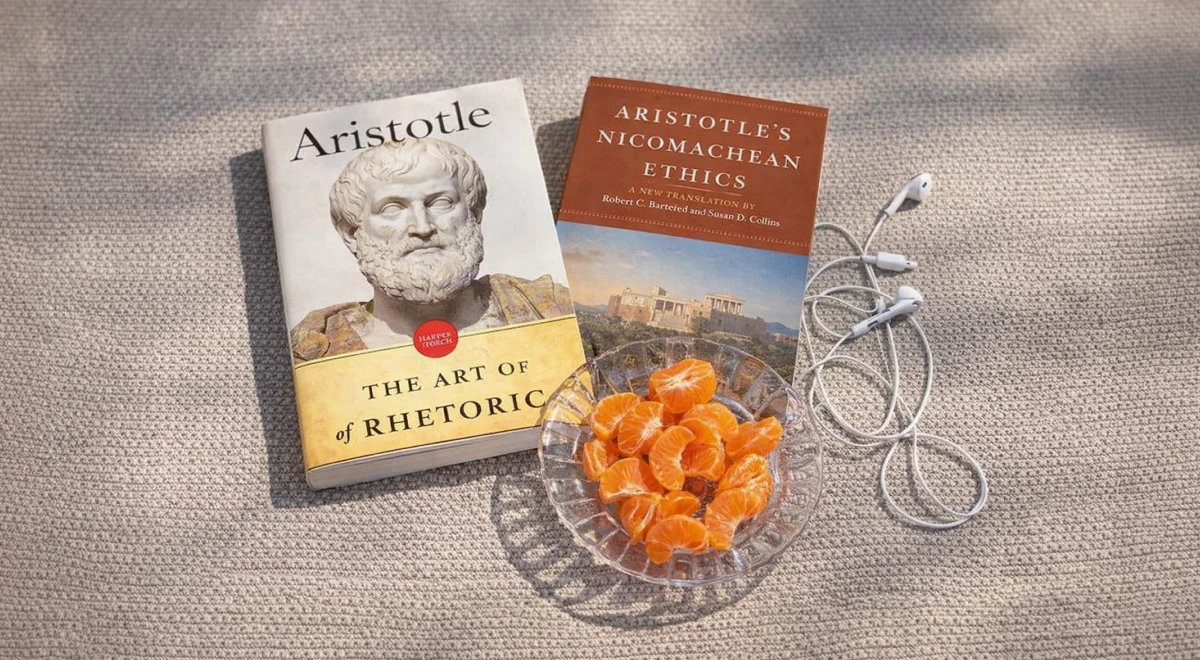
1. 'Aristotle's Nicomachean Ethics'
The most famous of all his writings is 'Nicomachean Ethics.' Aristotle argues that the goal of life is "eudaimonia," often translated as flourishing or happiness. He identifies that human fulfillment comes from living in accordance with reason and developing virtue ethics. This isn't a one-time achievement. It's a lifelong commitment to excellence. He explains that every action we take should aim at some good, and finding the highest good is the purpose of philosophy.
He believes that virtue is a habit. You don't become brave by thinking about courage; you become brave by doing brave things. This focus on action makes his philosophy very practical for self-improvement. By finding the "Golden Mean" between extremes — like courage sitting between cowardice and recklessness, you can handle tough situations with more balance and clarity. This book is a guide for anyone looking to build a character that's resilient, balanced, and genuinely happy.
2. 'The Art of Rhetoric'
In 'The Art of Rhetoric,' Aristotle provides a manual on how to persuade others and speak effectively. He breaks down persuasion into three categories: ethos (credibility), pathos (emotion), and logos (logic). This framework is the bedrock of modern communication, from political speeches to corporate negotiations. He emphasizes that the speaker must understand the audience's mindset to change their perspective or move them to action.
Aristotle teaches that being right isn't enough; you must also be persuasive. He explores how to tap into the audience's emotions and how to structure arguments that feel inevitable. By mastering these treatises, you learn to move people not just with facts, but with a deep understanding of human psychology and social dynamics. This book is a strong pick for leaders, managers, and anyone who needs to influence others in their daily life or professional career.
3. 'Aristotle's Poetics'
'Poetics' is the earliest surviving work of dramatic theory and literary criticism. Aristotle uses this text to analyze the nature of "mimesis" or imitation, specifically in tragedy and epic poetry. He breaks down the essential elements of a good story, including plot, character, and thought. By studying the structure of successful plays in Athens, he discovered rules for storytelling that screenwriters and novelists still use today.
He also introduces the famous concept of "catharsis," which refers to the emotional purging an audience feels when watching a tragedy. Aristotle argues that art isn't just for entertainment; it helps humans process complex emotions like pity and fear. That makes 'Poetics' a must-read for anyone interested in the psychological power of storytelling. Understanding these ancient Greek principles helps you see how stories shape our beliefs and why some characters stay with us for a lifetime.
📘 Master persuasive storytelling with Headway.
Understanding reality through Aristotelian logic and metaphysics
4. 'Organon'
Aristotle wasn't just a philosopher of ethics. He was a systematic thinker who wanted to categorize everything. His works on logic are grouped together as the 'Organon,' meaning instrument. These books, including 'Prior Analytics,' 'Posterior Analytics,' and 'On Sophistical Refutations,' teach you how to build a solid argument and identify logical fallacies in others. They provide the rules for syllogisms, which are the basic building blocks of deductive reasoning used in science and law today.
The 'Organon' also includes 'Categories' and 'On Interpretation,' which examine how we use language to define reality. By mastering these works, you gain a mental toolkit that prevents you from being manipulated by poor arguments. It's the original manual for critical thinking, helping you separate truth from faulty reasoning. These tools help you think more clearly and make decisions based on evidence rather than opinion or emotion.
5. 'Metaphysics'
In the 14 books of 'Metaphysics,' Aristotle asks the biggest questions possible: What is existence? What does it mean for something to be real? He moves beyond the physical world to look at "first principles" and the primary causes of all things. He explores the relationship between "substance," "matter," and "form," trying to understand what makes an object the specific thing it is. This text is where he challenges the ideas of his teacher, Plato, regarding the world of forms.



This masterpiece is where Aristotle defines the "unmoved mover," a concept that influenced religious and philosophical thought for thousands of years. It's often considered his most difficult work because it deals with the most abstract concepts of human thought. For a modern reader, 'Metaphysics' is a workout for the brain that helps you question your assumptions about reality. It encourages you to look for the meaning behind the surface level of everyday life.
6. 'On the Soul' ('De Anima')
'On the Soul' is an investigation into the nature of living things and consciousness. Aristotle moves beyond the physical body to explore what makes us alive. He discusses the different levels of the soul — nutritive, sensitive, and rational — and how they interact with our senses and intellect. He explains that the soul is the "form" of the body, meaning it is the actualization of a living being's potential to exist and act in the world.
This work is foundational for psychology. Aristotle examines how we perceive the world, how memory works, and even the nature of sleep in works like 'On Dreams.' The book bridges biology and philosophy, asking what it truly means to be a human being with a rational mind. By reading this, you gain a better understanding of your own mental processes and the relationship between your physical health and your cognitive abilities.
📘 Sharpen critical thinking with Headway.
Exploring the natural world: Aristotle's scientific treatises
7. 'History of Animals'
Aristotle's work in biology was revolutionary for its time. In 'History of Animals,' he used meticulous observation to categorize more than 500 species based on their habitats and behaviors. He was one of the first thinkers to use a hands-on approach to study nature, taking detailed notes on everything from insects to marine life. He believed that to understand life, you had to look at the diversity of living creatures and find patterns in how they survived.
This book shows a mind driven by order and purpose. While some of Aristotle's conclusions have been updated by modern science, his peripatetic method of gathering data and seeking "the why" remains a standard. He was interested in how animals lived and interacted with their environments. His work laid the groundwork for the classification systems that scientists like Linnaeus would perfect centuries later, proving that the Greek philosopher was also the world's first great biologist.
8. 'Generation of Animals'
Following his general history, 'Generation of Animals' dives deeper into the biological reproduction and development of living things. Aristotle wanted to know how life begins and how traits are passed down through generations. He applied his theory of "hylomorphism" — the union of matter and form — to explain how an embryo develops into a fully formed creature. This book is a primary example of his belief that "nature does nothing in vain."
He explains that the process of reproduction has a specific purpose that helps the creature fulfill its nature. This functional approach to biology was centuries ahead of its time. It teaches the reader to look for the "intent" in natural design. By reading this treatise, along with 'Parts of Animals,' you learn how Aristotle applied his logical principles to the physical world, creating a bridge between abstract thought and concrete observation.
9. 'Meteorology'
Aristotle's curiosity didn't stop at the water's edge. In 'Meteorology,' he examined weather patterns, earthquakes, and the oceans. He tried to explain phenomena like rainbows, thunder, and the movement of the tides using logic and observation. He categorized different types of wind and analyzed how water cycles through the atmosphere, demonstrating a deep interest in the physical laws that govern our daily lives on Earth.
This treatise shows his desire for a "complete works" understanding of reality. He believed that the universe was a rational place that could be understood through observation rather than myth. Even when his physics were eventually replaced, his drive to find natural causes for physical phenomena changed the course of human history. He essentially created the framework for physical science by insisting that we look for natural explanations for the things we see in the sky and the sea.
10. 'On the Heavens'
In 'On the Heavens,' Aristotle looked upward to the stars, attempting to explain the structure of the universe. He explored the nature of celestial bodies and argued that the heavens were made of a fifth element, distinct from earth, air, fire, and water. He discussed the shape of the Earth and the movement of the planets, trying to create a unified theory of how the entire cosmos functioned together.
His work here, along with 'On Generation and Corruption,' demonstrates his ambitious goal to explain the birth and death of all things. He believed that the movement of the stars followed perfect circular patterns, a belief that lasted until the time of Copernicus and through the Middle Ages. For the modern reader, this book is a fascinating look at how the ancient Greek world tried to make sense of the vastness of space.
📘 Explore cosmic thinking with Headway.
How to start reading books by Aristotle
Starting with the 'Complete Works of Aristotle' can be intimidating. The dense lecture notes and ancient Greek context often lead to "reading fatigue," where you buy the book but never finish the first chapter. Here's where most people get stuck — they have the best books on their shelf, but zero knowledge in their head.
Start small: Pick one chapter of 'Nicomachean Ethics' rather than reading the whole volume.
Focus on themes: Don't try to read both Aristotle's biological and logical works at the same time.
Use summaries or audiobooks: If you find the text too dense, start with a breakdown of the key ideas. Audiobooks or quick summaries help build your mental map before diving into the original text.

📘 Build reading discipline with Headway.
A Legacy of wisdom: Comparing the masters
Books written by Aristotle are remarkable — but what about the great works of other influential philosophers?
To expand your Aristotle books list and understand classical philosophy, it helps to see how Aristotle compares to his teacher, Plato, and other towering figures like Socrates and Seneca. While they all sought truth, their methods and focuses were vastly different.
| Philosopher | Key institution | Primary focus | Masterpiece / Essential work |
|---|
Socrates | Marketplaces of Athens | Questioning and Ethics | No written works (found in Plato's dialogues) |
Plato | Plato's Academy | Ideal Forms and Politics | 'The Republic' |
Aristotle | The Lyceum | Logic, Science, and Virtue | 'Nicomachean Ethics' |
Seneca | Roman Empire | Stoicism and Time | 'On the Shortness of Life' |
Explore ancient wisdom through quick summaries
If you find yourself drawn to the ideas in 'Aristotelian' thought, you might enjoy other pillars of ancient wisdom. Philosophy isn't just about Greek thinkers; it's a global tradition of seeking a balanced life. Headway's library includes several other definitive texts that complement Aristotle's focus on virtue and strategy.
'Meditations' by Marcus Aurelius: The personal journal of a Roman Emperor turned into one of the best introductions to Stoic thinking. It covers resilience, self-discipline, and finding calm when things get messy. Like Aristotle, Marcus Aurelius believed that our character is our destiny and that we must work daily to stay virtuous.
'Tao Te Ching' by Lao Tzu: This ancient text offers foundational Eastern philosophy on living a balanced and harmonious life. It focuses on the "Way" (Tao) and how to move with the flow of nature rather than fighting against it. It's a beautiful counterpart to Aristotle's more structured, logical approach.
'The Art of War' by Sun Tzu: A classic on military strategy that goes well beyond the battlefield, covering leadership, tactics, and conflict resolution. While Aristotle teaches you how to argue fairly, Sun Tzu teaches you how to win without always having to fight.
'On the Shortness of Life' by Seneca: A powerful Stoic treatise that warns against wasting time on things that don't matter. Seneca argues that life is long enough if we know how to use it. It's a perfect read for anyone struggling with modern distractions and looking to prioritize what truly brings fulfillment.
Stop scrolling and start growing with Headway
Mastering ancient philosophy takes time that many of us do not have. If understanding Aristotle were as easy as reading a "Books on Aristotle" list, you'd already be a master of logic. The reality is that the friction of old translations and complex treatises stops 90% of readers before they gain any value.
The Headway app removes that friction. Instead of struggling through 'Aristoteles' in the original Greek, you can get the 15-minute essentials of the world's best self-development and psychology books. Headway doesn't just give you information; it provides a system.
Personalized growth plans: Get a roadmap that connects ancient wisdom with modern psychological practices.
Spaced repetition: Use flashcards to move ideas like the "Golden Mean" from the page into your long-term memory.
Daily streaks: Build the very habits Aristotle preached by committing just a few minutes a day to your growth.
If you're waiting for a "better time" to start reading, it won't come. The only thing that changes behavior is a system that removes daily decisions — this is exactly what the Headway subscription does.
📘 Turn knowledge into growth with Headway.
Frequently asked questions on the best Aristotle books
How many books did Aristotle write?
Aristotle is believed to have written over 200 treatises, though only about 31 survive today. These cover everything from 'Poetics' to 'History of Animals.' Historians think these survivors were mostly his lecture notes used for teaching at the Lyceum in Athens, rather than polished books for the general public.
What if I want more books like Aristotle and Dante?
If you're looking for the popular YA novel 'Aristotle and Dante Discover the Secrets of the Universe' by Benjamin Alire Sáenz, please note it is a work of fiction. While the characters use the names of famous philosophers, the story is actually a modern coming-of-age tale about friendship and identity, not a philosophy book.
What is Aristotle's most famous book called?
Aristotle's most famous book is called 'Nicomachean Ethics.' This essential text explores how humans can achieve true happiness through the development of good habits and moral character. It's widely considered the foundation of Western ethics because it focuses on practical ways to live a balanced and fulfilling life every day.
What are the 14 books of Aristotle?
The "14 books" refers to the 'Metaphysics,' a collection of writings that look at the very nature of existence. These books examine the "first principles" of reality, including substance, cause, and the divine. It's considered one of Aristotle's most challenging and richest works for any serious philosophy student.
What is Aristotle most famous for?
Aristotle is best known for developing the system of formal logic and the concept of virtue ethics. He was the first person to develop a structured way of reasoning that influenced science, law, and politics for over 2,000 years. He also tutored Alexander the Great and founded the Lyceum.
What is Aristotle's masterpiece?
Many scholars believe 'Nicomachean Ethics' is Aristotle's masterpiece because it offers a timeless guide on how to live well. Others argue that his work on logic, the 'Organon,' is his greatest achievement because it provided the "tools" for all human knowledge. Both works display his incredible ability to organize information.
How did Aristotle view old age and the final stage of human life?
In his biological and ethical works, Aristotle often discussed the stages of human life, including old age. He viewed it as a natural decline in the body's heat and vitality, but his ethical works emphasize that a life spent building virtue prepares one for a dignified and meaningful end.
Where can I find a list of Aristotle books?
You can find his works on Amazon or in most local libraries. For the most scholarly version, look for the 'Revised Oxford Translation' edited by Jonathan Barnes. If you want a simpler start, check out the 'Basic Works of Aristotle' or high-quality summaries on growth platforms like Headway.
What books did Aristotle write that are now considered world classics?
Aristotle's most celebrated classics include 'Nicomachean Ethics' (on virtue and happiness), 'Politics' (on government and society), 'Poetics' (on drama and literature), 'Metaphysics' (on existence and reality), 'Physics' (on nature and motion), 'Rhetoric' (on persuasion), and 'De Anima' ('On the Soul').
Which books about Aristotle are worth reading for admirers of his works?
The best books on Aristotle include Edith Hall's 'Aristotle's Way' (which applies his ethics to modern life) and Jonathan Lear's 'Aristotle: The Desire to Understand' (a philosophical introduction to his thinking). For deeper study, try 'The Cambridge Companion to Aristotle' edited by Jonathan Barnes, Sarah Broadie's 'Ethics with Aristotle,' or Barnes's 'Aristotle' for historical context and rigorous analysis of his philosophical contributions.