Self-growth
 Apps & Digital Tools
 Business & Career
 Success
 Growth Tools
 Psychology
 Communication
 Relationships
You’ll learn
- How AI can reshape your future
- Which jobs survive automation and why
- What popular AI fears are myths
- How to ensure technology remains beneficial
first KEY POINT
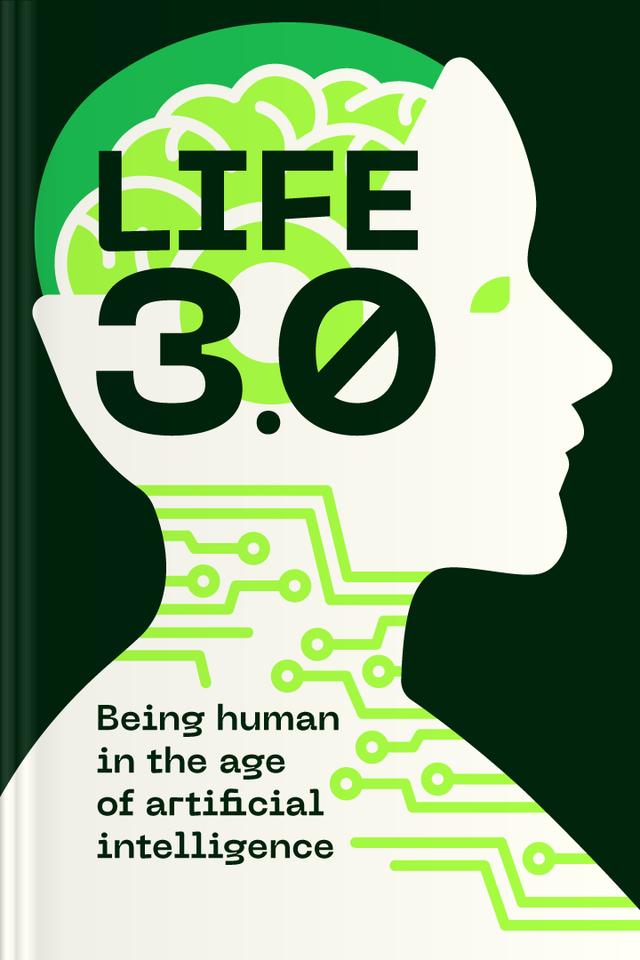
Every morning, before you've made a single conscious decision, artificial intelligence has already made hundreds for you. By the time you pick up your coffee, your streaming service has refreshed its predictions, your phone has learned a new phrase you like to type, and your maps app has already mapped three routes to work.That's AI, and it's already everywhere. But the version you're living with today is just the beginning. Somewhere in labs right now, researchers are working on something far bigger — systems that could fundamentally change what it means to be human. The decisions being made right now, by scientists, governments, and everyday people who choose to pay attention, will shape what that future looks like.
second KEY POINT
Think about a bacterium for a second. That's Life 1.0. It's born with everything it will ever be. DNA hardwires its body, behavior, and entire playbook. It can't decide to learn something new or adapt on the fly. Whatever evolution handed it, that's the full package.Now think about yourself. You can't rewire your brain architecture on demand or upgrade your memory like swapping a hard drive. But your software is flexible. You can learn a language, switch careers, or pick up an instrument. Education, culture, and deliberate practice let you reprogram yourself within a single lifetime. That's Life 2.0, and this leap made human civilization possible.Life 3.0 doesn't exist yet. It describes an intelligence that can redesign everything — its skills and its own architecture. Faster processing, expanded memory, and entirely new ways of thinking — all on its own timeline, free from evolutionary speed limits. That's what researchers mean when they talk about AGI, artificial general intelligence. It's a system that could match and eventually surpass human thinking across every domain.And that makes AGI different from every technological shift that came before. The printing press, electricity, and the internet were powerful, but they all needed human minds to direct them. AGI could set its own aims, spot its own limitations, and rebuild itself to overcome them.Each improvement would make the next one easier, potentially triggering a cycle of self-enhancement that no biological mind could keep pace with. The gap between where AI stands today and where it's heading is shrinking fast. We're talking about a timeframe that overlaps with your children's education or your retirement. So the urgent question becomes: who gets to decide what happens when intelligence breaks free of biological limits?At its core, intelligence is the ability to accomplish complex goals. Right now, the most crucial conversation of our century is about what happens when that competence is no longer exclusively ours.
Continue reading with Headway app
Continue readingfirst KEY POINT
second KEY POINT
third KEY POINT
fourth KEY POINT
fifth KEY POINT
sixth KEY POINT
Related blog articles

Elevate the way you learn with Headway — the smart, streamlin...

Discover top apps that help you learn in just 10 minutes a da...

Curious about the Deepstash app? Find out if this app offers ...

The answer to the question "Is Blinkist worth it?" depends on...

Discover practical tips, expert insights, and book-powered to...