Self-growth
 Apps & Digital Tools
 Business & Career
 Success
 Growth Tools
 Psychology
 Communication
 Relationships

Quick answer: Do book summaries actually help you learn?
Let's be honest about the stack of half-read books sitting on your nightstand. You bought them with the best intentions, but life got busy. Now, they just collect dust while you feel a nagging sense of guilt. You probably wonder if reading a quick summary is a lazy shortcut or a smart way to learn.
The short answer is yes — book summaries really do work, but only if you use them correctly. They are not a way to cheat the system, but rather a tool to help your brain filter and keep the ideas that matter. Let's look at why your brain actually prefers this method.
📘 Want to stop letting good books pile up unread? Try Headway and turn just 15 minutes a day into a real growth habit — explore the app today.
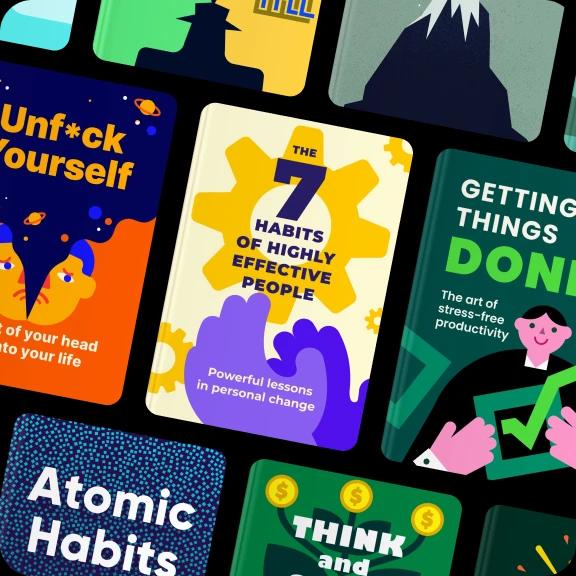
Go deeper into the ideas that fascinate you.
Explore thousands of book insights across any topic. A library built for lifelong learners.
Start exploringThe cognitive science behind condensed reading
Our brains were never designed to memorize hundreds of pages of background stories and filler text. In fact, cognitive research shows that we naturally forget most of what we consume almost immediately. To understand why condensed texts work, we have to look at how memory and attention function together.
Overcoming the forgetting curve: Why most of what you read disappears in days
In the late nineteenth century, psychologist Hermann Ebbinghaus discovered what we now call the forgetting curve. He proved that humans lose up to 80% of new information within just a few days if they do not actively review it. Book summaries combat this by stripping away the fluff and focusing on core concepts. By reviewing these main points at set intervals, you can easily move them into your long-term memory.
Managing your cognitive load: How summaries keep your brain fresh and focused
Cognitive load theory explains that our working memory has a very strict limit on how much it can process at once. When you read a 400-page book, your brain spends energy processing jokes, anecdotes, and repetitive descriptions. A great summary bypasses this fatigue by delivering only the core ideas. This keeps your mind fresh and ready to apply what you read. Instead of feeling overwhelmed, you walk away with clear, actionable steps.

The benefits of microlearning: Build a reading habit in 15 minutes a day
Our daily attention spans are shorter than ever, making long reading sessions difficult to maintain. Microlearning — studying in short bursts of 3 to 15 minutes — fits perfectly into this modern reality. It helps you build a daily reading habit without needing to clear your schedule. It is an easy way to improve your time management without stress. You can easily absorb a key concept while waiting for your coffee or riding the subway.
➡️ What is the Headway App and How Does it Work
How to use book summaries without losing the nuance
A common worry is that short summaries make you lose the deeper meaning of an author's work. While summaries are short, they are highly effective if you treat them as part of a larger learning system. You can protect the nuance by using a simple three-step approach to reading.
Filter your choices: Use a quick summary to test-drive a book before you decide to buy the full copy.
Learn the map: Read the summary first, so your brain already understands the main arguments before you read the full text.
Recall the lessons: Revisit the summary of a book you already read years ago to quickly refresh your memory.



Five habits to turn book summaries into real-life progress
Reading a summary can make you feel smart in the moment, but real growth requires action. To avoid the trap of just collecting facts, you need to turn your reading into active practice. Here are five simple habits that will help you turn what you read into real-world change.
Choose one takeaway: Never try to apply an entire book at once; just pick one small action and do it today.
Practice active recall: Close the app and spend two minutes explaining the main idea to yourself in your own words.
Write down your thoughts: Take brief notes or highlight key quotes to help cement the ideas in your mind.
Set daily reading goals: Spend just 15 minutes every morning learning something new to build consistent momentum.
Share what you learn: Discuss your new insights with a friend or colleague to deepen your own understanding.
📘 Ready to turn reading into real progress? Download Headway and apply one new lesson every day.
Book summaries vs. full books: Which wins?
Many people think you have to choose between reading summaries and reading full-length books. In reality, these two formats are not enemies — they actually work best when you use them together. Understanding when to use each tool is the secret to building good habits around self-growth. In his book 'Atomic Habits,' James Clear explains how small changes build up. You can use both formats to build your routine.
Use summaries for exploration: Read summaries when you want to quickly scan a wide range of topics, like leadership, finance, and wellness.
Use full books for depth: Buy the full book when a summary introduces an idea that completely changes how you look at your career or life.
Use summaries for maintenance: Keep a library of summaries to review books you have already read so you never forget their lessons.
How Headway stacks up against other learning apps: Find your perfect match
We have reviewed some of the most popular reading and audio platforms to show you how they compare. Take a look at our detailed guides to find your perfect match.
Blinkist versus Headway: Read our honest comparison of Headway vs Blinkist to see which app offers better features for your growth.
Evaluating Blinkist's value: Figure out if the subscription is right for you in our deep dive on whether Blinkist is worth it before signing up.
Audible's worth for audiobooks: Learn if a monthly audiobook credit fits your schedule in our honest assessment of whether Audible is worth it for daily listening.
Imprint's visual approach: Explore how visual learning stacks up against traditional summaries in our detailed Imprint app review for visual learners.
Shortform's detailed guides: Check out how deep-dive guides compare to snappy overviews in our comprehensive Shortform review to make your choice.
📘 With Headway, you can easily fit self-development into your busy routine. Download the app today to explore our growth plans and choose what works best for your goals.
Ready to read smarter, not longer? Start your growth journey with Headway
If you want to start growing every day but do not know where to begin, the Headway app is here to help. It simplifies personal growth by turning the world's best titles into structured summaries. You can listen to audio versions during your morning commute, read key highlights, and track your progress over time.
Features like highlights make sure that the things you learn actually stay in your mind. By taking just a few minutes each day, you can slowly replace your scrolling habit with real progress. It is a simple, stress-free way to invest in your future self without feeling overwhelmed. You can join millions of other readers who are already changing their lives one bite-sized lesson at a time.
📘 Get your personalized reading plan and take the first step towards a better you today.
Frequently asked questions on why book summaries work
Are book summaries effective?
Yes, summaries are highly effective if you use them to actively learn or preview a topic. Research shows that focusing on core concepts helps you retain main points without getting overwhelmed. They work best when you immediately apply the ideas to your daily routine instead of just skimming.
Do book summaries count as reading?
Absolutely. Reading is about absorbing new perspectives, and book summaries deliver those ideas directly to you. While you miss the narrative style of a full book, you still get the core educational value. Plus, you can read the whole book later if you want to delve deeper.
Can you actually learn a subject just by reading summaries?
You can gain a great foundational understanding of a topic by reading summaries. However, if you want to become a true expert in a highly technical field, you will eventually want to study deeper texts. Summaries are perfect for broad knowledge, while full books provide narrow, specialized depth.
How does the brain retain information from condensed texts?
The brain retains condensed information best when you pair your reading with active recall and spaced repetition. Revisiting key points a few times over a couple of weeks signals your brain that the information is useful. This simple process prevents the natural memory decay that happens after reading any book.
What is the 5 finger rule for books?
This is a simple test to find out if a book matches your current reading level. Open the book to any random page and read a few paragraphs. Raise one finger for every word you do not recognize or cannot easily understand.
One finger or none: The book is very easy to read and will be a quick breeze.
Two or three fingers: This is the sweet spot for learning new vocabulary without getting frustrated.
Four fingers: The text is challenging and will require extra focus and slow reading.
Five fingers: The book is likely too difficult for now, so you should choose an easier one.
How do I decide whether to read full books or summaries?
You should base your choice on your current goals, your time, and your familiarity with the subject. If you want a quick introduction to a new field, a summary is perfect. Use summaries to scan multiple ideas and find what sparks your curiosity.
Save full-length books for topics that directly impact your career or life. If a summary introduces a concept that changes your perspective, buy the full book. This way, you will save money and focus your energy on high-value reading.