Self-growth
 Business & Career
 Success
 Communication
 Healing
 Relationships
 Psychology
 Happiness
Did you know that, according to a Forbes article, in most companies, just 5% of the workforce is responsible for about 26% of the total output?
That's a massive gap. It raises the question: why does the average employee struggle to keep up while others seem to coast at a higher level? It isn't just about working more hours; it's about how high performers approach their day. They aren't just "busy," they're effective, and that's a huge distinction.
The best top talent isn't born; they're built through constant, bite-sized learning. Our app turns the world's most powerful career books into 15-minute summaries, making it easy to sharpen your skillset between meetings. It's the ultimate shortcut for anyone looking to step into leadership roles without burning out.
📘 Download the Headway app here and start your journey to peak performance!
Quick answer: What is a high performer?
A high performer is someone who consistently delivers top-tier results while maintaining a high work ethic and a positive attitude. They don't just "do their job" — they focus on optimization and how they can contribute to overall team success. Unlike people who just check boxes, high-performing employees are driven by impact and reliability.
Key elements of high performance:
Consistency: They deliver quality work every time, not just in short bursts.
Growth mindset: They view challenges as opportunities for professional development.
Proactivity: They anticipate problems and find solutions before being asked.
Adaptability: They stay calm and pivot when the work environment changes suddenly.
Why high performers matter in 2026
It's easy to think that top performers are just overachievers who make everyone else look bad, but the reality is they're the engine of any high-performance culture. When you have high-potential employees in the mix, they don't just hit their own key performance indicators — they actually raise the bar for everyone else.
In a tough work environment, these are the people who stay cool. Their retention is vital because losing one is like losing three or four average employees at once. They drive innovation and make problem-solving look easy, which directly affects the bottom line.
Beyond the company, being an achiever is about your own career development. It's the difference between feeling stuck in a dead-end role and actually having the leverage to choose your own path and reach a higher level of influence.
Core traits of high performers
If you look at top talent across different industries, from tech to teaching, you'll notice they usually share a few specific "non-negotiables." It's not about magic; it's about a specific skillset.
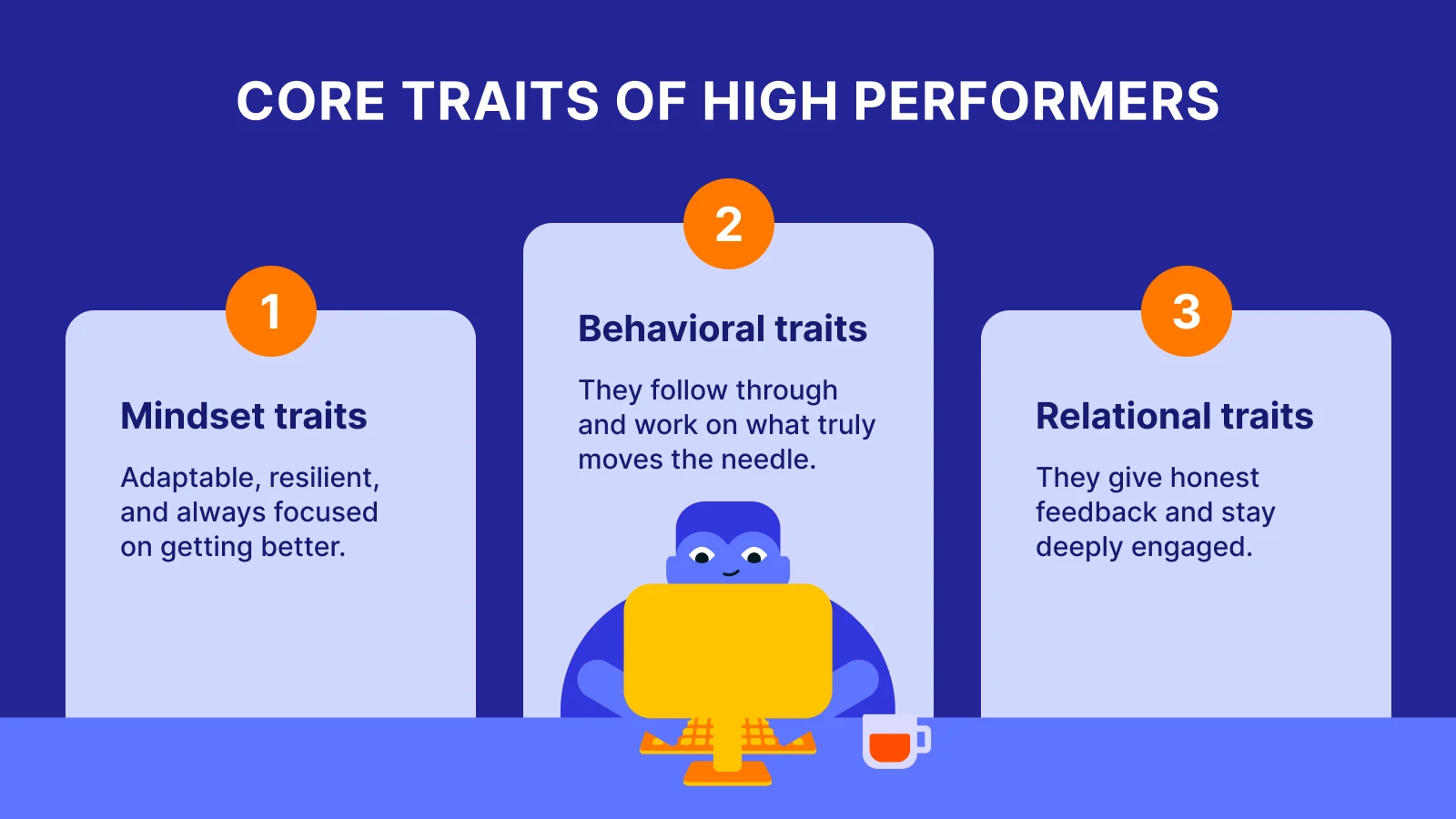
1) Mindset traits
Adaptability and grit: They don't freak out when a project pivots. They have the adaptability to handle a messy work environment and the resilience to keep going when things get hard.
The growth habit: They genuinely believe they can get better. Instead of hiding from constructive criticism, they crave it because they know it's the only way to sharpen their professional development.
2) Behavioral traits
Extreme follow-through: If they say they'll do it, it's done. You don't need to be micromanaging them because their work ethic is their own supervisor. They follow through on every tiny detail.
Strategic thinking: They don't just work hard; they work smart. They review the metrics and identify which tasks actually move the needle for team success.
3) Relational traits
Radical candor: They give and take constructive feedback without making it weird or personal.
High engagement: They aren't just physically present. Their employee engagement is high because they care about the "why" behind the work, which keeps the rest of the team members motivated too.
📘 Ready to stand out at work? Try Headway and master the strategic thinking that top performers use every day.
High performers vs average and low performers
Most people are just trying to get through the day. There's a massive difference between meeting the bare minimum and actually moving the needle. It usually shows up during performance reviews. While an average employee might wait for a webinar to be assigned to them, high performers are out there finding their own learning opportunities.
| Feature | High performers | Average and low performers |
|---|
Approach to tasks | Focuses on strategic thinking and impact | Just checks off the to-do list |
Response to feedback | Uses constructive feedback as fuel | Gets defensive or takes it personally |
Initiative | Proactive; looks for problem-solving gaps | Waits for instructions or micromanagement |
Attitude | Keeps a positive attitude even when stressed | Often complains or lacks employee engagement |


High-performance habits and daily systems
You don't just wake up and decide to be a "high performer." It's about the boring stuff you do when no one is watching. High-performing employees aren't just doing hard work; they have a system that makes it look easy.
Managing energy, not just time: They know that staring at a screen for ten hours is a fast track to burnout. They schedule "rest" as a high-priority task, so their personal life doesn't suffer, and they can stay sharp.
Tight feedback loops: They don't wait for annual performance management meetings. They check their own metrics and key performance indicators weekly. If they aren't hitting the mark, they pivot fast.
The 15-minute learning ritual: Most top talent has a massive LinkedIn following, but they aren't just scrolling. They're reading. Instead of trying to finish a 400-page book every week, they use Headway to get a quick optimization boost in the morning. They might take a lesson on adaptability from a leadership bestseller and apply it to their team meeting that same afternoon.
Focus over busyness: They kill the noise. No micromanaging of their own time. Just deep, uninterrupted blocks of work. They know that team success depends on them doing the high-value stuff, not just clearing their inbox.
Popular misconceptions about high performers
There's a lot of nonsense floating around on LinkedIn about what it takes to be at the top. Let's get one thing straight: being an achiever isn't about being a machine.
Myth: They just work longer hours. Actually, high-performing employees usually work smarter, not longer. They focus on follow-through and strategic thinking rather than just performing "theater" at their desks for 12 hours.
Myth: You're either born with it, or you aren't. Not true. High performance is a skillset you build. It's about your work ethic and your willingness to keep learning, not some magical DNA strand.
Myth: They have zero personal life. The best top performers fiercely protect their personal lives. They know that if they don't rest, they hit burnout, and their employee performance drops significantly. Sustainable success requires a life outside of the office.
📘 Don't wait for your next review to level up. Get Headway and take charge of your professional development now.
How to become a high performer: Quick guide
You don't need a promotion to start acting like a high performer. You can start right where you are. It's about moving from being an average employee to someone who consistently hits a higher level.
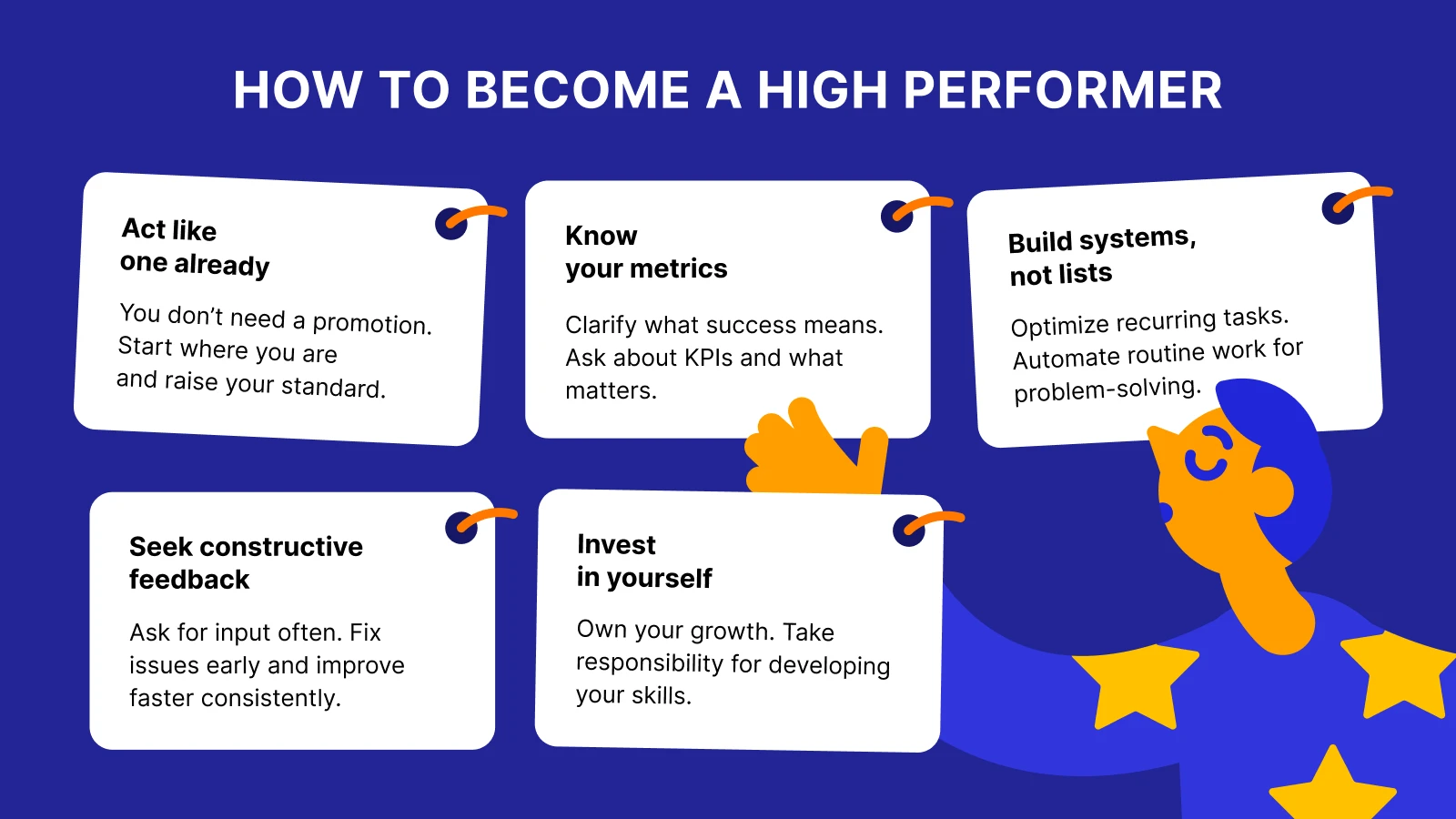
Get clear on your metrics. You can't win the game if you don't know the score. Ask your manager about your key performance indicators and what actually matters for team success.
Build a system, not just a to-do list. Focus on optimization. How can you do your recurring tasks faster? How can you automate the boring stuff so you have more time for problem-solving?
Crave constructive criticism. Stop avoiding performance reviews. Ask your team members for constructive feedback often. It's better to hear it now and fix it than to find out a year later that you've been off track.
Invest in your career development. Don't wait for the company to buy you a webinar. Take charge of your own professional development.
Master adaptability. The work environment will always be a bit chaotic. The people who get into leadership roles are the ones who can pivot without losing their positive attitude.
High performance requires high learning — Try Headway!
Becoming one of those high-potential employees doesn't happen by accident. It takes a commitment to learning things that most people are too lazy to look into. But you don't need to spend your entire weekend reading dry textbooks to get ahead.
Headway is a constant helper here: our app has summaries of legendary books on topics like performance management, company culture, and self-growth, as well as career-oriented growth plans. You can master the concepts from 'Atomic Habits' or 'Grit' while you're commuting or making dinner.
If you want to raise your employee engagement and finally get the retention and respect you deserve in your career, you need a better system for your brain.
📘 Download the Headway app and start building the habits of a true high performer in just 15 minutes a day.
FAQs about what a high performer is
How do I tell if I'm a high performer?
You'll know because you aren't waiting for a boss to tell you what to do. High performers are usually the ones people call when a project is hitting the fan. If you're spotting holes in a plan before they cause a disaster, you're likely top-tier. It's about reliability and actually caring if the final result is good.
What are the 5 signs of a high performer?
First, you own your mistakes instead of making excuses. You also hunt for ways to make work smoother. You don't panic when things change fast. You hit every deadline with quality work. Finally, you're someone the team actually wants to work with. These signs prove you're focused on real impact, not just looking busy until five.
What are the 5 habits of high performers?
They block out deep work time and ignore emails. They ask for the feedback that actually hurts so that they can fix blind spots. They read every single day. They prioritize rest to avoid burnout. Lastly, they check their own metrics weekly to ensure their hard work is actually moving them toward a higher level of success.
What is the mindset of a high performer?
It's basically a mix of "I can figure this out" and zero excuses. High performers don't treat failure like a wall; they treat it like free data for the next try. They value improvement over perfection. This mindset turns a stressful work environment into a series of puzzles that just need a bit of strategic thinking today.