Self-growth
 Business & Career
 Success
 Communication
 Healing
 Relationships
 Psychology
 Happiness
Research highlights that minor daily successes significantly improve well-being and reduce stress. That concept is central to becoming 1% better every day, a philosophy championed by James Clear, author of 'Atomic Habits.'
Indeed, improving by a tiny bit each day leads to huge gains over a long period. These micro-improvements build up, creating powerful momentum for self-improvement and self-help.
For more microlearning lessons, self-growth, and self-growth tips from leading thinkers, download the Headway app. It offers easy-to-digest summaries that help you grasp powerful ideas quickly!

Quick guide to becoming 1% better every day
The fastest way to start making daily progress involves these insights from top books:
The "1% better" rule: Small changes create massive compound growth.
Building strong habits: Tiny habits gain momentum through consistency.
Mental well-being: Small wins reduce anxiety and stress.
Practical steps: Actionable tips from books such as 'Drive' and 'The One Thing' applied daily.
Real-world success: Getting results from continuous improvement.
📘 Start your 1% journey today and watch your life transform with Headway



What does "1% better every day" mean?
Becoming 1% better every day breaks down big goals into manageable steps. Huge, overwhelming changes aren't necessary. The goal is consistently making tiny improvements. Think of it as a journey. You don't run a marathon on day one; you take one more step compared to yesterday.
If you improve by 1% each day, you become 37 times better over a year. If you get 1% worse each day, you decline almost to zero.
Bestselling author James Clear highlights this simple math, showing the power of continuous improvement. Small changes compound over time, leading to significant results.
📘 Build unbreakable habits in just 15 minutes a day on Headway!
Why minor improvements beat big goals
Huge goals, such as "I want to get fit," feel too large to start. The 1% better every day approach focuses on systems over goals. Instead of the finish line, you focus on the daily routine.
Consistency is more important than intensity. Doing one push-up every day is more effective than trying 100 push-ups once a month.
Small changes build momentum and create progress without overwhelming you. And these small wins help you overcome procrastination.
📘 Stop waiting for motivation and start building systems with Headway!
The science behind tiny daily improvements
Your brain loves repetition. When you repeat an action, your brain creates a pathway, making that action easier over time. That's the science of habit formation. Aiming for 1% better every day uses this natural process.
Each small win releases dopamine, a feel-good chemical that makes you want to repeat the action. Small wins create a positive feedback loop that strengthens your good habits.
Neuroplasticity means consistent, tiny improvements rewire your brain for success. Small habits, such as reading one page or doing one extra task, build better habits over time.
📘Master the art of "Atomic Habits" and micro-gains on Headway!
How can self-improvement reduce anxiety?
Feeling overwhelmed or stressed makes big goals seem impossible. Each small win provides a sense of accomplishment, reducing stress and improving your mood.
Instead of worrying about a monumental task, break it down. If you need to clean your whole house, cleaning one small area for five minutes is a 1% improvement. Breaking down tasks reduces the stress response and builds confidence.
Overcoming procrastination also reduces anxiety. Once you know how to stop dopamine addiction and reduce scrolling addiction, you can start your self-growth journey and easily manage anxiety triggers.
📘 Create a daily routine that guarantees success with Headway!
Four practical tips to become a better version of yourself
Start your journey of becoming 1% better every day using these practical tips from bestselling self-help books.
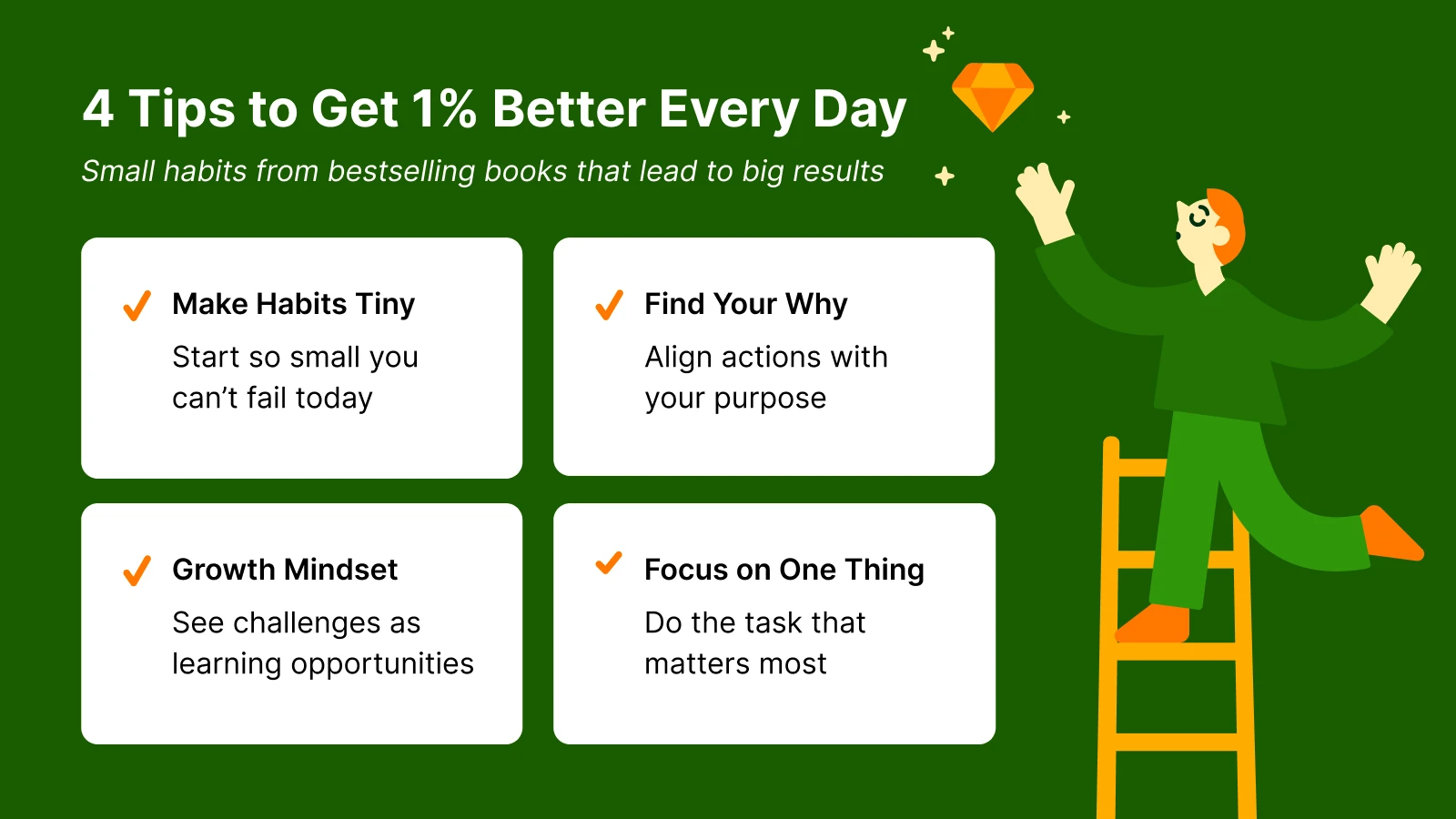
1. Make habits tiny and automatic
James Clear teaches the power of small changes. He explains how to build good habits and break bad habits.
Concept: Focus on identity-based habits. Instead of "I want to read a book," think "I am a reader." Start with minor, easy improvements.
Practice steps:
Habit stacking: Attach a new habit to an existing one. "After I pour my coffee, I will read one page."
Two-minute rule: Make new habits so small they take less than two minutes.
Environmental design: Make good habits easy to do and bad habits hard. Keep your workout clothes visible.
2. Align motivation with purpose
Daniel Pink, in 'Drive,' explores what motivates us beyond rewards. He highlights autonomy, mastery, and purpose as key drivers for continuous improvement.
Concept: When your daily actions align with your values, motivation comes naturally. Alignment helps you to achieve goals easily.
Practice steps:
Define your "why": Ask why a goal matters to you.
Seek mastery: Focus on improving a skill for its own sake.
Autonomy: Take ownership of your tasks and choose your approach.
3. Learn to love struggle and growth
Carol Dweck's 'Mindset' introduces the distinction between a fixed mindset and a growth mindset. A growth mindset sees challenges as opportunities to grow.
Concept: View failures or setbacks as chances to learn. A growth mindset helps you overcome procrastination.
Practice steps:
Embrace challenges: When faced with a difficult task, tell yourself, "This is a chance to learn."
Focus on effort: Praise effort and process, not just outcomes.
Feedback: See constructive criticism as helpful information.
4. Focus on one priority at a time
Gary Keller and Jay Papasan's 'The One Thing' argues for extreme focus. Identify the "one thing" that makes the most significant impact.
Concept: Focusing on one key task makes significant progress. Extreme focus allows you to optimize your efforts.
Practice steps:
Identify your "One Thing": Ask: "What's the ONE thing I can do such that by doing it, everything else will be easier?"
Block time: Dedicate a focused time each day to your one thing without social media distractions.
Say "no": Decline tasks that pull you away from your most important priority.
📘 Turn small steps into massive leaps forward with Headway!
Examples of 1% improvements in real life
This concept applies to any area:
Workplace productivity: Commit to spending 15 minutes each morning organizing your tasks. Over time, this tiny improvement leads to an organized workday. Stop wasting your evenings optimizing balance.
Fitness: Start with one extra push-up each day. These daily improvements lead to significant fitness gains.
Learning a language: Learn just one new word each day. This micro-habit makes the process sustainable.
Emotional health: Practice gratitude by listing three things you're thankful for each evening. Motivating yourself and others becomes easier with daily practice.
📘 Achieve your goals one tiny habit at a time on Headway!
Three common motivation myths and how to avoid them
"1% Sounds Too Small."
Many think 1% is too tiny to make a difference. That mindset ignores the power of compounding. The difference between good habits and bad habits comes down to these small margins. Sustainable, continuous improvement accumulates significantly.
"I already tried and got no results."
People often expect immediate outcomes. Improvements take time to show results. You might not see a big change after a week. Stick with it for six months. Patience and consistency are key. Daily routines and daily habits are essential.
"This is just hype."
Actually, it's a practical approach to self-improvement that leverages habit formation and compounding. It focuses on a system that works, rather than motivation alone.
📘 Shift from a fixed mindset to a growth mindset with Headway!
Start your journey to consistent growth with Headway
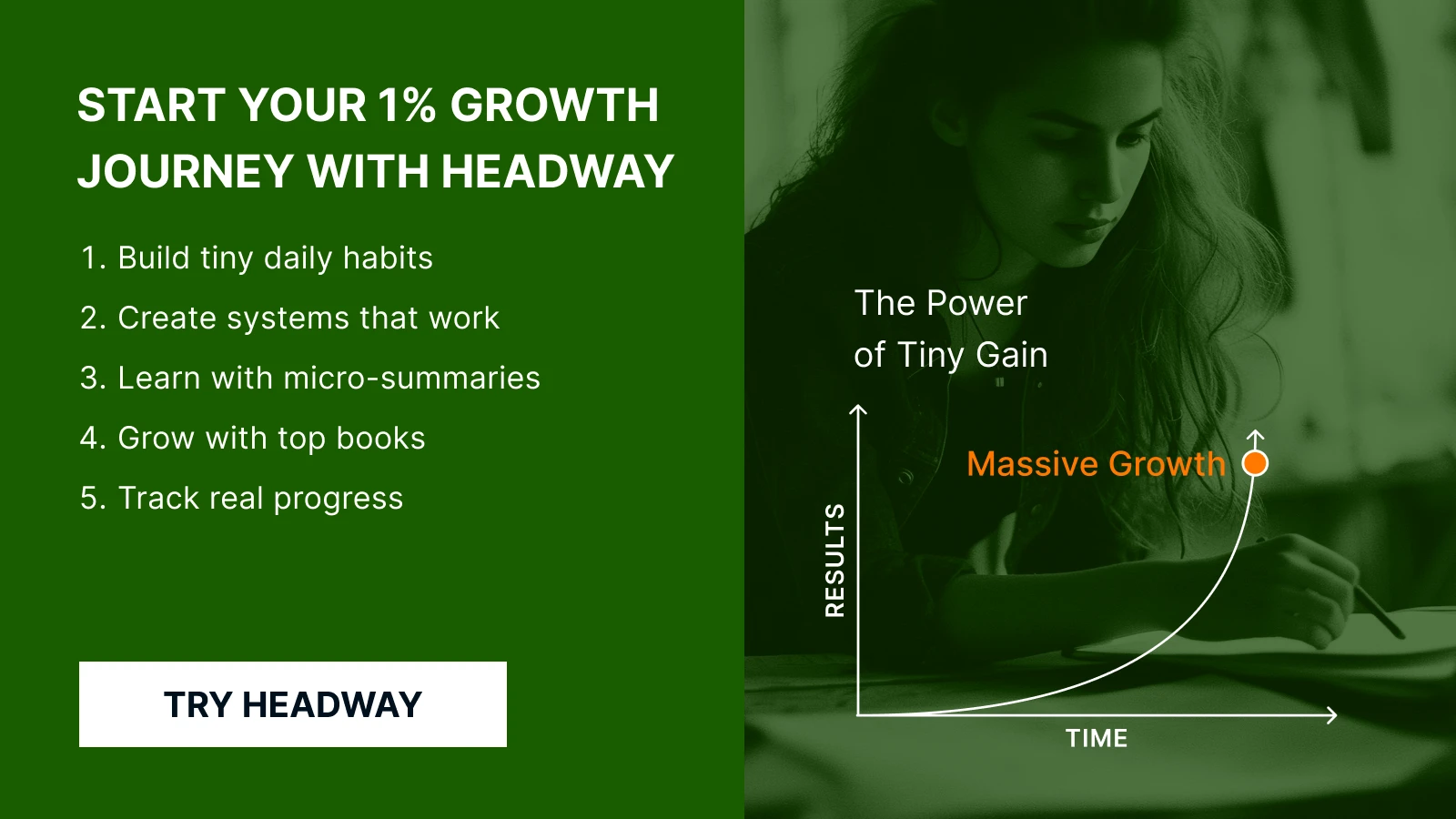
The path to becoming 1% better every day is a journey of continuous improvement. By focusing on tiny improvements and daily habits, you achieve transformations. True progress comes from the systems you maintain.
The Headway app supports you on this journey. Actionable summaries from bestselling self-help and self-improvement books provide microlearning lessons. It helps you solidify current habits and learn new strategies for growth.
Download the Headway app to improve your personal development and knowledge!
FAQs
What happens if I get 1% better every day?
If you improve by 1% every day, you become 37 times better by the end of the year. Small gains build on previous gains. And tiny improvements, when applied over a long period of time, lead to significant results beyond expectations.
What is the psychology behind self-improvement?
The psychology behind self-improvement involves habit formation, motivation, and mindset. Brains create pathways for repeated actions. Intrinsic motivation drives continuous improvement. A growth mindset, which holds that abilities can be developed, fuels a daily desire to learn and grow.
What is the science behind habit formation?
Habit formation relies on a neurological loop: cue, craving, response, and reward. A cue triggers a craving, which leads to a response, and a reward reinforces the loop. Understanding this helps build good habits and break bad habits by managing these four components.
How can I measure long-term progress?
Measuring long-term progress involves tracking daily improvements. Use a journal or an app to track habits. Focus on process goals rather than outcomes. This approach helps you see the impact of small changes over time as they compound into major achievements.
How do I stay motivated every day?
Link daily actions to a purpose, celebrate small wins, and create a supportive environment. Break down big tasks into manageable 1% improvements. Remind yourself of your goals and connect with others who share similar interests to maintain enthusiasm.
How can I do better every day at work?
Identify one small skill to practice, organize your workspace, or dedicate focused time to your most important task. Reduce distractions such as notifications. These daily improvements contribute to productivity, focus, and professional growth over time.