Self-growth
 Business & Career
 Success
 Communication
 Healing
 Relationships
 Psychology
 Happiness
So, you've finally decided to stop putting off learning a new language.
Maybe you're planning your dream trip to Rome and want to order your pasta in perfect Italian, or perhaps you're looking to learn Spanish to better connect with your colleagues or family. Whatever the reason, you've inevitably landed at the biggest crossroads in the world of language learning platforms: Rosetta Stone vs Duolingo.
On one side, you have the "old guard," a language program that's been around since the days of yellow boxes and CD-ROMs, promising total immersive learning. On the other, you have the green owl — a gamified learning powerhouse that has turned language acquisition into something that feels more like playing Candy Crush than studying.
Choosing the right app is about finding a method that actually sticks. If the tool doesn't match your learning style, you'll likely quit before mastering basic greetings. In this honest comparison, we'll see which app builds real conversational skills and which is just a fun way to kill time.
While you study, you can also use Headway to listen to 15-minute summaries on habit-building and focus, helping you stay consistent with your lessons.
Quick answer: Rosetta Stone vs Duolingo, which one to choose?
Rosetta Stone is best for immersive, deep learning, and pronunciation. Duolingo is best for daily practice, habit building, and budget‑friendly access.
If you are after a language learning journey that mirrors how you learned your native language, through pictures and intuition without English translations, Rosetta Stone is your best bet. But if you need a low-pressure, gamified way to stay consistent every day, Duolingo is the king of habit formation.
| Best for | Platform recommendation | Key reason |
|---|---|---|
Immersive learning | Rosetta Stone | No translations; focus on visual and audio intuition |
Daily habit building | Duolingo | Gamification and bite-sized lessons |
Budget friendly | Duolingo | Generous free version available |
Speech and accent | Rosetta Stone | Superior speech recognition technology (TruAccent) |
Language variety | Duolingo | Offers 40+ different languages |
Both apps are great starting points, but they aren't a guarantee for total fluency. Growing as a language learner means supplementing your apps with external knowledge and a growth mindset.
While Headway doesn't teach you the verbs, our summaries of the world's best nonfiction books help you build the mental discipline and learning habits needed to stay consistent with your language learning app, so you won't quit when the grammar gets tough.
Rosetta Stone vs Duolingo comparison (core comparison table)
| Feature | Rosetta Stone | Duolingo |
|---|---|---|
Teaching method | Immersive approach (no translation) | Translation-based, gamified, and interactive |
Pricing | Paid subscription or lifetime access | Free (ad-supported) or Super Duolingo |
Languages offered | ~25 popular language options | 40+ (including Swedish, Farsi, Arabic) |
Lesson length | 10–30 minutes per core lesson | 5–10 minute bite-sized chunks |
Speech tech | TruAccent (High Accuracy) | Standard voice recognition |
Best for | Beginner to Intermediate level immersion | Beginner habit routines and vocabulary |
What each platform is and how they teach
Rosetta Stone overview
If you've ever walked into a foreign language classroom where the teacher refuses to speak a single word of English, you already know the Rosetta Stone vibe. It's built on this immersive approach that completely avoids translation. You won't see "Gato = Cat." Instead, you see a picture of a cat, hear a native speaker say "Gato," and your brain has to make the connection on its own.
The idea is to trigger language acquisition the way kids do. It's all about an immersive experience where you focus on a core lesson for about 30 minutes. The star of the show here is their speech recognition technology, called TruAccent.
It's incredibly picky — if your Spanish or French accent is off, it'll make you do it again. This approach is great for visual learners (if you also use Imprint, Rosetta Stone is for you) who want to feel like they're actually "living" in the target language rather than just memorizing a dictionary.
📘 Master the science of habit-building on Headway so you never break your language streak again.


Duolingo overview
Duolingo is basically the opposite. It's a gamified learning machine that aims to make you feel like you're playing a game. You earn points, keep a "streak" alive, and compete in leagues. Its approach to teaching languages relies heavily on translation, flashcards, and fill-in-the-blank exercises.
It's perfect for language learners who only have five minutes while waiting for a microwave. You might learn how to say "The bear eats an apple" in German or Japanese, which feels a bit random, but it gets you used to the rhythm of a new language.
Because of the gamification, it's arguably the best app for anyone who struggles with motivation. It turns the learning experience into a series of tiny wins, making it much easier to start learning a new language without feeling overwhelmed.
Key comparison dimensions: Duolingo vs Rosetta Stone
1) Learning style and effectiveness: Immersion vs gamification
Science is a bit split here. Immersive learning (the Rosetta Stone way) is generally better for long-term retention because you aren't constantly switching back to your native language. It forces your brain to think in Italian or Portuguese, not in English. But it can be frustrating for a total beginner because there's no "safety net" of English explanations.
But the gamified style of Duolingo works because of the dopamine hit it provides. It makes you more likely to open the app every day. While you might become great at the game, you still might struggle when you have to have real conversations with a native speaker. You're basically training your brain for memorization and quick pattern recognition rather than for deep language skills.
2) Cost and value: Free owls vs paid immersion
Let's talk money, because that's usually where the Duolingo vs Rosetta Stone decision gets made for most people. Duolingo is famous for its free version. You can basically learn Spanish or German for $0, as long as you don't mind the occasional ad and the "heart" system that locks you out if you make too many mistakes.
If you want to get rid of the interruptions, the Super Duolingo price is pretty reasonable for a monthly subscription, and it's a solid deal if you're a casual learner.
Rosetta Stone doesn't do "free." It's a premium language program that charges for its immersive experience. They usually offer a monthly subscription model, but they're also among the few language-learning platforms that still sell lifetime access.
If you're a polyglot in the making and want to jump between Farsi, Arabic, and Japanese over the next ten years, the lifetime deal is actually a steal. When you compare Babbel vs Rosetta Stone or Pimsleur, you'll find Rosetta is often in the middle of the pack for pricing. It's more expensive than a basic language-learning app but cheaper than a private tutor.
3) Lesson structure and time commitment
If your learning style is "I have five minutes while I'm on the treadmill," then Duolingo is your soulmate. The lessons are bite-sized, similar to the ones on Blinkist. You do some flashcards, a few fill-in-the-blank prompts, and maybe read some short stories. It's designed for the "busy person" who wants to keep their progress alive without sitting down at a desk.
Rosetta Stone is a different commitment. A core lesson can take 30 minutes and will demand your full focus. Because there's no translation, you can't half-watch a movie while doing it. You're looking at photos of real-life situations and trying to figure out the grammar of Swedish or Portuguese by pure intuition. It's a deeper learning experience, but it's harder to squeeze into a chaotic schedule.
📘 Don't just learn words — build a growth mindset with bite-sized book summaries on the Headway app.
4) Pronunciation and speaking practice: TruAccent vs basic voice tech
Here's where the Rosetta Stone vs Duolingo comparison gets interesting. Most apps, like Audible, use basic voice recognition, but only through additional advice like Alexa, which basically just checks if you made a sound at the right time. Rosetta Stone uses speech recognition technology called TruAccent, which they've been refining for decades. It actually compares your voice to millions of native speaker samples. If you want a "clean" accent in French or Italian, Rosetta is vastly superior.
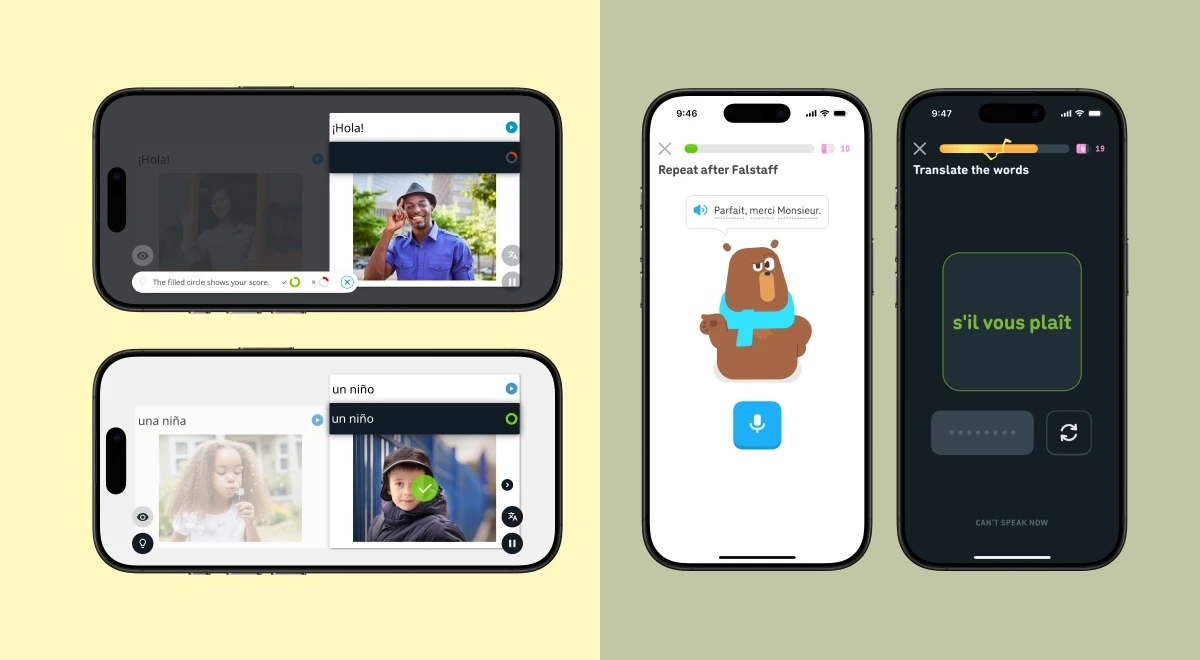
Duolingo has speaking tasks, but they feel a bit like a "pass/fail" test. You can often mumble your way through a Spanish sentence and still get a green checkmark. If your goal is real conversations where people don't go "Huh?" every five seconds, you'll need the discipline that Rosetta's speech recognition provides.
5) Course content depth and progress tracking
Duolingo is great for building a massive vocabulary, but it can be a bit weak on grammar. You'll learn a lot of words, but you might not know why the sentence is structured that way. It's very trial-and-error.
Rosetta Stone is much more systematic. It builds your language skills layer by layer. You won't just learn Farsi words; you'll start to "feel" the grammar. Yet, both apps tend to plateau at the intermediate level.
Once you get past the basics of a foreign language, you usually need to move on to something like Pimsleur for more real-world audio or Babbel for more practical conversational skills.
6) Language options and accessibility
If you're looking for a popular language, both of these have you covered. You can jump into Spanish, French, German, or Italian on either one without any issues. But if you're chasing something a bit more niche, Duolingo is the hands-down winner. They have over 40 different languages, including Swedish and even some fictional ones.
Rosetta Stone offers about 25 language courses of the most common speaking languages worldwide. If you're trying to learn Arabic, Farsi, or Japanese, you'll find their language program is very polished, but don't expect them to add a new dialect every month.
Both language learning platforms work great on your phone or desktop, and both offer some offline options, though Rosetta's immersive learning feels a bit more "serious" when you're sitting down for a long session on an iPad.
📘 Understand the world better. Use Headway to dive into cultural and social insights while you master your new language.
7) Real outcomes and use cases: Which one actually works?
Let's get to the point: which one helps you in real life?
If you are a traveler who just needs to survive a week in Mexico, Duolingo is probably all you need. You'll learn the memorization of key phrases and enough vocabulary to find a bathroom or order a beer. It's the best app for a beginner who doesn't want to overthink things.
But if you're a business professional or someone moving abroad, you need conversational skills that go beyond clicking buttons. And that's where the Rosetta Stone vs Duolingo comparison leans toward Rosetta. Because of the immersive approach, you're less likely to freeze up when a native speaker actually talks to you. You won't be translating in your head; you'll just be reacting.
8) Duolingo vs Babbel vs Rosetta Stone: The hybrid approach
Here's a secret: most successful language learners don't just use one app. They use a "stack" of apps.
You might use Duolingo for your daily five-minute habit to keep your streak alive, but also sit down twice a week for a core lesson on Rosetta Stone to boost your language acquisition. If you find that Rosetta is too repetitive, you might swap it for Babbel to get some grammar explanations. Or, if you want to focus purely on real conversations, you could even add Pimsleur into the mix.
The goal is to get to an intermediate level where you can actually enjoy the language. Don't be afraid to mix and match. Using flashcards alongside short stories and voice recognition tasks is how a polyglot actually gets the job done.
Get Headway to fuel your language journey
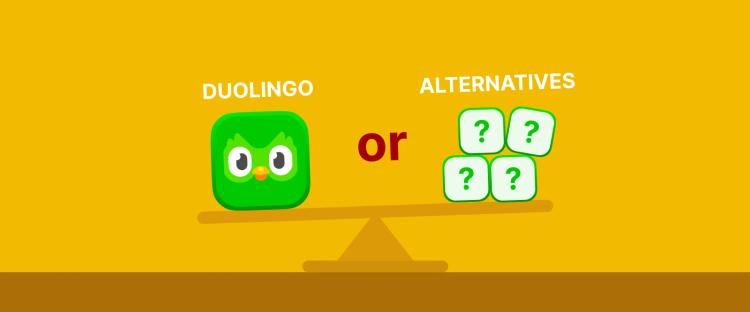
Having said all that, in the Duolingo vs Rosetta Stone battle, who wins?
If you want a free version that makes learning feel like a game and fits into a coffee break, stick with Duolingo. It's perfect for building a consistent habit and getting a handle on the basics. But if you're serious about your language education and want to improve your conversational skills without relying on English translations, Rosetta Stone is the superior language program.
In the end, the best app is the one you actually open. Pick one, stay consistent, and remember that even ten minutes a day is better than nothing. Still, learning a new language is hard, and it's easy to be excited on day one, but by day thirty, those fill-in-the-blank exercises can start to feel like a chore.
That's where Headway actually helps language learners stay on track: it doesn't teach you Spanish verbs or German nouns, but it gives you the "cheat codes" for a better learning style.
By listening to 15-minute breakdowns of books on habit formation, memory, and focus, you're basically training your brain to be a better student. It's a lot easier to stick to your language learning journey when you understand the science of how your mind actually picks up new skills.
📘 Invest in yourself — get the Headway app and turn your downtime into a masterclass in personal growth.
FAQs about Rosetta Stone vs Duolingo
Is Rosetta Stone or Duolingo better for learning languages?
It depends on your goal. If you want deep immersion and a better accent, Rosetta Stone is the superior choice. That said, if you just want to build a daily habit for free, Duolingo wins. When doing a Rosetta Stone vs Babbel vs Duolingo check, you'll see that each serves a very different type of modern language learner.
Will I become fluent with Rosetta Stone?
Not exactly. You'll reach a solid A2 or maybe B1 level, but true fluency requires speaking with actual humans. Rosetta Stone is great for building intuition, but it doesn't teach the complex grammar needed for high-level conversations. You'll need a tutor or native media to truly cross the finish line.
Can I reach C1 with Duolingo?
Standard Duolingo courses generally stop at the B2 level for major languages like French and Spanish. Even with a mix of apps, reaching C1 usually requires moving beyond apps into real-world content. Duolingo provides a great foundation, but you'll eventually hit a plateau where you need more academic or professional-level study.
Can Rosetta Stone get me to B2?
The standard "Foundations" app mostly focuses on getting you to a B1 level. That said, their specialized "Fluency Builder" for business can technically take you toward B2 or even C1. In any Rosetta Stone vs Duolingo vs Babbel breakdown, remember that moving up often means switching from simple picture-matching to more advanced, career-focused lessons within their professional tracks.
What is the easiest language to learn?
For English speakers, Norwegian is often ranked as the easiest because of its similar grammar and vocabulary. Spanish is a close second due to its phonetic consistency. If you compare Rosetta Stone vs Babbel vs Duolingo vs Pimsleur, you'll find that these popular languages have the most resources, making them even easier to master through consistent daily practice.
Is there anything better than Rosetta Stone?
"Better" is subjective. Babbel is often better for those who need clear grammar rules, while Italki is better for real human conversation. Modern AI tutors are also becoming huge rivals. If you find Rosetta Stone too repetitive, trying a more interactive, conversation-heavy platform might be exactly what you need.
Can I become fluent using Babbel or Duolingo?
Most learners reach a high-beginner or low-intermediate stage using these apps alone. They are fantastic for vocabulary and basic sentence structures, but they rarely bridge the gap to actual fluency. Truly mastering a language means moving beyond button-clicking and using what you've learned in spontaneous, unscripted conversations with real native speakers in the world.