Self-growth
 Business & Career
 Success
 Communication
 Healing
 Relationships
 Psychology
 Happiness
To rewire your anxious brain means retraining your nervous system so that fear responses don't take over your life. If your body tends to flip into danger mode when nothing is seemingly wrong, know that you're not broken. Your nervous system simply got used to the "threat" signal a little too well. And now, it's doing its job a bit too enthusiastically.
Neuroplasticity is the process by which these patterns can change. As a somatic coach, I get to see its magic work for my clients time and time again. Your brain builds and strengthens new neural pathways through repetition, so what you practice becomes easier to access when stress hits.
This guide provides practical tools based on research, my experience with anxious clients, and Headway summaries, including'Get Out of Your Head,' 'Peace Is Every Step,' 'Becoming Supernatural,' 'Hardcore Self Help,' and 'The Gifts of Imperfection.'
Don't have much time? Headway turns these concepts into 15-minute summaries that you can use immediately. Start here.
Core answer: To rewire your anxious brain, practice new responses repeatedly through body regulation (breathing, muscle relaxation techniques), cognitive behavioral therapy (CBT), attention training (mindfulness), and gradual exposure. Neuroplasticity means that what you practice becomes your new default.
Quick summary: Tips to rewire your anxious brain
In this article, you'll learn:
What it really means to rewire your anxious brain through neuroplasticity in a simple, non-performative way.
The core circuits behind anxiety: the amygdala, prefrontal cortex, and stress response.
Five science-backed strategies for retraining anxiety at the source (top-down and bottom-up)
Daily exercises you can use today to rewire your anxious brain, even if your schedule is chaotic.
How Headway summaries help you stay consistent when motivation disappears.
Interactive quiz: What's your anxiety level and brain type?
Next steps by result
Mild: Practice breathing and thought labeling once daily
Moderate: Add three small exposures weekly
Severe: Build a morning and night stabilizing routine with clinical support
Pacing note: When I work with clients who struggle with anxiety, I offer them this crucial tip: start with the smallest available step. That way, if you get overwhelmed or shut down, you can adjust accordingly.
Adjustments for neurodivergent brains
I can't emphasize enough that the most common anxiety advice online assumes that you have a standard brain. So, if you have ADHD, autism, or are otherwise neurodivergent, your entry point will shift. Even so, the goal remains the same: practice safety, little by little.
If you have ADHD:
Set two-minute timers; short practices are more likely to actually happen.
Habit-stack by attaching a new practice to something you already do, like making coffee or brushing your teeth.
Use app reminders. Letting your phone handle the memory frees up mental space.
Try movement-based regulation if sitting doesn't sit well with you (did you get the pun?).
If you're autistic:
If your social anxiety is tied to masking, address burnout alongside anxiety.
Start with external anchors like temperature, texture, and sound before internal body scans.
If you dissociate or have trauma responses:
Skip body scans. They might make you feel floaty or panicky. Try naming "five things you see" instead.
Go slower than recommended, not faster than you can tolerate. Do this no matter how tempting it is to push.
Sensory considerations:
Does breath control trigger panic? Just notice your breath without changing it.
Does muscle relaxation aggravate pain? Work on smaller areas or skip it entirely.
Does silence feel loud? Use guided audio or soft background sound.
Five science-backed strategies to rewire your anxious brain
Anxiety runs on both mental and physical tracks. You need both mental and physical tools, sometimes within the same five minutes.
Psychology Today describes anxiety as a defensive state driven by fear circuits and stress systems. The amygdala fires the emotional alarm, and stress hormones mobilize the body. With chronic anxiety, the brain can overestimate threat and stay defensive even when there's no actual danger.
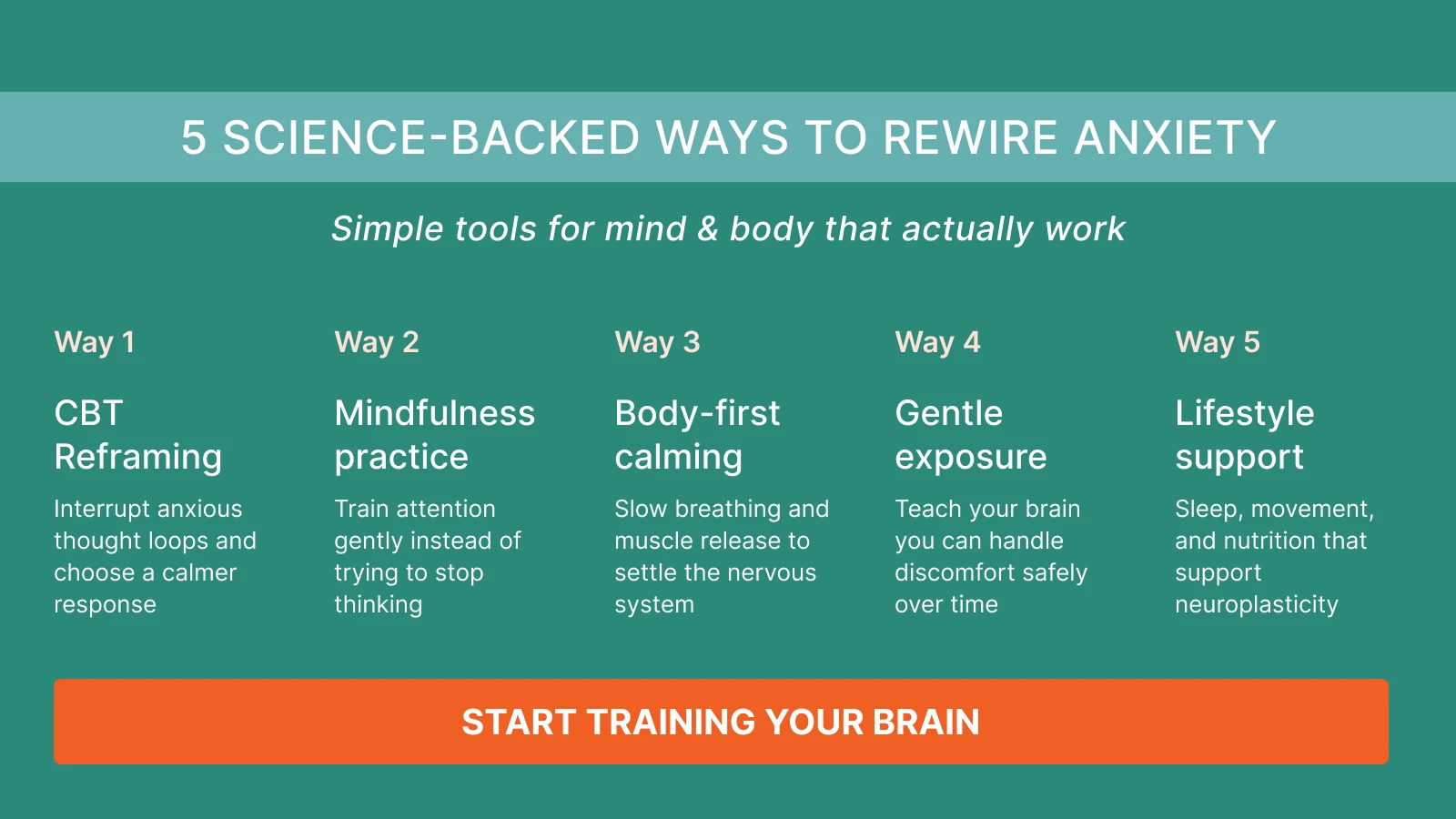
1) Cognitive behavioral training: Interrupt the thought loop
Anxiety makes thoughts feel urgent and factual. CBT works directly with your prefrontal cortex. First, it comes back online; then you can choose to respond rather than react.
Here's the simplest CBT version:
Write the anxious thought in one sentence.
Label the distortion: catastrophizing, mind-reading, or all-or-nothing thinking.
Reframe to something accurate and workable. Not positive, but practical.
Pick one action. It doesn't have to be big. Anything you can do in five minutes will do.
Best for: Rumination, generalized worry, social anxiety, and for "my brain won't shut up" moments.
Practice note (from somatic work): If you can't process your thoughts in real time, briefly write them down for later. The nervous system still learns from repetition. You're training pattern recognition first.
2) Mindfulness and meditation: Why you should practice it
The goal of mindfulness, contrary to what many people believe, isn't to stop thinking. It's an intentional practice of returning attention on purpose.
Try this:
Pick one spot to feel: nostrils, chest, or belly
Notice what comes up and name it simply: a thought, an emotion, or a sensation
Return to that one spot
Repeat
Some days, you'll return fifty times. Those returns are the workout. Even one minute counts if you actually show up for it. Find more mindfulness tools for anxiety on the Headway blog.

3) Body-first practices: calm the alarm so your mind can follow
When your body is in fight-or-flight mode, just "think positive" advice is absolutely useless. I see it over and over with my clients: they believe that it's possible to just "think your way out of stress." What I suggest instead is "speaking your nervous system's language," namely, its physiology. That way, your brain gets a "safe enough" signal.
Downshift breathing (two minutes):
Inhale for four counts.
Exhale for six.
Repeat anywhere between 10 and 15 cycles. Find what works for you.
Signs that it's working: Your shoulders drop, jaw unclenches, and vision widens. You will also notice that your thoughts slow down enough for you to think clearly without so much urgency.
Stop if you feel air hunger, panic, or dizziness. Some nervous systems experience breath control as a threat, and I wish more people knew this. If that's you, just notice your breath without trying to change it. There's nothing wrong with you; every nervous system is unique.
Progressive muscle relaxation (five minutes):
Tense one muscle group for five seconds.
Release for ten seconds and notice the contrast.
Move down through your body. Starting with your face, gradually move on to your neck, shoulders, arms, torso, and legs.
Many anxious people have been tense for so long that they've forgotten what relaxed feels like. You're rebuilding the map.
Orienting (thirty seconds):
Look around slowly.
Name five neutral objects.
Let your eyes land and settle.
More stress-reduction tools here.
4) Exposure and pattern breaking: teach your brain you can handle it
Avoidance feels good in the short term. And it's totally okay if you don't have the resources to practice new skills or handle the stress. Intentional, gradual practice is a long-term solution that teaches your brain that the trigger isn't dangerous. In fact, exposure gives your system corrective data.
Gradual exposure (start as small as possible):
Pick one fear-induced situation in its most manageable version.
Rate fear from zero to ten.
Stay with the discomfort for a limited amount of time.
Repeat only if you feel you have enough in the tank.
Watch your tolerance widen. Next time, stay a little longer; then step up, little by little.
Pacing note: If exposure spikes your symptoms for hours, you're moving too fast. With the nervous system, slower is faster. Stabilize first, then reduce the step size.
Client observation: I've seen clients do exposure "perfectly" and still get worse afterwards, regress — all because their nervous system was too activated and underresourced to digest new experience. So, the "trick" was to work consistently and gradually; that way, panic stopped hijacking the process.
This approach is also central to clinicians like Reid Wilson, Director of the Anxiety Disorders Treatment Center, who focuses on practical tools for anxiety disorders, panic attacks, OCD, and phobias, using progressive steps rather than avoidance.
5) Lifestyle support for neuroplasticity: Make rewiring easier
Neuroplasticity isn't a wellness trend; it's foundational wiring support. A chronically stressed body is more reactive, which makes an anxious mind even louder. Here's what actually gets results:
Do this:
Sleep: Have a consistent wake time most days.
Movement: Get in a 20-minute walk or strength workout nearly every day.
Nutrition: Maintain stable, nutritious meals, consistent hydration (can't emphasize this enough!), and fewer blood sugar spikes.
These things are not glamorous, but they're foundational and often overlooked.
When self-help isn't enough
Self-help can be powerful. It isn't always sufficient, especially with complex anxiety. Consider professional support if you experience:
Frequent panic attacks
Severe OCD rituals or constant checking
Agoraphobia, or the feeling that the world is shrinking fast
Trauma-related anxiety with dissociation or flashbacks
No improvement after six to eight weeks of consistent practice
We aren't meant to self-regulate alone, despite what an individualistic culture might suggest. More often than you'd think, the missing ingredient for healing is borrowed steadiness, or co-regulation. When your nervous system learns regulation from another regulated human, it remembers how to settle on its own. That's what we, somatic coaches, are here for.
Practical exercises from five key books
Each one trains a different part of your nervous system. Observe the pattern. It's all about short practices repeated often.
✔ Cognitive redirect (five minutes) —'Get Out of Your Head' by Jennie Allen
Notice the anxious thought.
Label it: "This is a worry story."
Ask: "Is this useful right now?"
Replace with: "Here's what I can do in five minutes."
Why this helps your brain: Labeling reduces fusion, so thoughts stop acting like facts. That strengthens prefrontal regulation. Be aware that spirals often worsen after scrolling. Social media comparisons feed loops of doubt and rumination.
✔ Mindful presence ritual (three minutes) — 'Peace Is Every Step' by Thich Nhat Hanh
Walk slower than usual.
Inhale: "Here." Exhale: "Now."
When your mind wanders, return to your footsteps and breath.
Why this helps your brain: It trains attention away from imagined future threat — anxiety's favorite fuel.
✔ Visualization and breath (five minutes) — 'Becoming Supernatural' by Joe Dispenza
Place a hand over your heart and breathe slowly.
Picture a moment you felt safe or capable.
Add one sensory detail, whether it's a sound, a temperature, or a color.
Why this helps your brain: Pairing calm breath with safe imagery builds an alternative pathway you can access under stress. In somatic work, this is called resourcing — building a library of "safe enough" states your nervous system can return to.
✔ Small wins tracking (two minutes daily) — 'Hardcore Self Help' by Robert Duff
Choose one micro-exposure you can repeat.
Do it.
Write: "I did it even while anxious."
Mark the win quietly.
Why this helps your brain: Small wins teach your system that discomfort is survivable, which reduces avoidance over time.
✔ Compassionate self-talk (two minutes) — 'The Gifts of Imperfection' by Brené Brown
"I can be anxious and still safe."
"My feelings are real, not always accurate."
"I don't need certainty to take one step."
"I can be imperfect and still worthy."
"I can ask for support without shame."
Why this helps your brain: Shame and self-judgment keep the threat system on. Compassion reduces fear-of-evaluation loops and supports safer connections.
Why your brain learned anxiety and how to teach it something new
Neuroplasticity in plain language
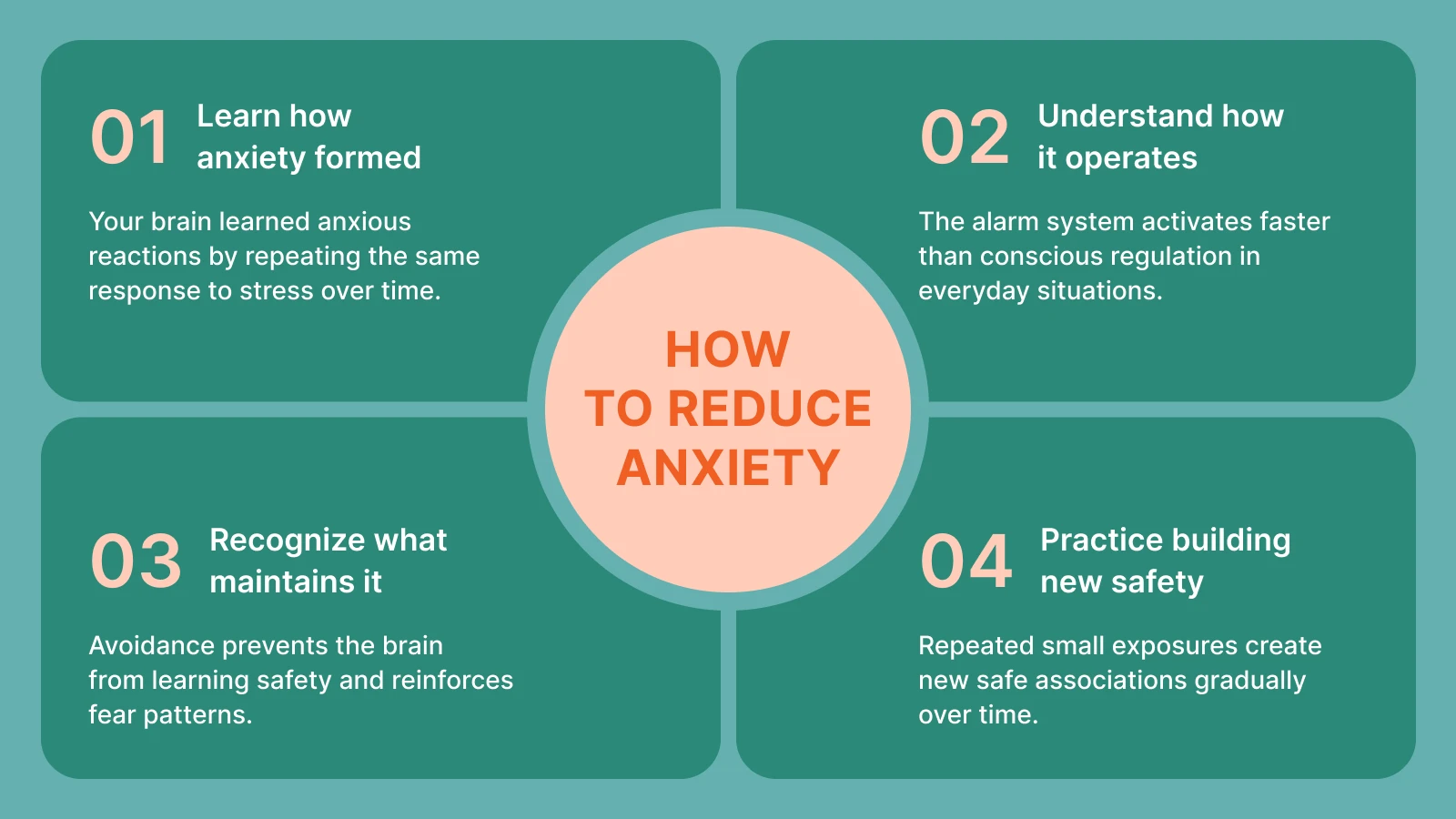
Your brain learns through repetition. Remember, "neurons that fire together, wire together." Anxiety strengthens fear pathways through repeated alarm and avoidance. You can weaken those pathways by practicing new responses repeatedly in real situations.
Key parts of the brain involved
Psychology Today describes anxiety as driven by:
Amygdala: Fast threat detection, emotional alarm
Prefrontal cortex: Interpretation, decision-making, regulation
Hypothalamus and sympathetic nervous system: Mobilize stress response
Hippocampus: Context and memory — can be helpful or anxiety-fueling
Tiny diagram: The amygdala-cortex balance
When the amygdala is loud, your body goes into fight-or-flight mode fast.
When the prefrontal cortex is online, you can interpret, choose, and regulate.
In anxiety, the alarm can overpower regulation, which is why you "know it's irrational" but still feel panicky. Your ancient brain's only task is to help you survive.
This two-system framework also appears in Catherine M. Pittman and Elizabeth M. Karle's work on anxiety neurobiology and neuropsychology. Catherine M. Pittman, PhD (PsyD audiences often look for this framing), is affiliated with Saint Mary's College, and their self-help book approach is linked with New Harbinger Publications' style workbooks and practical tools. Many people prefer the audiobook format when reading feels like an effort.
Somatic concepts that matter
These are the "why this works" pieces, without the textbook vibe:
Window of tolerance: The zone where you can feel and still think
Titration: Small, tolerable doses of discomfort
Pendulation: Move attention between discomfort and neutral sensation
Resourcing: Choose an anchor — feet, warmth, voice, memory, or an object.
NB: If a certain practice consistently overwhelms you, don't give up. It might just not be the right dose or tool for your nervous system right now. Every nervous system is unique, and it's worth exploring what truly works for yours. Understanding the amygdala-cortex circuitry pathway helps here; when you know how it works, you stop blaming yourself and start working with your system.
Why rewiring anxiety matters
Anxiety often grows through a simple learning loop:
Something triggers the alarm.
Your body mobilizes.
You avoid the trigger.
You feel relief.
Your brain learns: "good call, avoid harder next time."
That builds neural pathways that fire faster and more often. The good news is that this exact learning mechanism can work in your favor.
What happens in an anxious brain vs a rewired brain
| What's happening | Anxious brain | Rewired brain |
|---|
Threat appraisal | Overestimates threat | Calibrates threat more accurately |
Body response | Fast stress surge, high vigilance | Faster recovery after activation |
Attention | Locks onto danger cues | Returns to the present on purpose |
Behavior | Avoidance, reassurance-seeking | Approaches in small steps, tolerates uncertainty |
Thinking | Rumination, "what if" loops | Flexible, action-based coping |
This distinction matters for generalized anxiety, social anxiety, panic attacks, phobias, and OCD-spectrum patterns.
Your first week: What to do today, tomorrow, and beyond
Day one (15 minutes total):
Two minutes: Exhale-longer breathing
Five minutes: Cognitive redirect (label, reframe, and next step)
Five minutes: Muscle relaxation or orienting
Three minutes: Tiny exposure (smallest version)
Week one roadmap:
Days one and two: Pick one trigger, one micro-exposure
Day three: Write one reframe daily
Day four: Add a three-minute walking meditation
Day five: Do one exposure until anxiety drops slightly
Day six: Remove one amplifier (late scrolling, skipping meals, and caffeine overload)
Day seven: Review your wins and choose your next micro-step
Monthly check (10 minutes):
What triggers have changed?
What avoidance has shrunk?
What skills feel automatic now?
What support do I need? A therapy session, a support group, or maybe a workbook?
If you want extra structure, workbooks (many from New Harbinger Publications) turn insight into repetition. Repetition is the neuroplasticity game.
Ready to rewire your anxious brain? Start your 7-day practice with Headway
If anxiety is your brain's overprotective security guard, your job isn't to fight it. Your job is to train it.
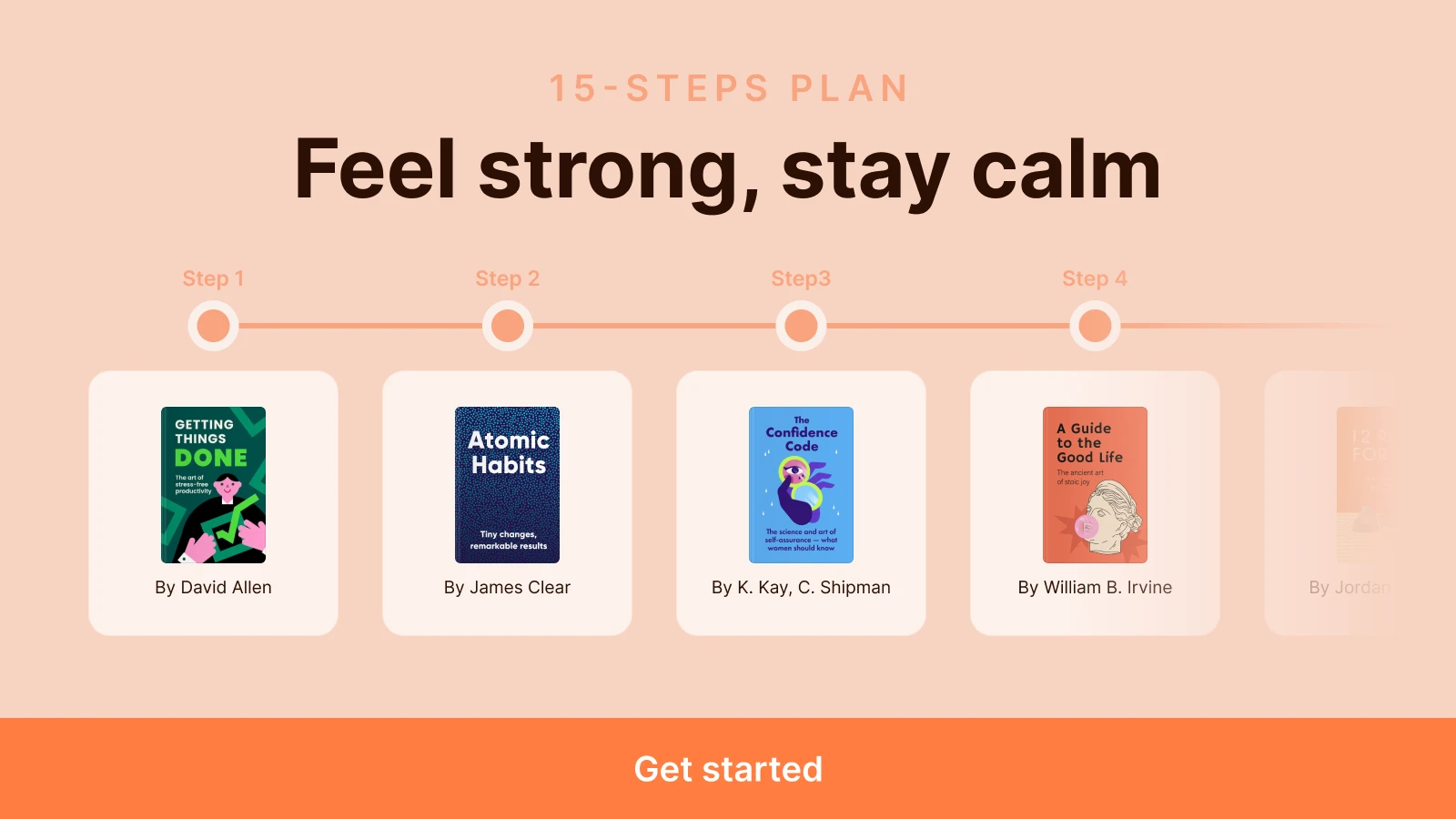
Headway helps you rewire your anxious brain by keeping you consistent. Instead of reading five full books and trying to remember everything, you get the core ideas in 15-minute summaries. Pick what you need that day and practice it.
Rotate summaries based on what you need:
Spirals and social media triggers: 'Get Out of Your Head'
Grounding and mindfulness: 'Peace Is Every Step'
Visualization and meditation routines: 'Becoming Supernatural'
Practical tools and exposure momentum: 'Hardcore Self Help'
Shame resilience and self-acceptance: 'The Gifts of Imperfection'
For extra support, check out the "How to reduce stress and anxiety" guide on the Headway blog, along with mindfulness practices tailored for anxiety. And if you're an audio learner, like me, the top picks for anxiety podcasts are worth a look too.
Your next step: pick one Headway summary, pick one exercise from this article, and do it daily for seven days. Start small. Stay consistent. That's how your nervous system learns new options.
FAQs
Can I rewire my brain from anxiety?
Yes, slowly but surely. It's a matter of practicing new responses to fear repeatedly. I usually start by helping clients regulate their bodies first. Only then do we begin reframing thoughts, tracking wins, and approaching triggers in small steps. Keep in mind that the goal isn't to "never feel anxious." The goal is faster recovery and more choice in how you respond.
Is my brain damaged from anxiety? Could it be reversed?
Most anxiety-related changes in the brain are stress-related, not permanent. There are many ways you can rewire your brain to lower chronic activation and support recovery, including sleep, movement, CBT, mindfulness, and nervous system tools. The key is that these become second nature, not temporary fixes. For intense panic attacks, OCD, or phobias, working with a clinical psychologist is worth considering.
How do I heal my brain from anxiety?
Start with two tracks: bottom-up regulation (breathing, grounding, relaxation) and top-down skills (CBT reframes, mindfulness). Then add gradual exposure so your brain gets corrective experience instead of avoidance. Evidence-based research shows you rewire your anxious brain through small daily repetitions, not by waiting until anxiety disappears first.
What is the root cause of anxiety?
Anxiety comes from a threat system that overestimates danger. The amygdala flags a threat quickly, and stress-response systems mobilize the body. When the alarm is high, the prefrontal cortex struggles to regulate. Genetics, learning history, temperament, and current stress load all affect sensitivity. Different types of anxiety, like generalized, social, and panic, share this core mechanism.
What is the single worst habit for anxiety?
In a word, chronic avoidance. It gives short-term relief but teaches your brain that the situation was dangerous, strengthening fear responses and negative thoughts. Compulsive reassurance-seeking does something similar. To rewire your anxious brain, approach triggers in small steps with regulation before and after. This principle applies across all anxiety types.
How do I reset my nervous system?
Try a fast body-first reset: exhale longer than you inhale for two minutes, do progressive muscle relaxation for five minutes, then orient by naming a few neutral objects. This downshifts stress activation and gives your brain a clearer "safe enough" signal so you can think again.
What are the best resources to learn more about anxiety neuroscience?
Catherine M. Pittman, PhD's work offers accessible explanations of how anxiety operates in the brain. Her YouTube lecture "How to Get Rid of Anxiety and Rewire Your Anxious Brain," co-presented with Elizabeth Karle, clearly breaks down the amygdala-cortex relationship. Her book 'Rewire Your Anxious Brain' (New Harbinger Publications) is considered a great book for understanding anxiety from both psychological and neurological perspectives. Many find the audiobook format helpful for retaining the concepts.