Self-growth
 Business & Career
 Success
 Communication
 Healing
 Relationships
 Psychology
 Happiness
Are you too busy to think about your day? Most people are. We rush from one project to the next without pausing to consider our behavior or beliefs, whether our course is worth following, or if we're heading in a worthwhile direction.
Truthfully, if you aren't asking yourself reflection questions, you're operating on autopilot — running the same patterns that you've established over your lifetime and wondering why nothing changes. That said, taking even 10 minutes to ask yourself the right questions can incredibly improve self-awareness, clarity of decision-making, and intentional action.
In this article, you'll find powerful self-reflection questions, along with strategies that will make these questions even more reflective and impactful. The advice is based on personal development books available in the Headway app — 15-minute summaries of nonfiction titles that help you self-reflect and convert self-awareness into action.
📘Download Headway today to use self-reflection as a launching pad for real growth.
Quick answer: Five self-reflection questions to try today (short version)
What are my core values?
What problem am I avoiding right now?
How can I strengthen my relationships?
Where do I see myself in 3 years?
Am I pursuing my own definition of success?
Top 15 reflection questions for personal growth: Full list
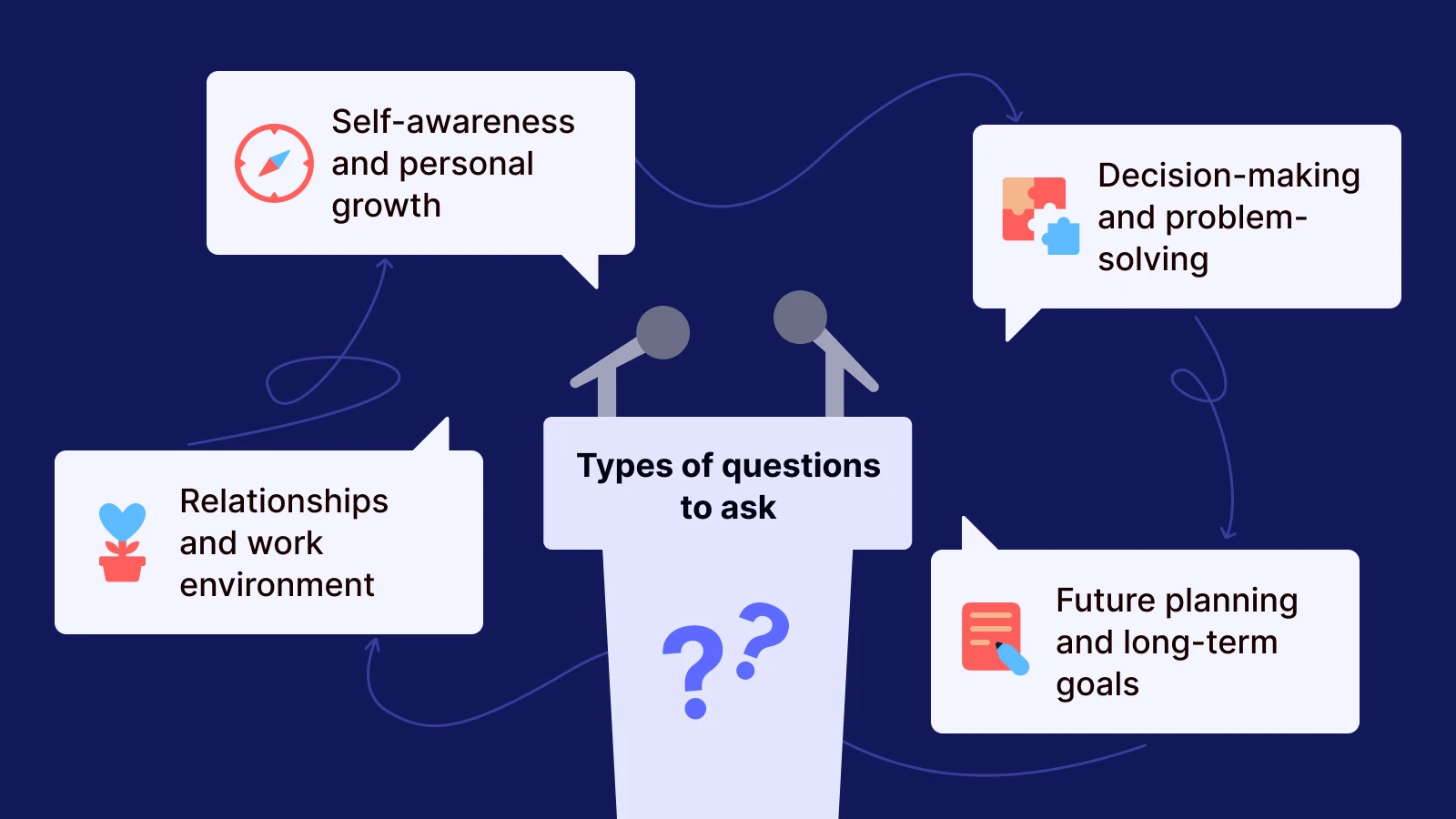
The right questions can unlock insights that you didn't know you needed. Below are 15 fascinating questions, categorized by life area, that will help you grow.
Self-awareness and personal growth
1. What habit should I break in order to move forward in my career?
Identify what's holding you back because of a bad habit (like procrastination, saying "yes" to everything, or avoiding tough conversations), and then acknowledge it.
2. When was the last time I pushed myself out of my comfort zone? What did I learn?
Growth almost always happens at the edges of comfort. When you reflect on these moments, you learn your potential for change.
3. What are my core values? Am I living in accordance with them?
When your behaviors don't conform to your personal beliefs, it's common to feel stuck or frustrated. This question can show you where you're out of alignment.
4. What changes would I make if I lived without fear of failure?
Fear is regularly disguised as "being realistic." This question will reveal what you truly want in a situation, versus what fear is determining for you.
📘A Headway tip: Read or listen to the 'The Mountain Is You' summary if you seek personal growth and self-awareness.
"Your life is a mountain ridge, not a plain" — a key point from Brianna Wiest's must-read.
Decision-making and problem-solving
5. When was the last time I made a significant decision without considering the pros and cons?
Most of the things we regret can be traced back to hastily made decisions. This question will expose some of your decision-making and problem-solving behaviors.
6. What new perspectives or ideas drove my thinking in a different direction?
The question will help you develop your ability to recognize changes in your thoughts and apply those changes moving forward.
7. What problem am I avoiding right now that I know I need to confront?
Avoidance won't make your problems go away; it will just complicate them more. Naming what you're avoiding or deflecting is the first step to addressing the issue.
📘A Headway tip: Check out the 'Questions Are the Answer' summary if you seek decision-making and problem-solving solutions.
"In a world filled with uncertainties, it's easier to focus more on finding answers to the wrong questions" — a key point from Hal B. Gregersen's must-read.
Relationships and work environment
8. How should I strengthen my relationships with my coworkers?
Professional success comes from much more than skills; it's about building connections. Consider whether you're investing in those relationships.
9. Who in my life encourages me to be the best version of myself, and am I giving them enough attention?
The people around you shape who you are. This question helps you figure out whether those in your circle promote your evolution or deter you from evolving.
10. What barriers do I need to overcome to protect my comfort and mental health?
Self-care isn't selfish. Think about what areas you overcomplicate or overcommit to, and then consider what boundaries you need to create in your day-to-day life.
📘 A Headway tip: Explore the 'How to Lead When You're Not in Charge' summary if you want to succeed in building strong personal and work relationships.
"What does a leader need besides the title?" — a key point from Clay Scroggins' must-read.
Future planning and long-term goals
11. Where do I see myself in 3 years, and what actions am I taking or not taking to get there?
Wishing for specific outcomes doesn't create them. This idea ties your long-term outcomes to either the action or the lack of action you're taking today.
12. What do I want to accomplish by the end of the year, and why is that important?
Understanding the "why" behind your goals helps make them easier to follow through with. You can use this approach to determine which skills or plans you should follow through on.
13. What, at this moment, would improve my career most if I learned it or had the experience?
Students or learners who focus on skills or knowledge that will drive the most improvement will see results the fastest.
14. Am I pursuing my own definition of success or someone else's?
It's easy to chase accomplishments that seem admirable on paper, but that don't actually make us feel accomplished. This question clarifies whether you're creating the life that you truly want.
15. What does the next year need to look like for me to feel I made progress?
Don't just set "resolutions" — rather, create a definition for what your idea of progress looks like. This method establishes clarity and a target for your professional life and personal growth.
📘A Headway tip: Listen to or read the 'The Bullet Journal Method' summary if you want to level up your planning and set goals.
"Personalization makes journals sacred" — one of the key points from Ryder Carroll's must-read.
The science behind reflection questions: Why they work



Self-reflection questions aren't just feel-good exercises — they're supported by research that shows specific improvements in how you think and the way you grow.
For instance, research conducted at Harvard Business School found that study participants performed 22.8% better on tasks than their peers, simply by reflecting on their lessons learned for 15 minutes each day.
This practice is transformative, as reflection helps you move from feeling stuck toward taking action. Here are the reasons why reflection works:
Decreases mental clutter: Your brain holds onto unfinished thoughts and half-made decisions, using mental space that can be redirected when you get clear on your thinking.
Shifts you from a reactive to a proactive state: You start to see patterns instead of simply reacting to whatever thought appears.
Better problem-solving state: Thought-provoking questions help you reflect on your experiences, and you can start to pull out lessons learned to use going forward.
Well-being: Research indicates that over 70% of professionals who reflect weekly report improved career growth and mental health.
For adult learners balancing demanding schedules, reflection questions offer cognitive clarity. Instead of living in a state of stress and confusion, you can transform your present thinking into future action by connecting it to self-reflection questions. This approach allows your brain the time it needs to process information and work through difficulties and confusion.
Don't forget, reflection turns experience into insight and helps you make conscious choices about where to place your attention.
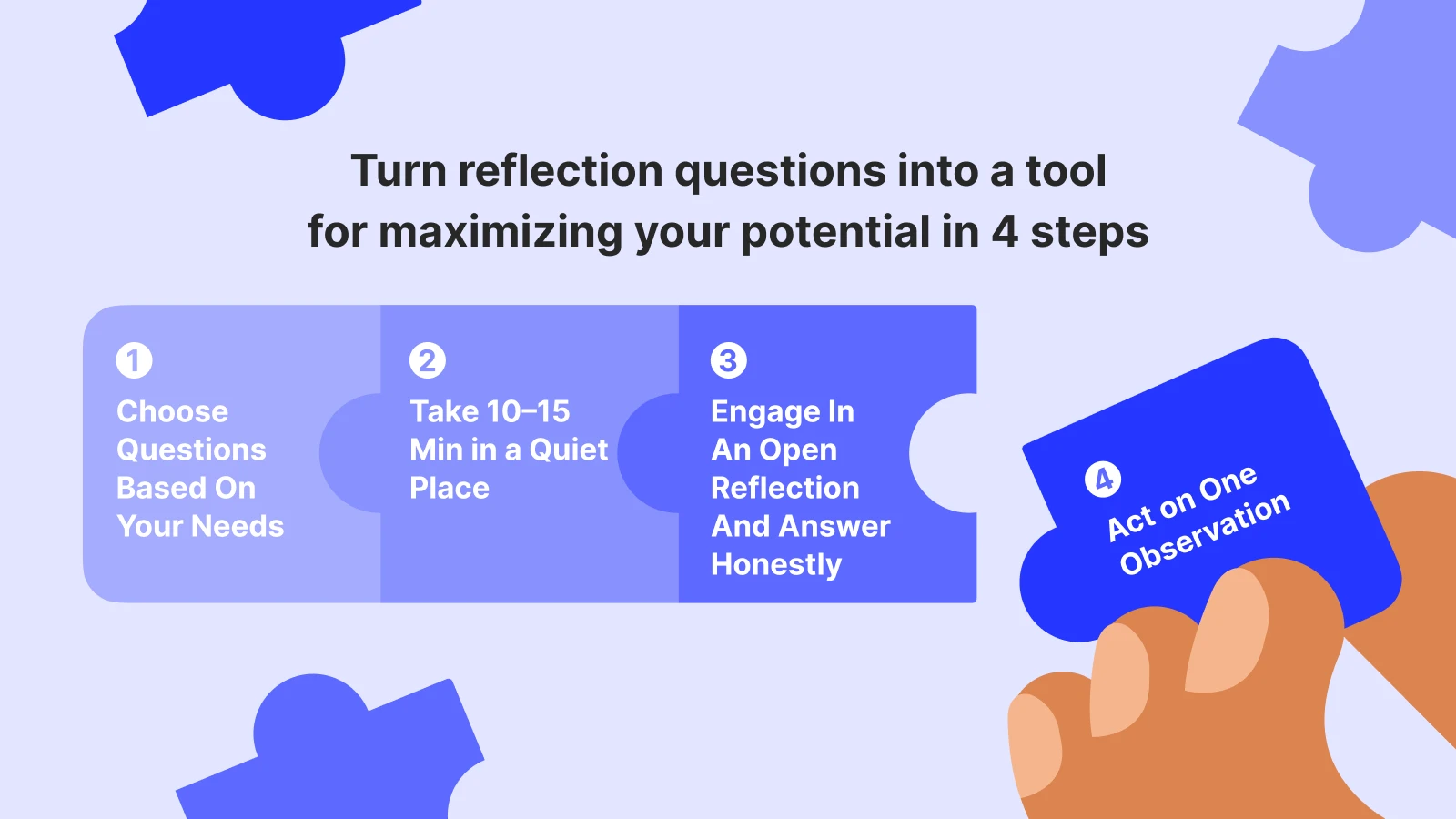
How you can use reflection questions to maximize your potential
Having reflection questions is meaningless if you don't act on them. Here's what you need to do to reflect, even when you feel busy.
Step 1: Choose 3–5 self-reflection questions based on your current needs
Don't try to do it all at once. Are you stuck in your professional life? Focus on career questions. Do you need to reconnect to what's important? Focus on personal values and self-discovery questions.
Step 2: Take 10–15 minutes in a quiet place
The best time to reflect is at the end of the year, the end of the week, or the end of the day. It has to be a place free from interruptions. Turn off notifications. This time is your space to check in with yourself.
Step 3: Engage in an open reflection and answer honestly
Write your answers — don't only reflect in your mind. Be honest with yourself, even when the responses may be uncomfortable. Don't obsess over your answers.
Step 4: Act on one observation
Return and look back at what you wrote. What are the patterns or insights about yourself? Write down one actionable change based on your reflection (a habit to break or a new routine to create).
When you have a busy schedule: If you only have five minutes to spare, pick one question related to your daily life that resonates with you and focus on it. Perfection isn't better than consistency. Five minutes every day is much better than one hour every month.
Incorporating it with learning: After finishing a book summary on Headway, reflect on: "What's one takeaway that relates to my life right now?" This approach brings active inquiry into play after passive reading, transforming the passive act of reading into an active process of self-improvement and self-discovery.
Start reflecting today and transform your growth with Headway!
Reflective questions serve as the bridge between learning and personal growth. Without reflection, insights can quickly fade away, sometimes in a matter of days. By reflecting on your learning, you turn ideas into wisdom that sticks, influencing your daily life, career, and relationships.
But for this, you'll definitely need specific productivity tools. Did you just finish a book about your personal values? Reflect on whether your actions with your friends align with those values. Did you just finish reading a book about self-care? Afterward, ask yourself what kind of boundaries you need to take care of yourself.
Headway's progress tracking and flashcards features create productive consistency, and the self-reflection questions ensure knowledge will stick. That's the difference between consuming content and transforming it into genuine self-awareness and actionable steps in all areas of your life.
Stop forgetting what you read — start transforming into the person you are becoming.
📘Download the Headway app and use insights from leading authors, paired with intentional self-reflection questions.
Frequently asked questions about reflection questions
Why is it important to reflect?
Reflection is what helps you turn experiences into learning. Without it, you'll end up repeating the same patterns and mistakes over and over again. This process creates a dependency on habitual behavior without analysis. Reflection also improves self-awareness, supports decision-making, and helps you identify what's actually working, while turning your passive experiences into purposeful growth and improved mental health.
What is the first rule of reflection?
The first rule of reflection is honesty. You should answer the questions honestly, even when they're uncomfortable, without filtering or performing for an imaginary audience, because self-deceit defeats the entire purpose. Real reflection requires acknowledging the reality of what's happening in your life, not what you fantasize about.
What are examples of reflection questions?
Some examples are: "What habit keeps me from moving forward?", "When was the last time I stepped outside my comfort zone?", "Am I living according to my core values?", or "Where do I envision myself in 3 years?" Reflection questions inspire self-awareness about your behavior, values, growth, and goals.
Why is it hard to reflect?
Any moment of reflection requires you to slow down in a culture that's highly focused on constant productivity. Confronting mistakes, admitting to bad habits, or acknowledging that we are off track can feel uncomfortable. Furthermore, reflection provides delayed gratification — rewards build with time, making it easier to bypass.
What are good daily reflection questions?
Good daily reflective questions may include: "What worked well today?", "What could I have done differently?", "What did I learn?", "What am I thankful for?" These daily self-reflection questions help to process your day, see patterns, and maintain self-awareness regularly, with minimal time commitment.