Self-growth
 Apps & Digital Tools
 Business & Career
 Success
 Growth Tools
 Psychology
 Communication
 Relationships

So, you've hit a 200-day Duolingo streak and now read a menu in Spanish without blinking? But then someone actually speaks to you, and your brain goes completely blank.
Research found that foreign language speaking anxiety is one of the most consistent barriers to language production. That gap between knowing and doing is exactly what the Speak app claims to close.
This Speak app review explains how a popular AI language learning app puts speaking practice, pronunciation feedback, and structured conversation drills at the center of every session.
Speaking more confidently is one part of the equation. Having something worth saying is the other.
Download Headway for 15-minute nonfiction summaries on communication, confidence, and growth!

Quick summary: The Speak app at a glance
Here's the short version if you're in a hurry.
Speak is an AI language-learning app focused on speaking drills, pronunciation feedback, and structured conversation practice, rather than gamified vocabulary matching.
It supports seven languages: English (for non-native speakers), Spanish, French, Italian, Korean, Japanese, and Chinese.
Premium costs approximately $17.99/month or $83.99/year; Premium Plus runs around $39.99/month or $164.99/year.
The app is a strong fit for beginners and early-intermediate learners who want guided structure with real speaking output from day one.
Advanced learners and anyone who needs open-ended, off-script conversation will hit a ceiling fairly quickly.
Keep reading for the full breakdown: features, real user takes, an honest look at the cons, and how Speak compares to Duolingo, Babbel, Rosetta Stone, and Pimsleur.
What is the Speak app and how does it work
Speak is an AI-powered language learning app built by Speakeasy Labs with a single core argument: fluency comes from speaking, not from reading grammar explanations or tapping matching pairs on a screen.
Backed by the OpenAI Startup Fund and built on the same underlying AI infrastructure that powers ChatGPT's language capabilities, the app requires voice input from the very first session.
Unlike gamification-heavy apps that reward streaks and points for passive tasks, Speak's gamification is built around speaking output; you advance by actually talking, not by tapping the right answer.
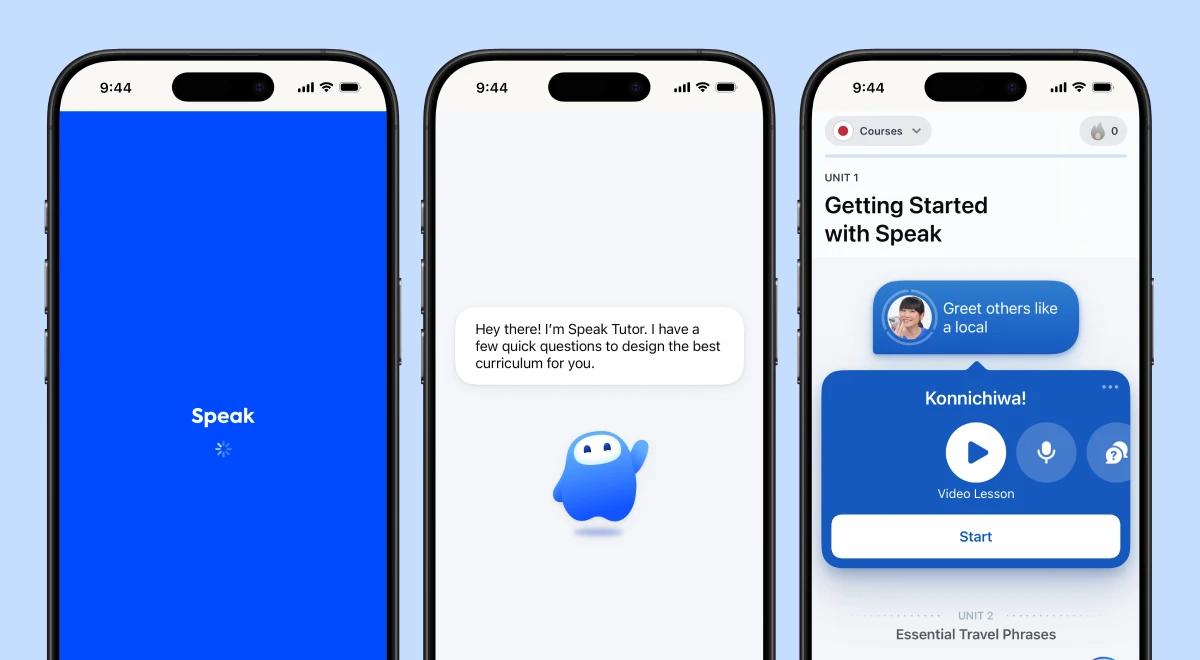
Here's how a typical lesson works:
A video tutor introduces vocabulary or a pronunciation concept in a short clip.
You move into a speaking drill, repeating phrases while the speech recognition engine scores your pronunciation in real time.
A roleplay scenario drops you into a practical situation (ordering at a café, handling a job interview, navigating a travel emergency).
Smart review surfaces the words and phrases the AI flagged as weak, using a spaced-repetition system.
No passive listening, no multiple choice. The entire session is built around voice output. That structure is what separates Speak from most language learning apps, and it's also why the beginner experience feels refreshingly direct.
📘 Build the mindset actually to follow through on your goals. Explore habit and communication books on Headway!
Speak app features: What's inside the subscription
Each of these features has a specific function. Here's what they do in practice.
1. Speaking drills
Sentence repetition with real-time pronunciation scoring. Words are highlighted as you say them so you can see exactly where the AI flags a problem.
2. Free Talk
Open AI conversation sessions with no script. It's the closest the app gets to unstructured chat, though the conversation does follow predictable patterns (question, answer, follow-up question).
3. Roleplay
Scenario-based dialogues covering practical, real-life situations: ordering food, job interviews, travel, and similar contexts. These are among the most useful sessions for building conversational confidence.
4. Tutor lessons
Short video lessons introducing vocabulary and pronunciation concepts. These are closer to custom lessons than generic grammar videos: each session is tied to the specific content you've been drilling. More common at beginner levels; the tutor q&a element helps explain the "why" behind grammar questions.
5. Vocab builder
Matching and fill-in exercises for reinforcing new words between speaking sessions, functioning like a light flashcard system. Unlike static flashcards, the words it surfaces are drawn from your recent sessions rather than a fixed deck.
6. Ask Speak Tutor
Submit grammar or vocabulary questions and receive written explanations. Useful when you don't understand why something is correct, not just that it is.
7. Smart review
The spaced repetition system that resurfaces weak words and phrases over time. Similar in function to a phrasebook review, but driven by your actual performance data.
8. Made for You (Premium Plus only)
Personalized lesson sets built around your most frequent mistakes. Only becomes available after completing a Free Talk session, which means absolute beginners can't access it immediately.
9. Personalized study plan (Premium Plus only)
A structured weekly learning schedule based on your stated goals. This, combined with Made for You, is the main justification for the Premium Plus price jump.
📘 Get smarter about how habits form and stick. Try Headway for 15-minute book insights on psychology and self-improvement!
Speak app pricing: Plans, tiers, and what you get
How much does Speak cost? The app doesn't publish a flat public price list. Rates vary by region, and Speak runs frequent promotional pricing. The figures below were verified against the US App Store in August 2026.
There is no ongoing free tier that supports daily practice. The 7-day free trial gives full Premium access, but once it expires, you pay or lose access.
Plan | Monthly price | Annual price | Key inclusions | Key exclusions |
Free trial | $0 for 7 days | — | Full Premium access for 7 days | Expires; no ongoing free tier |
Premium | ~$17.99/month | ~$83.99/year (~$7/month) | Full curriculum, speaking drills, roleplay, free talk, smart review, ask speak tutor | Up to 3 "Made for You" lessons/day; no personalized study plan |
Premium Plus | ~$39.99/month | ~$164.99/year (~$13.75/month) | Everything in Premium + unlimited "Made for You" lessons, unlimited tutor lessons, personalized study plan, target frequent mistakes. | — |
📘 Make every spare minute count. Get book insights on productivity and focus from Headway!
Speak app pros: Where it delivers
Speech recognition is among the most accurate available in consumer language apps. Powered by OpenAI technology, it catches mispronunciation at the phoneme level rather than just flagging whether a word was recognizable.
The AI voice quality is smooth. No robotic stiffness; the voices in free talk and roleplay sessions sound natural enough that beginner experience doesn't feel like talking to an automated phone system.
Structured curriculum removes decision fatigue. Open the app, and it tells you what to do next. For beginners who'd otherwise spend 10 minutes deciding what to study, that clarity matters.
Speaking-first design means learners produce language from session one. You're not building up to speaking through weeks of reading. The voice quality requirement starts immediately.
Roleplay scenarios cover practical real-life situations. Job interviews, restaurant orders, travel emergencies — these map onto actual use cases rather than textbook sentences nobody says.
Progress tracking gives visible feedback across sessions. You can see improvement over time, which matters for motivation when fluency still feels far away.
Speak app cons: The limitations reviewers keep finding
Speech recognition can be overly lenient. Multiple reviewers on Reddit and the App Store note that mispronounced words or reversed word order sometimes still score as correct during speaking drills. When pronunciation accuracy is the whole point, that's a real problem.
No accent variety in Premium. The app defaults to American English with no option to switch to British English, Australian English, or specific Spanish variants. For learners targeting a particular accent, that's a meaningful limitation.
Free Talk conversations follow predictable patterns. The AI asks a question, you answer, it asks another. Conversations rarely drift to unexpected topics or recover naturally when you say something unusual, which is exactly what real conversation requires.
The structured course, free talk, and smart review don't integrate into a single adaptive system. They feel like three separate tools sitting side by side rather than a single loop that learns what you need.
The price jump from Premium to Premium Plus is steep for what amounts to more of the same drill format, with personalization layered on top. At $165/year vs. $84/year, that gap needs to deliver clear results.
Intermediate and advanced learners hit a ceiling. The structured format no longer matches the kind of varied, spontaneous speaking practice that higher fluency actually requires. Content becomes repetitive, and the roleplay scenarios don't get more complex at higher levels the way a good tutor's sessions would.
"Made for You" lessons require a completed Free Talk session first. That locks the most personalized feature away from absolute beginners who aren't ready for open conversation, the exact people who might benefit most from tailored corrections.
📘 Get books on confident communication and overcoming fear delivered in 15 minutes. Try Headway!
Speak app user experience: What real users say on Google Play
Google Play reviews tell a pretty clear story: where you land on Speak depends almost entirely on your level and what you're measuring.
Rosalyn Mulder, 5 stars (February 2026): After trying Duolingo and Mango, Rosalyn found Speak stood apart because of the tutor-style feedback model: you speak, the app responds. She noted the daily streak as a genuine motivator and called it the best language-learning experience she'd had across multiple apps.
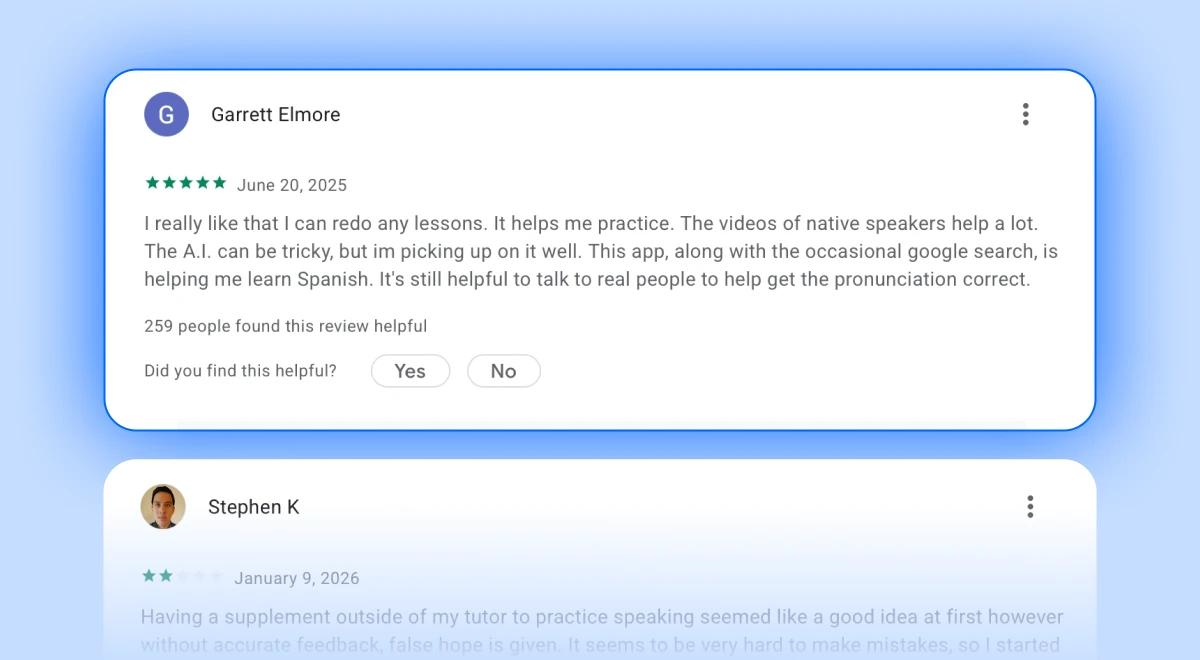
Garrett Elmore, 5 stars (June 2025): Garrett appreciated being able to redo lessons for extra speaking practice and found the native speaker videos useful for pronunciation. He did flag that the AI can be tricky to work with, and noted that talking to real people is still necessary to fully nail pronunciation. The app works best alongside real-world practice, not instead of it.
Lezly Orellana, 3 stars (October 2025): Lezly found the app friendly and well-designed at first, but felt the paywall kicked in too quickly. She added that the range of options can feel overwhelming for a new user trying to figure out where to start.
Stephen K, 2 stars (January 2026): Stephen's review is the clearest documentation of the speech recognition leniency issue. While practicing Japanese, he deliberately gave incorrect answers, yet the app still marked them as correct. His verdict: without accurate pronunciation feedback, the app functions more like a flashcard drill than genuine speaking practice.
These are individual user experiences. Current ratings and full review counts are available directly on Google Play and the App Store.
Speak vs Duolingo, Babbel, and other alternatives: Which one fits your goal
Most people comparing language apps are really asking one of two questions: do I want to build vocabulary and reading comprehension, or do I want to start speaking? Speak vs Duolingo is a common comparison because they appear to target similar audiences, but they solve different problems.
Speak vs. Babbel is a closer comparison; Babbel also uses structured lessons and focuses on practical conversation.
App | Primary focus | Best for | AI speaking practice | Free tier | Starting price |
Speak | AI speaking drills + structured curriculum | Beginners wanting guided speaking practice | Yes (core feature) | 7-day trial only | ~$84/year |
Duolingo | Gamified vocabulary + reading | Building daily habit, early vocabulary | Limited | Yes (generous) | ~$96/year (Super) |
Babbel | Grammar-first structured lessons | Grammar foundation + practical phrases | Limited | No (short trial) | ~$83.40/year |
Rosetta Stone | Immersive vocabulary via images | Visual learners, no-translation approach | Basic | No | ~$159/year |
Pimsleur | Flashcards, reading lessons, interactive exercises | Commuters, audio learners, pronunciation | No | 7-day trial | ~$165/year |
For a deeper look at how Duolingo alternatives stack up, or whether Babbel vs Duolingo makes a clearer case for one over the other, those comparisons are worth reading before committing to any single app.
📘 Expand your vocabulary of ideas. Get 15-minute book summaries on communication and growth from Headway!



Why Headway works as a learning companion to Speak
Speaking practice builds confidence in the moment. But the ideas, vocabulary, and mental frameworks you bring to a conversation come from what you consume when you're not speaking.
That's where Headway fits in, not as a language-learning app, but as the reading layer that gives you more actually to say. Here's what the app actually does.

Book summaries in audio and text, built for your schedule
Headway's library covers 2,500+ nonfiction titles across communication, confidence, psychology, habit formation, and self-improvement. These are the exact categories that make someone a better conversationalist, not just a more grammatically correct one.
Growth plans that evolve with you
When you sign up, Headway asks about your goals and builds a custom reading plan from day one. The best book summary app for busy learners is one that removes that decision fatigue entirely, and that's what Headway's personalized recommendations are designed to do.
Spaced repetition and streaks that make learning stick
Headway uses spaced repetition cards to help you revisit and retain key ideas over time — the same science-backed method Speak uses for vocabulary review, applied to the broader ideas from books.
You can save highlights from any summary and return to them later. Daily streaks and progress tracking add a gentle layer of motivation: a single session takes as little as 3 minutes, so even on a packed day, you can keep the habit alive.
Interactive Shorts and listen modes
Beyond book summaries, Headway offers interactive Shorts: bite-sized stories that adapt to your answers and help you work through real-life challenges like managing conflict or building confidence.
There are also multiple listen modes: ambient sounds for deep focus, binaural beats for sleep, and relaxing music for calm. If you're using Speak alongside Duolingo or looking for Goodreads alternatives to build a consistent reading habit, Headway fits naturally alongside both. It's also worth comparing it to platforms like Mindvalley if you want structured personal growth that goes beyond language learning.
📘 Got 15 minutes? Get a full book's worth of ideas from Headway!

Start speaking, keep growing: Put Headway alongside your language practice
This Speak app review proves that not all language apps can make you open your mouth from day one. For beginners and early-intermediate learners of English or Spanish, Speak is a useful tool for building speaking-output habits and overcoming the initial freeze that foreign-language speaking anxiety causes.
The limits are real, though. The speech recognition leniency, the ceiling for higher-level learners, and the price gap between Premium and Premium Plus are worth knowing before you subscribe. If you're at an intermediate level or higher, you may find yourself outgrowing the format faster than you'd expect.
What speaking practice can't do is fill your conversations with better thinking. And Headway's 15-minute audio and text summaries on communication, psychology, confidence, and self-improvement can fill in this gap.
Download Headway and turn your spare minutes into something worth saying out loud.
This review was prepared by the Headway editorial team and is current as of August, 2026. App prices, ratings, and features can change. Check the App Store, Google Play, Trustpilot, and speak.com for the latest updates.
FAQs about the Speak app
Is the Speak app actually worth it?
It depends on your level and target language. Speak works well for beginners and early-intermediate learners in English or Spanish who want a structured curriculum with built-in speaking output. The annual Premium plan (~$84/year, around $7/month) offers good value at that stage. Advanced learners often find the format repetitive before long, and learners targeting non-core languages get a less developed experience.
How does Speak's AI pronunciation feedback work?
Speak uses speech recognition technology (backed by OpenAI) to analyze pronunciation in real time during speaking drills and free talk sessions. It highlights words as you say them and flags errors, sometimes prompting you to repeat. Worth noting: multiple reviews flag the recognition as occasionally lenient, passing mispronounced words or reversed word order as correct.
What languages does Speak support?
Speak currently supports seven language tracks: English (for non-native speakers), Spanish, French, Italian, Korean, Chinese, Japanese. English and Spanish are the most fully developed tracks. Other languages have functional curricula but fewer lessons, role-play scenarios, and tutor content than the flagship tracks.
What's the difference between Speak Premium and Premium Plus?
Both tiers include the full core curriculum, speaking drills, role-play, free talk, smart review, and Ask Speak Tutor. Premium Plus adds unlimited "Made for You" personalized lessons built around your frequent mistakes, unlimited tutor lessons, and a personalized study plan with structured weekly schedules. The price difference is roughly $81/year, which is meaningful if you're using the personalized features daily, less so if you're mostly running through the standard curriculum.
Is Speak better than Duolingo for speaking practice?
Yes, specifically for speaking. Speak requires voice output from the first session; Duolingo's speaking component is optional and secondary to its core gamified format. That said, they're solving different problems. Duolingo is effective for building vocabulary recognition and a consistent daily habit. Speak is the better choice if your specific goal is to produce spoken language rather than to read or recognize it.
Can beginners use the Speak app?
Yes, the app is particularly well-suited to beginners. The structured curriculum removes the decision fatigue of building your own study plan, and the speaking-first approach starts building output habits immediately rather than delaying them until you feel "ready." The main caveat is that "Made for You" personalized lessons require completing a free talk session first, which can feel premature for absolute beginners.
What happens after the Speak free trial ends?
The 7-day free trial converts to a paid subscription at the plan rate you selected when signing up. There is no ongoing free tier that supports daily practice. If you want to keep using the app after the trial, you'll need an active subscription. Canceling before the trial ends prevents the charge from being assessed.
How long does it take to see results with Speak?
Early confidence gains (specifically around getting comfortable speaking out loud without freezing) are common within 2 to 4 weeks of consistent daily use. Conversational fluency at a practical level requires sustained practice well beyond what any single app provides. Speak builds the habit of speaking; fluency comes from applying that habit across varied, real-world situations over time.