Self-growth
 Business & Career
 Success
 Communication
 Healing
 Relationships
 Psychology
 Happiness
Have you ever wondered why you do the things you do? Maybe you've felt a sudden burst of anger during a simple conversation, or you've noticed yourself reaching for a snack even when you aren't hungry. Understanding human behavior isn't just for college professors; it's a tool that helps you navigate your daily life, relationships, and career with more clarity.
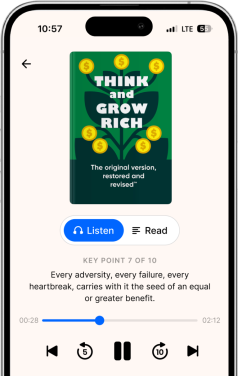
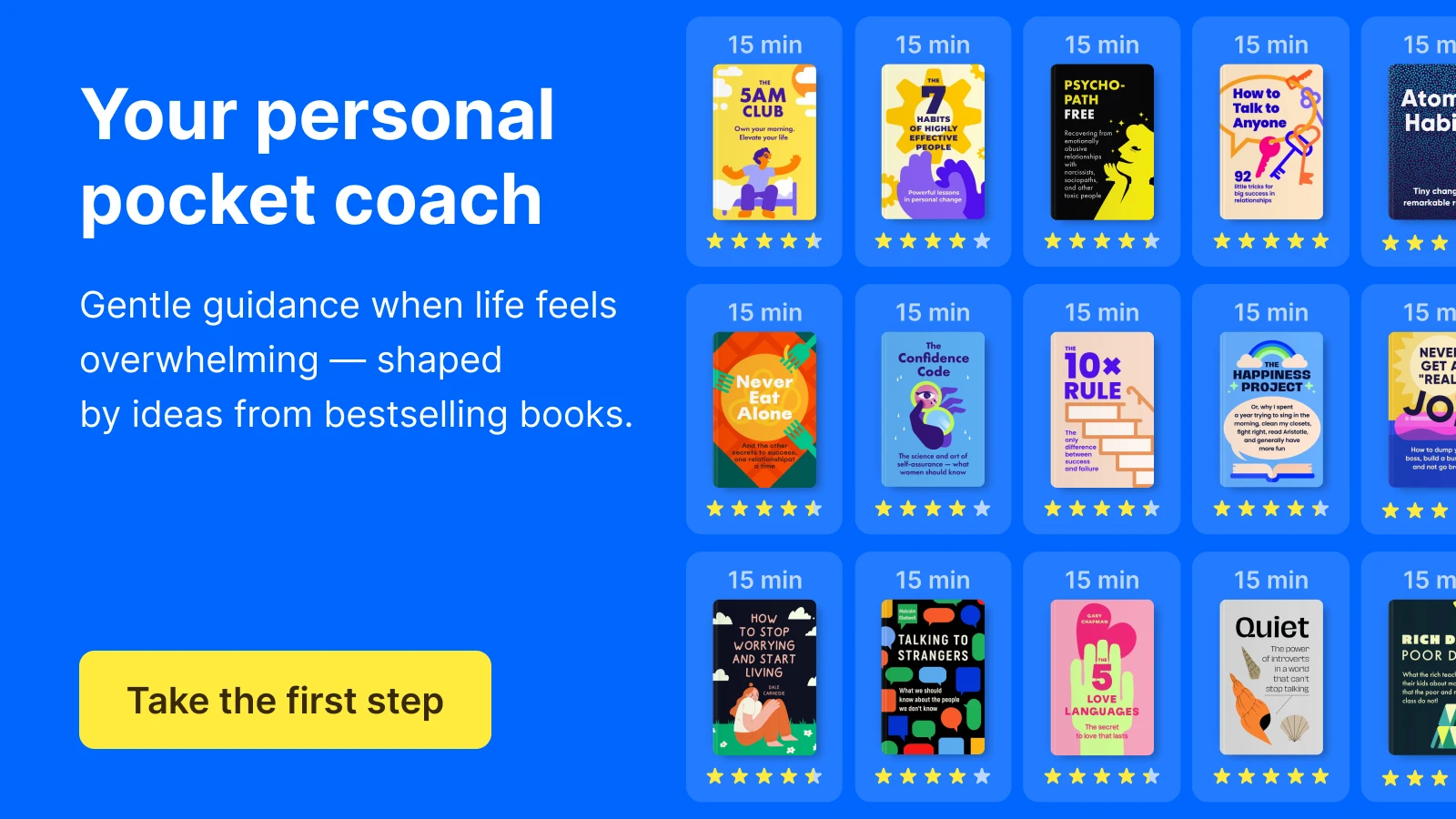
Finding the right entry point into the field of psychology can feel like trying to find a specific needle in a giant haystack. With thousands of titles out there, picking up a heavy textbook might actually discourage you from learning. If you're looking for a shortcut, Headway helps you skip the fluff. The app distills the world's best psychology bestsellers into actionable book summaries, making it easy to absorb life-changing insights without the mental fatigue.
➡️ How exactly does Headway work?
The list below focuses on the best psychology books for beginners — books that strip away the confusing jargon and offer eye-opening insights you can use immediately. Whether you choose to read the full titles or start with their key ideas on Headway, these resources will help you decode the human mind in record time.
Quick Answer: What are the best psychology books for beginners?
If you're looking for a shortcut to the most impactful ideas, these titles are the perfect place to start. They're widely considered must-read classics because they explain complex human traits in simple, relatable ways.
'Thinking, Fast and Slow' by Daniel Kahneman: Learn how your brain uses two different systems to make decisions.
'Man's Search for Meaning' by Viktor Frankl: See how finding a purpose helps humans survive even the darkest times.
'Influence: The Psychology of Persuasion' by Robert Cialdini: Understand the hidden triggers that make people say "yes."
'Brain Rules' by John Medina: A guide to how your brain works at work, home, and school.
'The Body Keeps the Score' by Bessel van der Kolk: Explore how our bodies store emotional trauma and how we can heal.
Why you should start reading psychology today
It feels like everyone is trying to get a better handle on their own mind lately. You aren't imagining it — a 2025 Google Trends study shows that US searches for things like anxiety and depression climbed fast between 2023 and 2025. Anxiety is hitting record highs, while interest in therapies like cognitive behavioral therapy (CBT) is picking up major steam. This shift has also sparked a massive wave of digital mental health tools and AI-driven support. In fact, the global online therapy market is set to surpass $64 billion by the end of this year.
You can also see this hunger for answers on our bookshelves. Sales of psychology-focused self-help books rose by nearly 20% recently. Americans now buy over 18.6 million of these books every year to tackle burnout and find resilience.
Podcasts have followed the same path, with shows like 'The Happiness Lab' consistently dominating the charts. All this proof shows that we are all looking for ways to understand our own logic. Learning these concepts is the first step toward building better connections and truly boosting your well-being.
Best psychology books for understanding the human mind
To understand how we think, we have to look under the hood. The following books are world-famous for their ability to explain the "why" behind our thoughts and actions.
1. 'Thinking, Fast and Slow' by Daniel Kahneman
It's a massive bestseller for a reason. Daniel Kahneman, a Nobel Prize winner in Economic Sciences, explains that our brains have two modes: System 1 is fast and emotional, while System 2 is slower and more logical. Most of our mistakes happen when we let the fast system take the wheel when we should be using the slow one. It's a foundational text in psychology that'll change how you view every choice you make.
The book explores how these two systems often clash, leading to cognitive biases that affect our judgment. By understanding these mental shortcuts, you can learn to pause and engage your logical mind before making impulsive decisions. It's essentially a manual for better thinking, helping you recognize when your intuition is helping you and when it is leading you astray.
2. 'The Man Who Mistook His Wife for a Hat' by Oliver Sacks
If you prefer storytelling over statistics, this book is for you. Oliver Sacks was a neurologist who shared fascinating case studies of patients with unusual brain conditions. By looking at what happens when the brain breaks, we learn incredible things about how a healthy human mind usually works. It's one of those eye-opening reads that feels more like a collection of mysteries than a science book.
Sacks manages to treat his patients with deep empathy, turning clinical observations into profound reflections on identity and the human spirit. Each story challenges your assumptions about reality, showing just how much our brains construct the world we see. It's a perfect pick for those who want to see the human side of neuroscience and understand the mind's resilience.
Top picks for social psychology and persuasion
We live in a world where everyone is trying to sell us something — an idea, a product, or a version of themselves. These books teach you how to spot those tactics and how to use them ethically to reach your own goals.
3. 'Influence: The Psychology of Persuasion' by Robert Cialdini
Robert Cialdini is a giant in the world of social psychology. In this book, he outlines the six principles of persuasion, such as reciprocity (our urge to give back when we receive) and social proof (doing what others do). Whether you are a business owner or just want to be a smarter consumer, you should read this.
Cialdini spent years working "undercover" at used-car lots and telemarketing firms to observe these triggers in action. He explains that these automatic responses were once survival mechanisms, but in our modern world, they are often used to manipulate us. Understanding these rules helps you defend yourself against unwanted influence and communicate your ideas effectively to others.
4. 'How to Win Friends and Influence People' by Dale Carnegie
While often labeled as self-help, this book is actually a masterclass in human behavior. Dale Carnegie's advice has lasted for decades because it focuses on basic psychological needs: the desire to feel important and appreciated. It's a practical guide for anyone wanting to improve their everyday life interactions.
Carnegie provides simple, actionable rules, like using a person's name and showing genuine interest in their stories. While the title might sound calculating, the core message is about building sincere connections through empathy and active listening. It remains one of the most popular book recommendations for anyone looking to bridge the gap between their goals and their relationships.
5. 'Scientific Advertising' by Claude C. Hopkins
If you're interested in the psychology of persuasion within business, this one is a classic. Claude C. Hopkins explains that people don't buy products; they buy solutions to their problems. By understanding consumer psychology, you can create messages that actually resonate with what people want.
Hopkins argues that advertising should be treated as a science, with every campaign tracked and measured for its psychological impact. He covers everything from the importance of headlines to the power of giving away samples. It's a must-read for marketers and entrepreneurs who want to understand the deep-seated motivations that drive consumer behavior.
Essential reading list for mental health and well-being
Sometimes, we read psychology to heal. These books focus on the emotional side of being human, offering tools to manage stress, trauma, and the search for happiness.
6. 'Man's Search for Meaning' by Viktor Frankl
Viktor Frankl was a psychiatrist who survived the Holocaust. He observed that the prisoners who had the best chance of survival were those who could find a "why" for their existence. This book is a powerful look at the resilience of the human spirit and remains a top recommendation for anyone looking for perspective on their own life.
The first half of the book is a chilling account of his experiences in concentration camps, while the second half introduces his theory of logotherapy. Frankl argues that we can't always control our circumstances, but we can always choose our attitude toward them. It's a deeply moving work that offers a psychological blueprint for finding purpose even in the most difficult times.
7. 'The Body Keeps the Score' by Bessel van der Kolk
This book has spent years on the bestseller lists because it completely changed how we think about trauma. Bessel van der Kolk shows that trauma isn't just "in your head" — it actually changes the physical structure of your brain and body. It's a must-read for anyone interested in the link between neuroscience and emotional healing.
He details how traditional "talk therapy" often fails to reach the parts of the brain where trauma is stored. Instead, he explores alternative treatments like yoga, neurofeedback, and theater to help survivors reconnect with their bodies. This book provides a hopeful and scientific look at how we can move past the past and reclaim our lives.

8. 'The Happiness Hypothesis' by Jonathan Haidt
Jonathan Haidt looks at ancient wisdom through the lens of modern science. He compares the mind to a rider on an elephant: the rider is our conscious thought, and the elephant is our gut instinct. This book helps you understand how to get the two to work together to improve your overall well-being.
Haidt examines ten "Great Ideas" from history and tests them against the latest psychological research. He tackles everything from the importance of community to the role of genetics in our base level of happiness. It's an incredibly balanced book that avoids the "toxic positivity" found in some self-help titles while providing real tools for a better life.
9. 'The Dance of Anger' by Harriet Lerner
Anger is an emotion that many of us try to hide, but Harriet Lerner argues it's actually a useful signal. This book teaches you how to use anger to identify what isn't working in your relationships. You can use it as a guide in changing long-standing patterns of behavior in intimate dynamics.
Lerner focuses on the concept of "differentiation" — maintaining your own sense of self while staying connected to others. She explains how we often get stuck in circular arguments that lead nowhere and provides a path to communicate our needs more effectively. It's an essential read for anyone looking to turn conflict into an opportunity for growth and clarity.
Beginner-friendly deep dives: Understanding memory, habits, and skill
If you want to focus on specific cognitive abilities — like how to learn faster or remember more — these books provide the "how-to" guide.
10. 'Brain Rules' by John Medina
John Medina is a developmental molecular biologist who knows how to make science fun. He lays out 12 rules for how our brains work, such as the fact that exercise boosts brain power and that we don't pay attention to boring things. It's a fantastic starting point for beginners who want to thrive at work and at home.
The rules are presented in a very practical way, showing how you can reorganize your office or your study schedule to match how your brain actually learns. Medina's writing is clear and filled with humor, making it easy to see how simple lifestyle changes can have a massive impact on your cognitive abilities.
11. 'Remember: The Science of Memory and the Art of Forgetting' by Lisa Genova
Lisa Genova explains that forgetting isn't always a sign of a problem; sometimes, it's just how the brain stays efficient. She walks you through the difference between "tip-of-the-tongue" moments and actual memory loss. It's a comforting and clear look into the intricate workings of the human mind.
She uses relatable examples to show why you might forget where you parked your car but remember the lyrics to a song from 20 years ago. By understanding the different types of memory, you can stop stressing over normal lapses and start using techniques that actually help you store important information.
12. 'Mindless Eating: Why We Eat More Than We Think' by Brian Wansink
Why do we eat more when we're with friends or watching TV? Brian Wansink used behavioral experiments to show how our environment can nudge us into overeating. It's behavioral psychology at its most practical.
He reveals that we often eat based on visual cues — like the size of a bowl — rather than our actual hunger signals. By making small changes to your kitchen and your habits, you can lose weight or eat healthier without ever feeling like you're on a restrictive diet.
13. 'The Talent Code' by Daniel Coyle
Daniel Coyle traveled to "talent hotbeds" around the world to find out how people become great at what they do. He found that greatness isn't born; it's grown through a specific type of practice that builds a substance in the brain called myelin.
The book explains that talent is about insulation — the thicker the myelin sheath around your neural circuits, the faster and more accurate your skills become. Coyle provides a roadmap for "deep practice," showing how anyone can improve their performance by breaking skills into small, manageable chunks.
14. 'The Black Swan' by Nassim Nicholas Taleb
This book explores the impact of highly improbable events. Nassim Nicholas Taleb argues that we are psychologically wired to ignore the possibility of "Black Swans" and then try to explain them away after they happen. It's a deep dive into the psychology of decision-making and our natural biases.
Taleb challenges the use of standard statistical models for predicting the future, showing how they often fail when we need them most. He encourages readers to build lives and systems that are "robust" to shocks, rather than relying on the illusion of certainty in an unpredictable world.
15. 'Stumbling on Happiness' by Daniel Gilbert
Daniel Gilbert explains that our brains are poorly equipped to predict what will make us happy in the future. He uses a mix of humor and hard science to show how our imaginations trick us into thinking we know what we want. It's a fascinating study of the psychological quirks that prevent us from achieving long-term satisfaction.
The book delves into why we remember the past incorrectly and how these memories influence our future choices. Gilbert proves that our current emotional state colors our expectations for the future, leading to a cycle of "stumbling" toward happiness without ever quite reaching it.
16. 'Quiet: The Power of Introverts in a World That Can't Stop Talking' by Susan Cain
Susan Cain argues that our society is built for extroverts, leading us to overlook the incredible contributions of introverts. She explores the psychology of temperament and how it affects our success in the workplace, school, and relationships. It's a must-read for anyone who feels like they don't fit the "loud" mold of success.
The book provides a deep dive into the brain science of introversion, showing that it isn't a flaw but a different way of processing the world. Cain offers practical advice for introverts on navigating extroverted spaces without losing their identity, while also teaching extroverts how to collaborate more effectively with their quieter counterparts.
17. 'Daring Greatly' by Brené Brown
Brené Brown explores the psychology of vulnerability and how it's actually a sign of strength, not weakness. Based on years of research into shame and connection, she argues that we cannot truly live a "wholehearted" life without embracing the possibility of failure. It's a transformative look at the emotional barriers that hold us back.
She explains that we often use "armor" — like perfectionism or numbing — to protect ourselves from hurt, but these same tools keep us from experiencing joy. This book provides a roadmap for letting go of the need to be perfect and finding the courage to show up as your authentic self.
18. 'Flow: The Psychology of Optimal Experience' by Mihaly Csikszentmihalyi
Mihaly Csikszentmihalyi introduces the concept of "flow" — a state of total immersion where time seems to disappear. He explores how we can achieve this state more often in our work and hobbies to increase our overall life satisfaction. It's a foundational text in positive psychology that focuses on the science of happiness through engagement.
The book explains that happiness isn't something that happens to us; it's something we create by taking on challenges that match our skills. By understanding the conditions required for flow, you can turn even mundane tasks into rewarding experiences that contribute to your personal growth.
19. 'Emotional Intelligence' by Daniel Goleman
Daniel Goleman argues that your "EQ" is actually more important for success than your IQ. He explores the five core components of emotional intelligence — self-awareness, self-regulation, motivation, empathy, and social skills — and how they affect everything from our health to our careers.
The book offers a biological perspective on how our emotions can "hijack" our rational brain and what we can do to stay in control. Goleman shows that emotional intelligence is a set of skills that can be learned and improved at any age, offering a clear path to better self-management and leadership.
20. 'Predictably Irrational' by Dan Ariely
Dan Ariely shows that humans aren't the logical creatures we think we are; instead, we make the same irrational mistakes over and over again. From why we overvalue what we own to how "free" offers trick us into spending more, this book is full of surprising revelations about our behavioral quirks.
He explores how social norms and market norms clash, and how our expectations can actually change our physical experience of things (like wine tasting). It's an eye-opening look at the hidden forces that shape our choices every day, helping you recognize your own biases before they lead you astray.
21. 'The Power of Habit' by Charles Duhigg
This book is a perfect companion for anyone starting their psychology journey. Charles Duhigg explains the "habit loop" — the cycle of cue, routine, and reward that drives everything from brushing our teeth to smoking. Understanding this loop is the secret to breaking bad habits and building good ones.
By reading the Headway summary, you'll learn how to identify the hidden triggers in your environment. It's a practical, science-backed approach to taking control of your daily actions and improving your long-term success. Duhigg shows that you don't need more willpower; you just need a better system.
Prioritize your growth with Headway
Starting your journey into psychology is one of the most generous gifts you can give yourself. Whether you want to master your emotions, understand the people around you, or simply build a more resilient mind, the insights you've discovered today are the first step toward a more intentional life. Choose one book today and watch how even a small amount of knowledge can lead to massive results in your personal growth.
And if you're excited by all these titles but your schedule is packed, you don't have to wait until you have a free weekend to start. The Headway app helps you turn these psychology insights into a daily habit. Instead of feeling guilty about a growing reading list, you can listen to 15-minute summaries while you drive or read key takeaways during your lunch break.
📘 Prioritize daily growth with Headway.
Frequently asked questions about psychology books for beginners
What is the best psychology book for understanding everyday life and neuroscience?
For a blend of everyday application and neuroscience, 'Brain Rules' by John Medina is hard to beat. It explains how physical factors like sleep, stress, and movement affect your brain's performance. You'll learn about your mind while getting actionable tips to improve your daily routine.
What are the best psychology books for beginners on Amazon?
When searching on Amazon, you'll find that titles like 'Thinking, Fast and Slow' consistently top the charts. Amazon's great for buying physical books, but Headway offers a faster route to the same wisdom. In just a few minutes, you can absorb the key ideas from these bestsellers and keep your growth journey moving.
Which must-read psychology books focus on psychotherapy?
If you're curious about the therapeutic process, 'Maybe You Should Talk to Someone' by Lori Gottlieb is an excellent starting point. The book offers a rare, behind-the-scenes look at the relationship between therapist and patient. It makes the world of psychotherapy feel accessible, human, and deeply relatable for any new reader.
Are there any good psychology reviews on Goodreads for beginner books?
Goodreads is a fantastic resource for checking community reviews and ratings before you commit to a book. Once you've browsed the reviews there, Headway can help you take the next step with quick summaries of the key ideas. It's the perfect way to see whether a book like 'Man's Search for Meaning' matches your growth goals before you buy.
Who is the most famous figure in the field of psychology (Freud, Aronson)?
Sigmund Freud is undoubtedly the most famous name, known for his groundbreaking work on the subconscious. That said, modern psychology students often find the work of Elliot Aronson or Daniel Kahneman more applicable today. While Freud started the conversation, newer researchers have provided the data-driven insights we actually use in modern behavioral science.
Is 'Stumbling on Happiness' a good psychology book for beginners?
Yes, 'Stumbling on Happiness' by Daniel Gilbert is a fantastic read for beginners. It explores why humans are so bad at predicting what will actually make them happy in the future. Gilbert uses humor and solid research to explain the psychological quirks that keep us from achieving long-term satisfaction.