Self-growth
 Business & Career
 Success
 Communication
 Healing
 Relationships
 Psychology
 Happiness

President vs CEO is one of those distinctions that sounds obvious until someone asks you to explain it. Both titles sit at the top of the org chart and carry significant weight.
Yet the roles, mindsets, and day-to-day realities are often quite different. Understanding these key differences matters whether you're climbing toward the C-suite, leading a team right now, or building a business from scratch.
This article breaks down a clear president vs ceo comparison and explores the skills needed to thrive. Whether you're mapping out a career plan or decoding a job posting, you'll leave with a clearer picture.
To deepen your leadership knowledge, you need the right resources at your fingertips. Headway bridges this gap by providing bite-sized insights from the world's most powerful business and management books.
Download the Headway app today to accelerate your journey to the top!
★★★★★ 172K+ reviews
Empower yourself with the best insights and ideas!
Get the #1 most downloaded daily growth app.
Get startedQuick summary: CEO vs. president compared
Here's what you need to know right now:
The CEO (Chief Executive Officer) is the highest-ranking executive in an organization, responsible for long-term strategy, company vision, and stakeholder relationships.
The president of the company is typically the second-in-command, focused on operational execution and on managing the company's internal performance and teams.
In many small businesses and startups, one person holds both titles simultaneously.
CEOs are outward-facing. They represent the company to the board of directors, investors, partners, and the public.
Presidents are inward-facing. They translate the CEO's strategy into the day-to-day operations that actually move the business forward.
President vs CEO vs owner: Key differences
The three roles differ most clearly in focus, authority, and accountability. Here's how they break down.
| Role | Primary focus | Key responsibilities | Accountability & authority |
|---|---|---|---|
CEO | Strategic & external-facing | Sets overall strategy, long-term vision, and big-picture direction. Acts as the face of the company and manages the relationship with the chairman of the board and the directors. | Accountable for shareholder value and corporate governance. Reports directly to the board of directors. |
President | Operational & internal-facing | Oversees day-to-day operations, manages the executive team/VPs, and translates high-level strategy into actual execution. | Accountable for operational performance. Reports to the CEO, managing director, or business owner. |
Owner | Financial control & final authority | Holds the financial stake. May delegate daily functions or actively hold the CEO/President titles themselves. | Has the final say on significant business decisions, regardless of operational involvement. |
In practice, the lines between the roles of a CEO, a president, and an owner blur constantly. This is especially true in smaller companies, where the business owner may also hold the CEO title and serve informally as president.
📘 Master C-suite dynamics and lead with clarity, start with Headway!
Key responsibilities that separate presidents from CEOs
While both roles demand exceptional leadership, their daily focus areas diverge significantly. Understanding exactly where a CEO's duties end and a president's begin is crucial for a smooth-running executive team. Here's a closer look at the specific domains each leader owns.
CEO responsibilities: Strategic and external
The CEO is the steward of the company's vision. This role lives in the world of long-term strategy, partnerships, and corporate decisions that shape the direction of the entire organization. Concretely, a CEO's responsibilities include:
Setting and communicating the company's vision. The CEO decides where the business is going and makes sure every stakeholder, from the board of directors to the executive team to frontline employees, understands and buys into that direction.

Master strategic decision-making and get expert ideas.
Managing the board relationship. CEOs report to and answer to the board members. This includes presenting performance data, aligning on strategic goals, managing shareholder value expectations, and navigating corporate governance requirements.
External representation. The CEO is the face of the company. They lead investor relations, manage major partnerships, handle high-stakes public communications, and build the company's reputation in the market.
Capital allocation and big-picture resource decisions. Which markets to enter, which company strategy to pursue, whether to acquire or divest: these are CEO-level calls. The CEO is also typically responsible for recruiting and managing other senior executives, including the president and CFO.
Example metric: A CEO at a growth-stage company might track revenue trajectory, market share expansion, and net promoter score to gauge whether the company's vision is resonating.
📘 Decode executive roles and climb faster with insights from Headway!
The President's responsibilities: Operational and internal
The president translates the CEO's strategy into execution. Where the CEO is asking "where are we going?", the president is answering "how do we get there?". Their responsibilities include:
Overseeing day-to-day operations. The president manages the daily operations of the business, including systems, teams, and processes that keep the company running smoothly.
Managing senior leaders. While the CEO sets the company's vision, the president typically manages the vice presidents and department heads responsible for human resources, sales, product, and operations. They're the connective tissue between business strategy and execution.
Driving performance. The president is accountable for hitting the short-term targets that ladder up to the long-term strategy. This means managing the executive team's performance, removing obstacles, and escalating problems before they become crises.
Internal culture and operational excellence. Presidents shape the company's internal environment. They define how the organization works, how decisions are made, how conflicts are resolved, and how teams collaborate.
Example metric: A president might be tracking operational efficiency ratios, employee engagement scores, and cross-functional project completion rates.
📘 Understand who drives strategy vs. execution with Headway!



When one person holds both titles
In startups and small businesses, the president vs CEO distinction often doesn't exist in practice. The founder wears both hats, sometimes all the hats. Here's when companies combine the roles and when they split them:
When roles combine: Early-stage startups where one founder is running everything. Small businesses where the business owner is also the top executive. Companies where operational and strategic leadership are tightly coupled. Situations where the board wants a single point of accountability at the top.
When roles separate: Companies that have scaled to a point where one person can't credibly own both the vision and the execution. Situations where the CEO is highly external-facing and needs a strong operational counterpart.
Governance and corporate structures that require distinct roles, which is often the case in public companies. When a founder CEO brings in a seasoned operational leader as president to complement their strengths.
The split typically happens as a company scales from startup to established enterprise. Smaller companies often operate just fine with one person handling both functions. As the organization grows in complexity, the two roles naturally diverge.
The demands of corporate governance, stakeholder management, and strategic planning become a full-time job on their own, separate from the work of managing day-to-day operations.
📘 Learn what CEOs actually do all day with Headway!
Skills and mindset: Цhat leaders in each role must develop
Understanding the difference between these roles isn't just organizational trivia. It's a career development question. The skills you need to succeed as a CEO versus a president are meaningfully different, even though both require exceptional leadership.
Strategic thinking vs. operational excellence
CEOs live in the world of strategic planning, big-picture thinking, and long-term goals. They need to hold ambiguity, make decisions under uncertainty, and communicate a company's vision in a way that motivates and aligns the entire organization.
Presidents need operational excellence: the ability to build systems, manage complexity, and drive consistent execution across the entire business. This is the discipline of turning strategy into scorecards, processes, and accountability structures.
Reid Hoffman's 'Masters of Scale' is essential reading for the strategic dimension of leadership. It unpacks how visionary founders think about scale and how the best leaders build companies that can grow far beyond their own direct involvement.
Vision setting vs. execution mastery
Setting a company's vision requires more than knowing where you want to go. It means building the narrative, earning trust, and staying the course when the market pushes back. For CEOs, this is a core competency.
For presidents, execution mastery is the equivalent. Verne Harnish's 'Scaling Up' is one of the most practical frameworks available for leaders who need to build the operational infrastructure that turns ambitious goals into actual results.
If you're in or moving toward a president-type role, this book belongs in your regular reading rotation.
📘 Master operational excellence like top presidents using Headway!
Decision-making psychology
Both roles require high-quality decision-making under pressure, but the nature of the decisions differs. CEOs are often making calls with limited information and long time horizons, where the cost of being wrong might not surface for years.
Presidents are making decisions faster, with more data, and with consequences that show up in the next quarter's numbers.
Kim Scott's 'Just Work' is a valuable lens for understanding how leaders create environments where good decisions actually get made, where people can challenge ideas, surface problems, and contribute fully without being shut down by hierarchy or bias.
Emotional intelligence
This one applies equally to both roles. The highest-ranking executives, whether president or CEO, need the emotional range to lead people through uncertainty, give hard feedback, and maintain trust across a complex organization. The best leaders understand that corporate decisions ripple through real people's lives.
The deeper examination of startup culture in 'The Cult of We' offers instructive case studies in what happens when emotional intelligence breaks down at the top.
📘 Discover when to split roles for maximum growth with Headway!
How you can build your leadership knowledge: Quick growth habits
You don't have to wait for a C-suite executive to start building the mindset that gets you there. Here's a daily routine built around leadership reading that any professional can implement:
Morning (5-10 min): Audio summary on visionary leadership. Try 'Masters of Scale' by Reid Hoffman to understand long-term strategy.
Commute (5-10 min): Practical operational content. 'Scaling Up' by Verne Harnish is the go-to for operational excellence and execution mastery.
Mid-day (10 min): Reflection on a recent decision. Journal on one strategic or operational call you made and what you'd do differently.
Evening (10 min): Short text summary on culture or organizational dynamics. 'Just Work' by Kim Scott is excellent for understanding internal environments.
Weekly: One deeper dive into 'The Cult of We' by Eliot Brown and Maureen Farrell for a real-world case study in shaping corporate culture.
The leaders who become good managers and eventually top executives aren't the ones who worked harder. They're the ones who learned smarter. Reading is the highest-leverage leadership development tool available to you.
📘 Develop CEO-level decision-making skills with Headway!
My personal experience as a CEO
I've held senior executive roles across major organizations, and I can tell you that the gap between what the president vs CEO distinction looks like on paper versus what it feels like in practice is significant.
On the day-to-day reality of the CEO role: The biggest misconception is that the CEO is removed from the details. In my experience, it's the opposite. The CEO needs to be close enough to the business to sense when something is wrong, while maintaining enough altitude not to get pulled into execution problems that belong to the operational leaders.

Unlock your full leadership potential by taking the quiz.
That balance is genuinely difficult. You're constantly managing the tension between zooming in and zooming out.
On key decision-making moments: Some of the most defining moments I've experienced as an executive aren't the big strategic announcements. They're the quieter calls about organizational structure, resource allocation, and people.
Deciding when to separate roles that had been combined, or when to consolidate them, often has more long-term impact than any product or market decision.
On combining CEO and president functions: When you're carrying both hats, the risk is that the operational demands of running day-to-day operations crowd out the time you need to think strategically. The calendar doesn't lie.
If your week is consumed by managing the executive team, resolving process breakdowns, and handling internal escalations, you are functioning as a president, whether that's in your title or not.
On the role of reading and self-growth: The most consistent pattern I've observed in executives who continue to develop, versus those who plateau, is their reading habits. Being a good leader is not a destination. It's a practice.
The leaders I respect most are still learning, still curious, still willing to have their models challenged. Books, especially the kind that give you frameworks alongside real-world stories, are one of the most efficient ways to borrow others' hard-won experience.
📘 Build emotional intelligence for executive success using Headway!
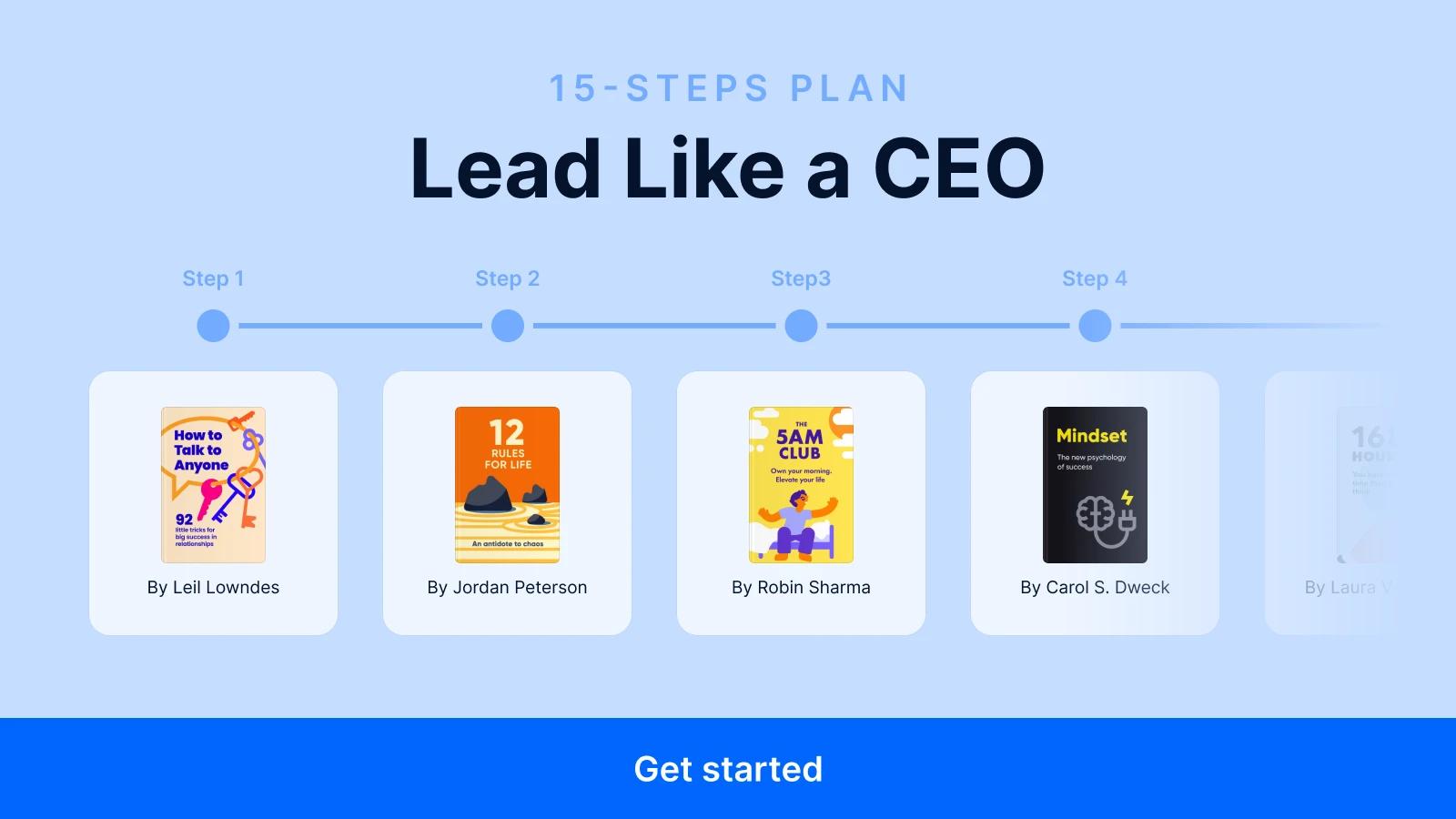
Boost your career growth with Headway book summaries
To bring it back to the core question: the president is focused on running the company's daily operations and managing internal performance.
The CEO is focused on setting the company's vision, managing the board of directors, and representing the organization externally. In smaller companies, one person does both. As organizations scale, the roles diverge, and so do the skills required to succeed in each.
If you're serious about creating a career plan that leads toward senior leadership, start building your knowledge base now. Headway's book summaries give you the core insights from the books that matter most, in the time you actually have.
Whether you're building toward a president-level operational role or a CEO-level strategic one, the intellectual foundation is the same: wide reading, rigorous reflection, and the willingness to keep learning.
'The Cold Start Problem' is another excellent addition for leaders thinking about growth, network effects, and the strategic challenges of scaling. And if you're networking your way into leadership circles, that book will reframe how you think about building relationships at scale.
For more tips like that, get the Headway app and learn on the go!
FAQs
What's the difference between president and CEO?
The CEO (Chief Executive Officer) is the highest-ranking executive responsible for the company's overall direction, long-term strategy, and stakeholder relationships. The president typically operates as the second in command, managing day-to-day operations and executing on the CEO's strategy. In many organizations, especially smaller companies, one person holds both titles simultaneously.
Can a company operate without a president?
Yes. Many companies, particularly in the startup and small-business space, operate with a CEO and no separate president. The president's role often emerges as a company scales and needs dedicated operational leadership to complement the CEO's more external, strategic focus. It's a structural choice, not a requirement.
Is the president higher than a COO?
Generally, yes, though it depends on the organization. The president is typically the second-in-command after the CEO, while the COO (Chief Operating Officer) focuses specifically on operations. In some companies, the president and COO titles are combined. In others, the president has broader authority across the entire company, while the COO is specifically accountable for operational functions.
What's the career path to each role?
The path to CEO typically runs through strategic leadership roles: general management, business-unit leadership, and senior executive positions, where you build a track record of setting direction and delivering results at scale. The path to the presidency more often runs through operational excellence, VP-level roles managing large functions, followed by broader general management. Both benefit from diverse experience, strong networks, and ongoing investment in leadership development.
Can a president also be the CEO of a company?
Absolutely. This is common in founder-led businesses, small businesses, and early-stage startups. When one person holds both the president and CEO titles, they're accountable for both the strategic vision and the day-to-day operations of the company. As organizations grow, companies often separate roles to allow each area to receive dedicated leadership focus.
What are the key skills needed to succeed as a president or CEO?
For CEOs: strategic thinking, vision-setting, stakeholder communication, board relationship management, and the ability to make high-stakes decisions under uncertainty. For presidents: operational excellence, execution discipline, people management, cross-functional coordination, and the ability to translate strategy into results. Both roles require strong emotional intelligence, sound decision-making, and commitment to continuous learning.