
 Self-growth
 Apps & Digital Tools
 Business & Career
 Success
 Growth Tools
 Psychology
 Communication
 Relationships

You've got a cloud certification to chase, a framework your team adopted last quarter, and a backlog that couldn't care less about either. So where does real skill-building actually fit?
That question is the whole reason people land on a Pluralsight review before they subscribe. Pluralsight is a subscription-based learning platform built for one job in particular: helping technologists get better at technical work — software development, cloud, data, security, and IT operations — through video courses, hands-on labs, and skill assessments.
This Pluralsight review 2026 walks through what you get, what it costs, where it shines, and where a different kind of tool might serve you better.
One quick note on where Headway comes into this. Headway is a book-summary app, and it isn't a Pluralsight rival — the two do genuinely different jobs, and I'll keep that distinction honest throughout.
If your goal is passing an AWS exam, Pluralsight is built for you. If you also want the leadership, focus, and communication skills that shape a tech career — and you'd rather absorb them in 15-minute audio sessions on your commute — that's where Headway fits.
📘 Want the durable-skills side of a tech career in bite-sized audio? See how Headway fits a schedule like yours.
All app features and prices described in this article are accurate as of September 2026.

Quick answer: What is Pluralsight at a glance
Short on time? Here's the summary before the details.
What it is: A subscription learning platform for technology skills, with video courses, learning paths, hands-on labs, and skill assessments.
Best for: Developers, IT professionals, and teams who want structured, in-depth training in software development, cloud, data, security, and IT operations.
Course topics: Software development, IT operations, product & UX, and business skills, with expanded libraries for AI, data, cloud, and security.
Pricing: Individual plans start at $21/month for Core Tech (billed yearly); the Complete plan runs $39/month (billed yearly). Business plans start at $47/month per user.
Free trial: Individual plans include a 10-day free trial.
Standout features: Skill IQ and Role IQ assessments, 3,500+ hands-on labs, cloud and AI sandbox environments, and certification prep.
Keep in mind: It's a specialist tool. If you want soft skills, personal growth, or something you can learn during a run, you'll want a different app alongside it.
📘 Weighing a few learning tools at once? Get your first big idea in 15 minutes with Headway.
What is Pluralsight and how does it work?
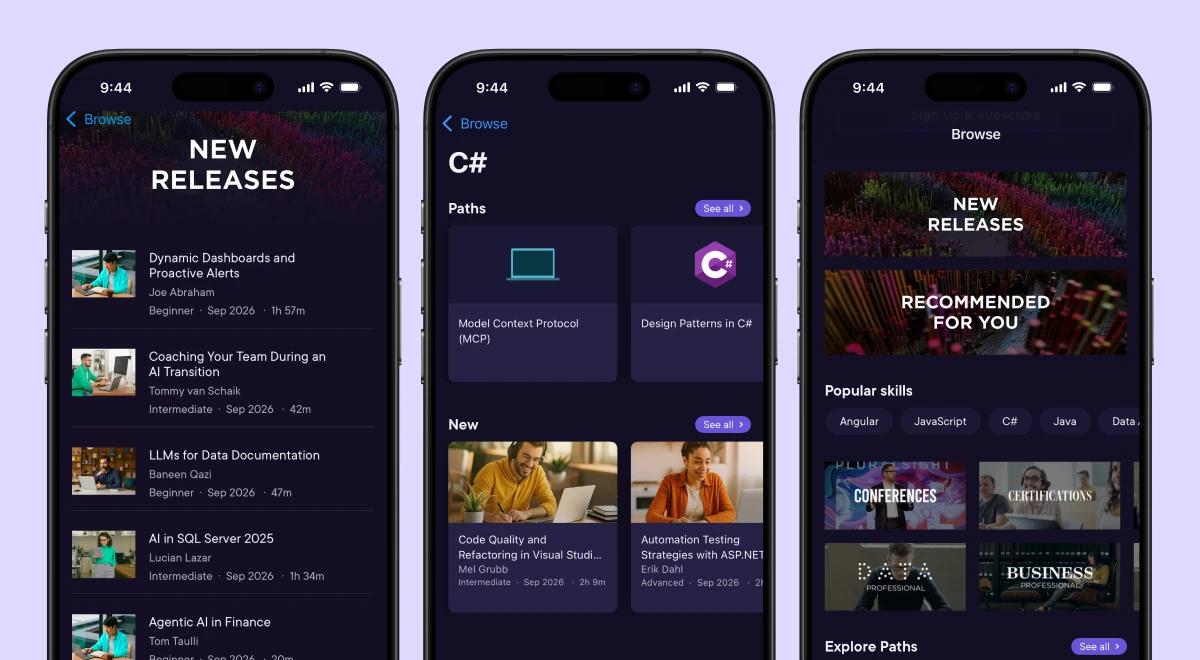
Pluralsight is a technology-focused learning platform that Pluralsight itself describes as "the leading skill development app." Instead of a marketplace of one-off classes, it runs on a subscription model: you pay for access, then work through video courses, structured learning paths, and practice environments at your own pace.
The setup splits cleanly into two audiences. For individuals, Pluralsight pitches "brand-new tech skills" for career growth. For organizations, it positions itself as a way to build tech teams and deliver on initiatives. Either way, the core loop is the same: pick a topic, follow a path, practice in a lab, and check your skill level with an assessment.
On scale, Pluralsight leans on a few numbers from its own About page: 2,500+ expert authors, business customers in 180 countries, and a claim that it's trusted by 70% of the Fortune 500.
The company is headquartered in Texas and lists names like Amazon, Microsoft, Cisco, and Wells Fargo among its business customers. You can learn on the web, on the mobile app for iOS and Android, or through a desktop app that supports offline streaming — handy for a flight or a spotty connection.
Pluralsight courses and course quality
The catalog is the reason most people show up, so let's start there. Pluralsight courses are video-based and organized by tech domain, and the two main individual tiers draw a clear line through the library.
What the course library covers
The Core Tech plan opens access to 3,900+ courses across software development, IT operations, product & UX, and business skills. The Complete plan expands that to 6,500+ courses and adds the specialized libraries — AI, data, cloud, and security — that a lot of technologists are chasing right now. For a developer moving toward machine learning or a sysadmin pivoting into cloud, that expanded set is usually the deciding factor between the plans.
Course depth and who it's built for
Course quality on Pluralsight skews toward depth rather than breadth of trivia. Subject-matter experts (those 2,500+ authors again) author the courses, and the platform is designed for people who want to genuinely build a skill, not just watch a two-hour overview and move on.
If you're a beginner, the structured paths keep you from guessing what to learn next; if you're an intermediate learner or a working professional, the specialized libraries give you somewhere to go deeper. It's programming courses, cloud training, data science courses, and security material presented as a curriculum rather than a pile of videos.
Learning paths and skill paths
Individual courses are useful, but the learning paths are where Pluralsight earns its keep for career development. A path strings courses together into an ordered route toward a specific outcome — say, becoming proficient in a language, a cloud provider, or a security discipline.
The business library lists 900+ curated learning paths, and the platform frames them around a clear idea: figure out where you stand, then chart a trajectory to proficiency. Instead of deciding whether to watch the Django course before or after the REST fundamentals course, you follow a path built by someone who already knows the sequence.
For anyone who freezes at the "so many courses, where do I even start" moment, that structure is a real part of the value.
Skill IQ, Role IQ, and skill assessments
Here's the feature set that separates Pluralsight from a plain video library. Its assessment tools try to answer a question most learning platforms dodge: how good are you, really?
Skill IQ measures your proficiency in a specific skill and shows you where the gaps are, so your next course isn't a guess.
Role IQ zooms out to a whole role — think "cloud engineer" or "software developer" — and maps your readiness across the skills that role demands.
Alongside those, Pluralsight surfaces skill rankings with weekly and all-time leaderboards, gives you opportunities to review key concepts, and points you toward tailored next steps. If you like knowing your number and watching it climb, this is the part of the platform you'll open most.
📘 Prefer to track progress the low-pressure way, with streaks instead of leaderboards? Set up your personalized plan on Headway.
Hands-on labs and hands-on practice
Watching someone deploy to a cloud console and doing it yourself are two very different experiences, and Pluralsight knows it. The platform includes 3,500+ hands-on labs plus real-world cloud sandbox and AI sandbox environments.
The point of hands-on practice here is that you write, run, and break things in a safe space instead of risking your own account or a production environment. For cloud and AI work especially, that sandbox time is often worth more than the videos — it's where a concept stops being abstract and turns into something your fingers remember.
This is a genuine strength, and it's a big reason Pluralsight suits people preparing for technical roles rather than casual browsers.
Certification prep and cloud certification
If a certification is your target, Pluralsight is built to get you there. Certification prep runs through the platform, and the business tier includes access to all certification practice exams.
Cloud certification is a particularly strong fit. With the Cloud+ library (which folds in A Cloud Guru courses) and the certification practice exams, you can study the material, practice in a live sandbox, and rehearse the exam format in one place. Pair that with a learning path, and you've got a fairly complete route from "I want this cert" to "I'm ready to sit it."

Pluralsight pricing: How much does a subscription cost?
Now the part everyone scrolls to. Pluralsight pricing is subscription-based, and the individual plans reward paying yearly — the site notes yearly billing saves 30% versus monthly.
Here's how the individual Pluralsight subscription breaks down (billed yearly):
| Plan | Price | What you get |
|---|---|---|
Core Tech | $21/month | 3,900+ courses across software development, IT operations, product & UX, and business skills, plus skill assessments, learning paths, certification prep, and hands-on labs |
Complete (most popular) | $39/month | Unlimited access to 6,500+ courses, everything in Core Tech, plus the expanded AI, data, cloud, and security libraries |
AI+ / Cloud+ / Data+ / Security+ | $24.50/month each | Core Tech plus one specialized library — hands-on AI, all A Cloud Guru courses, 1,400+ data science courses, or cybersecurity, respectively |
Pluralsight pricing is accurate as of September 2026. Prices may vary by region, current promotions, and seasonal offers—check pluralsight.com for the latest.
A 10-day free trial is available so you can test the platform before you commit. For teams, pricing shifts to a per-seat model: the For Teams plan (2–20 people) runs $47/month per user billed annually and includes the full 6,500+ course library, 3,500+ labs, 900+ paths, sandboxes, certification practice exams, and all Skill IQ and Role IQ assessments.
Larger organizations use the For Enterprise plan, which is quote-based through Pluralsight's sales team and adds custom sandboxes, a dedicated account team, and optional services like SSO and instructor-led training.
Pluralsight pros and cons
Every platform makes trade-offs. Here's the honest ledger.
What works well:
Real depth in tech. The courses, paths, and specialized libraries go deep on software development, cloud, data, and security — this is a specialist, and it shows.
Hands-on practice, not just video. Labs and cloud/AI sandboxes let you build, not just watch.
You always know where you stand. Skill IQ and Role IQ turn vague "I should learn this" into a measurable skill level.
Strong certification support. Practice exams plus sandbox time make it a solid certification-prep tool, especially for cloud.
Structured for busy people. Learning paths remove the paralysis of choosing what to study next.
Where it falls short:
It's a specialist, not a generalist. If you want soft skills, leadership, or personal growth, you're looking at the wrong catalog.
The value depends on consistency. A subscription only pays off if you actually finish paths — and technical courses ask for real focus, which is hard to summon at the end of a coding day.
Best at a desk. The learning is designed for focused sessions, not for a run or a school pickup.
Price adds up for casual learners. If you only need an occasional course, a subscription can feel like a lot.
📘 Want something that fits the pockets of time Pluralsight can't reach? Turn your commute or gym session into learning time with Headway.



How Pluralsight compares to other platforms
Pluralsight doesn't exist in a vacuum, and it's worth knowing where it sits before you subscribe. A few quick, honest distinctions (check each platform for current pricing, since it changes):
Pluralsight vs Udemy: Udemy is a marketplace of individually priced courses from independent instructors, so quality varies more, but you can buy a single class outright. Pluralsight is a curated subscription with consistent, expert-authored depth and built-in assessments.
Pluralsight vs Coursera: Coursera leans on universities and offers specializations and full degrees, which suits academic or credential-driven goals. Pluralsight is narrower and more practical, focused squarely on job skills for technologists.
Pluralsight vs LinkedIn Learning: LinkedIn Learning spreads across business, creative, and tech topics for a broad professional audience. Pluralsight goes deeper on tech and adds labs and skill assessments that LinkedIn Learning doesn't match.
If you're comparing learning tools more broadly — not just technical ones — it's worth reading around the category. There's a full breakdown of whether MasterClass is worth it for skill-based inspiration, a Course Hero review for study help, and a roundup of Duolingo alternatives for language learners.
On the book-summary side, you can check whether Blinkist is worth it, how Headway compares to Blinkist, a review of the Imprint app, and — for audiobook fans — whether Audible is worth it and how much Audible costs.
Where Headway fits into a tech career
Pluralsight builds the hard technical skills your job runs on. But a tech career isn't only cloud configs and clean code — it's leading a team, communicating under pressure, managing your focus, and making good decisions when the backlog is on fire. Those durable skills live in a different catalog.
That's the job Headway is built for. Headway turns the best ideas from 2,500+ bestselling books into 15-minute summaries you can read or listen to, across leadership, productivity, communication, psychology, and mindset. It's used by 60M+ people across 170 countries and was named one of TIME's World's Top 5 EdTech Companies in 2025.
The reason it slots so neatly next to a platform like Pluralsight is when and how you use it. Headway is audio-first, so plenty of people listen while they run, lift at the gym, walk the dog, or sit in traffic — turning time you'd never spend on a video course into learning time. A summary runs about 10 to 20 minutes, and a quick session can take as little as three, so it survives even a brutal sprint week.
There's real science under that convenience. Behavior researchers describe habit stacking — attaching a new behavior to a routine you already have, so an existing cue does the remembering for you.
BJ Fogg builds his 'Tiny Habits' method around exactly that kind of anchor, and James Clear popularized the same idea in 'Atomic Habits'. Your morning walk or the first few minutes of a commute becomes the trigger, and the effort of "finding time" quietly goes away.
Workplace-learning research points in the same direction. In a 2018 study on microlearning at work, Emerson and Berge found that short, just-in-time lessons succeed largely because employees can fit them between tasks instead of blocking out dedicated study time.
There's a memory angle too: context-dependent learning research suggests we recall ideas more easily in the kind of setting where we first met them, so knowledge picked up across your real day can resurface right when you need it.
Beyond the summaries, Headway leans into retention and habit: Recaps resurface the core ideas after you finish, Highlights save key lines in both audio and text, personalized growth plans connect summaries into a structured route around a goal, and gentle streaks keep you consistent without the pressure of a leaderboard.
There's a Shorts tab with four visual, interactive formats for scrollable lessons, offline downloads for flights, and support for Apple CarPlay and Android Auto so you can learn hands-free on the drive.
Real technologists, real routines
You don't have to take my word for how this plays out. A few Headway users have written up exactly how they fit learning into demanding, tech-heavy lives.
Ivan Karačić, a freelance software developer and startup founder (and a triathlete and parent of three), got through over 120 book summaries in four months, mostly on early-morning walks. His line that sticks with us: he uses Headway "the way a developer uses documentation" — looking for what's relevant, then digging deeper when he needs to.
Israel Erick López Andrade, a freelance writer and editor with 20+ years behind him, tested Headway specifically for his professional development after burning too many hours on courses and videos that led nowhere. He leaned hardest on the Learning Plans — structured routes with names like "Build Your Personal Brand" and "Stop Wasting Your Time" — and fit sessions into his commute and a morning run.
Abdelrahman Mohamed Soliman, a corporate lead cost control engineer and acting cost control manager, credits a 20-minute morning habit with moving him from constant firefighting to strategic leadership. His takeaway translates to any high-pressure role, coding included: "20 minutes of thinking saves hours of rework."
Want more? There's a college student's two-month experiment and a leadership coach who folded daily micro-learning into their practice, if those routines are closer to yours.
Pluralsight vs Headway: two tools, two jobs
To make the "different jobs" idea concrete, here's how the two line up side by side.
| Feature | Pluralsight | Headway |
|---|---|---|
Primary format | Interactive video courses and hands-on labs | 15-minute audio and text summaries |
Focus | Technical skills: software development, cloud, data, security, IT operations | Personal growth: leadership, productivity, communication, mindset |
Content volume | 3,900–6,500+ courses | 2,500+ summaries |
Practice tools | Hands-on labs, cloud and AI sandboxes | Recaps, Highlights, growth plans, streaks |
Assessments | Skill IQ, Role IQ, skill rankings | Progress tracking and streaks |
Best learning setting | At a desk, in focused sessions | On the move — commute, gym, or a walk |
Certifications | Certification prep and practice exams | Not a certification tool |
Pricing model | Subscription from $21/month (billed yearly) | Flexible plans, plus a free daily summary |
Free option | 10-day free trial | Free plan: one summary per day |
Headway's US plans start at $19.99 for four weeks, $39.99 for 12 weeks, and $59.99 for 24 weeks, and there's a free plan that gives you one summary a day at no cost. Whatever plan you land on shows its exact price at checkout.
Headway pricing is accurate as of September 2026 for US users. Prices and discounts vary by region and promotion — the final amount always appears on the checkout screen before you confirm.
Is Pluralsight worth it? The verdict
So, is Pluralsight worth it in 2026? For the right person, clearly yes. If you're a developer, IT pro, or team leader who wants to build measurable technical skills — and you'll actually use the labs, paths, and assessments — the depth justifies the subscription. The certification support and sandbox practice alone can pay for a year if a cert moves your career forward.
For everyone else, the answer softens. If you're a casual learner, if you want soft skills instead of tech skills, or if you rarely finish a long video course, the value gets harder to defend. Pluralsight is a specialist, and specialists reward the people who commit to them.
The smartest move, honestly, is often to know which tool does which job — and to stop asking one app to be everything.
Build the durable skills your tech career runs on — with Headway
Our Pluralsight review showed that Pluralsight can take your cloud, code, and security skills a long way. What it won't teach you is how to lead the standup, keep your head on a chaotic launch day, or make the call when two priorities collide. Those skills come from a different shelf — and from the kind of consistent, bite-sized habit that fits a real schedule.
That's what Headway does. Fifteen minutes of the best ideas from top nonfiction books, in audio or text, during the time you already have. Answer a few quick questions and Headway builds a personalized plan around your goals — the leadership, focus, and communication side of the work that no lab can teach.
📘 Give your growth the same structure you give your code. Start with Headway and turn 15 quiet minutes into your best thinking of the day.
Frequently asked questions about this Pluralsight review
Is Pluralsight worth it in 2026?
Pluralsight is worth it if you're a developer, IT professional, or team building measurable technical skills and you'll use its courses, hands-on labs, and Skill IQ and Role IQ assessments. The depth in software development, cloud, data, and security is real — for beginners and experienced developers alike. For casual learners or anyone after soft skills, this Pluralsight review would point you toward a lighter tool.
Pluralsight vs Udemy, Coursera, or LinkedIn Learning — which is better?
It depends on your goal. Udemy sells individual courses of varying quality; Coursera offers university-backed specializations and degrees; LinkedIn Learning spreads broadly across business and creative topics. Pluralsight goes deepest on technical skills and adds hands-on labs and skill assessments that the others don't match. Pick based on whether you want depth, credentials, breadth, or single-course flexibility.
How do I cancel a Pluralsight subscription?
You can cancel a Pluralsight subscription anytime from your account settings on pluralsight.com. If you signed up through the Apple App Store or Google Play, cancel through that platform instead, since it handles the billing. Cancel before your renewal date to avoid the next charge, and confirm the exact steps in your account, as menus can change over time.
Does Pluralsight give you a certificate you can add to your resume?
Pluralsight isn't an accredited university, so its course completions aren't formal degrees. Where it earns its keep is certification prep — getting you ready for recognized industry certifications, especially cloud certifications. The credential employers actually weigh is the industry cert you pass; Pluralsight's courses, practice exams, and hands-on labs exist to help you prepare for it with real confidence.
Is A Cloud Guru part of Pluralsight?
Yes. A Cloud Guru's cloud courses are available inside Pluralsight through the Cloud+ plan, which pairs them with the Core Tech library and Pluralsight's cloud sandbox environments. If cloud training or cloud certification is your focus, that's the plan to look at. The Complete plan also folds cloud content into its wider catalog alongside AI, data, and security.
How long does it take to finish a Pluralsight course or learning path?
It varies with the topic and your pace. A single Pluralsight course is usually a few hours of video plus practice, so you can wrap one up over a weekend. A full learning path bundles several courses toward a role or skill, so it can span a few weeks at a steady rhythm. There's no deadline — you learn on your own schedule.
Is Pluralsight free, or is there a student discount?
Pluralsight doesn't offer a permanent free plan, but there's a 10-day free trial on individual plans so you can test the courses, labs, and assessments before paying. After that, it's a paid subscription starting at $21/month for Core Tech, billed yearly. For student or promotional discounts, check pluralsight.com directly, since those offers change over time.
Can Headway replace Pluralsight?
No, and it isn't meant to. Pluralsight teaches hard technical skills — coding, cloud, security — through courses and labs. Headway delivers 15-minute summaries of nonfiction books on leadership, productivity, and communication. They cover different ground. Plenty of professionals pair them: Pluralsight for the technical work, Headway for the durable skills that shape a career.


