Self-growth
 Business & Career
 Success
 Communication
 Healing
 Relationships
 Psychology
 Happiness
Ever feel like you're just "reacting" to your job instead of actually leading your team?
You get promoted because you were great at your job, but suddenly you're in leadership roles and realize no one actually taught you how to manage people. That gap is exactly why you need a personal leadership development plan.
It can become your personal roadmap to stop feeling overwhelmed and become the boss people actually want to work for. After all, leadership development doesn't happen by accident. And that's why you need tools like Headway.
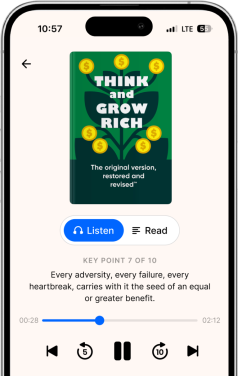
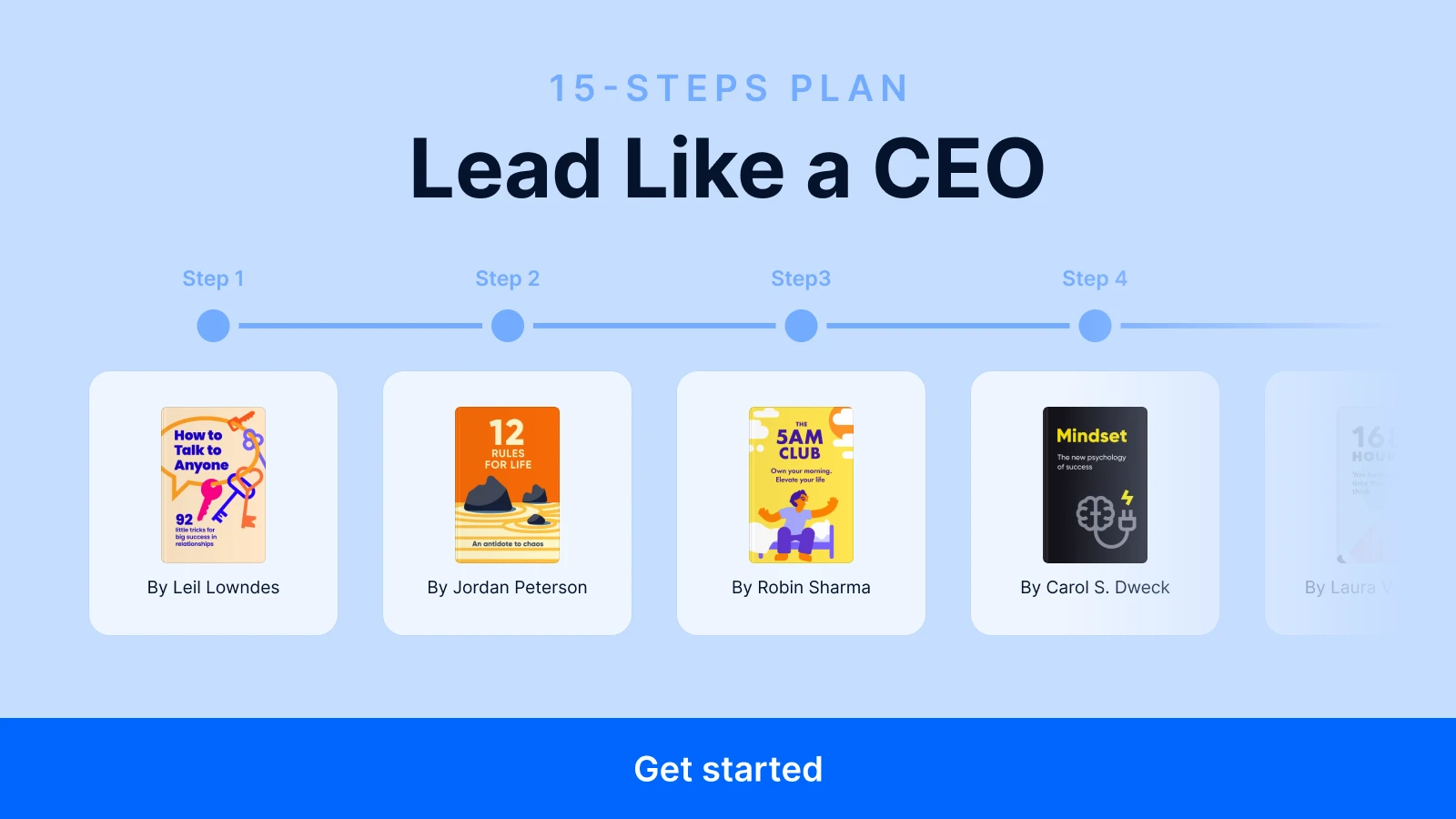
Our app offers iconic and popular leadership books in 15-minute summaries (audio and text formats), so you can learn effective leadership. You get the big ideas from experts without having to spend weeks reading. It's the perfect tool for busy learners who want to level up fast.
📘 Download the Headway app and start building your leadership skills today.
Quick answer: What is a personal leadership development plan?
A personal leadership development plan is a strategic roadmap you create to grow your leadership skills, align them with your values, and measure progress over time. It's an ongoing process that moves you from where you are now to where you want to be in your career.
Key components include:
Self-assessment: Identifying your current leadership competencies and skills gaps.
Vision statement: Defining the kind of effective leader you want to become.
SMART goals: Setting specific goals that are attainable and time-bound.
Action plan: The actual action steps and resources (like a mentor or a leadership program) you'll use.
Milestones: Checkpoints to track your progress within a set time frame.
Why a personal leadership development plan matters
Most people just "wing it" when they get promoted. They figure if they were good at their old job, they'll naturally be good at effective leadership. But that's a huge mistake. Leadership is an entirely different skillset, and if you don't have a personal leadership development plan, you're basically driving in the dark without a GPS.
Today, leadership positions are harder than ever to hold onto. Everyone expects you to have high emotional intelligence, stay cool under pressure, and keep retention numbers high, all while hitting your metrics. If you're just reacting to whatever fire starts in your inbox, you're not leading; you're just surviving.
Having an actual action plan gives you a massive edge. It transforms you from being an "accidental manager" to a truly effective leader. When you show your team members that you're actually working on your own professional development, it builds instant credibility. It's the difference between hoping you're doing a good job and actually having the roadmap to prove it.
Core components of a personal leadership development plan
A good plan isn't a 50-page manifesto. It just needs a few key components to keep you on track. If you overcomplicate it, you'll never look at it again.
📘 Don't let your leadership journey stall. Grab Headway for bite-sized insights from the world's best career coaches.
1) Self-assessment
You can't get where you're going if you don't know where you're starting. Self-assessment requires honest self-reflection. Don't just guess what you're good at; use tools like 360-degree feedback or even just an honest chat with a mentor.
You need to find those skills gaps. Maybe you're great at the technical skills, but your conflict resolution is nonexistent. Be brutally honest with yourself here.
2) Vision and values
Who do you actually want to be? Write it down as a vision statement. Your vision statement isn't corporate fluff; it's about your leadership style. Do you want to be the visionary who inspires, or the coach who develops top performers? Knowing your values helps you make decisions when things get messy.
3) Goal setting (SMART)
Don't just say "I want to improve communication." That's useless. You need SMART goals. SMART means your leadership development goals have to be attainable and time-bound.
Example: "I will improve my communication skills by taking a leadership training course and presenting at three team meetings by the end of Q3."
4) Action steps and resources
How are you actually going to learn? These action steps become your development strategy. It could be joining a formal leadership development program, finding a mentorship opportunity, or just reading two book summaries a week on Headway. These are the daily and weekly action steps that lead to professional growth.
5) Timeline and milestones
Success needs a time frame. Set short-term goals and check them every month. If you don't have milestones, the "daily grind" will eat your plan for breakfast. You need to measure progress regularly to see if your leadership development journey is actually moving forward.



Personal leadership development plan: Step-by-step creation guide
Building your personal leadership development plan isn't some massive academic project. It's just about being honest about where you're at and where you're going. Follow these steps:
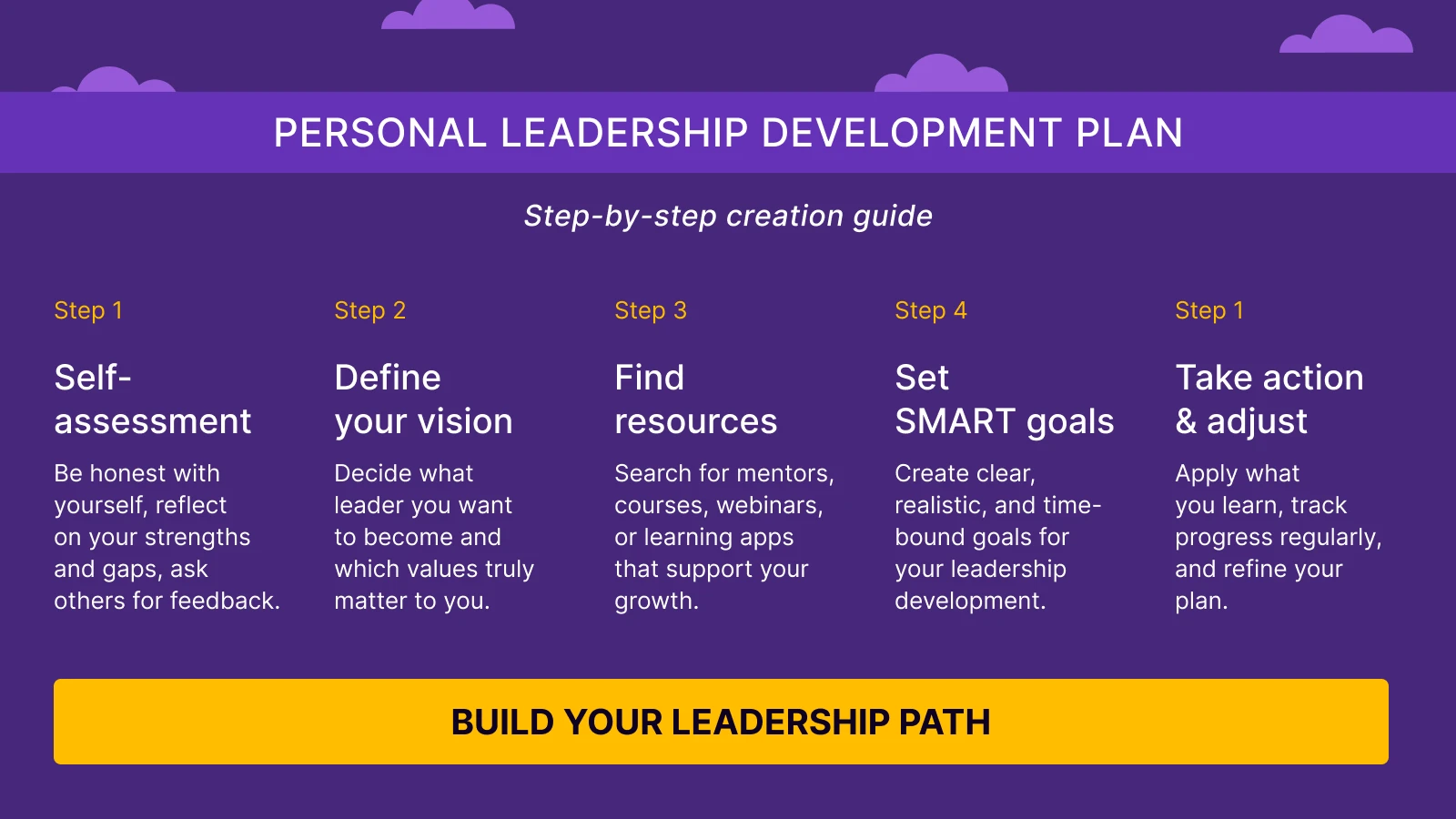
Step 1: Get honest with a self-assessment. Look in the mirror. Use self-reflection to find your skills gaps. Are you actually good at decision-making, or do you just wait for someone else to choose? Ask your team members for their honest take, even if it's hard to hear.
Step 2: Figure out your vision. What's your vision statement? Basically, what kind of boss do you want people to talk about in five years? Your vision isn't just about your career goals; it's about the leadership qualities you actually care about.
Step 3: Hunt for resources. Don't wait for your company to hand you a leadership program on a silver platter. Find your own development opportunities. Look for a mentor, sign up for a webinar, or use Headway to catch up on leadership competencies during your lunch break.
Step 4: Write down those SMART goals and keep them attainable. If you set a time frame that feels impossible, you'll just quit. Make sure they're specific goals, like "improving my conflict resolution skills by handling the next three team disputes personally."
Step 5: Execute and adjust. If you set a time frame that feels impossible, you'll just quit. Make sure they're specific goals, like "improving my conflict resolution skills by handling the subsequent three team disputes personally.
📘 Ready for the next promotion? Start your leadership development plan today with the help of the Headway app.
Examples of personal leadership development plans
Sometimes it helps to see how this actually looks in the real world. Here are a few ways different people might map out their professional growth.
The new manager (Building confidence)
Vision: To be a supportive leader who empowers people rather than micromanaging.
Goal: Improve effective communication and delegating within 3 months.
Actions: Read 'The One Minute Manager' summary; set up weekly 1-on-1s with a mentor.
Metrics: A 20% increase in team productivity and better scores on the next performance management review.
The tech specialist (Moving to leadership)
Vision: Transition from "expert" to "leader" by focusing on strategic thinking.
Goal: Master the leadership skills needed for a Director role by the end of the year.
Actions: Enroll in a leadership development program; volunteer for cross-department projects.
Metrics: Successful completion of a high-level project and a shift in leadership style from "doing" to "guiding."
The mid-level exec (Expanding influence)
Vision: To drive company culture and improve retention across the board.
Goal: Boost emotional intelligence and self-awareness to lead larger groups.
Actions: Start a daily self-reflection journal; get 360-degree constructive feedback every quarter.
Metrics: Lower turnover rates and higher employee engagement scores in the department.
Four advanced strategies to enhance your plan
If you've already got your basic action plan down, it's time to look at the "hidden" factors that actually determine whether you'll move into those top-tier leadership positions.
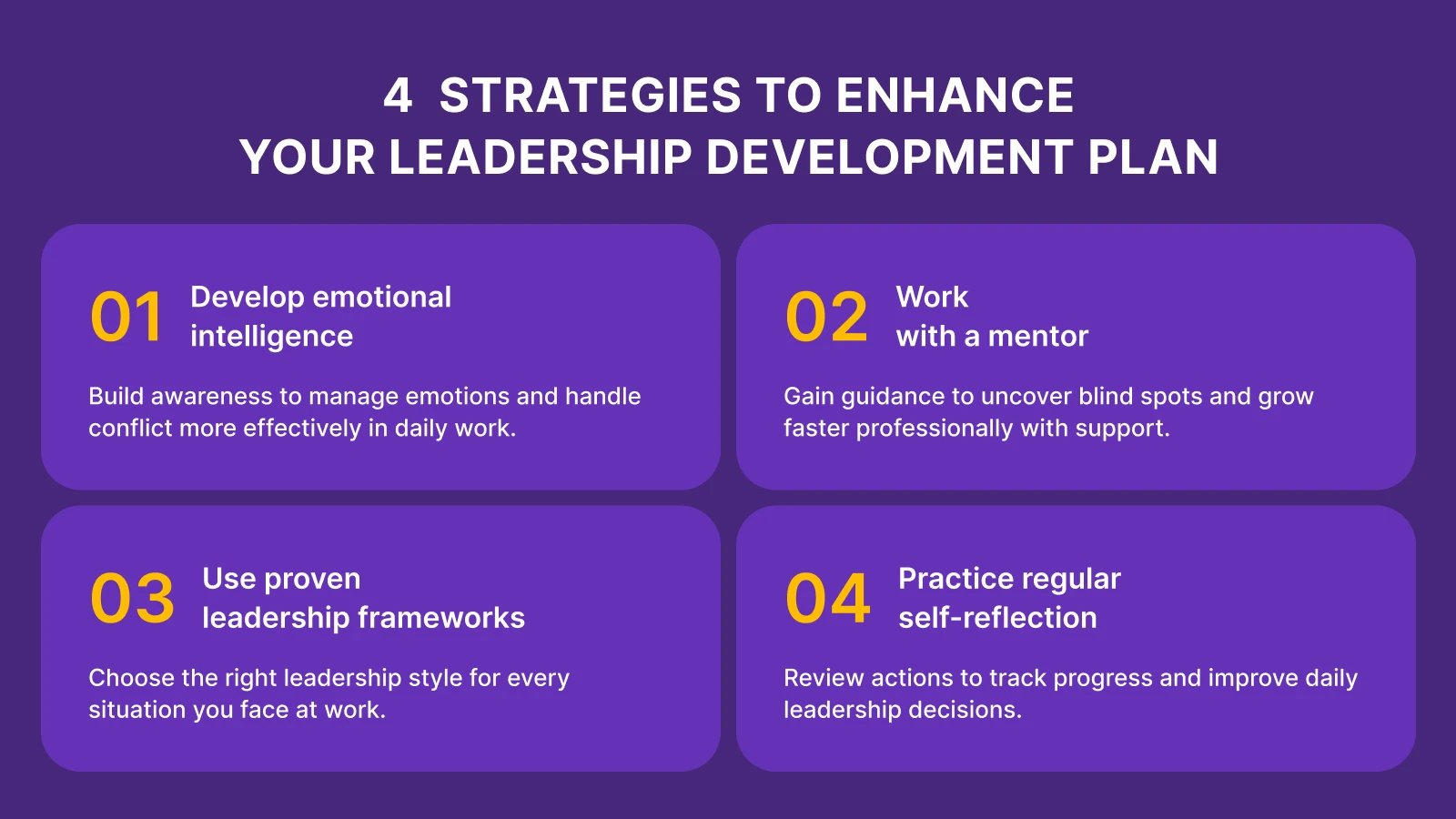
Double down on emotional intelligence. You can have the best technical skills on the planet, but if you can't read the room, your personal leadership development plan will hit a wall. Work on your self-awareness. When a meeting goes sideways, do you get defensive or do you pause? High emotional intelligence is what allows for real conflict resolution and keeps team members from quitting.
Don't sleep on mentorship. You can't see your own blind spots. That's why mentorship is a total game-changer. Find someone who has been where you want to go. They can help you identify skills gaps you didn't even know you had. A good mentor doesn't just give advice; they challenge your decision-making and push your professional growth faster than you could alone.
Use proven leadership models. You don't have to reinvent the wheel. Look into frameworks like the "Three Levels of Leadership" or "Situational Leadership." These aren't just for leadership training sessions; they are tools you can use every day to decide which leadership style fits the current mess you're trying to fix.
Practice active self-reflection. Make it a habit to look back at your week. Did you act like an effective leader, or did you just bark orders? This kind of ongoing process is how you actually measure progress. If you aren't reflecting, you're just repeating the same mistakes with a different title.
Make Headway a part of your personal leadership development plan
The reality is that an effective leadership development plan is never really "finished." It's a leadership development journey that lasts as long as your career does. You have to stay in a state of continuous learning if you want to keep those leadership roles and actually make an impact.
But let's be real — you're busy. You don't always have time for a week-long leadership development program or a 400-page book. This is exactly why Headway is ideal for you: the app has the most important action steps and insights from bestsellers like 'The 7 Habits of Highly Effective People' and 'The Leadership Challenge.'
No matter whether you're working on your communication skills or trying to master adaptability, Headway gives you the professional development you need without the fluff. It's the easiest way to hit your leadership development goals while you're at the gym or waiting for a meeting to start.
📘 Ready to take your professional growth seriously? Download Headway and start mastering the skills you need for your next big promotion!
FAQs about a personal leadership development plan
How to write a personal leadership development plan?
To start, you need to be honest about where you're at right now. Use a self-assessment to find your skills gaps and then write a clear vision statement for your future self. Set some SMART goals that are actually attainable within a set time frame. Finally, pick your resources, like a mentor or some leadership training, to make sure you actually follow through.
What are the 5 components of a personal development plan?
A solid plan needs five things to actually work. You start with a self-assessment to find your weaknesses, then create a vision statement to stay motivated. Next, you set SMART goals, so you have a roadmap. You also need an action plan with specific steps, and finally, some metrics to measure progress and see if you're actually moving toward those leadership roles.
What are examples of PDP goals?
Goals can vary based on your role, but they should always be specific. You might aim to improve your communication skills by leading more meetings or focusing on emotional intelligence to handle team conflicts better. Other examples include mastering new technical skills or finding a mentorship opportunity. Whatever you choose, ensure they align with your long-term career goals and professional growth targets.
What are the top 3 development needs as a leader?
Most leaders struggle with the same few things. First, emotional intelligence is huge: you have to read people well to lead them. Second, strategic thinking is vital so you aren't just reacting to fires all day. Third, mastering effective communication is non-negotiable. If you can't explain your vision clearly to your team members, your personal leadership development plan won't get very far.
What are the 5 smart goals for work examples?
Here are five quick examples:
1) Complete a leadership development program by December.
2) Increase team retention by 10% this year.
3) Give constructive feedback to three employees weekly.
4) Read one leadership book summary on Headway every Monday.
5) Lead a cross-department project by Q3. Each of these is time-bound and hits a specific skill development need for your ongoing process.
What are the 5 qualities of a good leader?
A great leader usually has high self-awareness and really strong emotional intelligence. They also need to be experts at decision-making, even when the data is messy. Good communication skills are a must so everyone stays on the same page. Finally, adaptability is vital: you have to pivot when the plan changes. These leadership qualities are what set bosses apart from real leaders.