Self-growth
 Business & Career
 Success
 Communication
 Healing
 Relationships
 Psychology
 Happiness
You probably know that feeling of looking at your bank account and wishing it came with an extra zero or two. Most of us go through school learning about the Pythagorean theorem, but never once hearing about how a credit card actually works or why saving money matters so much for your future.
It's easy to feel like you're behind, especially when you see other people seemingly mastering their financial life while you're still trying to figure out where your paycheck goes every month.
The good news is that you don't need a finance degree to achieve financial success. The answers you're looking for are already written down in some of the best personal finance books ever published.
But finding the time to read thousands of pages is a challenge for any busy person. That's where Headway helps. We provide bite-sized summaries of the world's bestsellers, giving you the knowledge to work toward your goals in just 15 minutes. Whether you want to pay off student loans, start investing, or just get a better handle on your money management, these summaries act as a perfect road map for your specific financial journey.
📘 Take control of money with Headway.
Quick answer: Best personal finance books for every goal
If you're looking for the right title to start your journey, your choice depends on your current financial situation. Here's a quick guide to the top picks for different needs:
Debt relief: 'The Total Money Makeover' by Dave Ramsey focuses on paying down debt with "Baby Steps."
Wealth automation: 'I Will Teach You to Be Rich' by Ramit Sethi shows you how to automate your accounts and focus on "Big Wins."
Money mindset: 'The Psychology of Money' by Morgan Housel explains the behavior and emotions behind financial decisions.
Simple investing: 'The Simple Path to Wealth' by J. L. Collins advocates for low-cost index funds and financial independence.
Building assets: 'Rich Dad Poor Dad' by Robert T. Kiyosaki teaches you how to make your money work for you rather than working for money.
With thousands of books on personal finance available on Amazon and trending on Goodreads, it's hard to know which ones are worth your time. This comparison will help you navigate the classics and modern hits so you can start making better financial decisions right away.
📘 Skip this part and build a personalized reading list with Headway.
Why reading personal finance books is your best investment
Before you can change your bank balance, you have to change how you think about money. Most people stay stuck because they lack a basic financial planning strategy, and they often make moves based on fear or what they see on social media. Reading personal finance books gives you access to the minds of experts who have already spent decades studying what works and what doesn't.
Build financial literacy: Understand the terms and systems that run the world of money.
Create a plan: Get a step-by-step guide for saving money and building wealth.
Improve money management: Learn how to track your spending and automate your financial life.
Achieve financial independence: Find out how much you actually need to stop working and retire early.
Many of the best books on personal finance emphasize that money is 80% behavior and only 20% head knowledge. By consistently reading or listening to summaries of personal finance books, you're training your brain to prioritize financial security over temporary impulses. This habit is often the first step toward a truly rich life.
📘 Build wealth smarter with Headway.
Comparison: Which personal finance book matches your goal?
Choosing the right book depends entirely on where you're starting from and where you want to go. Not every bestseller is right for every person at every stage of their life.
| Book title | Author | Primary goal | Best for |
|---|---|---|---|
'The Total Money Makeover' | Dave Ramsey | Debt elimination | People with high-interest debt |
'I Will Teach You to Be Rich' | Ramit Sethi | Automation and lifestyle | Young adults and professionals |
'The Psychology of Money' | Morgan Housel | Behavioral finance | Understanding habits and risk |
'The Simple Path to Wealth' | J. L. Collins | Passive investing | Long-term wealth and FIRE |
'Rich Dad Poor Dad' | Robert T. Kiyosaki | Wealth mindset | Shifting from employee to owner |
You can read all of these books, and even more, in the Headway app! If you feel overwhelmed by the number of choices, our personalized growth plans can help you focus on what matters most. These plans offer a curated sequence of insights designed to help you achieve your money goals, ensuring you stay consistent on your path to financial freedom.



The classic debt-crusher: 'The Total Money Makeover' by Dave Ramsey
If you're currently struggling with debt and feel like you're drowning in payments, Dave Ramsey is the name you'll hear most often. His bestseller, 'The Total Money Makeover,' is famous for its "Baby Steps" program, which has helped millions of people get out of debt and find financial security. Ramsey's tone is blunt, no-nonsense, and highly motivational, making it one of the best personal finance books for beginners who need a kickstart.
He argues that you should stop all investing until you've paid off your consumer debt and built an emergency fund. His philosophy is built on "gazelle intensity," where you cut every possible expense to pay off your credit card balances and student loans as fast as humanly possible. While some critics argue his math isn't always the most efficient, nobody denies that his system works for people who need a simple, emotional win to keep going.
Master the basics: 'Get a Financial Life' by Beth Kobliner
Sometimes, you just need a reliable resource that covers every possible money question you might have. Beth Kobliner has created an encyclopedic guide that is essential for young adults and anyone looking to master their financial life. From understanding taxes and insurance to saving money and investing, this book covers the basics in a clear way.
It's the kind of reference you keep on your shelf and turn to every time you face a major life change. It's widely considered one of the best books on personal finance for those who want a complete overview. Whether you're buying a home or just opening your first savings account, this book has you covered.
The modern automation guru: 'I Will Teach You to Be Rich' by Ramit Sethi
On the opposite end of the spectrum is Ramit Sethi. His book, 'I Will Teach You to Be Rich,' is widely considered one of the best personal finance books for young adults. Sethi doesn't care about your $5 lattes; instead, he wants you to focus on the "Big Wins" like negotiating a higher salary, picking the right index funds, and automating your accounts so you never have to think about them again.
Sethi's philosophy is built around the idea of a rich life, unique to each person. For some, it might mean traveling first class; for others, it means buying whatever they want at the grocery store without looking at the prices. He encourages you to spend extravagantly on the things you love, as long as you cut costs mercilessly on the things you don't.
Understanding the "Why" with 'The Psychology of Money' by Morgan Housel
While Ramsey and Sethi focus on what to do with your money, Morgan Housel focuses on how you feel about it. 'The Psychology of Money' has quickly become one of the best personal finance books of all time because it explores the strange, irrational ways humans make financial decisions. Housel argues that doing well with money has little to do with how smart you are and a lot to do with how you behave.
The book is a collection of short stories that explain why we take risks, why we value financial freedom, and why the most important part of any financial planning is leaving room for error. It's a great read for anyone who has ever felt "dumb" for making a bad money move. It helps you realize that everyone views the world through a different lens based on their unique financial journey.
The path to early retirement: 'The Simple Path to Wealth' by J. L. Collins
If your goal is early retirement and you want a strategy that's so simple it fits on a single index card, then 'The Simple Path to Wealth' by J.L. Collins is the book for you. Originally written as a series of letters to his daughter, this book has become a cornerstone of the financial independence (FIRE) movement. Collins argues that most of the "experts" on Wall Street are just trying to confuse you so they can take your money in fees.
His advice is straightforward: spend less than you earn, avoid debt, and put everything else into low-cost index funds like VTSAX, Vanguard's Total Stock Market Index Fund. Collins is a strong fan of the Bogle philosophy, named after John C. Bogle, the founder of Vanguard. This approach removes the stress of trying to pick individual stocks or time the stock market, which usually leads to failure for the average beginner.
Mindset and wealth: 'Rich Dad Poor Dad' by Robert T. Kiyosaki
No list of personal finance books is complete without mentioning 'Rich Dad Poor Dad' by Robert T. Kiyosaki. While the book has faced its share of criticism over the years, it remains a bestseller because it fundamentally changes how people view assets and liabilities. Kiyosaki explains the difference between his "Poor Dad" (his highly educated but financially struggling father) and his "Rich Dad" ( his friend's father, who was a wealthy entrepreneur).
The core lesson is that the rich don't work for money; they have their money work for them. Kiyosaki emphasizes the importance of financial literacy and the need to acquire assets that put money in your pocket, like real estate or businesses, rather than liabilities like cars or big houses that take money out. By understanding this distinction, you can stop running on the rat race treadmill and start building a foundation for long-term financial success.
Handle money as a youth: 'Broke Millennial' by Erin Lowry
If you're just starting, you need a guide that speaks your language without the boring lectures. Erin Lowry's book is the perfect entry point for younger readers dealing with 21st-century money struggles. It tackles the "social" side of money, like how to handle group dinners on a budget or navigate awkward debt talks with your partner.
You get practical advice on managing student loans and starting your financial journey from scratch. The tone is funny and relatable, making it one of the best personal finance books for beginners. By the time you finish, you'll feel more confident about your paycheck and your future.
Value investing wisdom: 'The Intelligent Investor' by Benjamin Graham
For those who want to understand the true philosophy of the stock market, looking to the masters is a must. Benjamin Graham is the father of value investing, and his wisdom has influenced the most successful investors in history, including Warren Buffett. The book teaches you how to ignore the noise of the market and focus on the long-term value of your assets.
It provides a foundational road map for anyone serious about building wealth through stocks. You learn how to stay rational even when everyone else is panicking during a market dip. This timeless perspective helps you build a portfolio that can weather any financial storm.
The power of passive growth: 'A Random Walk Down Wall Street' by Burton G. Malkiel
If you prefer a strategy that assumes the market is smarter than any individual's picks, this is your guide. Burton G. Malkiel explains why a simple "buy and hold" strategy using index funds is the best way to achieve financial success. He argues that the market is efficient, and trying to beat it by picking individual stocks is often a losing game.
This book is a cornerstone for those pursuing financial independence through passive investing. It turns the complex world of the stock market into something manageable for the average person. Malkiel's research proves that sometimes the best thing you can do for your money is to just leave it alone.
Redefining wealth: 'The Millionaire Next Door' by Thomas J. Stanley and William D. Danko
You might be surprised to learn that the wealthiest people in your neighborhood often don't look rich at all. This study by Thomas J. Stanley and William D. Danko revealed that most millionaires are actually frugal people who live well below their means. They prioritize financial security and building wealth over status symbols like luxury cars or designer clothes.
This bestseller fundamentally changed the public's understanding of what it takes to achieve financial freedom. It reminds you that being rich and looking rich are two very different things. By following the habits of the "millionaire next door," you can build a stable future regardless of your current salary.
Wealth on autopilot: 'The Automatic Millionaire' by David Bach
Building a fortune doesn't have to be a daily chore if you set up the right systems from the start. David Bach argues that the secret to becoming wealthy is making your financial planning automatic. By "paying yourself first" and automating your savings and investing, you remove the need for constant willpower.
Bach introduces the "Latte Factor," showing how small daily savings can lead to massive long-term results. This book is a perfect road map for busy people who want to achieve financial success on autopilot. It proves that you can become a millionaire without ever having to balance a checkbook or worry about a budget.
Use Headway as your financial success shortcut
You might be thinking, "This all sounds great, but I don't have time to read 10+ personal finance books." That's exactly why over 55 million people have joined the Headway community. Headway summarizes the key ideas from the world's best books on personal finance so you can get the essential knowledge you need to crush your goals in just 15 minutes.
Instead of spending weeks reading 'The Psychology of Money,' you can listen to a summary during your morning commute and immediately understand how your emotions affect your financial decisions. You can compare the advice in 'The Total Money Makeover' with the strategies in 'I Will Teach You to Be Rich' in a single afternoon. This approach allows you to find the road map that fits your life without the overload that often stops people from starting.
Plus, Headway is an endless source for great reads across all categories, including wellness, career, and psychology. Because financial success is so closely tied to your habits and mindset, having a library of summaries at your fingertips helps you grow in every area of your life. It's one of the smartest ways to invest in yourself and your financial journey, one small insight at a time.
📘 Accelerate financial learning with Headway.
Frequently asked questions about personal finance books
What are the best personal finance books for beginners in 2026?
If you're just starting, look for 'The Total Money Makeover' by Dave Ramsey for debt or 'I Will Teach You to Be Rich' by Ramit Sethi for automation. Both offer a clear step-by-step plan. Erin Lowry and her book 'Broke Millennial' are also great for relatable, modern advice.
Which books help most with financial independence and early retirement?
'The Simple Path to Wealth' by J. L. Collins is a top pick for the FIRE movement. You should also read 'Your Money or Your Life' by Vicki Robin and 'Financial Freedom' by Grant Sabatier. These titles focus on index funds and maximizing your financial security to buy back your time.
Are there personal finance books that focus on mindset?
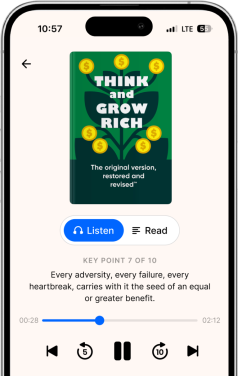
Yes, 'The Psychology of Money' by Morgan Housel is a great place to start for understanding your financial decisions. Also, check out 'Think and Grow Rich' by Napoleon Hill and 'The Richest Man in Babylon' by George S. Clason. These classics focus on the mental habits required for building wealth and achieving financial success.
What are the top personal finance books for learning about the stock market?
Start with 'The Intelligent Investor' by Benjamin Graham for a foundation in value. For a more modern approach, read 'A Random Walk Down Wall Street' by Burton G. Malkiel or 'The Little Book of Common Sense Investing' by John C. Bogle. These books explain why index funds are usually the best choice.
Where can I find summaries of the best personal finance books of all time?
The Headway app is the best place to find bite-sized summaries of top personal finance books. You can read or listen to the key takeaways from Robert T. Kiyosaki, David Bach, Bill Perkins, and more. It's a great way to improve your financial literacy without a huge time commitment.
What should I read if I want to manage my credit card and student loans?
Beth Kobliner covers these topics extensively in 'Get a Financial Life.' You might also find 'The Index Card' by Helaine Olen and Harold Pollack helpful for its simplicity. For a more aggressive approach to debt, Dave Ramsey remains a popular choice on Amazon and Goodreads.
Can personal finance books help with my overall wellness and retirement planning?
Absolutely. Books like 'Die with Zero' by Bill Perkins and 'The Automatic Millionaire' by David Bach connect your money to your life goals. They remind you that financial planning is about more than just numbers. It's about ensuring your financial situation supports your happiness and long-term security.