Self-growth
 Business & Career
 Success
 Communication
 Healing
 Relationships
 Psychology
 Happiness
You want to grow. You want to read more, learn faster, and finally get around to that book everyone keeps recommending. But your calendar looks like a game of Tetris, and "free time" is a funny joke you tell yourself at 1 AM.
Here's the thing — you don't need two-hour study sessions to get smarter. Mobile microlearning is changing how people pick up new skills. It turns those tiny gaps in your day — waiting in line, riding the bus, even brushing your teeth — into real learning moments. All you need is your phone.
And with the right microlearning app on your smartphone, five spare minutes can actually move the needle on your goals.
📘 Make every minute count with Headway.
Quick answer: What is mobile microlearning?
Mobile microlearning is a learning strategy that breaks down big topics into short, focused lessons — usually 1 to 15 minutes long — delivered straight to your phone or tablet. Think book summaries, quick quizzes, audio snippets, and flashcards you can breeze through between meetings. It uses bite-sized formats designed for small screens and busy schedules.
Research indicates that microlearning can improve knowledge retention compared to traditional long-form courses, with gains sometimes reaching up to 50% in specific contexts. This finding is likely due to its alignment with natural attention spans and spaced-repetition principles.
Why your brain loves short lessons (and hates long ones)
Let's talk about why traditional training methods don't stick for most people. Ever sat through a three-hour webinar and walked away remembering almost nothing? That's not your fault. Your working memory — the part of your brain that juggles new information — has a limit. Dump too much into it at once, and things start falling out. Researchers call this cognitive overload, and it's why long courses have such low completion rates (often below 20%).
There's also something called the "forgetting curve." It's a well-documented pattern: learners lose up to 70% of new information within 24 hours if they don't review it. That stat is pretty brutal, but it also explains why mobile microlearning works so well.
Short learning programs break information into small chunks. Then they use spaced repetition — showing you the same ideas at smart intervals — to help those ideas stick. You're not fighting your brain's natural limits. You're working with them.
Multiple studies on e-learning have found that learners complete micro-modules at rates around 80%, compared to roughly 20% for traditional courses. That's not a slight difference. That's an entirely different learning experience.
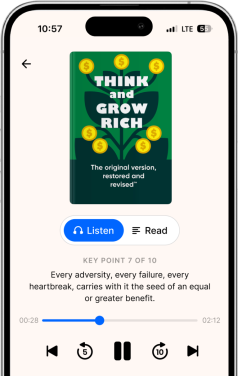
Headway was built around this science. When you first open the app, an onboarding quiz asks about your goals — better communication, money skills, productivity, whatever matters to you. From there, the app builds a personalized growth plan that keeps adapting. It recommends microlearning content based on your interests, so the learning process never feels like a chore.
➡️ What is the Headway app and how does it work?
Five ways mobile microlearning beats traditional learning
The shift toward using mobile devices as primary learning tools isn't going away. And honestly? It makes sense. Here's why this approach works better than sitting through a full-length course or reading a 400-page book cover to cover.

You actually finish what you start: Let's be real — most people never complete long courses. With a mobile microlearning app like Headway, a single session can take as little as three minutes. That low bar makes it easy to keep your daily streak alive. No guilt, no pressure. Just small wins that add up.
You get answers when you need them: Sometimes you don't need a full course on leadership — you need to know how to handle a tough conversation with your boss at 2 PM today. That's just-in-time learning. Headway's Interactive Shorts let you explore real-life scenarios and practice different responses in the moment.
The knowledge actually stays with you: Reading something once isn't enough. Using multimedia formats — audio, text, and spaced-repetition flashcards — helps information move from short-term to long-term memory. Headway's flashcard feature is designed exactly for this: you revisit key ideas at the right intervals, so they don't just vanish after a day.
You can learn literally anywhere: Mobile microlearning platforms go wherever your phone goes. Got an offline commute? Download your summaries in advance. Switching between devices? Start a summary on your phone and pick it up on another device. The whole point is that your learning environment fits your life — not the other way around.
It replaces bad habits with good ones: You know those moments when you reach for your phone to scroll through social media? That same impulse can trigger you to open a learning app instead. This method is called habit stacking, and it's one of the easiest ways to swap doomscrolling for actual professional development.
📘 Transform idle minutes with Headway.

How to build a mobile microlearning routine that actually sticks
Creating a new learning habit is easier when the tools are already in your pocket. You don't need a desk, a quiet library, or a two-hour block. You just need a learning strategy that fits into your existing daily routines.
Here's a simple system that works:
Start with your goals: When you open Headway for the first time, the onboarding quiz helps you define what you want — better communication, career growth, wealth building, mental health, you name it. The app uses your answers to personalize your recommendations so every summary feels relevant.
Grab the "micro-moments": Your morning commute, lunch break, or the ten minutes before bed — these are golden opportunities. Pop in your earbuds and listen to an audio summary. If you're an iPhone user, you can even use Siri voice commands to save highlights hands-free while you're driving or cooking.
Review what you learned: Don't just consume — retain. Spending two minutes each evening going through your saved highlights or flashcards can make a huge difference. It's here where spaced repetition does its magic, moving new ideas from "I vaguely remember that" to "I know this."
Mix up the formats: Tired after a long day? Switch to audio. Need some deep focus time? Read the text summary. Headway offers multiple listening modes, including focus sounds and relaxing music, so you can match the format to your current energy level. This variety in formats also helps reinforce learning from different angles.
Track your progress: One of the biggest reasons habits die is that you don't see the results. Headway's streak tracker and daily goals give you visible proof that you're moving forward. Even on those days when you only squeeze in one three-minute summary, that still counts.
Mobile microlearning vs traditional learning: a side-by-side look
Sometimes it helps to see the numbers side by side. Here's how microlearning on mobile devices compares to traditional learning methods.
| Aspect | Mobile microlearning | Traditional learning |
|---|
Session length | 1–15 minutes | 1–3 hours |
Completion rate | ~80% | ~20% |
Knowledge retention | High (uses spaced repetition) | Low (information dump) |
Accessibility | On-demand, mobile-first | Fixed schedule, desktop-based |
Cost | Low (subscription model) | High (per-course pricing) |
Formats | Audio, text, quizzes, flashcards | Lectures, textbooks |
Personalization | Algorithm-driven recommendations | One-size-fits-all |
The difference in completion rates alone tells you a lot. When learning fits into your workflow and respects your time, you're way more likely to keep going.
Who benefits most from mobile microlearning?
You might think microlearning is only for corporate training programs in healthcare or tech. And sure, plenty of companies use microlearning modules to train employees. But the real value shows up when you use it for your personal life.
Here's who gets the most out of it:
Busy professionals who want professional development but can't carve out hours for courses. A quick book summary during lunch is more realistic than a three-day workshop.
Students juggling classes, jobs, and social lives. Microlearning on a mobile phone gives them a way to pick up new skills in formats that feel natural, like listening to a summary between classes.
Parents who barely have time to finish a cup of coffee, let alone a 400-page book. Five-minute learning sessions fit into the cracks of their day.
Anyone trying to build better habits. If you're swapping social media time for growth time, having a mobile microlearning app on your home screen is the easiest first step.
The best thing about learning apps is that they meet you where you are. You don't have to rearrange your life around a class schedule or a textbook. The learning platforms come to you.
📘 Build smarter habits with Headway.
What makes a great microlearning platform?
Not all microlearning apps are created equal. Some are designed for corporate LMS setups — think employee training portals with compliance modules. Others are built for personal growth.
When you're picking a mobile microlearning platform for yourself, here's what to look for:
Personalization: The app should adapt to your goals, not hand you a generic syllabus. Good algorithms learn what you're interested in and serve up relevant content over time.
Multiple formats: Great learning platforms offer more than just text. Look for audio summaries, quizzes, flashcards, and multimedia content. Variety keeps you engaged and improves retention.
Usability on small screens: A microlearning app should feel good on your phone. If you have to pinch and zoom your way through lessons, that's a bad sign. The user experience matters more than you'd think.
Offline access: Your learning shouldn't stop just because you're on a plane or a subway with no signal. Offline mode is a must.
A library that grows with you: You don't want to run out of content in a month. Look for platforms with a deep catalog that covers a range of topics — not just one niche.
Headway: Built for your personal growth
While a lot of mobile microlearning platforms are designed for corporate training and learning management systems, Headway is built around you. It's not another LMS with employee compliance courses. It's a daily partner for people who want to get smarter, one 15-minute session at a time.
Here's what makes it different:
The mobile app is designed from the ground up for smartphone use. The learning process feels more like a game than a textbook — you've got daily goals, streak tracking, and achievements that keep you motivated. The app's instructional design team has packed over 2,500 titles into the library, and your personalized recommendations make sure you always have something worth learning next.
If you're an Apple user, you'll love the integration between Siri and Apple Shortcuts. Your downloaded summaries get indexed directly in your iPhone's search, so you can pull up any insight without even opening the app. It's one of those small touches that makes a big difference in your daily routines.
Headway has earned recognition as an award-winning app, and for good reason. Over 55 million people worldwide already use it to grow, learn, and work toward their goals. That's not a small community -- it's proof that mobile microlearning works when it's done right.
📘 Elevate personal growth with Headway.
Frequently asked questions about mobile microlearning
What are microlearning mobile platforms, and how do they work?
Microlearning mobile platforms are apps that deliver short lessons directly to your phone. They work by breaking books, courses, or expert knowledge into bite-sized chunks — usually 1 to 15 minutes each. Most use algorithms to personalize what you see based on your goals and habits. Headway, for instance, uses an onboarding quiz to match you with relevant book summaries and then adapts as you keep learning.
When should I use a mobile microlearning module instead of a full course?
Go with a mobile microlearning module when you need specific, practical knowledge fast — like prepping for a negotiation or brushing up on leadership before a meeting. Full courses make more sense for deep certifications or technical skills that require hands-on practice. But for ongoing personal growth and building daily learning habits, short modules win because you'll actually finish them.
Can I use microlearning apps without an internet connection?
It depends on the app. For instance, Headway's microlearning mobile app lets you download summaries in advance, which is great for flights, subway commutes, or anywhere with limited connectivity. Just download what you want before you go, and you're set.
How does microlearning improve knowledge retention?
The short answer is spaced repetition and active recall. Instead of cramming everything into one session, microlearning spaces out key ideas over time. Each time you revisit a concept through flashcards or short reviews, you interrupt the forgetting curve and push information deeper into long-term memory. It's one of the most research-backed learning technologies out there.
Is mobile microlearning the same as e-learning?
Not exactly. E-learning is a broad term that covers everything from hour-long online courses to full degree programs. Mobile microlearning is a specific approach within e-learning, focused on short, mobile-first lessons designed around knowledge retention and learning outcomes. Think of it as the most time-friendly corner of the e-learning ecosystem.
What learning outcomes can I expect from a microlearning app?
That depends on your goals and consistency. Most learners report better focus, stronger recall of key concepts, and more confidence applying what they've learned in real life. The structured approach — daily goals, spaced repetition, personalized content — tends to produce measurable results faster than self-directed reading alone.
What's the difference between microlearning and mobile LMS?
A mobile LMS (learning management system) is the platform that hosts, tracks, and delivers courses — think of it as the container. Microlearning is the format within it: short, focused lessons designed for quick consumption. Some LMS platforms specialize in microlearning content, while others also deliver longer courses. For personal growth, you want an app that excels at microlearning rather than a full corporate LMS.
How many minutes a day should I spend on mobile microlearning learning?
Consistency matters way more than marathon sessions. Even 5 to 15 minutes of daily microlearning mobile learning adds up to 30–90 hours over a year — more than most people get from traditional courses. The trick is showing up every day, even if you only have time for one quick summary. Small daily reps build stronger habits than occasional binges.
Is mobile-based microlearning suitable for complex topics?
Absolutely. Mobile-based microlearning actually handles complex topics better than you'd expect. Instead of cramming everything into one overwhelming session, it breaks big ideas into smaller pieces that your brain can actually process. Ten focused 10-minute sessions beat a single 100-minute lecture every time. Each short session gives you time to absorb one concept before moving to the next.