Self-growth
 Business & Career
 Success
 Communication
 Healing
 Relationships
 Psychology
 Happiness
This Mindvalley review breaks down everything you need to know before spending $199 for an annual subscription or $29 for a monthly subscription. We'll look at what's included in the Mindvalley membership, what's excluded, and what real users are saying on platforms like Trustpilot and Reddit. We'll also explore whether there are smarter alternatives for your personal growth budget.
Ready? Let's break it down, step by step.
Mindvalley review: A quick verdict for busy readers who need answers now
Mindvalley is a platform offering over 100 courses across spirituality, wellness, and self-development. If you're seeking guided meditations, energy work, and community-focused learning led by world-class instructors, it could be a good fit.
But for practical, career-focused, and rapid self-improvement, Mindvalley courses might not be the most efficient use of your time and money.
For $89.99 per year (less than half of Mindvalley's price), the Headway app gives you access to more than 2,500 book summaries from psychology, business, productivity, and personal development. You can learn the core ideas from books like 'No Time Like the Future,' 'The 7 Habits of Highly Effective People,' and 'Thinking, Fast and Slow' in just 15 minutes each.
It's not about which platform is "better." It's about what fits your learning goals today. Let's figure that out right now.
What is the Mindvalley ecosystem?
Mindvalley is a personal transformation platform founded by entrepreneur Vishen Lakhiani. The company positions itself as a school for things traditional education forgot to teach — like emotional intelligence, spiritual wellness, and building better relationships.
As they put it: "Traditional education taught you how to make a living — but not how to live."
The core product is what they call "Quests." These are multi-week video courses led by various instructors on the Mindvalley app.
Each Quest typically includes daily lessons ranging from 15 to 30 minutes and access to the Mindvalley community discussions, where learners can connect with each other.
The platform organizes its content into several categories: Mind, Body, Soul, Career, Entrepreneurship, Relationships, and Family categories, including Kids, Teens, and Parenting. According to many Mindvalley courses reviews, the AI curriculum feature is helpful, suggesting personalized courses based on your current interests.
And who are the trainers? Well, you might recognize some of them:
Jim Kwik, whose Mindvalley Superbrain review scores consistently highlight his effective memory and speed-reading techniques delivered through the popular Superbrain program.
Marisa Peer offers programs that focus on building confidence and self-worth.
Lisa Nichols brings expertise in personal empowerment and motivational speaking.
Ben Greenfield covers biohacking and fitness optimization.
Vishen Lakhiani himself leads several programs, including his 'Be Extraordinary' Quest.
Other notable instructors include Emily Fletcher (meditation and stress management), Katherine Woodward Thomas (conscious uncoupling and relationship healing), and Sadhguru (yogic wisdom and inner engineering).
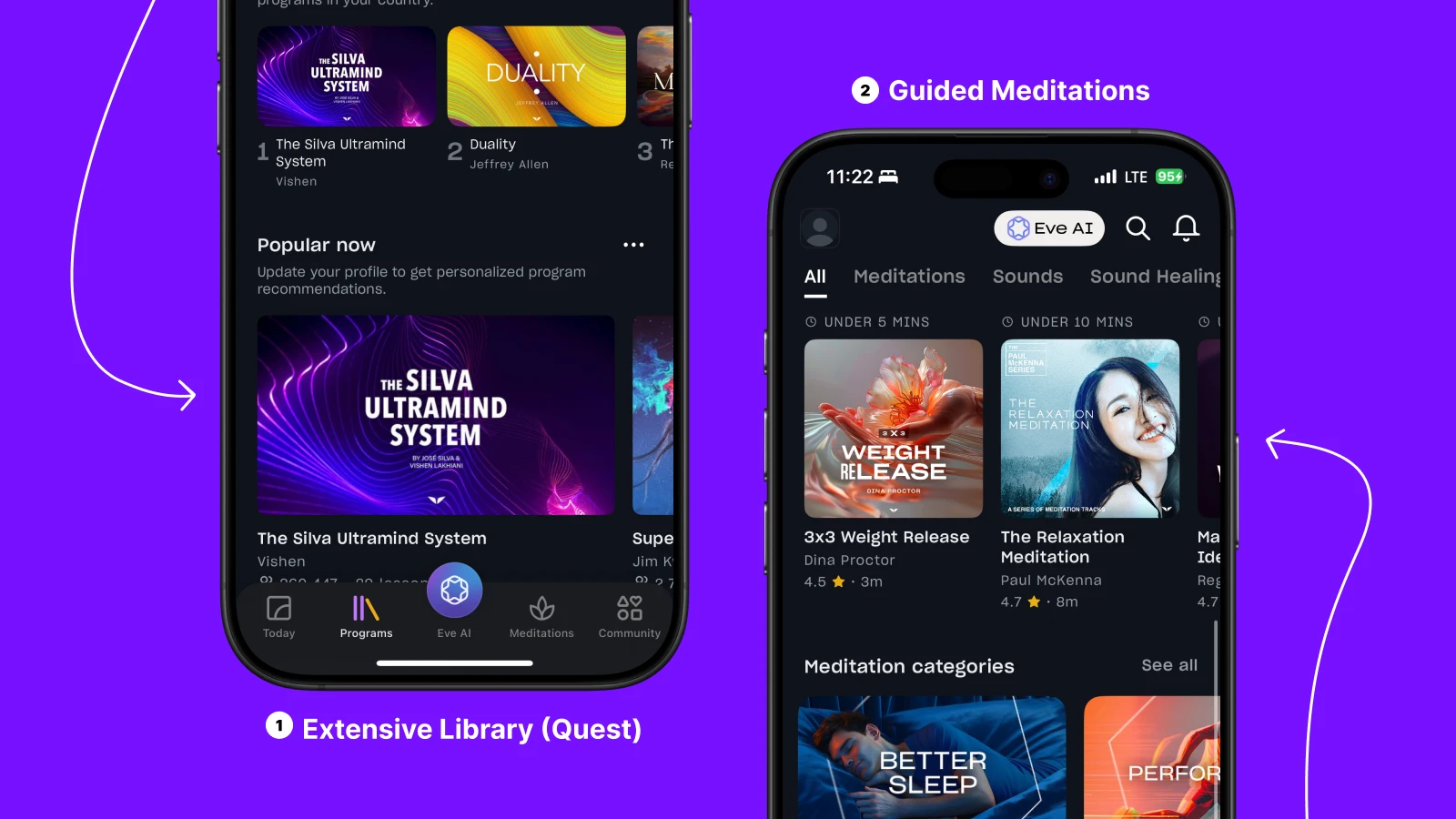
In this Mindvalley membership review, we can't miss the fact that Mindvalley app includes over 1,000 guided meditations for various purposes — sleep, focus, relaxation, and personal transformation. The platform is available on Apple devices, Android phones, desktop computers, iPad tablets, and Apple TV. You can also join a private social network where all members can connect, share their progress, and support fellow learners.
It sounds like a comprehensive ecosystem for self-improvement. But here's where things get more complicated.
The content library: Spiritual depth vs practical breadth
A quick scroll through the course catalog reveals something you should know about. Many of the most promoted programs focus on spirituality, energy work, well-being manifestation, and consciousness expansion. There are courses like 'The Silva Ultramind System,' programs about intuition and developing your sixth sense, and various meditation-focused offerings.
Is that a problem? Not necessarily. If you're seeking wellness and personal transformation through spiritual practices, you'll find plenty of depth here. Some users praise the platform for exactly this reason.
But if you're looking for tactics for productivity, business strategy, or career advancement, the library feels thinner. There are entrepreneurship courses, yes. But the ratio leans heavily toward the spiritual and esoteric.
So Mindvalley excels at helping you explore inner work, mindset shifts, and spiritual growth. It's less focused on helping you build concrete professional skills or absorb the latest research in behavioral science, economics, or leadership.
📘 If your self-development goals include learning faster, you might get more value from a platform that distills insights and tips from thousands of books across hundreds of topics. That's exactly how Headway works. Instead of following a multi-week course, you can explore bite-sized summaries from the world's best authors in just a few minutes a day.
Popular Mindvalley programs: What you actually get
Mindvalley Superbrain: Memory tricks or real transformation?
The Superbrain Quest with Jim Kwik is one of Mindvalley's most popular programs, and it's easy to see why. The promise is compelling: spend 15-20 minutes daily for 30 days, and you'll supposedly unlock superhuman memory, razor-sharp focus, and faster learning abilities.
Jim Kwik structures the program around practical memory techniques like the M.O.M (Method of Memory) approach, spaced repetition strategies, and mnemonic devices for remembering names, numbers, and foreign languages. The curriculum covers eight parts, from fundamentals and lifestyle optimization to specific memory methods for speeches, vocabulary, and even speed reading.
Looking at the day-by-day schedule, you'll encounter techniques like the Peg Memory Method, the Location Method, and something called Superbrain Yoga. There are also "implementation days" built in, which suggests the program recognizes that learning techniques and actually using them are two different things.
Does it work? Many Superbrain Mindvalley reviews highlight noticeable improvements in recall and mental clarity. The techniques themselves aren't revolutionary — memory champions have used similar systems for decades — but Jim Kwik packages them in an accessible, structured format that makes daily practice easier.
The real question is whether you need a 30-day video course to learn these methods. Books like 'Moonwalking with Einstein' by Joshua Foer or 'Remember It!' by Nelson Dellis cover similar memory techniques in formats you can finish in a few hours rather than a month. That said, the daily coaching structure might work better if you need external accountability.
Student reviews are available on the official Superbrain page if you want to hear directly from people who've completed the program. Just remember: the techniques work, but they require consistent practice beyond the initial 30 days to stick.
The Silva Method: Mind control that actually makes sense
Developed by José Silva in 1966, The Silva Method is a mind-training technique built around controlling your brainwaves to unlock mental clarity, creativity, and intuition. Silva was a radio technician from Texas who believed the brain had untapped potential beyond basic survival.
His core insight? By deliberately shifting between brainwave states, you could access abilities most people never use. Beta is your alert, task-focused state. Alpha is relaxed and receptive to learning. Theta appears during meditation and deep sleep, perfect for introspection. Delta is the deepest unconscious state where your body repairs itself.
Silva believed that accessing alpha and theta states through dynamic meditation and visualization could improve creativity, reduce anxiety, and develop intuitive decision-making. Research now backs this up — studies show that increasing theta to alpha brainwave ratios improves creativity and emotional integration while reducing anxiety.
Mindvalley's Silva Ultramind System Quest packages Silva's framework into structured daily sessions. You'll learn dynamic meditation, the centering exercise (accessing alpha consciousness), the mental screen technique (visualization for goals), and projection exercises (expanding awareness beyond physical limitations).
Mindvalley Silva Method reviews from members suggest real transformations.
The reality check? Silva's original book covers these same techniques. The structured Quest provides guided sessions and community support, but the fundamentals aren't exclusive to Mindvalley's platform. Mindvalley Silva program reviews are available on their official site if you want member perspectives before committing.
AI Mastery: Learning to leverage what everyone's talking about
AI Mastery is Mindvalley's answer to the question: "How do I actually use AI without getting left behind?" It's a 5-month program led by Vishen Lakhiani and a roster of AI experts including tech leaders from Microsoft, Google, and various AI startups.
The pitch is simple: AI is the ultimate leverage tool for entrepreneurs, creators, coaches, and executives. While everyone else is stuck doing manual busywork, you'll learn to automate tasks, multiply income, and unlock creative breakthroughs in minutes instead of months.
The curriculum covers practical applications like launching campaigns, writing viral content, analyzing data, building tools, and scaling brands — all using AI prompts. The program runs 44 live training sessions over 22 weeks, with modules on applying AI to your business instantly, building a personal AI toolkit, mastering content creation at AI speed, creating no-code tools and automations, and even monetizing AI skills.
What sets it apart from free YouTube tutorials? Structure, community, and depth. You're not just learning ChatGPT prompts — you're learning frameworks for thinking like AI-first innovators, understanding what LLMs and custom GPTs actually do (without the hype), and developing ethical AI practices for leading teams responsibly.
AI Mastery Mindvalley reviews from students show real-world results. A startup founder mentions enhanced productivity and setting the stage for future innovations. A business owner reports the program transformed their startup's operations. A college marketing graduate created a social media planner that automates posts, generates ideas, and creates images using AI tools.
But here's the reality check: This is a premium program that requires separate payment beyond the standard Mindvalley membership. You're committing five months and paying extra for structured learning that could theoretically be pieced together from free resources, online courses, and experimentation.
The Mindvalley AI course review consensus suggests it's valuable if you need accountability, community, and a comprehensive roadmap. If you're self-motivated and comfortable learning through trial and error, you might get 80% of the value by reading AI-focused books, following industry newsletters, and experimenting with tools yourself.
Student testimonials are available on the official AI Mastery page if you want to hear directly from participants before deciding whether the investment makes sense for your situation.
Mindvalley 10X: The fitness shortcut that sounds too good to be true
The 10X Quest promises a "permanent body transformation in just two 15-minute workouts a week." If that sounds impossible, you're not alone in your skepticism. But the program is built around a specific physiological principle called the adaptive response—the same survival mechanism that forced our prehistoric ancestors to get stronger, faster, and more resilient when escaping predators.
The idea is simple: traditional fitness approaches waste your time on ineffective exercises with minimal results. With 10X, you trigger your body's adaptive response through specific exercises with the right intensity, resistance, and tension on muscle fibers. The result? Your body adapts rapidly without requiring hours in the gym.
The program runs 25 hours of training across 12 weeks, structured in four phases. Week 1 is the warm-up. Weeks 2-4 begin your transformation. Weeks 5-9 focus on sculpting your dream body. Weeks 10-12 help you integrate the 10X lifestyle for long-term sustainability.
Beyond the workouts, you get science-based nutrition, rest, and lifestyle guidelines designed to improve your results. The program claims it's safe for all ages, genders, and fitness levels, and you can even do it at home with minimal equipment.
Does it work? Mindvalley 10X reviews from the platform's 294,044 enrolled students suggest people are seeing results, though individual experiences vary based on consistency and starting fitness levels. The adaptive response principle is scientifically sound — high-intensity interval training and resistance training do produce results in less time than traditional steady-state cardio.
The real question is whether you need a paid program to learn these principles. Books like 'Body by Science' by Doug McGuff or 'The 4-Hour Body' by Tim Ferriss cover similar high-efficiency workout protocols. Free resources on HIIT and strength training are abundant online.
That said, if you struggle with motivation, need structured guidance, or want community accountability, the 10X Quest provides a clear roadmap. Just remember: no fitness program works without consistent effort, regardless of how efficient the protocol claims to be.
Mindvalley certifications: Professional credentials or personal development?
Mindvalley offers coaching certifications that promise to blend meaningful work with income potential and location freedom. Over 4,000 coaches have been certified through their programs in specializations like Holobody Coaching, Business Coaching, and Worldmentality.
Here's the critical distinction: This is not an accredited professional credential recognized by organizations like the International Coach Federation (ICF). It's a personal development certification within Mindvalley's ecosystem. It won't qualify you for corporate coaching positions or meet requirements for professional liability insurance.
Mindvalley coaching certification reviews from graduates on their official certifications page show mixed perspectives. One CEO mentioned exploring topics in greater depth. An educator from Singapore said she couldn't find certification that resonated with her beliefs until discovering Mindvalley's program. A business administrator from London felt she found her purpose and path.
The certification makes sense if you want to coach within Mindvalley's community, already have clients and want additional frameworks, or view this as personal development with a certificate. It doesn't make sense if you need widely recognized coaching credentials or ICF-accredited training for career advancement.
This is a premium offering costing extra beyond your Mindvalley membership. Clarify your goals first: professional recognition in the coaching industry, or personal growth with coaching tools? Your answer determines whether this investment delivers what you actually need.
The learning experience: Hollywood videos vs microlearning
Mindvalley's lessons look stunning — they're the kind of content you actually want to sit down and watch. The filming, editing, and overall storytelling are very professional. Many videos feature beautiful locations, smooth animations, and cinematic quality that rivals what you'd see on streaming services.
But do high-quality videos equal better learning? Research states not always. The multimedia learning principles indicate that simpler presentations improve our retention. Fancy visuals sometimes distract from core concepts rather than reinforcing them. Your brain gets caught up in the beautiful scenery instead of encoding the information you're supposed to remember — and apply.
Mindvalley Quests require 20–30 minutes of daily commitment for a specified duration (typically several weeks). That's a significant time commitment, especially for busy professionals, parents, or people juggling multiple responsibilities. That means if you miss days, you're playing catch-up on video content designed to be consumed in a specific sequence.
Now, let's compare that to the microlearning approach. Bite-sized learning delivers information in small chunks that fit into any schedule. Research indicates that microlearning can boost retention by 17% to 50% compared to long-form learning sessions or online courses. Science shows that our brains handle information best in small chunks — we simply can't focus on too many things at the same time (Google 'cognitive limits' or Miller's Law if you want to find out more about how we process around seven items at once).
Headway built its entire platform around this principle. You can finish a complete book summary in 15 minutes. You can listen during your morning commute (like a podcast!) or read while waiting for your coffee. No homework assignments or multi-week commitments. That's the difference between watching a movie and acquiring a skill. Both have their place in life, but if you need practical knowledge quickly, microlearning wins.
📘 Download Headway to see how it changes your day.
Mindvalley pricing: The "all-access" pass reality
How much does Mindvalley cost? Mindvalley costs $199 per year. That works out to approximately $16.58 per month when paid annually. If you prefer paying month to month, the price is $29 (as of January 2026).
Since prices can change, it's always a good idea to double-check the current offer on the official website before signing up.
One thing worth knowing: Mindvalley's 15-day refund policy only applies if you subscribe directly on their website. If you sign up through the app, you're bound by Apple's or Google's rules, not Mindvalley's (so the 15-day refund policy doesn't apply in this case).
This is something users have complained about repeatedly on Reddit. One user described being stuck with charges they couldn't reverse because they'd purchased through the app instead of the website.
Here's another important detail from the membership documents that surprises many subscribers. Your annual membership does NOT include access to all content on the platform. Premium programs, such as WildFit (a popular nutrition and weight management program), Lifebook (an intensive goal-setting program), Mindvalley Mastery, and the Certification series, require separate purchases in addition to your membership fee.
This aspect means that some of Mindvalley's most talked-about programs aren't included in the "unlimited access" membership, which costs $199. You'll need to budget additional funds if you want to take advantage of those specific offerings. For someone who signed up expecting everything to be included, this can feel like a bait-and-switch situation.
Now, let's look at what your money gets you across different platforms:
| Platform | Annual сost | What you get |
|---|
Mindvalley | $199/annual plan, $29/monthly plan | 100+ Quests, 1000+ meditations, community access |
Headway | $89.99/annual plan, $29.99/3 months, $12.99/monthly plan | 2,500+ book summaries in text and audio formats |
For less than half the price of a Mindvalley annual membership, Headway gives you access to insights from over 2,500 books. That includes bestsellers on habits, psychology, communication, productivity, business strategy, health and wellness, relationships, parenting, and personal growth.
And if you're not ready for an annual commitment, Headway's quarterly plan at $29.99 for three months lets you test whether book-based learning works for your style — at roughly the same price as just one month of Mindvalley.
The "guru" problem: One voice vs many perspectives
Here's something that doesn't get discussed enough about Mindvalley's learning model.
Each Quest is built around a single instructor and their specific methodology. Jim Kwik teaches you his particular method for memory improvement. Marisa Peer teaches her approach to rapid transformational therapy. Vishen Lakhiani shares his philosophy on living extraordinarily.
This system can be fantastic when you connect deeply with an instructor's teaching style. The video lessons foster a sense of intimacy with the teacher. And you feel like you're learning from a mentor who genuinely cares about your transformation.
But what if you don't connect with their style? What if their examples don't resonate with your life situation, or their approach feels off to you? You're essentially stuck. You've paid for access to their worldview, and if it doesn't click, there's no easy alternative within the same platform.
Traditional books — and book summary platforms like Headway — don't have this limitation.
Want to understand habit formation? Read 'Atomic Habits' by James Clear, then 'Tiny Habits' by BJ Fogg, then 'The Power of Habit' by Charles Duhigg. Each author brings different research, different examples, and different frameworks for understanding behavior change. This way, you get a 360-degree view of the topic, rather than a single guru's method.
No single expert has all the answers, so the best learning often comes from synthesizing multiple perspectives, identifying patterns that appear across different approaches, and building your own framework from various sources.
📘 With Headway, you get exactly this kind of breadth. On any topic you care about — whether it's productivity, leadership, relationships, psychology, health, or wealth — you can explore insights from dozens of different authors. You see where experts agree and where they differ.
That's a fundamentally different kind of self-improvement. It treats you as someone capable of critical thinking, not just a student who needs to follow a teacher's exact instructions.
DAY 1

DAY 2

DAY 3

DAY 4
DAY 5
DAY 6




The truth about Mindvalley: What real users say on Trustpilot and Reddit
We dug into real user reviews across multiple platforms to uncover the truth about the Mindvalley experience. Here's what people are saying honestly.
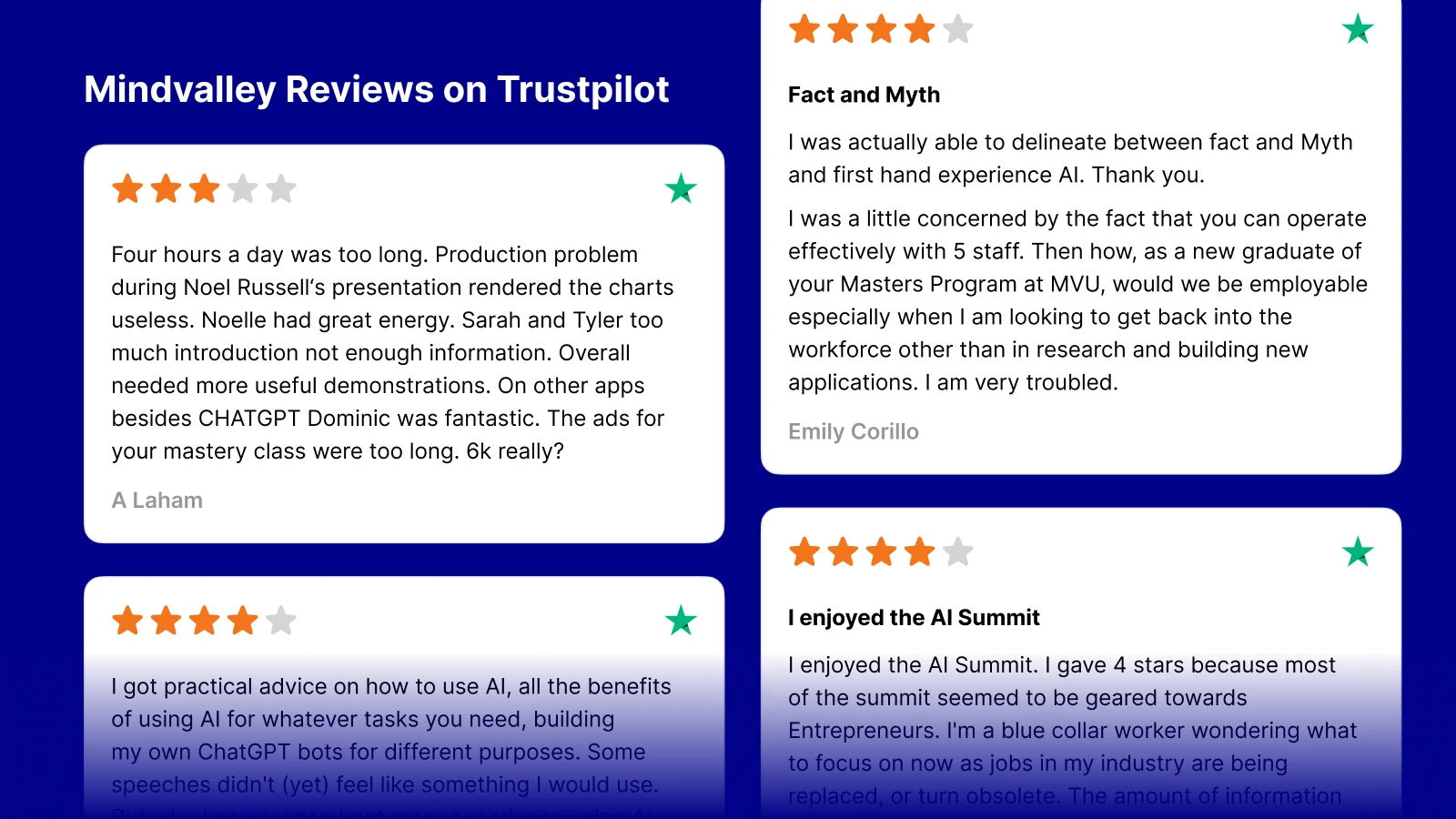
On Trustpilot, reviews tend toward 4–5 stars, though they're mixed in their content. Several reviewers praised specific events like the AI Summit for providing practical tips and useful demonstrations. One user mentioned learning about building ChatGPT bots and appreciated speakers sharing actionable insights they could apply immediately.
However, some reviewers noted that sessions felt heavily focused on marketing and upselling. One user wrote that they left sessions early because the content shifted from genuine education to promotion for paid programs. Another reviewer questioned whether completing Mindvalley programs would actually improve job prospects, expressing concern about practical outcomes and career relevance.
One Trustpilot reviewer raised questions about the platform's long-term sustainability, expressing concerns about staffing levels and inquiring about the fate of graduates of certification programs.
Reddit feedback tends to be more critical overall. Here are some concerns that appear repeatedly in discussions:
One user described taking a manifestation-focused course and finding it oversimplified compared to expectations. They unsubscribed after two months, feeling the content didn't deliver on its marketing promises.
Technical issues with the Mindvalley app came up multiple times across different threads. One Reddit user reported being locked out of paid meditations and described customer support via WhatsApp as creating "endless loops" without actual resolution. Another user confirmed similar experiences — quests that felt "life-changing" paired with frustrating technical problems and support challenges that undercut the positive learning experience.

Perhaps the most troubling account came from a Reddit user who experienced significant personal hardship, losing their home in fires. Despite their platform's zero usage during the crisis and their explanation of the circumstances, they reported that Mindvalley refused to provide a refund for a $399 charge. They contrasted this with other companies that showed compassion during their difficult time.
Some Reddit users called the platform "overpriced for content quality available elsewhere." Others used stronger language, with one poster labeling it a "scam." However, defenders exist too — one user questioned critics' qualifications to judge and reported genuinely positive experiences with the quests they completed.
What should you take from all this feedback? User experiences vary widely, and your results may differ. Technical issues and customer support seem to be legitimate concerns that appear across multiple reviews. The refund process has clear limitations, especially for in-app purchases that don't qualify for Mindvalley's 15-day guarantee. And whether the content delivers value depends heavily on what you're looking for and how well you connect with specific instructors and their teaching styles.
Before committing $199, we recommend spending 20 minutes searching Trustpilot, Reddit, and social media for recent reviews. Look for feedback from people with goals similar to yours — their experiences will be more relevant than generic star ratings. Pay attention to how recent the reviews are, since e-learning platforms change over time.
If you have specific questions about pricing, cancellation, or refunds, visit the official Mindvalley website, check the FAQs, or contact their support team directly, rather than relying solely on user reviews.
Who is Mindvalley app actually for?
Based on everything we've covered in this review, Mindvalley makes sense for people who:
Want community-based learning and enjoy connecting with other members through the supportive community and social network features. Some learners thrive with accountability partners and group energy.
Prefer video content and learn best by watching instructors demonstrate concepts visually. If you're a visual learner who enjoys the production quality of streaming services, the video lessons will feel engaging.
Are interested in spirituality, meditation, energy work, and consciousness exploration as primary areas for growth. The content library is strongest in these categories.
Have time to commit to multi-week programs with daily 20–30 minute lessons. The Quest format requires consistent daily engagement over several weeks.
Are drawn to specific instructors like Jim Kwik, Marisa Peer, or Vishen Lakhiani and trust their particular approach to personal transformation.
Mindvalley is probably NOT the right choice for you if:
You're a busy professional who needs answers quickly and can't commit to lengthy video courses.
You're on a budget and want maximum learning value per dollar spent. At $199 per year with premium content excluded, other options provide more high-quality content for less money.
You prefer science-backed, research-grounded content over spiritual or esoteric approaches. The library leans heavily toward consciousness and energy work.
You like exploring multiple perspectives on topics rather than following a single guru's method. The Quest format is instructor-centric by design.
You've had frustrating experiences with subscription services and value hassle-free refund policies. The in-app purchase refund situation is concerning based on user reports.
Choose what works best for your growth
The good news? You don't have to pick just one tool for your entire personal development journey. Different online learning platforms serve different purposes. Here's how some popular options compare:
MasterClass focuses on celebrity instructors teaching their craft — cooking with Gordon Ramsay, writing with Neil Gaiman, filmmaking with Martin Scorsese. It's entertainment-focused learning from famous practitioners who excel in their specific domains.
Skillshare emphasizes creative and practical skills — illustration, graphic design, photography, writing, and business fundamentals. It's practical and project-based learning with shorter courses.
Coursera partners with universities to offer academic courses and professional certificates. If you need credentials for your career or want structured, college-level content with assessments, this fits better than Mindvalley.
Skillsta focuses on power skills through interactive, real-life-inspired content. It covers emotional intelligence, communication, creativity, and productivity — the interpersonal abilities that matter most in modern workplaces.
Headway distills the world's best non-fiction books into 15-minute summaries available in both text and audio formats. It's built specifically for busy people who want to grow every day without lengthy time commitments or expensive subscriptions.
Still weighing your options? We've reviewed other popular mobile learning apps to help you decide. If audiobooks are your thing, check out our breakdown in our "Is Audible worth it?" article and our full Audible review to see how it compares. For book summary apps specifically, we've also published an "Is Blinkist worth it?" article, put together a detailed Headway vs Blinkist comparison, and reviewed alternatives like Shortform and Imprint. Each platform has its strengths — the right choice depends on how you learn best and what fits your budget.
If you're not ready to commit $199 to Mindvalley but still want to build daily growth habits, Headway might be your smarter starting point. You'll learn proven concepts from thousands of books written by diverse authors, identify which topics matter most to you personally, and build a foundation of knowledge that serves you for the rest of your life.
Before committing to a specific guru's multi-week program, why not first explore what the world's most respected authors have discovered? Millions of readers have tested their books over the years or decades. The ideas that survive and spread are usually the ones worth learning.
Ready to start your growth without the $199 commitment? Download the Headway app and see how much you can change in just 15 minutes a day.
Frequently asked questions on Mindvalley
Is Mindvalley worth it?
That really depends on what you're hoping to get out of it. If you're drawn to spiritual growth, meditation, mindset work, and learning alongside a global community, many people feel Mindvalley is worth the investment.
The video quality is top-tier, the platform feels polished, and some instructors have extremely loyal followings who credit the programs with meaningful personal shifts.
That said, if you're looking for very practical, no-nonsense learning with flexible access and straightforward pricing, Mindvalley can feel frustrating. The annual fee isn't small, and some of the most talked-about programs (like WildFit or Lifebook) cost extra on top of your membership.
Is Mindvalley legit or a scam?
Mindvalley is absolutely a real company with real courses and well-known instructors. It's not a scam in any legal or technical sense.
Some users talk about life-changing insights and habits they never found in free courses — and have continued using for years. Others leave disappointed, feeling the platform didn't live up to the hype.
Most negative feedback tends to focus on customer support delays, app-related issues, and confusion around full refunds — especially for purchases made inside the app. If refunds matter to you, it's safer to buy directly through the website rather than through an app store.
What are Mindvalley Quests?
Mind valley Quests are the platform's signature multi-week video courses led by expert instructors. Each Quest typically runs several weeks with daily 15-30 minute lessons covering topics from meditation and fitness to entrepreneurship and relationships. Mindvalley Quests reviews from users highlight the high production quality and structured learning format, though some find the time commitment challenging. The Quest format is included in your standard membership, unlike premium programs that cost extra.
Which is better: Mindvalley or MasterClass?
These two platforms aren't really trying to do the same thing.
Mindvalley is centered on inner work — personal growth, spirituality, relationships, mindset, and transformation — usually through multi-week programs with community elements.
MasterClass, on the other hand, is more about learning skills and ideas from famous people, with a stronger focus on entertainment and inspiration.
If you want meditation, self-development, and a sense of shared journey, Mindvalley makes more sense. If you want to learn storytelling from a filmmaker or cooking from a world-class chef, MasterClass will probably feel like a better fit. The "better" option depends entirely on what you want to learn.
What is Mindvalley's Unlimited Abundance program?
Unlimited Abundance is a Quest by Christie Marie Sheldon focused on clearing money blocks and shifting your relationship with wealth. The program uses energy clearing techniques and visualization exercises to address limiting beliefs about abundance. Mindvalley Unlimited Abundance reviews show mixed reactions — some users report mindset shifts around money, while others find the energy work approach too esoteric for practical financial planning. If you prefer evidence-based money management, books like 'The Psychology of Money' might be more effective.
Is Gaia or Mindvalley better?
Gaia leans heavily into spirituality. Its content is deeply focused on yoga, meditation, consciousness, ancient wisdom, and alternative perspectives on health and reality.
Mindvalley covers spirituality too, but it spreads its focus across more areas — career, relationships, productivity, and emotional intelligence — alongside personal growth and meditation.
If you're looking for a deep dive into spiritual topics, Gaia may feel more aligned with your interests. If you prefer variety across multiple life areas in one subscription, Mindvalley offers a broader range of options.
How much does Mindvalley cost?
As of early January 2026, Mindvalley charges $199 per year (about $16.58 per month when billed annually), or $29 per month if you pay monthly.
It's important to know that some flagship programs — such as WildFit, Lifebook, certifications, and advanced trainings — are not included in the standard membership and require separate payment.
Prices and inclusions can change, so it's always smart to double-check the current offer on the official website before subscribing.
Is there a free version of Mindvalley?
There isn't a full free version, but Mindvalley membership does offer free masterclasses and sample content so you can get a feel for the teaching style and production quality before committing.
Full access to complete programs, quests, and the meditation library requires a paid membership. They also offer a 15-day money-back guarantee — but only for purchases made directly through their website. If you subscribe through an app store, refunds follow that store's rules instead. If you want the safest trial experience, the website is the better option.
Is Mindvalley's Duality program worth it?
Duality is a Quest by Jeffrey Allen exploring the balance between masculine and feminine energy within yourself. The program uses energy healing practices and guided meditations to help you integrate both aspects for greater wholeness and balance. Mindvalley Duality reviews from students tend to be positive among those already interested in energy work and spiritual development, though it may feel abstract if you prefer concrete, action-oriented personal development. The program is included in standard membership.
How do I cancel my Mindvalley membership?
You can cancel your membership from the Billing section in your account settings. Once canceled, you'll still have access to the content until the end of your current billing period.
If you're eligible for a refund on a recent website purchase, you can request it through their refund page. Refunds usually take a few business days to process.
For anything unclear — billing issues, refund eligibility, or technical problems — it's best to contact Mindvalley's support team directly rather than relying on second-hand information.
Is Mindvalley a university?
No, Mindvalley is not an accredited university or educational institution. It's a personal development platform offering online courses. However, you may have heard about Mindvalley University as the host of an annual event called "Mindvalley U." Mindvalley U is a multi-week conference featuring more than 100 talks and 150 speakers, reaching over 1,800 attendees from more than 80 countries, which is held in person.
The 2026 event runs from July 20 to August 2 in Tallinn, Estonia. Past speakers include Marisa Peer, Nir Eyal, and Ken Honda. Think of it as an immersive festival for personal growth rather than a degree-granting institution. Completing Mindvalley programs won't earn you academic credentials.
If you're curious about attendee experiences, searching for "Mindvalley University review" or "Mindvalley Academy review" will show you feedback from people who've attended these events or completed certification programs — just remember to look for recent reviews since experiences can vary year to year.