Self-growth
 Business & Career
 Success
 Communication
 Healing
 Relationships
 Psychology
 Happiness
Do you wake up feeling like you've put on 200 pounds overnight? If you're not a morning person, you know that heavy, lethargic feeling. You might look at people like Mel's husband, Chris, who springs out of bed like a "weirdo" the moment the alarm rings — and wonder, "Just what is the Mel Robbins morning routine and why does it work for so many people?"
The truth is, even if you don't think you have a morning routine, you do. Hitting the snooze button five times, scrolling through social media for 45 minutes, or hiding under the covers is a routine. It's just one that isn't working. Chronic snoozing is more than a bad habit; it's a signal to your brain that you are avoiding your life and your potential.
Mel Robbins, born Melanie Lee Schneeberger, spent years fixing this. Before she was a "billion-view podcaster" and New York Times bestselling author, she was a criminal defense attorney and a CNN legal analyst covering high-profile cases like the George Zimmerman trial.
She created the "Million-Dollar Morning," a science-backed system to help you reclaim your focus and start every single day with a win. In this guide, you'll learn how to rebuild your life — one morning at a time — by mastering the Mel Robbins morning routine.
Quick answer: What are the six steps of the Mel Robbins morning routine?
To stop procrastination and improve your wellness, follow these six non-negotiable steps. Whether you call it the Mel Robbins five-step morning routine (combining light and movement) or the full Mel Robbins six-step morning routine, the core principles remain the same. These steps are designed to work with your brain, not against it.
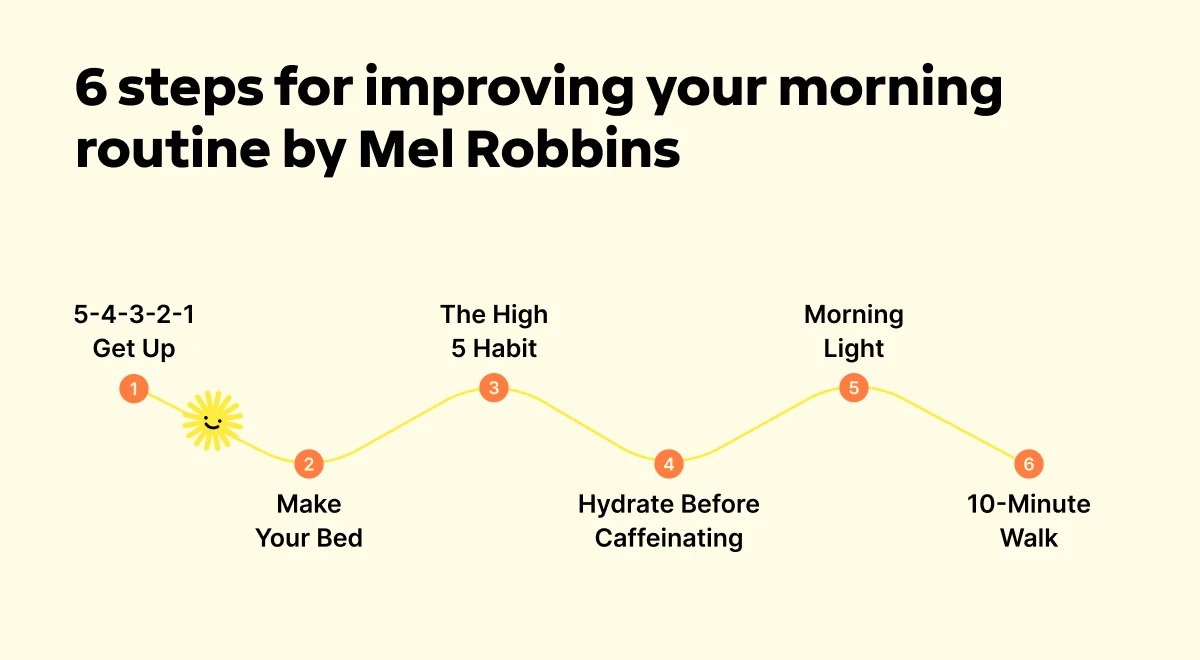
Step 1: 5-4-3-2-1 get up. Use the 5-second rule to beat sleep inertia as soon as the alarm rings.
Step 2: Make your bed. This 60-second act of discipline builds a sense of completion and tidiness.
Step 3: The High 5 habit. High-five yourself in the mirror to trigger "neurobics" and rewire your self-perception.
Step 4: Hydrate before caffeinating. Drink a full cup of water immediately to kickstart your hydration.
Step 5: Morning light. Use the 5-10-20 rule to reset your circadian rhythm and stop melatonin production.
Step 6: The 10-minute walk. Walk briskly to quiet your body clock's anxiety through "optic flow."
Why your morning routine determines your life
How you start your day is how you live your life. Most people wake up in a state of reaction, immediately checking their phone and letting the world dictate their mood. Mel didn't always have this figured out. In her early 40s, she hit "rock bottom." She was unemployed, drowning in heavy debt, and struggling to even get out of bed.
This period of her life was the catalyst for the 5-second rule. She realized that the habit of hesitation was what kept her stuck. If you search for a "Mel Robbins Morning Routine review" online, you'll find countless different stories from people whose lives have been transformed by these simple actions. If you're in a dark place right now, you're likely giving away your power before you even put your feet on the floor. Mel argues that your morning is for you, not for the world. If you can control the first hour of your day, you can control your mental health and your future.
The million-dollar morning routine Mel Robbins teaches is a game-changer because it shifts you from being a passenger to being the driver. It isn't about being "productive" for a boss; it's about proving to yourself that you matter. When you follow a system, you build self-trust. That trust is the foundation for every achievement you envision for yourself.
Why is waking up so hard? Seven reasons it's not your fault
Mel explains that if you struggle to get up, it's often because of your biology or history, not laziness. Understanding these seven factors can help you stop the cycle of self-criticism.
Genetics: Research shows 351 genetic markers are linked to being a morning person. It's an inherited trait that varies from person to person.
The "Adenosine Trap": Early caffeine traps "sleepy chemicals" in your brain, ensuring an afternoon energy crash.
Trauma: Past trauma can activate a "freeze response" in the morning. This makes your body feel physically heavy and difficult to move.
Anxiety: Cortisol levels naturally peak when you wake up. Without physical movement, this energy often translates into a sense of dread.
Depression: Around 75% of people with depression struggle with sleep problems. This is due to a sense of heaviness and a "dark cloud" feeling.
Life transitions: Major changes like retirement or an empty nest can throw your body clock out of whack.
Environment: If your bed is too cozy and your phone is right next to you, you're inviting distraction into your sanctuary.
The authority of reinvention: Melanie Lee Schneeberger to Mel Robbins
Before Mel was a global speaker, she was Melanie Lee Schneeberger, a woman who had to learn the hard way how to stop "screwing herself over." Her transition from a criminal defense attorney to a CNN legal analyst and then to a self-help leader wasn't a straight line. It was built on the back of the morning routine Mel Robbins now shares with the world.
She hosted TV shows like 'Monster In-Laws' and 'Someone's Gotta Go,' but her real breakthrough came when she stopped performing for others and started showing up for herself. This is why her advice feels different — it isn't coming from a place of "perfection," but from the trenches of a hard-won life. When you listen to The Mel Robbins Podcast, you aren't just getting tips; you're getting a blueprint from someone who has lived through the "heavy" mornings herself.
Step 1: Using the 5-second rule to launch out of bed
The first decision you make is the most important one. Hitting the snooze button is procrastination in its purest form, signaling that your goals aren't worth waking up for. It's the foundation of the Mel Robbins 5-4-3-2-1 morning routine.

When you hit snooze and drift back to sleep, your brain starts a new sleep cycle. These cycles take 75–90 minutes to finish. By waking up 9 minutes later, you are in the middle of the cycle, creating sleep inertia. This brain fog can last up to four hours, meaning you've wasted your most alert period of the day.
The story of the rocket ship launch
Mel discovered the 5-second rule when she was drowning in $800,000 of debt. Her marriage was failing, and she was drinking too much. She saw a television commercial showing a rocket ship launch: "5-4-3-2-1-Liftoff."
The next morning, she didn't wait for a feeling of motivation to come. She counted 5-4-3-2-1 and stood up before her brain could make excuses. She later introduced this in her 2011 TEDx talk, 'How to Stop Screwing Yourself Over,' which became one of the most-watched talks in history. By counting backward, you move the gear shift in your brain from "autopilot" to the "action center" in your prefrontal cortex.
Step 2: The psychological power of making your bed
Making your bed is about more than just a tidy room. It's the first act of discipline in your Mel Robbins million-dollar morning routine that builds momentum.
Admiral William H. McRaven wrote an entire bestselling book about this principle. He argues that if you make your bed every morning, you will have accomplished the first task of the day. That small win gives you a sense of pride and encourages you to tackle the next task on your Mel Robbins morning routine list.
A gift for your future self
Mel calls making the bed a "gift" to your future self. When you return home after a stressful day, you deserve to see a clean and peaceful space. A messy bed is a visual reminder of a life that is out of control. By tucking in the sheets, you are proving that you can follow through on a promise to yourself. This act removes visual clutter, which research shows can significantly reduce anxiety and improve focus.
Step 3: The science of the high 5 habit
High-fiving yourself in the mirror sounds like something you'd see on TikTok, but it's actually a form of "neurobics." This practice creates new neural pathways by pairing a routine activity with an unexpected physical movement.
Most of us look in the mirror and immediately start picking ourselves apart. We criticize our wrinkles, our weight, or our tired appearance. The high-five habit stops the internal critic by offering support instead of judgment. Mel shares the full science behind this in her bestselling book, 'The High 5 Habit: Take Control of Your Life with One Simple Habit.'
The NBA study on winning teams
Researchers at UC Berkeley studied NBA teams to see how physical touch affected performance. They found that teams that gave the most high-fives at the start of the season had the best records by the end. High fives communicate trust, belief, and support. When you high-five your reflection, you are telling yourself, "I see you, I believe in you, let's go."
Why neurobics and dopamine matter
Neurobics are exercises that challenge your brain's autopilot. By high-fiving yourself, you release a small hit of dopamine, which acts as a reward. This positive reinforcement makes the habit easier to maintain. Over time, this rewires your brain. You stop seeing someone who isn't "good enough" and start seeing a teammate.
Step 4: The Adenosine Trap and waiting for coffee
Mel learned from experts like Dr. Amy Shah that reaching for coffee the moment you wake up is a major mistake. Caffeine does not actually give you energy; it simply "borrows" it by blocking sleepiness.
Your brain produces a chemical called adenosine that builds up throughout the day, making you tired. When you sleep, your brain flushes it out. However, when you first wake up, there is often a "leftover" layer of adenosine that still needs to be cleared.
Parking spots for sleepiness
Think of adenosine like cars trying to park in "parking spots" in your brain. When they park, you feel sleepy. Caffeine is like a "valet" that temporarily blocks those parking spots. If you drink coffee immediately, the caffeine blocks the spots, but the adenosine is still floating around. Once the caffeine wears off, all those "cars" rush into the parking spots at once. That results in the "2:00 pm crash."
The 90-minute hydration rule
Mel recommends drinking a full cup of water first thing in the morning. It helps your body naturally flush out the "sleepy chemicals." You should wait at least 90 minutes before having your first cup of coffee. This pause allows your body clock to wake up naturally and ensures your energy is stable for the rest of the day. You'll find that you no longer need multiple cups of coffee just to survive the afternoon.
Unlock your daily growth superpower
Transform your routine to fuel continuous learning and effortless improvement.
Let's startStep 5: How morning light resets your brain
Your circadian rhythm is the internal clock that regulates your sleep and wake cycles. This clock is controlled by light hitting the specific cells in your eyes. Getting bright morning light in your eyes tells your brain to stop producing melatonin. It also sets a timer for that evening.
The 5-10-20 rule for light
Mel uses a simple rule for how much light you need based on the weather:
5 minutes if it's a bright and sunny day.
10 minutes if it's a cloudy or overcast day.
20 minutes if it's raining or very dark (or use a bright SAD lamp).
Don't look directly at the sun. Just being outside is enough to reset your body clock. This simple habit ensures you get better sleep tonight by properly timing your hormone production.
Step 6: The 10-minute walk for anxiety relief
Mel recommends a 10-minute morning walk, not for exercise, but for your nervous system. Brisk walking (walk like you're late!) creates something called "optic flow." As you walk, your eyes move back and forth, scanning the environment. This lateral eye movement sends a signal to the amygdala to quiet the "fight or flight" response. And it immediately lowers morning anxiety and clears your head.
Movement alternatives: From walking to pilates
If you can't get outside, don't use it as an excuse to stop your Million-Dollar Morning. The goal is movement and "forward ambulation," which means moving forward in space. If you prefer indoor movement, you can try a 10-minute pilates or yoga session. These low-impact exercises still help regulate your nervous system and wake up your muscles.
The "Hot 15" productivity secret
Once Mel finishes her walk, she doesn't check her phone. Instead, she goes to her kitchen table for the "Hot 15." This time is set apart for 15 minutes of focused work on a project that matters only to her. It's a core part of the Mel Robbins 15-minute morning routine.
Most people spend their mornings responding to the world's agenda, checking texts, social media, or work emails, and letting other people dictate their priorities.
Putting your goals first every single day
The "Hot 15" ensures that you make progress on your own dreams every single day. Whether it's writing a book, planning a business, or learning a new skill, those 15 minutes belong to you. Because you haven't looked at your phone yet, your brain is in a "flow state." You'll be amazed at how much you can accomplish in just 15 minutes of pure focus.
Eight mantras to direct your mind
In an episode of The Mel Robbins Podcast, Mel discusses how to direct your mind on purpose. She uses these affirmations every morning to keep her mind sharp:
Today is going to be a great day.
Something remarkable is going to happen for me today.
No matter what happens today, I can handle it.
An exciting new chapter in my life is starting today.
I need to give myself more credit for how hard I'm trying.
I'm allowed to be a work in progress.
If I keep showing up, life will reward me.
I have an essential contribution to make to the world.
How to use mantras effectively
Don't just say them; try to feel them. Mel suggests saying them while you look at yourself in the mirror. It might feel weird at first, but you're training your RAS (Reticular Activating System) to look for the good. Your RAS is a filter that looks for evidence of whatever you deem important.
Why most people fail using mantras
Most people think mantras are like magic spells that work instantly. They say the words, but they don't actually believe them. If you tell yourself "I am rich" while you're drowning in debt, your brain will reject the thought as a lie. This reaction is called cognitive dissonance.
Another reason for failure is inconsistency. You can't expect 30 years of negative programming to disappear in two mornings. You need to use these sentences every single day to see a real change in your mental health. Finally, people often fail because they don't "feel" the words. If you just whisper them while looking at the floor, you aren't training your brain. You have to look yourself in the eye and use the positive reinforcement of the high-five to make it stick.
Designing your environment for success
Mel is a huge believer in "removing friction." If you want your morning routine to work, you must set yourself up the night before. You can find robust resources, templates, and episodes of the Mel Robbins morning routine podcast on melrobbins.com.
The biggest friction point for most people is the phone. If your phone is your alarm, you're already in trouble. The moment you turn off the alarm, you see notifications that suck you into the "scrolling trap."
➡️ How to Stop Scrolling Addiction and Reclaim Your Time in 5 Easy Steps
The bathroom phone hack
Charge your phone in the bathroom or another room. Buy a cheap, old-fashioned alarm clock for your bedside table. This method forces you to use the 5-second rule to get out of bed to turn off the alarm. Once you're in the bathroom, you're already on your feet. You can start brushing your teeth and do your High 5 Habit. By the time you get back to your phone, you've already won the morning.
How to handle routine-killers: Kids, travel, and bad days
Life isn't always perfect. You might have a baby who keeps you up all night or a busy travel schedule. Mel's newest viral framework, 'The Let Them Theory,' which became a #1 New York Times bestseller in 2025, is perfect for these moments.
Mel's advice is to "allow the world to be as it is." If your kids wake up early and ruin your "Hot 15," let them. Don't fight the reality of your life; just adapt your routine using the lessons from 'The Let Them Theory.'
The modified Million-Dollar Morning
If you only have 5 minutes, do a "micro" version of the routine. Use the 5-second rule to get up. High-five the mirror while you brush your teeth. Drink water. Consistency is more important than duration. Even if you can't do the 10-minute walk, doing the first three steps keeps the habit alive. It proves to your brain that you're still the kind of person who keeps promises to yourself.
The top five books for a better morning
To build a perfect morning routine, you need to understand the science of habits. You can find these titles summarized on the Headway app in both audio and text formats:
'The High 5 Habit: Take Control of Your Life with One Simple Habit' by Mel Robbins: It's the foundational guide for the mirror habit and self-support.
'The Miracle Morning' by Hal Elrod: A classic guide that uses the "SAVERS" method to transform your life.
'The 5 AM Club: Own Your Morning. Elevate Your Life' by Robin Sharma: A deep dive into how early rising can transform your creativity and wealth.
'What the Most Successful People Do Before Breakfast' by Laura Vanderkam: Practical strategies from a time-management expert.
'Own the Day, Own Your Life' by Aubrey Marcus: A complete guide to optimizing your wellness through every hour of the day.
Why reading summaries helps
Reading or listening to these summaries on Headway is a great way to stay motivated. You don't have to read a 400-page book to get the essential ideas. When you hear a summary during your morning walk, it acts as a mental primer. It reminds you why you're doing the hard work of changing your habits.



A message for the "struggling" version of you
If you're thinking, "I could never do this," remember where Melanie Lee Schneeberger started. She wasn't born a "wellness guru"; she was a criminal defense attorney who had hit a wall. She was broke, scared, and defeated. You don't need to be perfect to start. You just need to count 5-4-3-2-1 and take one small step.
The "Million-Dollar Morning" isn't for people who already have it all figured out. It's for the person who's tired of their own excuses. It's for the person who wants to finally feel like they're in control of their own life.
Take the first step toward self-support
Start tomorrow. Don't worry about the 10-minute walk yet if that feels too big. Just commit to the 5-second rule and the High 5 Habit. When you stand in front of that mirror and press your palm against the glass, you're starting a new relationship with yourself. You're choosing to be your own cheerleader instead of your own bully. That is the most valuable thing you will ever do for your mental health.
Why Headway is the best tool for your Million-Dollar Morning
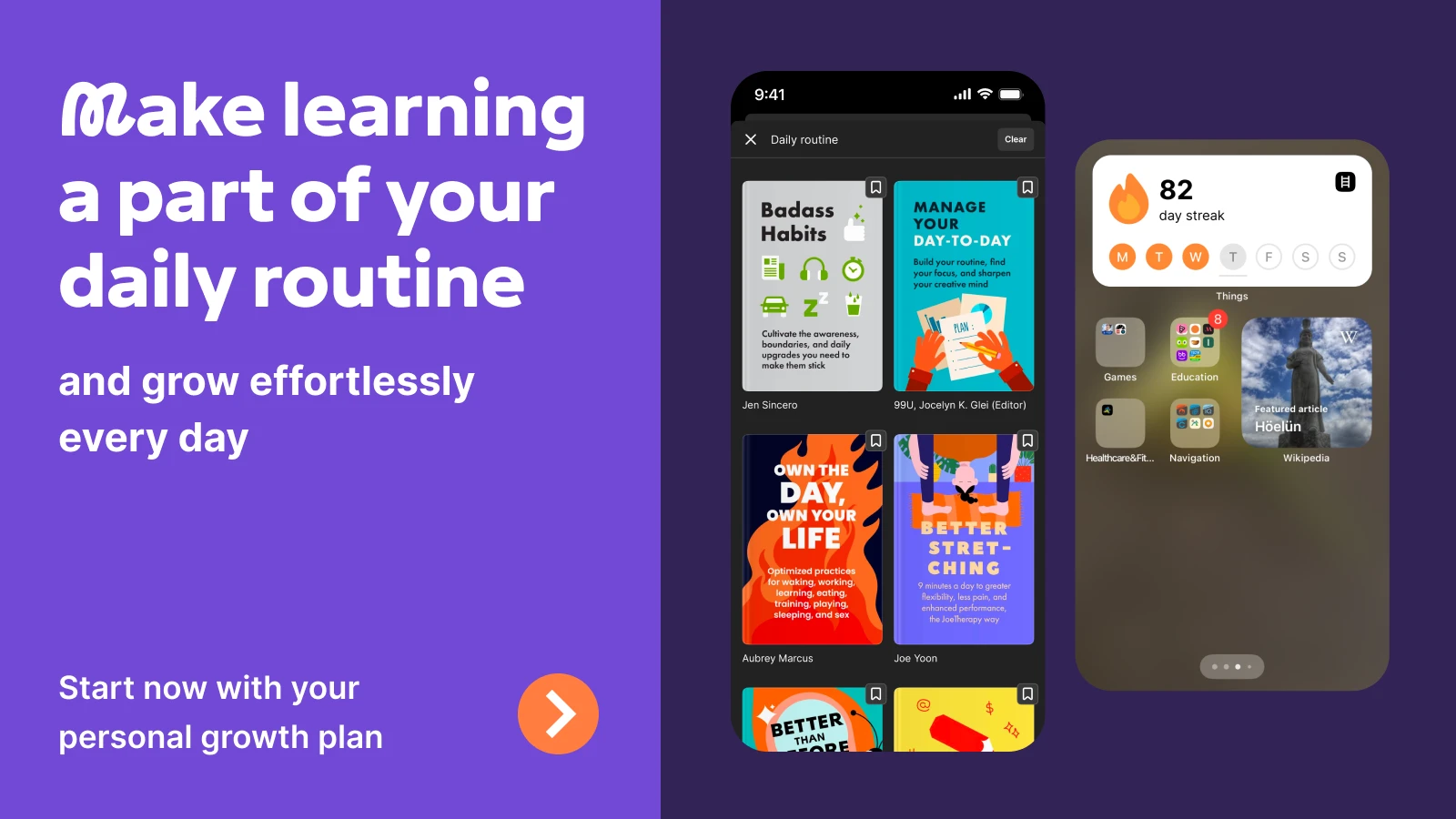
Most people fail because of indecision. If you have to think about what to do, you'll just hit snooze. Headway provides the structured system you need to stay on track.
Personalized growth plans: After you take the onboarding quiz, Headway builds a custom reading plan for you. It matches your goals, removing the friction of deciding what to learn today.
Interactive shorts: These bite-sized stories allow you to practice solving challenges in real-time. You can explore different ways to handle stress or procrastination.
Daily streaks and progress tracking: Headway has a gentle motivation system. Even a 3-minute session counts toward your streak, helping you build the habit of consistency.
Ambient sounds for focus: During your "Hot 15," you can use Headway's ambient focus sounds. These help block out distractions and put your brain in a state of flow.
Highlights and spaced repetition: When you find a powerful quote or idea in a summary, you can save it as a highlight. Headway uses flashcards to help you revisit those ideas so the knowledge actually sticks.
📘 Strengthen morning consistency with Headway.
Frequently asked questions about the Mel Robbins morning routine
What is Mel Robbins' morning routine?
The "What is the Mel Robbins morning routine?" question is usually answered by her six specific steps. These actions include using the 5-second rule to get up, making your bed, using the high-five habit in the mirror, drinking water, getting 10 minutes of light, and taking a brisk walk to clear your mind.
Is this routine good for ADHD?
Mel Robbins often says the 5-second rule is the "starter motor" for an ADHD brain. It turns a "big" decision into a simple countdown, bypassing the analysis paralysis that makes getting out of bed feel impossible. The technique provides the structure needed to stop overthinking and start moving without the usual mental friction.
What if it's cloudy outside?
Use the 5-10-20 rule to reset your body clock. If it's cloudy, aim for 10 minutes of light. If it's raining, aim for 20 minutes outside. Even on a dark, overcast day, the natural light outside is much stronger than indoor light. It's still essential for resetting your circadian rhythm and stopping melatonin production.
Can I listen to a podcast on my walk?
Mel recommends a quiet walk occasionally to experience "auditory flow." However, listening to an inspiring book summary on Headway is a great way to prime your mind. Just make sure you aren't scrolling through social media while you walk. Avoiding that keeps your focus internal and ensures you're feeding your brain high-quality ideas.
Why shouldn't I drink coffee right away?
Drinking coffee immediately traps adenosine in your brain. That action causes a major "afternoon crash" later on once the caffeine wears off. Waiting 90 minutes and choosing hydration first allows your body to naturally wake up and flush out those chemicals. This small delay ensures your energy stays stable for the rest of your day without needing a sugar hit.
What is the "Million-Dollar Morning" exactly?
It's the name Mel Robbins gives to her 6-step system for starting the day. It's called "Million-Dollar" because the clarity and focus it gives are worth more than any amount of money. It's a proven system for high performance and peace of mind that allows you to stop reacting and start leading your own life.
What is the 5-5-5-30 morning routine?
The 5-5-5-30 is a popular wellness method involving five minutes each of meditation, journaling, and movement, followed by thirty minutes of deep work. While not her primary system, Mel Robbins supports this focus on self-care. It helps you avoid the phone and build the positive reinforcement necessary to feel empowered throughout the rest of your day.
What is the 5-second rule morning routine?
The 5-second rule morning routine involves counting '5-4-3-2-1' to help you get out of bed immediately. This technique is a game-changer because it interrupts the habit of hesitation and chronic snoozing. By moving your body right away, you stimulate the prefrontal cortex and take control of your focus before the world starts making demands.
What are the steps in Mel Robbins' morning routine?
The Mel Robbins morning routine steps follow six specific actions: count 5-4-3-2-1 to wake up, make your bed, use the high-five habit in the mirror, drink water, get 10 minutes of light, and go for a walk. These science-backed actions regulate your circadian rhythm and provide the foundation for a productive life, as discussed in her bestselling book.
What does Mel Robbins do before bed?
Mel Robbins prepares for success by starting her routine the night before. She avoids social media before bed, sets her intentions, and places her phone in the bathroom to prevent morning scrolling. This intentional wind-down protects her mental health and ensures she wakes up ready to follow the million-dollar morning routine Mel Robbins outlines on her podcast.