Self-growth
 Business & Career
 Success
 Communication
 Healing
 Relationships
 Psychology
 Happiness
If you're looking to pick up a new skill these days, the sheer number of options is enough to make your head spin.
You've probably narrowed it down to two of the biggest names out there, but you're stuck on the final choice. Almost every eager learner faces the classic MasterClass vs Coursera dilemma. It's like asking whether you'd like to learn filmmaking from James Cameron, or whether you are looking for a data science professional certificate to land a new job.
The confusion is real because these aren't really direct competitors; they're two entirely different flavors of online education. One feels like Netflix for your brain, packed with inspiring celebrity instructors and incredible production value. The other is a serious e-learning powerhouse, partnered with top universities to offer accredited courses and even full degrees.
This guide will help you figure out exactly where Coursera or MasterClass fits into your personal development strategy. At Headway, we believe learning should work around your life, not the other way around. While we focus on summarizing life-changing books, we know that combining different educational tools is one of the best ways to keep growing.
MasterClass vs Coursera: Quick answer snippet
If you're just looking for the bottom line so you can start learning already, here it is: MasterClass is best for creative inspiration and elite expert insights; Coursera is best for structured academic learning, degrees, and professional credentials.
Basically, if you want to be entertained while picking up a new skill from a legend like Gordon Ramsay, go with MasterClass. If you need a certificate that a recruiter at Microsoft will actually respect, Coursera is for you.
Best for creative inspiration: MasterClass – Think high-end documentaries with celebrity instructors.
Best for career growth: Coursera – It focuses on specializations, professional certificates, and full degrees.
Pricing: MasterClass starts at $120/year (around $10/month, billed annually); Coursera ranges from free courses to $59/month for Coursera Plus.
Certification: Coursera offers accredited certificates; Masterclass provides a certificate of completion but no formal academic credit.
Coursera vs MasterClass: At-a-glance comparison table
Here's a quick MasterClass vs Coursera comparison to help you see how these two online learning platforms stack up against each other.
| Feature | Coursera | MasterClass |
|---|---|---|
Primary focus | Academic, computer science, and data science | Creative skills, lifestyle, and entrepreneurship |
Instructors | Top universities (Stanford) and industry leaders | World-renowned experts and celebrities |
Production style | Traditional video lectures and quizzes | High-end, Netflix-style production value |
Credentials | Professional certificates and full degrees | Personal enrichment (no official credit) |
Hands-on work | Graded assignments and learning paths | Downloadable workbook and self-guided projects |
Pricing model | Subscription or pay-per-course ($49+) | Annual subscription starting at around $120/year |
Deep MasterClass and Coursera overviews: Academics vs inspiration
1) What is Coursera?
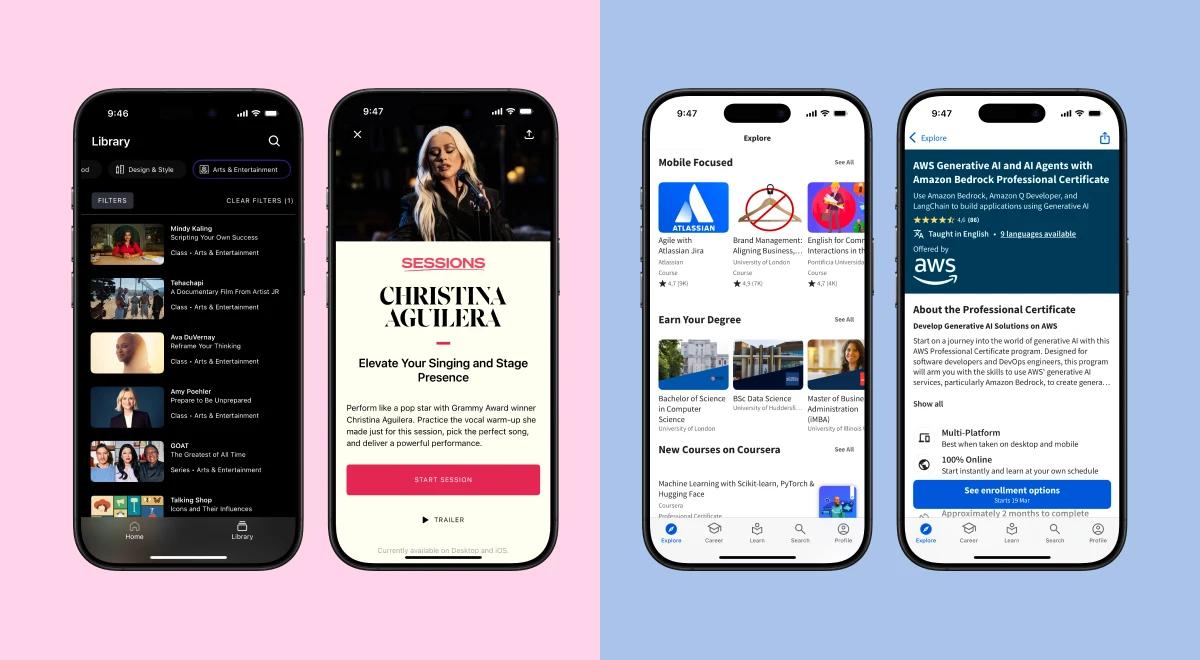
Coursera isn't just another online learning platform; it's basically the digital wing of the global Ivy League. When you sign up, you aren't just getting "content" — you're getting a seat at a virtual table with Stanford, Yale, and the University of Michigan. It was founded by two computer science professors who wanted to democratize high-level knowledge, and that academic DNA is everywhere.
If you're a beginner looking for a new skill, the sheer variety can be overwhelming. Coursera offers thousands of courses across fields like computer science, data science, and business. But it goes way beyond just watching a few video lectures.
This is serious e-learning. You're looking at modules that span weeks and are built around learning paths that require real mental effort. You'll be doing quizzes, submitting graded assignments, and often participating in peer-review sessions where other learners critique your work.
For those focused on professional development, Coursera is the "gold standard." They've partnered with giants like Microsoft and Google to create professional certificates that are actually recognized by hiring managers on social media and LinkedIn.
And for those who want to go all the way, they even offer full degrees — think of a Master's degree you can earn in your pajamas at your own pace. It's about university-level rigor without the commute or the six-figure price tag.
📘 Keep your momentum high — use Headway to stay sharp and inspired between your big course modules.
2) What is MasterClass?
On the flip side, we have MasterClass. If Coursera is the university library, MasterClass is the front-row seat at a private gala. It's an online education experience that feels more like Netflix than a classroom. You aren't learning from a career academic; you're learning from a world-renowned expert who has reached the absolute peak of their industry.
When you watch Gordon Ramsay teach you how to sear a scallop, or listen to a filmmaker break down a shot, you're experiencing the highest production value in the business. They don't just set up a webcam; they use cinematic lighting, intimate interviews, and crisp audio that make the learning experience feel like a high-end documentary.
MasterClass is primarily built for creative skills, entrepreneurship, and lifestyle. While there aren't any quizzes or tests to stress you out, they do provide a very high-quality workbook for every class. This downloadable PDF is packed with recipes, writing prompts, and business diagrams to give you a hands-on way to follow along.
It's perfect for learners who want to be inspired by celebrity instructors and learn the "philosophy" of greatness rather than just memorizing a technical manual. It's about upskilling your mindset just as much as your talent.
Comparative sections: MasterClass vs Coursera comparison
1) Teaching and course style compared: Academic rigor vs narrative inspiration
When you dive into the MasterClass vs Coursera comparison, the first thing you notice is how your brain reacts to the screen. Coursera is built for hands-on mastery. It's an online education platform that mimics a traditional classroom, so it follows a very specific course structure.
You move through modules in a linear fashion. If you're taking a computer science course, you aren't just watching; you're usually in a virtual lab environment, writing code that gets tested immediately.
This "learn-by-doing" learning style is essential for technical professional skills like data science, where being "kind of" right isn't good enough. You'll find yourself hitting pause to take notes on a complex formula from a Stanford professor or re-watching a segment on machine learning three times just to pass the next set of quizzes. It's in-depth, demanding, and meant to stick.
Start reading summaries on mastering complex professional skills in minutes daily.
MasterClass, on the other hand, is built on the power of narrative, much like Audible's approach. The celebrity instructors don't lecture; they share. They talk about their real-world failures, the "aha!" moments, and the secrets they've picked up after so many years in the game. It's designed to spark a new skill or a fresh perspective rather than just giving you a list of dry facts to memorize.
While Coursera gives you the technical how-to, MasterClass gives you the why. This learning style is incredible for creative skills like writing, acting, or entrepreneurship, where the master's intuition is more valuable than a textbook definition. You aren't being tested on what you remember; you're being invited to change the way you think about your craft.
It's a much more passive learning experience than a university-level course. Yet, the emotional impact of hearing a legend speak can sometimes be a better motivator than a letter grade.
2) Pricing and value: Annual subscriptions and USD costs
Let's get real about the pricing and what you actually get for your hard-earned money. Coursera pricing is a bit like a "choose your own adventure" book. If you just want to learn and don't care about the fancy paper at the end, Coursera offers a huge library of free courses. You can "audit" them, which means you get the knowledge without the cost.
However, if you want the professional certificates, individual courses usually start around $49. For the truly dedicated learners, there is Coursera Plus. This is an annual subscription that costs about $399 (or roughly $59 a month). It gives you unlimited access to over 7,000 courses, which is an incredible value for money if you plan to take more than 3 or 4 classes a year.
MasterClass has a much simpler, "Netflix-style" model. They essentially abandoned the pay-per-course idea years ago. Now, you pay for an annual subscription that starts at about $120, which works out to roughly $10 a month. There are higher tiers if you want to watch on more devices at once, but for most people, the basic plan is plenty.
For that price, you get access to everything — from Gordon Ramsay's cooking to language learning tips and space exploration. There's no extra charge for certificates or workbooks.
Both platforms offer a 30-day money-back guarantee, so you can test them out risk-free. If you're looking for the absolute cheapest way to pick up a specific software trick, you might also look at Udemy, but for high-quality, curated content, these two lead the way.

3) Certificates and career outcomes: What carries weight on LinkedIn?
Let's get into the nitty-gritty of the "return on investment." When you spend 40 hours on a platform, you usually want something to show for it, especially when you're looking to upskill for a promotion.
Find psychology insights that actually apply to your next performance review—start reading summaries.
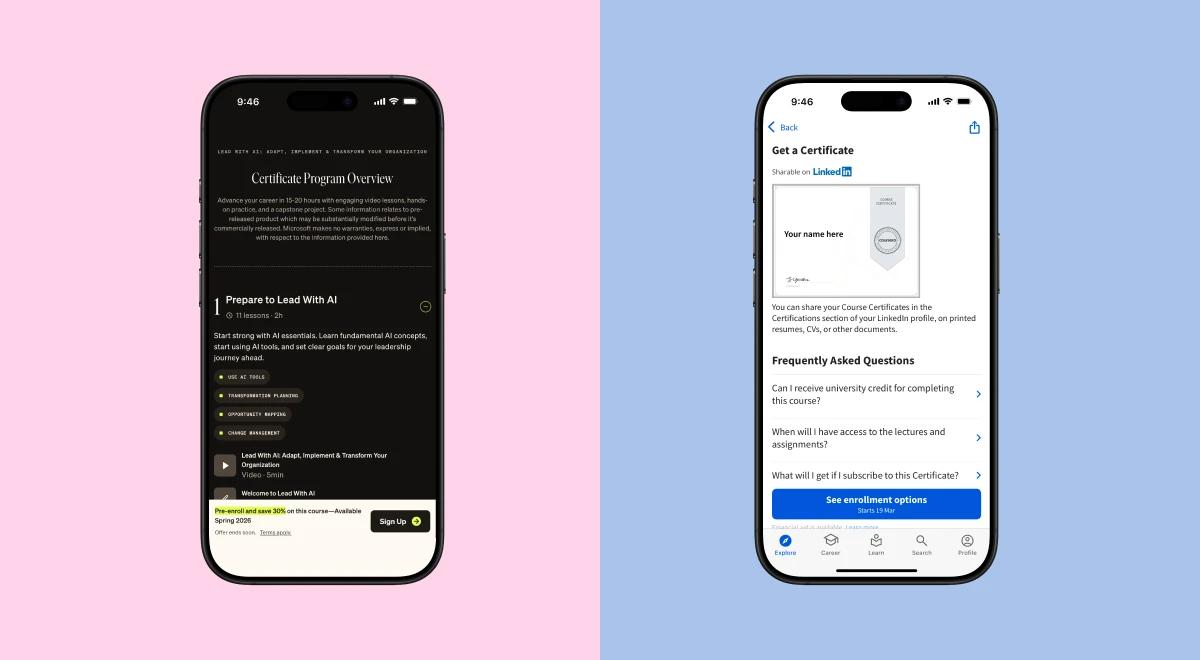
On Coursera, the outcome is very clear. Because their professional certificates and specializations are co-branded with names like Microsoft, Google, and Stanford, they carry legitimate weight in the corporate world. When you post a Coursera certificate to LinkedIn, a recruiter sees that you've passed quizzes and graded assignments from an accredited source.
It's a signal that you have the technical skills to do the job. If you're aiming for a role in data science or computer science, having that university-backed seal of approval is a massive advantage.
MasterClass, meanwhile, doesn't really play the "official credit" game. You won't get a college degree for watching Gordon Ramsay talk about kitchen prep. While you get a certificate of completion, it isn't accredited in the traditional sense. However, don't dismiss the value for money here. In creative fields like writing, filmmaking, or entrepreneurship, your degree is your portfolio and your mindset.
MasterClass helps you build the taste, vision, and real-world intuition that you can't get from a textbook. It's about professional development for your soul and your craft, rather than just adding a line to your resume.
📘 Don't just learn technical skills — download Headway to master the leadership mindset that gets you promoted.
4) Best for career advancement: Certificates and degrees
If your goal is a higher salary or a complete career pivot into a technical field, Coursera is the winner. Their learning paths are specifically designed to make learners "job-ready." You can start as a total beginner and work your way up to an intermediate level in high-demand areas like project management or cybersecurity.
What's even more impressive is the path to full degrees. You can actually earn a Bachelor's or Master's from world-class institutions for a fraction of what you'd pay for on-campus online education. It's flexible learning at its best. You can keep your day job, study at your own pace, and still earn a degree identical to that of students sitting in a physical classroom in Michigan or London.
5) Best for personal enrichment: Creativity and legend-led lessons
Now, if you're looking to feed your curiosity or master a hobby that makes life more interesting, MasterClass is in a league of its own. It's the place for people who want to learn entrepreneurship from Richard Branson or creative skills like songwriting from Alicia Keys.
The classes are short enough (similar to Blinkist's summaries) to binge on a Saturday night but deep enough to actually change how you approach your hobbies. It's the online learning platform of choice for those who want to hear about the real-world process of people who have reached the top.
You get to see their hands-on techniques up close — whether it's a writer's messy first draft or a chef's knife skills. It isn't about passing a test; it's about expanding your horizons and learning to see the world through the eyes of world-renowned experts.
6) Learning experience and engagement: Quizzes vs workbooks
The day-to-day learning experience on these platforms is shaped by how they try to keep you from quitting.
Coursera uses the academic pressure model. You have deadlines, progress tracking, and quizzes that you actually have to pass to move forward. This structure is great for people who need a bit of a "push" to stay disciplined. Their mobile app is also incredibly functional, letting you download video lectures so you can upskill while you're offline or commuting.
MasterClass engagement is all about the hook. Because the production value is so high, visual learners who also like apps like Imprint stay engaged because it's genuinely entertaining. Instead of quizzes, they give you a thick, high-quality workbook. This workbook isn't some cheap printout; it's often a 40- to 100-page PDF filled with assignments, reading lists, and real-world exercises.
It's a more self-driven learning style, but for a beginner who finds traditional schools dry, this cinematic approach can be far more effective at making the knowledge stick.
7) Community, support, and platform features
When you're knee-deep in a data science project or trying to figure out a complex computer science algorithm, you're going to get stuck. On Coursera, you've actually got a safety net. Most of their online courses have dedicated forums where you can chat with other learners, ask questions, and even get feedback from teaching assistants.
It's a very communal learning experience that makes the whole online education thing feel less lonely. Plus, their mobile app is built for this — you can jump into a discussion or check your progress tracking while you're standing in line for coffee.
MasterClass is a bit different. It's much more of a solo journey. While they've experimented with "Sessions" (which are more hands-on and have a community element), the core of the platform is you and the legend on the screen. You won't find the same level of academic support or peer-to-peer interaction, but you do get the workbook, which is essentially your offline mentor.
It's flexible learning at its most relaxed. You aren't answering to a professor; you're answering to your own creative drive.
📘 Too busy for a 40-hour degree? Get the core insights of the world's best business books on Headway in just 15 minutes.
8) Hybrid and complementary growth paths: The ultimate strategy
Here's a secret that the most successful learners know: you don't have to pick just one. In fact, you shouldn't. The best way to upskill is to create a learning stack.
Imagine using Coursera for the technical, accredited side of your career, maybe earning professional certificates in entrepreneurship or management. Then, on your "off" days, you watch a MasterClass with a world-renowned expert to see how those theories actually play out in the real world. It's the perfect balance of academic theory and creative execution.
This is also where a tool like Headway becomes a total game-changer. While you're working through in-depth video lectures on edX or Coursera, you can use Headway to listen to 15-minute summaries of the books that these instructors often reference.
If you're taking a leadership course from Stanford, grabbing the key insights from 'Leaders Eat Last' on Headway helps reinforce those professional skills without adding hours to your study time. It bridges the gaps between different online learning platforms, helping you stay motivated and ensuring that the big ideas actually stick in your long-term memory.
Make your knowledge stick with the Headway app!
Trying to keep up with annual subscription goals is hard when life gets in the way. Whether you're trying to learn Spanish on a language learning app or tackling modules in a university-level course, there's always that moment where you feel like quitting.
Headway is the connective tissue that makes your online education actually work. Our app focuses on the big ideas. For learners comparing MasterClass vs Coursera, Headway is a great option for education because it helps you build the mental discipline and productivity habits needed to finish those online courses.
If you're feeling overwhelmed by the variety of courses out there, you can use Headway to explore a topic first. Want to see if you're actually interested in entrepreneurship before dropping hundreds of USD on a specialization?
Listen to a few book summaries on the topic. It's a low-pressure way to upskill your mindset and decide which learning style or platform is worth your time and money.
Who wins in the MasterClass vs Coursera comparison?
If you've made it this far, you've probably realized that the MasterClass vs Coursera debate isn't about which app is better — it's about which one fits your life right now.
You should choose Coursera if:
You need accredited credentials, professional certificates, or even full degrees to move your career forward.
You want a university-level learning experience from institutions such as Stanford or Microsoft.
You prefer structured learning paths with quizzes, graded assignments, and peer interaction.
You should choose MasterClass if:
You are looking for high-quality inspiration from celebrity instructors and world-renowned experts.
You value high production value and want to learn at your own pace without the pressure of exams.
You want to develop creative skills or entrepreneurship through a storytelling, Netflix-style lens.
The truth is, both are high-quality investments in yourself. Whether you want to upskill for a new job or just satisfy a lifelong curiosity, the most important step is just to start.
📘 Combine your chosen platform with Headway to keep your motivation high, and you'll find that mastering a new skill is a lot more achievable than you thought.
Frequently asked questions about MasterClass vs Coursera
Is MasterClass better than Coursera for specific goals?
It depends on whether you want entertainment or a job. While you won't find MasterClass vs Coursera for online MBA courses because MasterClass lacks academic credit, it wins for creative inspiration. Coursera is better for technical mastery, but MasterClass is superior if you want to see how a world-class legend actually thinks and works.
What is the main disadvantage of taking MasterClasses?
The biggest letdown is the lack of feedback. When comparing MasterClass vs Coursera disadvantages, you'll notice MasterClass is passive — you watch, but nobody grades your work. It's perfect for picking up a hobby. Still, it won't give you the rigorous testing or the verified university credentials that you need to actually prove your skills to a recruiter.
Is MasterClass really worth the annual subscription price?
If you're a curious person who loves high-end documentaries, it's a steal. The gap between MasterClass instructors and Coursera instructors is huge; you're learning from household names rather than professors. If watching a legend like Questlove or Malala motivates you to finally start your own project, the inspiration alone is worth the membership's yearly cost.
Can I use ChatGPT to help me with Coursera assignments?
You can use AI as a tutor to explain complex concepts, but don't let it do the heavy lifting. Coursera has strict plagiarism filters, and shortcutting the process defeats the purpose of the course. In a Skillshare vs MasterClass vs Coursera comparison, Coursera is the most academic, so maintaining your own integrity is vital for your growth.
What is the best alternative to MasterClass right now?
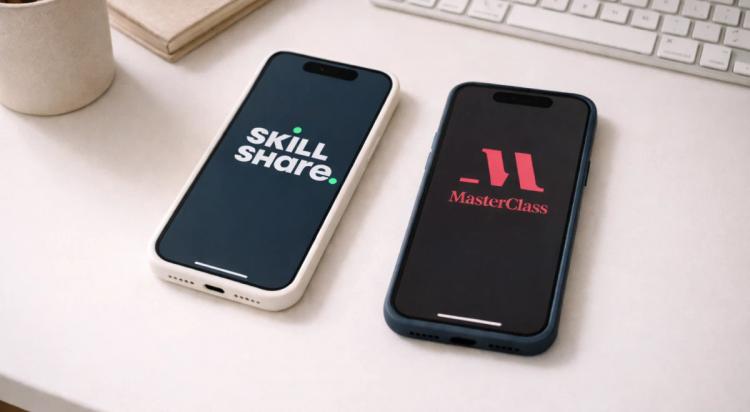
If you want similar high-quality production but more practical, how-to creative lessons, Skillshare is the top pick. You should look at BBC Maestro for celebrity-led content or Udemy if you just want to learn a specific technical skill without the cinematic, high-budget Hollywood flair.